

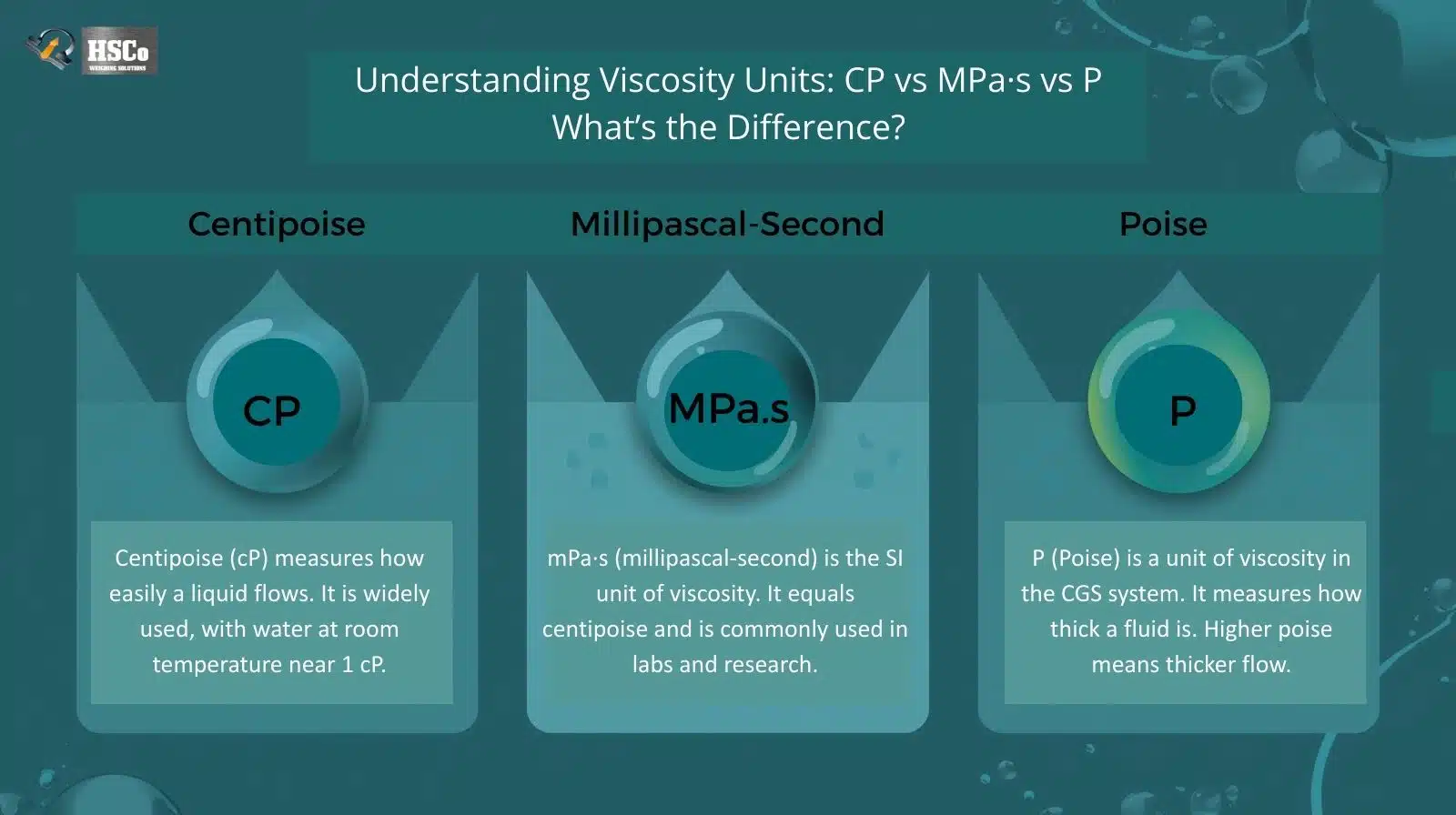
What is the difference between CP, mPa·s, and P when it comes to viscosity units?
If you’ve never worked with liquids in labs, factories, or even in cooking, you may have seen viscosity units like CP, mPa·s, and P. At first glance, these abbreviations can look like a foreign language. You might be curious about why there are different units for the same property and which one is the “right” or most useful for your work. Anyone who measures, compares, or reports viscosity, whether for quality control, research, or production, needs to know what these units mean. At HSCo, we often help customers deal with these differences so they can choose the right unit for their needs and understand their results correctly. This guide will explain the units in simple, clear language, give you real-life examples, and help you feel sure that you can use viscosity measurements correctly in your work.
Ready to measure viscosity yourself?
HSCo's keypad and touchscreen viscometers are listed under density and viscosity meters. See the models and ask for a quotation. See HSCo viscometers
What does viscosity mean?
Let’s first talk about what viscosity is before we get into units. In the simplest terms, viscosity tells you how hard it is for a fluid to flow. Think about stirring water and honey:
- Water has a low viscosity which means it flows easily.
- Honey has a high viscosity which means it flows slowly
Viscosity has an effect on everything, from pouring syrup on pancakes to pumping oil through pipes. Knowing the units helps you talk about and measure viscosity correctly.
Common Units of Viscosity
There are a number of ways to measure viscosity. Beginners usually come across these the most
- CP (Centipoise)
- mPa·s (millipascal-second)
- P (Poise)
They all come from slightly different ways of measuring things, but they often describe the same property. Let’s take them apart.
CP (Centipoise)
Centipoise (cP) is probably the unit that most people in labs and businesses know best.
- The CGS system (centimeter-gram-second) is what it’s based on.
- Water at room temperature (about 20°C) has a viscosity of about 1 cP.
Why it’s helpful:
- It’s easy to see because low values match up with common fluids.
- Used a lot in industries like food, cosmetics, paints and lubricants.
Examples:
- Water: ~1 cP
- Olive oil: ~80 cP
- Honey: ~2,000 cP
mPa·s (Millipascal-Second)
The SI unit of dynamic viscosity is mPa·s. It is becoming more common in research and technical fields because it works with the modern metric system.
- 1 mPa·s = 1 centipoise (cP)
- So, at room temperature, water is also about 1 mPa·s.
Why it’s useful:
- Works with the SI system used in physics, engineering, and internationally.
- Great for writing research papers or lab reports.
Conversion:
- 1 cP = 1 mPa·s
P (Poise)
People don’t use the word “poise” (P) as much in everyday conversation, but it can still be found in older books and some fields.
- It also comes from the CGS system.
- 1 P = 100 cP
Many modern centrifuges automatically detect the rotor type. If the machine can’t read the rotor or senses something off, it will refuse to spin for safety reasons.
Why it’s useful:
- Easier for fluids that are very thick.
- For example, industrial lubricants and tar can be measured in P instead of hundreds or thousands of cP.
Example:
- Honey: ~20 P (instead of 2,000 cP)
How to Change Units
Once you learn the basics, converting is easy:
- cP ↔ mPa·s: 1 cP = 1 mPa·s
- P ↔ cP: 1 P = 100 cP
- P ↔ mPa·s: 1 P = 100 mPa·s
When writing about viscosity for international journals, mPa·s is usually the best choice. cP is usually easier to use for everyday lab work.
Why it’s important to know the difference
If you use the wrong unit, you might make a mistake or get confused:
- Getting chemicals or liquids that are either too thick or too thin
- Looking at information from different labs
- Lying during audits or research
Example:
If a recipe says to use a fluid with 50 cP and you read it as 50 P by mistake, the fluid would be 2,500 times thicker than it should be!
Advice for People Who Are New
- Look at the way the system measures: Labs can use either CGS (cP/P) or SI (mPa·s).
- Know what you see: Water at 20°C is your baseline. Which is about 1 cP or 1 mPa·s.
- Be careful when you convert: Use simple multiplication or online calculators to get the right answer.
- Clearly label: Always put units in your notes and reports to avoid confusion.
- Watch out for the temperature: Because viscosity changes with temperature, you should give both the value and the temperature.
Conclusion
To be accurate and consistent you need to know what viscosity units mean.
- In labs and factories, people often use cP.
- mPa·s is better for doing research and reporting around the world because it works with the SI system.
- Poise (P) is helpful for fluids that are very thick.
If they know the differences and how to change them, beginners can measure, compare, and talk about viscosity with confidence. Paying attention to units keeps mistakes from happening, ensures quality and makes data clear to everyone, whether they are in a lab, a factory, or a research paper.
FAQs
What is the easiest unit for beginners to remember?
Centipoise (cP) is usually the easiest to understand because fluids like water, oil, and honey fall into simple ranges that are easy to picture.
Are cP and mPa·s the same thing?
Yes. One cP is the same as one mPa·s. They are just from different ways of measuring things (CGS vs. SI).
When is it better to use Poise (P) than cP?
If you are working with very thick fluids, like industrial oils or tar, you should use Poise instead of cP.
Do the viscosity values in these units change with temperature?
Of course. As the temperature goes up, the viscosity goes down. Always give the viscosity value and the temperature.
Is it easy to change viscosity values from one unit to another?
Yes. 1 P = 100 cP = 100 mPa·s, and 1 cP = 1 mPa·s. For all conversions, you can just multiply.