
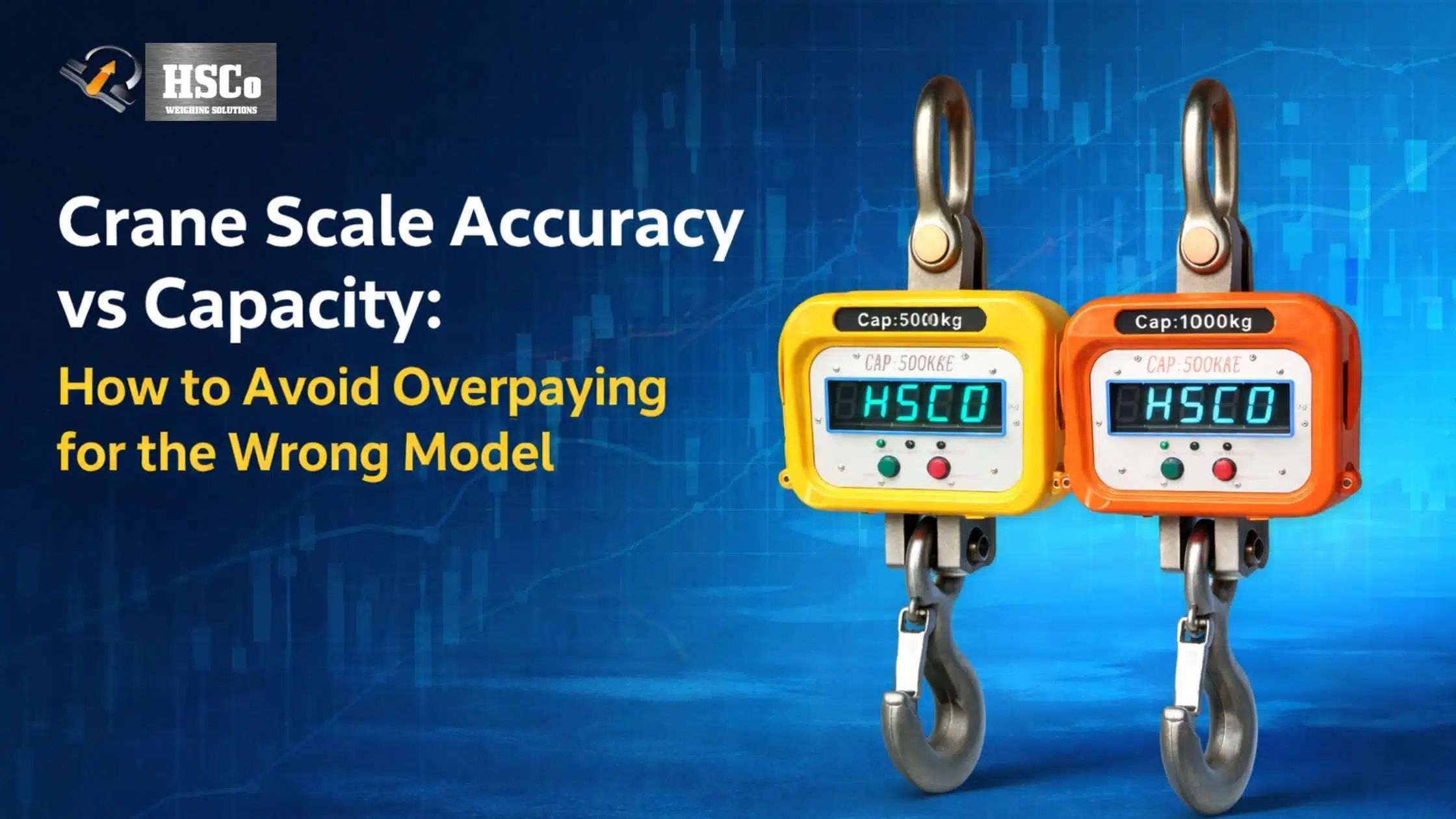
It can seem like a big deal to pick the right crane scale. These powerful tools are necessary for safety and efficiency in many fields, including shipping and manufacturing. At Hindustan Scale Company we often see customers struggle with two important things: accuracy and capacity. Both are important, but knowing the difference between them is the key to finding a model that meets your needs perfectly without going over your budget. If you get this wrong, you might pay too much for features you don’t need, or even worse, you might choose a scale that puts safety and operational integrity at risk.
Match the crane scale to your load
HSCo crane scales start from Rs. 14,500 (ex-GST). Compare models and ask for the capacity, hook, display and connectivity needed for your lifting job. See crane scales by capacity
What’s the Big Deal? Explaining Accuracy vs. Capacity
It’s like picking out a car. Capacity is the number of people it can hold, and accuracy is how accurate the speedometer is. A two-seater sports car won’t work because you need to carry five people, no matter how accurate its speedometer is. A 15-passenger van is also too much for a small family. The same idea works for crane scales.
Getting a Handle on Capacity
Capacity is simple: it’s the heaviest thing that the crane scale can safely weigh. If you usually lift things that weigh about 4,000 kg, a scale that can hold 5,000 kg is a good idea. It gives you a safe space without being too much.
Why Is It So Important to Pick the Right Capacity?
- Safety: Putting too much weight on a scale is very dangerous. It can break down machines, which can cause accidents, damage goods, and hurt people badly.
- Durability: Constantly pushing a scale to its limit will wear it out faster, which means it will need expensive repairs and downtime.
- Cost: Scales with a higher capacity cost more. You don’t need to pay for a scale that weighs 20,000 kg. if your heaviest load will never be more than 5,000 kg.
Getting to Know Accuracy
How close the scale’s reading is to the object’s true weight is what accuracy means. Most of the time, it’s shown as a percentage of the scale’s full capacity. For instance, a scale that can hold 10,000 kg and is accurate to within ±0.1% could be off by as much as 10 kg.
People often think that more accuracy is always better. In some cases, like chemical processing or aerospace, accuracy is very important. In other cases, though, it’s just a waste of money. A construction site that weighs precast concrete beams may not need to be as precise as a business that charges customers based on weight.
How Frequently Should You Calibrate Your Weighing Scale?
The trick is to find the right balance between capacity and accuracy that works for your business. This is how to do it.
Step 1: Set the Most Weight You Can Carry
First, figure out which items you will need to weigh the most. Don’t just make a guess. Check your shipping manifests, project plans, or inventory. Add a safety buffer of about 20–25% to this number once you have it. This gives you a safe amount of room and makes sure you never push the scale too far. A scale with a capacity of 10,000 kg is a good choice if your heaviest load is 8,000 kg.
Step 2: Find Out How Accurate You Need to Be
Then, think about how important accuracy is to your business.
For business transactions: If you buy or sell things based on their weight, you have to be very accurate. Mistakes can cause problems with billing, lost money, or even lawsuits.
For things that happen inside: If you’re weighing things to make a batch or keep an eye on your inventory a normal level of accuracy might be fine. It doesn’t have to be as precise to weigh scrap metal for recycling as it does to mix pharmaceutical ingredients.
For safety checks: When weighing loads to make sure they don’t go over the limits of cranes or transport vehicles, standard industrial accuracy is usually good enough. The main goal is to keep things from getting too heavy, not to get the weight down to the last gram.
Step 3: Think About the Environment
Where will you use the scale? A foundry or construction site outside could put the scale in very hot or cold weather, dust, and vibrations. These things can change how well and accurately a scale works. Look for models that have features that make them work well in tough conditions, like temperature compensation and strong housing.
How Much It Costs to Get It Wrong
It’s not just a hassle to pick the wrong scale; it can also cost you money.
Paying too much for capacity: If you buy a scale that can hold twice as much as you need, it’s like paying for an empty floor in an office building. You could put that money to better use in other parts of your business.
Paying too much for accuracy: Ultra-precise scales have parts that are more sensitive and cost more. You’re paying extra for a feature you’ll never really use if your operations don’t need that level of accuracy.
Not thinking about what you need: This is the worst mistake you can make. A scale that is too small is dangerous, and one that isn’t accurate enough for your needs can cost you money and hurt your reputation with customers.
Conclusion
To find the right crane scale, you need to know exactly what you need it for on a daily basis. Don’t let the biggest numbers or the most advanced features get in the way. Instead, think about the real-world aspects of your job. You can choose a model that is safe, reliable and cost-effective. With confidence if you carefully consider how much capacity you need and how accurate your tasks need to be. This balanced approach makes sure you get a tool that will work well for your business for years to come without paying too much for features you don’t need.
1. What happens if I put too much weight on my crane scale?
If you overload a crane scale, the internal load cell may be damaged, which could lead to wrong readings or a complete failure. More importantly, it poses a serious safety risk because it could cause the load to fall.
2. Does a crane scale that costs more always work better?
Not always. Price is often more related to capacity and extra features (like remote controls or data logging) than to accuracy alone. A scale with a lot of capacity may not be as accurate as a scale with less capacity that is made for precise weighing.
3. How often do I need to calibrate my crane scale?
Most companies say that you should calibrate your equipment at least once a year. You should calibrate the scale more often, like every three or six months, if you use it a lot, in a rough environment, or for business transactions that are sensitive.
4. Does the temperature have an effect on how accurate my crane scale is?
Yes, very hot or very cold weather can make the metal parts inside the load cell expand or contract, which could affect accuracy. To lessen this effect, many modern scales have features that adjust for temperature.
5. What is the difference between resolution and accuracy?
The accuracy of a measurement tells you how close it is to the real value. Resolution, or readability, is the smallest change that the scale’s display can show. A scale can show a lot of decimal places and still be wrong.