


Introduction:
How well a fluid can resist a flow is called its viscosity. It is critical, for instance, in pharmaceuticals, oil products, cosmetic products, food, etc. In this guide, we will discuss the history of viscometers, the scientific principles, the latest innovations, the various applications, and the custom viscometers manufactured by Hindustan Scale Company (HSC) that stand out for precision and reliability.
Ready to buy a viscometer?
HSCo's keypad and touchscreen viscometers are listed under density and viscosity meters. See the models and ask for a quotation for your lab. See HSCo viscometers
Key Takeaways
HSC manufactures a wide range of viscometers including high precision rotational, and automatic units that measure temperature and flow. They are accurate, user-friendly, and durable which makes these devices sought after in laboratories and factories all over the world.
The Viscometer’s Evolution
1.1 The beginnings of industry
The word “viscometer” was borrowed by Charles Dollfuss in 1831 for a simple efflux cup that measured the outflow of a liquid dye through. During the period, the dye would thicken as time passed. By 1890’s the US (Saybolt), Germany (Engler), and England (Rochwood) developed efflux viscometers and used heated baths for temp control. They used Saybolt seconds and Engler degrees for reporting.
1.2 The Advancement of Rotational Tools
The first rotary viscometer was invented by Don Brookfield in 1934 which was capable of displaying the viscosity on a dial. The device was capable of measuring how viscosity varied with shear rate, which made it useful for non-Newtonian fluids. The Brookfield device became the most versatile instrument in laboratories and processing companies in the world.
1.3 The Era of Automation and Digital Technology
Since the 1990s, viscometers have been transformed from simple measuring devices into automated laboratory workhorses, operational and data collection hubs due to the introduction of microprocessors, digital displays, and sophisticated software.

These features include:
Streamlined automated procedures designed for easier testing and real-time data collection.
Automatic temperature compensation that maintains accuracy of readings regardless of temperature shifts.
Integrated audit trails and electronic signatures that comply with the requirements of FDA 21 CFR Part 11.
The modern devices are more user-friendly, operationally, and compliance-focused with international standards.
2. The physics of viscometry
Viscosity is an essential measurement of how difficult it is to flow a certain liquid, which is determined by how a liquid’s molecules tug on each other. The two types of measurements which describe viscosity include:
Dynamic viscosity, μ, is the ratio of shear stress to shear rate, and is measured in centipoise (cP).
Kinematic viscosity is defined as the ratio of dynamic viscosity to fluid density, v = viscosity/density, and is measured in centistokes (cSt).

2.1 Newtonian vs Non-Newtonian fluids: These fluids will always retain a constant viscosity regardless of shear rate. Water and light oils serve as the best examples.
Ketchup and paints demonstrate non-Newtonian fluids as their viscosity varies with shear rate. Rheometers are specifically designed for the measurement of fluids with variable viscosities.
2.2 Principles of Measurement
The efflux (capillary) method measures kinematic viscosity directly by timing the flow of a fluid’s passage through a thin container tube under the influence of gravity.
The rotational method measures the twisting force (torque) on a spindle that is immersed in the fluid and rotated, which allows obtaining dynamic viscosity measurements and studying non-Newtonian fluids.
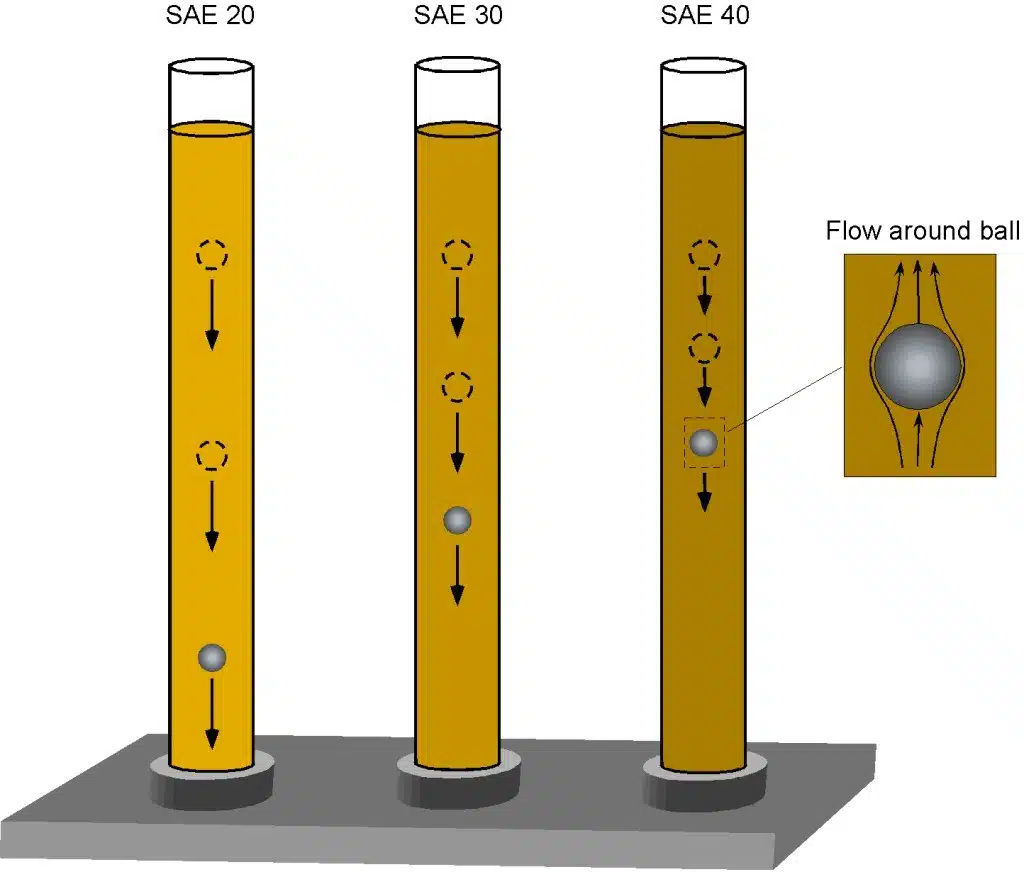
Falling-Ball Method: This method utilizes Stokes’ law to relate the steady descent of a small sphere to the viscosity of the fluid through which it is falling:
[ F_D = 6 \pi \mu r v ]
In this case, (r) is the sphere’s radius, (v) is the sphere’s velocity of descent, and (F_D) is the drag force.

3. Advances in technology for viscometers
3.1 Rotational Viscometers
With this device, you are able to regulate the rate of rotation, which is beneficial for materials whose viscosity increases and decreases with rate of rotation. They are capable of measuring torque in a digital manner, and they are often equipped with temperature control which ensures stable and clear readings.
3.2 Capillary Viscometers
These are the Ubbelohde and Ostwald which have been carefully designed to allow liquid to self serve the downward flow through a tube. They give accurate and reproducible results when used in a closed temperature bath.
3.3 Vibration Viscometers
These have a vibrating probe. The liquid surrounding the probe dampens the vibrations. This damping can be used to estimate viscosity.
3.4 Tribological Viscometers
These viscometers can withstand very high and low temperatures and pressures. They are very useful in measuring the viscosity of lubricants for hot and heavily working engines and other machines.
4. Uses in Other Industries
To ensure uniformity in products, processes, and compositions, viscometers play a critical role. They can be found:
Key Applications in the Industry
| Industry | Applications |
| Medicines | Syrups, suspensions, injections |
| Food & Beverages | Sauces, dairy, drinks |
| Oil & Petrochemicals | Drilling mud, crude oil, fracking fluids |
| Chemicals & Polymers | Polymer melting, chemical reactions |
| Cosmetics & Skincare | Consistent cream/lotion texture |

5. Why Hindustan Scale Company Viscometers Are the Best in The Business
The Hindustan Scale Company is a trusted name in viscometers. This company is based in Mumbai. This is what differentiates their instruments:
High precision and reproducibility
The latest sensors and factory calibration are utilized in HSC’s High-Accuracy series. This means in a pharma, biotech, or research lab, you can trust that every sample taken will yield the same accurate readings, and thus, dependable readings.
Detecting and Making Up for Temperature
Our high-sensitivity probes have built-in temperature compensation, which means adjustment is done automatically. Regardless of how much the temperature changes, you always get the correct viscosity readings. This is critical to the functioning of our systems because viscosity measurements are highly sensitive to even small changes in temperature.