

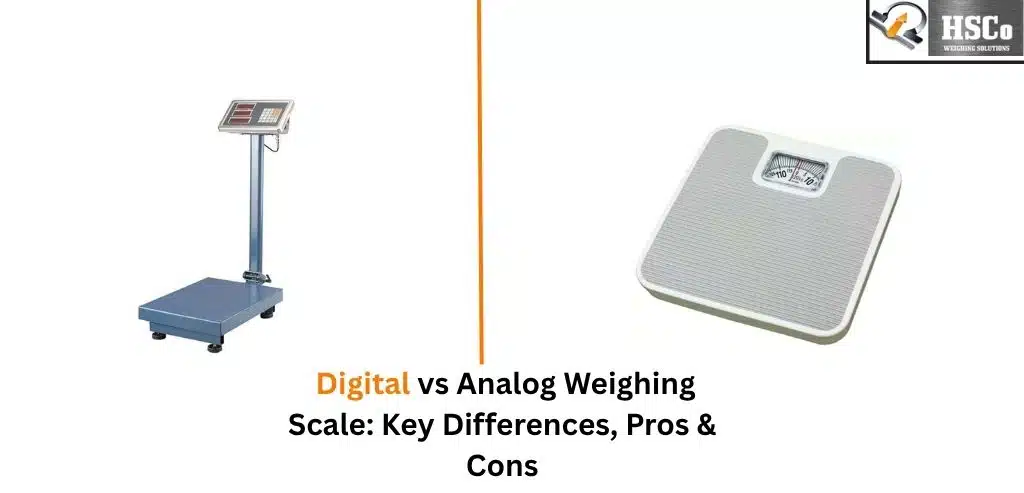
Digital vs Analog Weighing Scale: What’s the Difference?
Weighing scales are must-have weight measurement equipment for use in many settings ranging from kitchens and fitness centers to medical facilities and factory settings. These tools mainly fall into two categories: digital and analog.
See HSCo's digital scales by type
Digital table-top scales from Rs. 2,000 (ex-GST), platform scales from Rs. 4,620 (ex-GST) and hanging scales from Rs. 1,500 (ex-GST): HSCo's weighing scale page sorts the range by type. See scales by type
Analog scales, or mechanical weighing scales or manual weighing scales, work on a spring system and show weight on a revolving dial.
Digital scales (or electronic weighing scales) use advanced sensors to calculate weight and show it on an LED or LCD digital display.
Although analog scales are prevalent in homes, and neighborhood stores, modern homes, health clubs, clinics, and industries have digital versions, as they are more accurate and offer additional features.
How Analog Weighing Scales Work?
Analog weighing scales operate through a spring mechanism. When you stand on the platform, your body weight compresses the spring inside, and the motion is registered as a reading on the dial.
These scales are operated manually and contain no electronic components, so they are naturally low-maintenance. Since they do not require batteries or electricity, they are reliable in any setting.
Their traditional design is attractive for people who like to use plain, tough tools without the bells and whistles.
How Digital Weighing Scales Work?
Electronic scales use electronic sensors and microchips to calculate weight.
The force on the scale activates electronic sensors, which translate the weight into electronic impulses.
The reading is displayed on a clear LED or LCD digital readout to make it simple to read.
Most of them feature auto-calibration, tare functionality and memory storage for increasing functionality.
These battery-powered devices usually come with hi-tech features like Bluetooth pairing, BMI calculation, and smart app connectivity.
Key Differences Between Digital and Analog Scales
Accuracy & Precision:
- Digital Weighing Scale: Provides high accuracy with decimal readings and is used to monitor slight changes in weight.
- Analog Weighing Scale: Gives rough estimates, which can be slightly different every time you weigh.
Ease of Reading:
- Digital Weighing Scale: Shows weight in clear view on an LCD or LED display, usually with a backlight for readability.
- Analog Weighing Scale: Uses a dial and needle, which is more difficult to read with accuracy, particularly in dim light.
Power Source:
- Digital Weighing Scale: Battery operated or rechargeable power; will not work without enough charge.
- Analog Weighing Scale: Never needs any power operates mechanically all the time.
Durability:
- Digital Weighing Scale: Has very sensitive electronics which are prone to being damaged if dropped or dampened.
- Analog Weighing Scale: It is built with fewer sensitive components, thus more rugged against rough handling.
Price Range:
- Digital Weighing Scale: Low-end models are cheap; prices increase with additional features such as smart connectivity or body measurements.
- Analog Weighing Scale: Typically lower cost because of the restricted functionality and less complex construction.
Features:
- Digital Weighing Scale: Can have add-ons such as tare function, memory storage, body mass index (BMI), Bluetooth, and fitness app syncing.
- Analog Weighing Scale: Provides only standard weight measurement without digital features or tracking.
Pros and Cons of Analog Scales
Pros:
- Analog but dependable, no power or charging required.
- It is designed to be durable for vigorous, long-term applications.
- It is easy to operate; simply step on the device and look at the dial.
Cons:
- May not be precise decimal weight lacks accuracy.
- More difficult to read particularly for elderly or in dimly lit rooms.
- Susceptible to manual calibration inaccuracies with time.
Pros and Cons of Digital Scales
Pros:
- Offers accurate readings down to decimal points great for fitness and medical tracking.
- User-friendly interface with bright display and extra functions.
- Includes smart scale features like Bluetooth and memory.
Cons:
- Requires batteries or recharging may run out at the wrong times.
- The device has delicate electronics that can fail if it is dropped.
- Can be too much for users, who like simplicity.
Which Weighing Scale Should You Use?
Here’s how to determine which scale is more suitable for your particular needs:
For home fitness or accuracy tracking: A digital weighing scale is your best option. The detailed readings and high-end features help you in measuring progress accurately.
For heavy use or plain environments (such as warehouses, or neighborhood stores): An analog scale is perfect. It’s low-tech but dependable for basic use.
For medical, baby, or clinical applications: Opt for a digital scale with precision, and safety features. It provides steady and uniform readings.
Use this as your guide to purchasing scales when it comes to comparisons of types and features.
FAQs About Digital and Analog Scales
Are digital scales more precise than analog?
Yes, electronic scales generally provide more accurate and precise readings, usually with decimal points.
How frequently should I calibrate a digital scale?
Most electronic scales are auto-calibrating, but to achieve best accuracy, calibrate every few weeks orafter moving the scale.
Are analog scales capable of going out of calibration?
Yes, mechanical scales can move with age, thanks to spring wear or misuse. Periodic manual adjustment is recommended.
Which last longer analog or digital?
Analog scales tend to live longer because of their low-maintenance construction and absence of electronics, but can become less accurate over time.
Final Thoughts: Choose the Right Scale for Your Lifestyle
In deciding between a digital or analog weighing scale, your choice must depend on your priorities, either accuracy, convenience of use, budget, or ruggedness.
Choose digital for modern, feature-rich applications.
Go with analog for simplicity and rugged use.
No matter your preference, the right scale can make a big difference in your health, productivity, or business operations.
Explore our range of weighing scales today, or learn more about precision weighing to find your perfect fit!
your advice is just so raw, technical, professional and direct not advertising intentions!!!
Ple I love it, and it’s just so clear and real that irrespective of courses, am the master decider.