
Blogs
Rice stock declaration: do your bag weights match your stock book?

An order dated 6 November 2026 required rice traders, wholesalers, retailers, big chain retailers, and processors or millers across India to make a rice stock declaration every Friday on the Food Stock Portal, in six categories [1, 2]. Our advice: weigh the bags in batches on a stamped platform scale and record the net weight for each category, instead of multiplying the bag count by 50 kg.
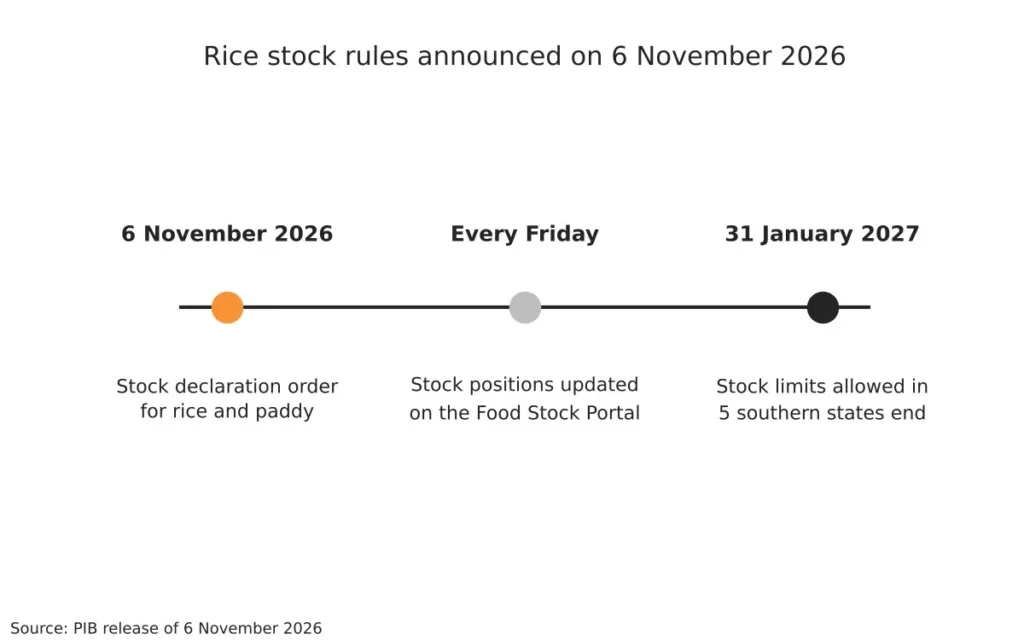
The Ministry of Consumer Affairs, Food and Public Distribution announced the order on 6 November 2026 [1]. It covered traders and wholesalers, retailers, big chain retailers, and processors or millers in all states and Union Territories [1, 2]. The same day, the Centre gave its concurrence for Andhra Pradesh, Karnataka, Kerala, Tamil Nadu and Telangana to impose stock limits on rice and paddy through control orders wherever considered necessary, with any such limits to remain in force up to 31 January 2027 [1, 3]. The Financial Express, citing sources, reported that prices of southern varieties such as Sona Masuri and Ponni had risen sharply in the months before the order [3].
What did the 6 November 2026 rice stock declaration order ask for?
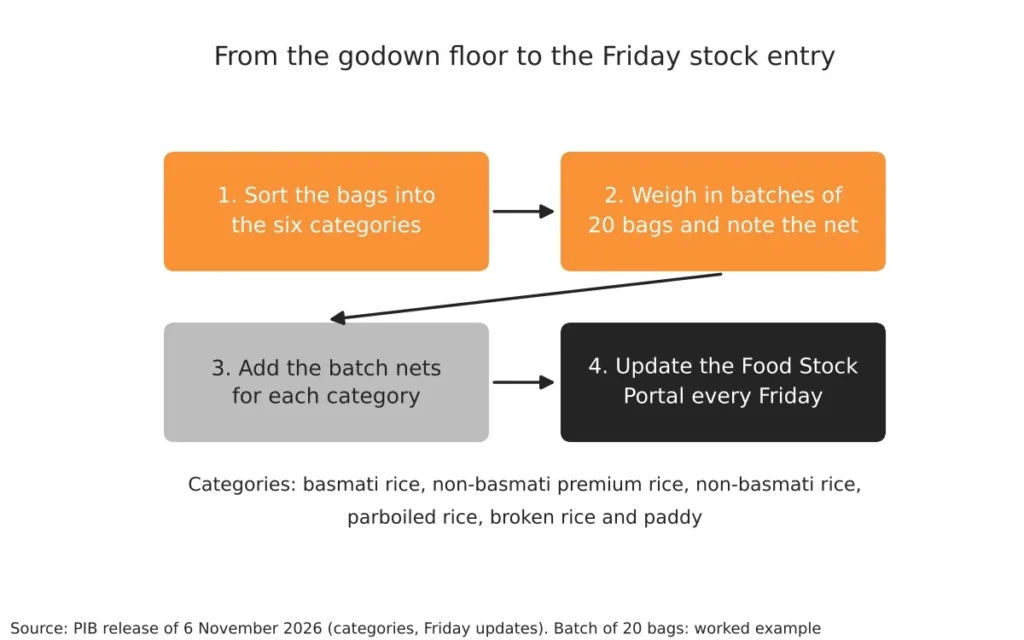
The order asked for stock positions under six categories: basmati rice, non-basmati premium rice, non-basmati rice, parboiled rice, broken rice and paddy [1, 2]. It asked for them to be updated on the Food Stock Portal every Friday [1, 2]. The PIB release said the information furnished must be accurate and regularly updated [1]. Our advice is to keep a separate running total for each category you hold, so paddy and each kind of rice never share one ledger line.
Why can bag count times 50 kg differ from the real stock?
A stock book that multiplies the bag count by the marked weight assumes every bag holds exactly that weight. A bag opened for a sample, or filled on a different machine, may hold a little less or a little more. Only weighing shows that difference.
How much can a small shortfall per bag add up to?
Your book shows 800 bags of non-basmati rice at 50 kg each, which is 40,000 kg. You weigh them in batches and find the average net weight is 49.6 kg a bag.
Stock on the scale = number of bags × average net weight per bag
| Average net weight per bag | Stock on the scale (800 bags) | Gap from the 40,000 kg book |
|---|---|---|
| 50.0 kg | 40,000 kg | 0 kg |
| 49.8 kg | 39,840 kg | 160 kg |
| 49.6 kg | 39,680 kg | 320 kg |
| 49.4 kg | 39,520 kg | 480 kg |
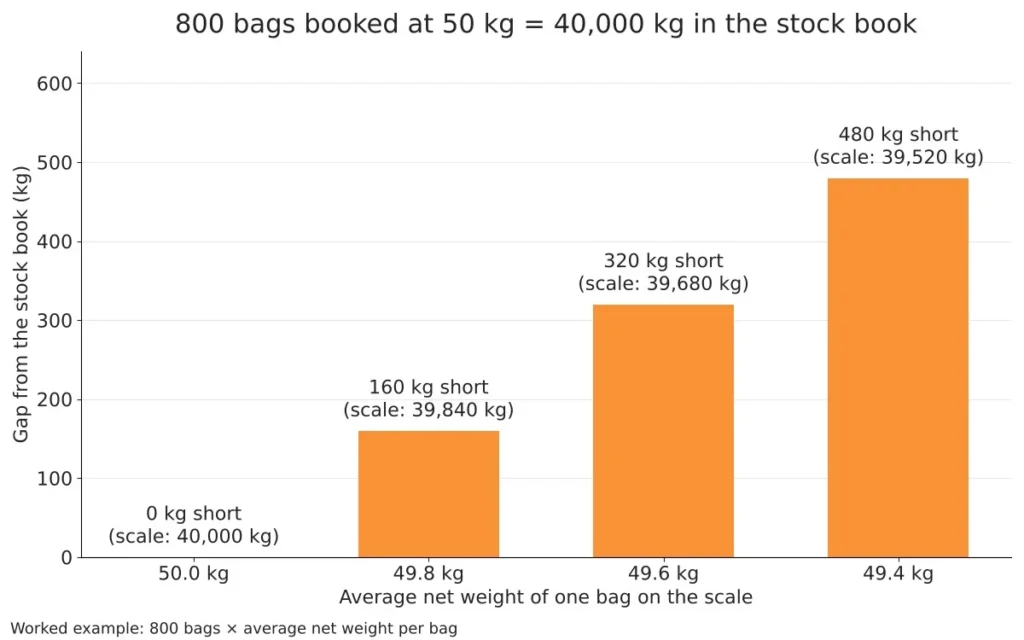
At 49.6 kg a bag, the book shows 320 kg more rice than the godown holds. Use the weighed figure for that category when you work out its stock position, convert it to the unit the portal asks for, and keep the batch sheet that shows how you got it.
How do you batch weigh rice bags on a platform scale?
The PIB release does not describe a weighing method [1]. The steps below are our advice.
- Set the scale on level, firm ground near the stack. Switch it on with nothing on the platter, so it reads zero.
- If you weigh on a pallet, use one that fits inside the platter. Place it empty on the platter and press tare, so the display leaves out the pallet. Weigh 20 empty sacks with their ties and divide by 20 for an average sack weight. Take that average, times the number of bags, off each batch. The result is an estimated net weight, so recheck a few empty sacks now and then, and whenever the packaging changes. Our post on the tare button explains tare and zero.
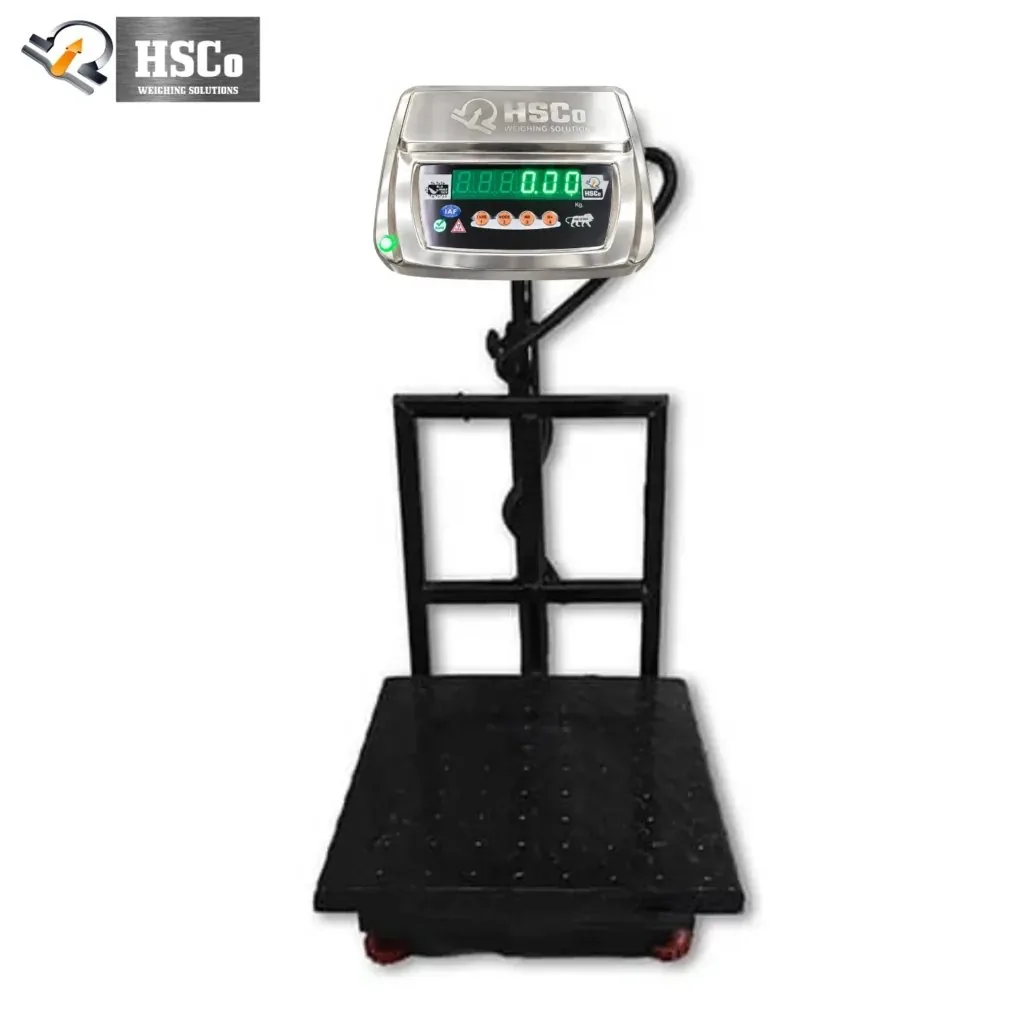
- Stack one category at a time, with the stack fully on the platter. Keep rice, sacks and pallet together within the capacity. On a 1,500 kg PLCHQHS [4], 20 bags of 50 kg hold 1,000 kg of rice and leave 500 kg for the rest.
- Write down the batch number, the category, the bag count and the net weight before the next batch goes on.
- Add the batch nets for each category and use those totals, in the unit the portal asks for, when you update the Food Stock Portal on Friday [1].
Which HSCo scale fits a rice godown?
Choose the scale by the total weight of one load, pallet and sacks included, and by the size of the stack.
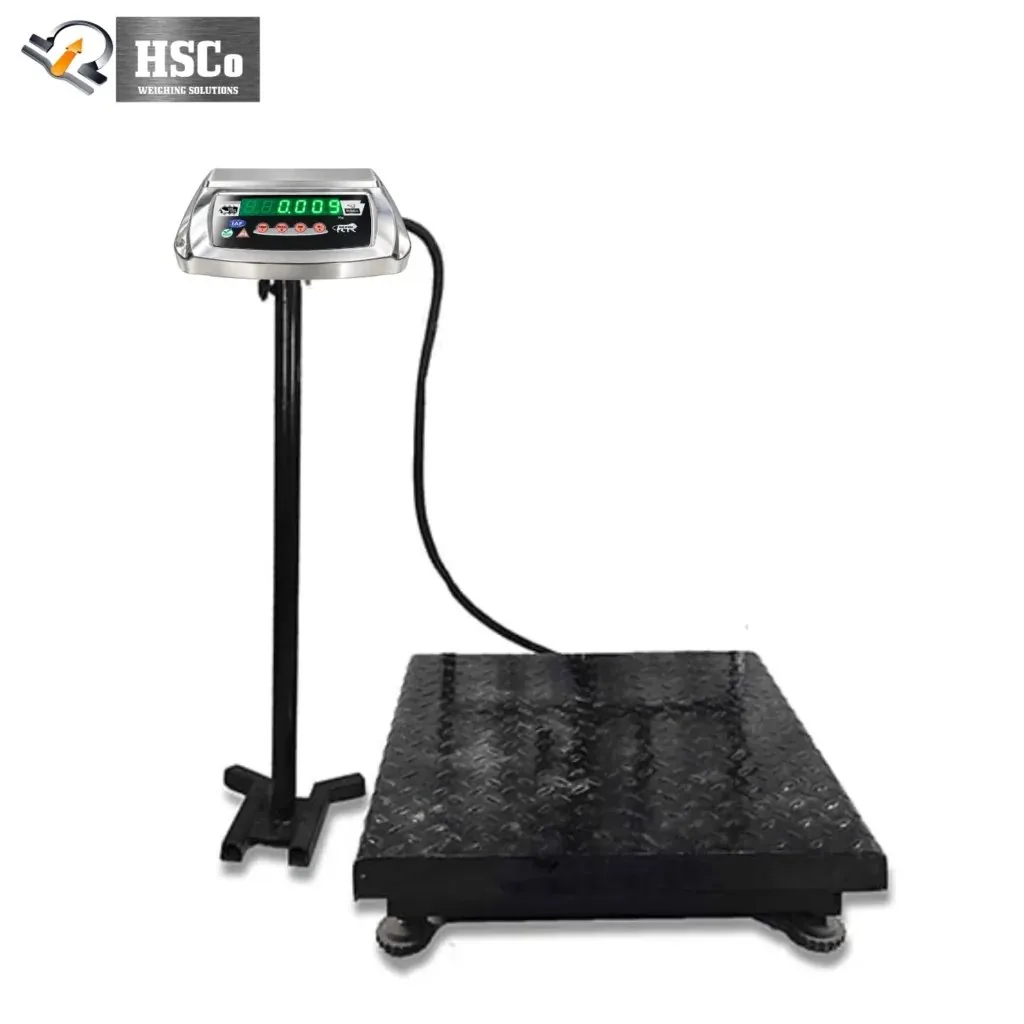
 PLCHQHS heavy duty platform scale, 1,500 and 2,000 kg: comes in 1,500 kg (75 × 75 cm platter) or 2,000 kg (90 × 90 cm), with four IP67 load cells, tare, and a second display at the back for the customer [4]. For loads of 20 bags of 50 kg on the 1,500 kg model.
- PLCHQB platform scale, 500 and 1,000 kg: reads in 50 g or 100 g steps on a chequered MS plate, with an optional printer output for a paper record of each batch [6]. The 500 kg model has a 600 × 600 mm platter [6]. For rice loads up to 400 kg (500 kg model) or 900 kg (1,000 kg model), sacks and pallet extra, if the stack sits on the platter.
- PLCHQS electronic platform scale, 50 to 300 kg: weighs to 10 g on the 100 kg and 150 kg models, with tare, zero and two displays [5]. For checking a single bag against its marked weight at the gate, on the 100 kg model or above.
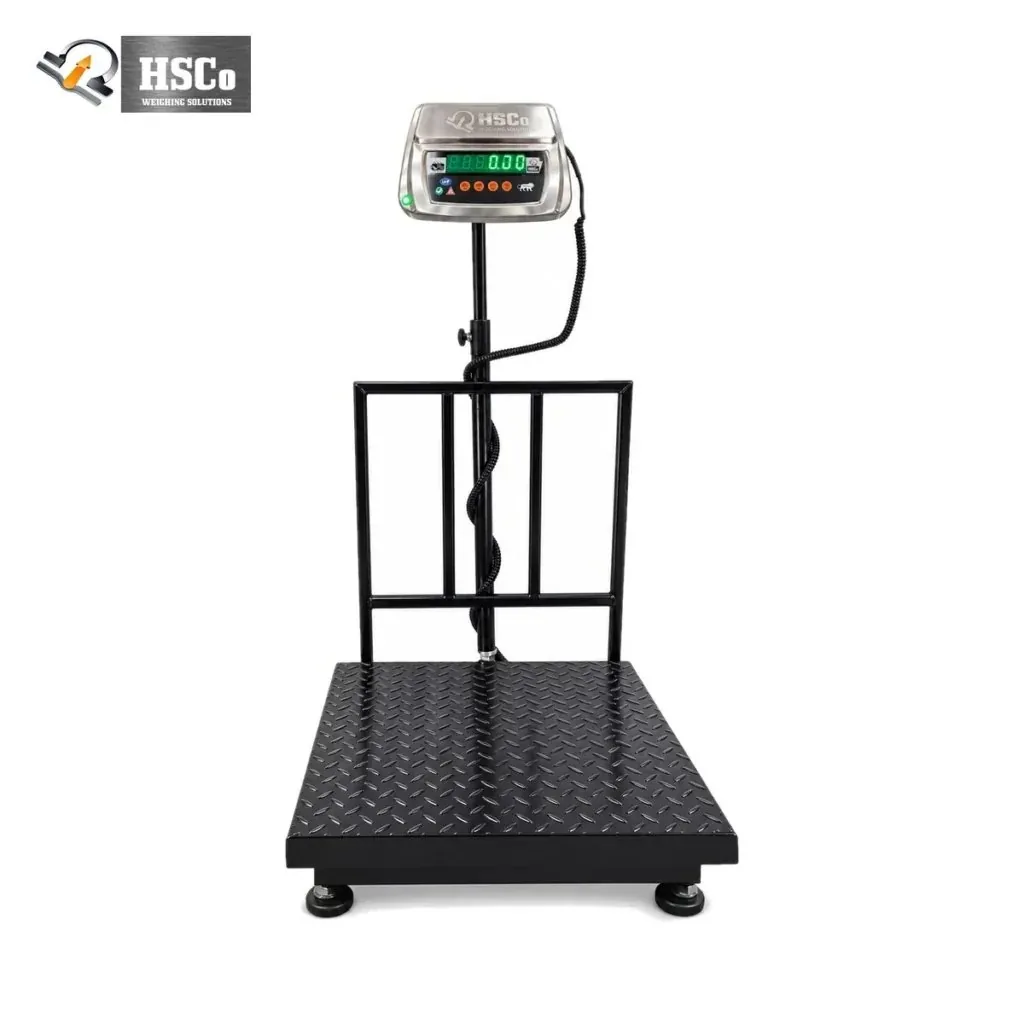
Scales for grain stores and mandis are on our weighing scales for agriculture page. Tell us your bag size and how many bags you weigh a day: call +91-7045922250 or write to hsc@hindustanscale.com.
Frequently asked questions
Who must declare rice stock on the Food Stock Portal?
The order dated 6 November 2026 directed traders and wholesalers, retailers, big chain retailers, and processors or millers in every state and Union Territory to declare their rice and paddy stock on the Food Stock Portal [1, 2]. It asked them to update the stock positions every Friday, in six categories: basmati rice, non-basmati premium rice, non-basmati rice, parboiled rice, broken rice and paddy [1, 2].
What happens if a rice trader does not register on the Food Stock Portal?
The PIB release of 6 November 2026 said an entity found unregistered on the Food Stock Portal, or violating the prescribed stock limits, would be liable for punitive action under the Essential Commodities Act, 1955 [1, 2]. Under that order, a rice trader holding rice or paddy stock was to be registered on the Food Stock Portal and to update the stock position there every Friday [1].
How many 50 kg rice bags can a 1,500 kg platform scale weigh at once?
On a 1,500 kg platform scale, the rice, sacks and pallet together must stay within 1,500 kg, and the stack must sit fully on the platter. Thirty 50 kg bags hold 1,500 kg of rice alone, which leaves nothing for sacks or pallet. Twenty bags hold 1,000 kg of rice and leave 500 kg for them. The PLCHQHS 1,500 kg model has a 75 × 75 cm platter [4].
Until when can southern states keep stock limits on rice?
On 6 November 2026 the Centre gave its concurrence for Andhra Pradesh, Karnataka, Kerala, Tamil Nadu and Telangana to impose stock limits on rice and paddy through control orders wherever considered necessary [1, 2]. Any such limits were to remain in force up to 31 January 2027 [1, 3].
Sources
- Press Information Bureau, Ministry of Consumer Affairs, Food and Public Distribution, “Government doubles OMSS (D) rice sale target from 25 LMT to 50 LMT for 2026-27; 25 LMT already sold through e-auctions up to 31 October 2026” (pib.gov.in, 6 November 2026). Release ID 2333623
- ThePrint (PTI), “Centre mandates rice, paddy stock declaration; allows five southern states to impose limits as prices climb” (theprint.in, 6 November 2026). PTI report
- The Financial Express, “Southern states told to put holding limits on rice” (financialexpress.com, 6 November 2026).
- Hindustan Scale Company, “PLCHQHS Heavy Duty Platform Scale – 1,500 and 2,000 kg, Four Load Cells, Two Displays” (hindustanscale.com).
- Hindustan Scale Company, “PLCHQS Electronic Platform Scale – 50 to 300 kg, Chequered Plate, Double Display” (hindustanscale.com).
- Hindustan Scale Company, “PLCHQB Platform Scale – Chequered MS Plate, 500 / 1,000 kg, Dual Display” (hindustanscale.com).