
Blogs
VGM method 2: what a shipper needs before weighing export pallets

VGM method 2 means you add up the masses of every package and cargo item, with its pallets, dunnage and other securing material, and then add the empty container’s tare [1, 2]. In India the shipper’s method must first be approved by the Administration, and it needs an ISO 9001:2015 quality system (or an updated standard that applies), scales certified by Legal Metrology and a way to re-verify the tare [1].
The Merchant Shipping (Carriage of Cargoes and Oil Fuels) Rules, 2026 were notified on 2 September 2026 as G.S.R. 774(E), and rule 1(2) brings them into force on the date of their publication in the Official Gazette [1]. Their rule 7 and Annexure I set out how the gross mass of a packed container is verified, and a packed container without a verified gross mass is not loaded on the ship [1]. The requirement comes from SOLAS amendments in force since 1 July 2016 [2].
What does VGM method 2 include?
Method 2 adds up single weights. Annexure I lists them as all packages and cargo items, the pallets, dunnage and other securing material packed in the container, and the tare mass of the container [1, 2]. The rules define tare mass as the mass of the empty container with no packages, cargo items, pallets, dunnage or other packing or securing material in it [1].
Who approves VGM method 2 in India, and what do you need?
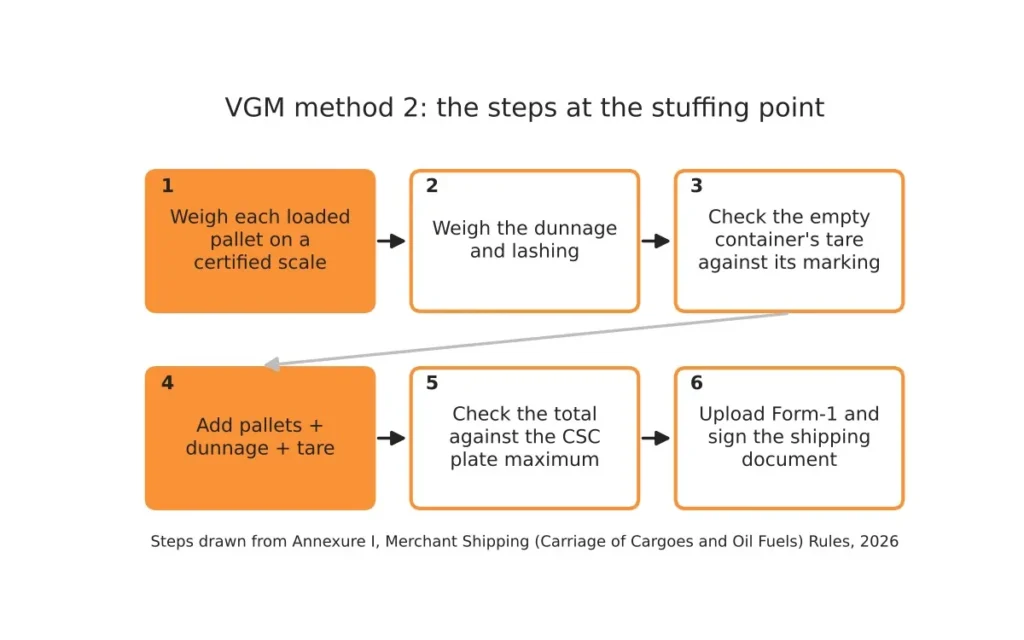
The Administration, which the rules define as the Director General of Maritime Administration, approves the method after the jurisdictional Mercantile Marine Department (MMD) inspects your premises [1]. Paragraph 9 of Annexure I asks the shipper for five things [1]:
- a method that is part of a quality management system meeting ISO 9001:2015, or an updated standard that applies [1];
- a list of calibrated weighing scales certified by the Department of Legal Metrology [1];
- a way to re-verify the weight of an empty container against the tare marked on it [1];
- an upload of the verified gross mass and the Form-1 details to a dedicated secure website, your own website or one you have a tie-up with [1];
- an application in Form-2 to the jurisdictional MMD, with the fee [1].
The Form-2 scrutiny sheet also asks for Legal Metrology certificates for your electronic weighing equipment, the safe working load of the lifting hooks and chain block for the empty container, enough space to weigh single items including pallets, and a copy of your tamper-proof weight document [1]. In November 2026 the Directorate General of Maritime Administration (DGMA) cargo safety page listed four method 2 approvals, one marked expired [3].
Which rules must a VGM weighing scale meet?
Paragraph 11 of Annexure I covers every weighbridge or weighing appliance used for VGM [1]. Each one must:
- be electronic, and calibrated and certified by the Department of Legal Metrology [1];
- come under a quality management system certified to ISO 9001:2015, or an updated standard that applies [1];
- have enough capacity to weigh the loaded container with its truck or trailer, where that is needed [1];
- have a tamper-proof mechanism that prevents tampering with its calibration [1];
- give the verified gross mass in a tamper-proof document [1].
The operator must also check the calibration with standard weights at frequent intervals and record each check [1]. We arrange re-verification of scales anywhere in India [4]. Our government stamping post explains renewal.
How do you check the container’s tare weight?
The container’s owner must mark the tare correctly, and the shipper must have a way to re-verify it [1]. For that re-verification, Annexure I says a combination of an electronic scale with a pulley or chain block, or other relevant methods, may be accepted [1]. If the actual empty weight differs noticeably from the marked tare, the container is not accepted for stuffing until the marking reflects its actual weight [1].
How do you add up VGM method 2 for one container?
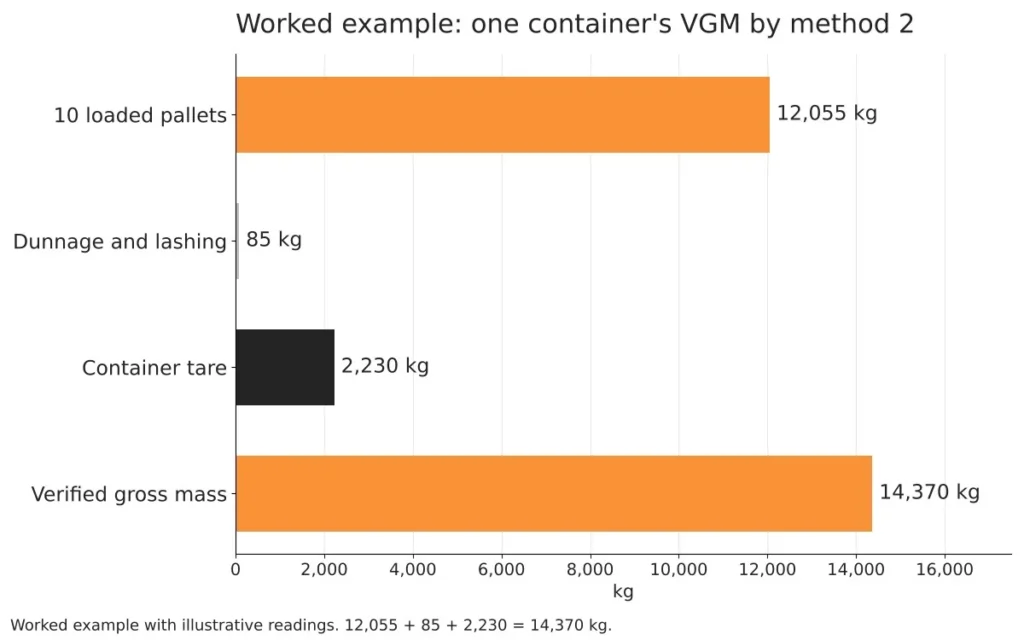
Add the readings for the loaded pallets and for the dunnage, then add the container tare. This worked example uses illustrative readings for 10 loaded pallets.
VGM = loaded pallets + dunnage and lashing + container tare
| Item | Reading |
|---|---|
| 10 loaded pallets, 1,190 to 1,220 kg each | 12,055 kg |
| Dunnage and lashing | 85 kg |
| Container tare, as marked | 2,230 kg |
| Verified gross mass | 14,370 kg |
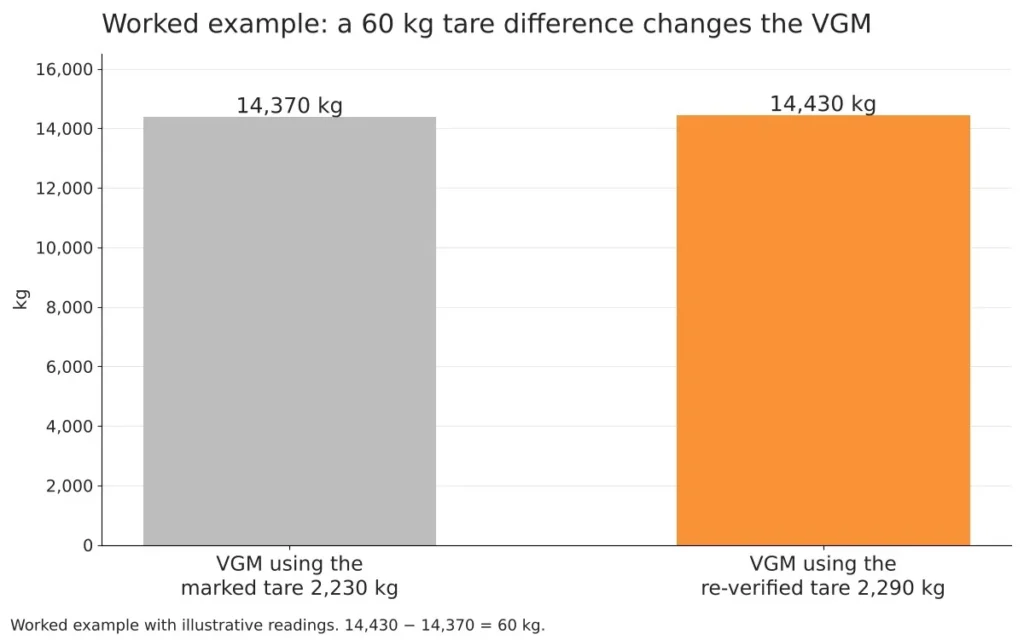
Suppose the same empty container weighs 2,290 kg when you re-verify it. The sheet then totals 14,430 kg, so a figure built on the 2,230 kg marking would be 60 kg light. Paragraph 12 of Annexure I also says the verified gross mass must not exceed the maximum gross weight on the container safety approval plate, the CSC plate [1]. The master of the ship decides whether to accept or reject a container, and that decision is final [1].
The shipping document must be signed by a person the shipper has authorised, show that person’s name, designation, phone number and email, and be submitted electronically with a digital signature [1]. Send the verified gross mass to the master of the ship or his representative early enough for the stowage plan [1].
Which HSCo scale fits a method 2 stuffing point?
Each scale must meet paragraph 11 of Annexure I, including its tamper-proof rules, so confirm them for your model before you order.
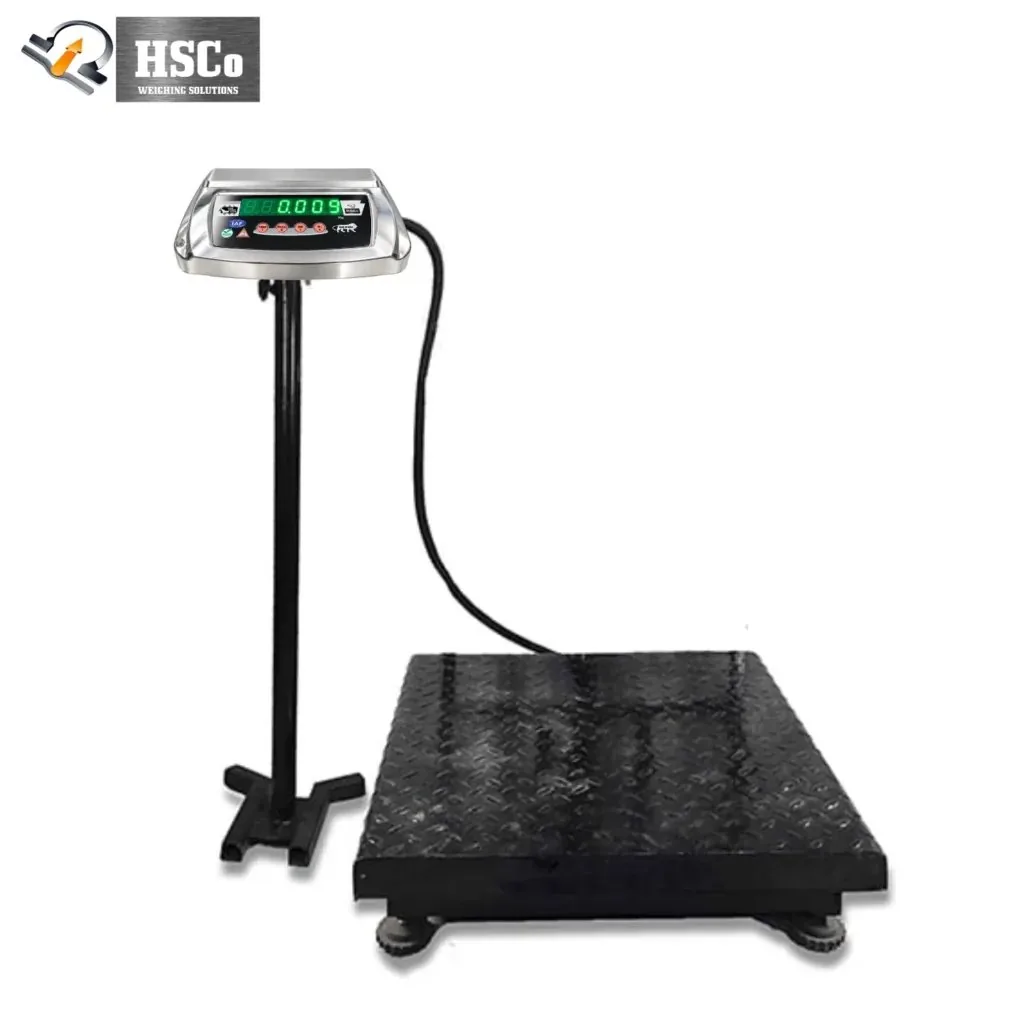
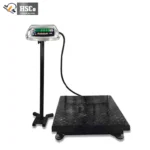
 PLCHQHB heavy-duty platform scale: 2,500, 3,000 or 5,000 kg capacity on a chequered mild-steel platform from 100 × 100 cm to 150 × 150 cm, with four IP67 load cells and a double-sided display; Legal Metrology stamped [5]. For loaded pallets set down by a forklift.
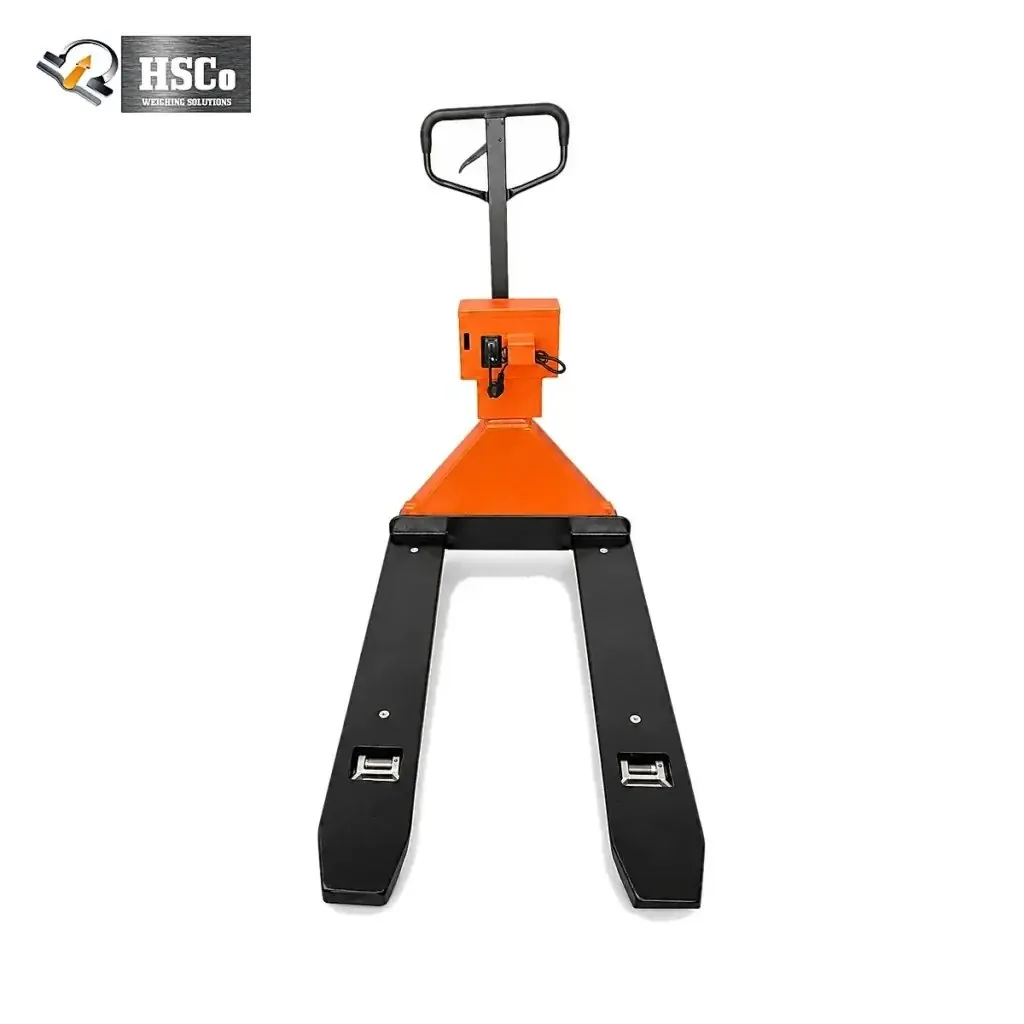
- HPT digital pallet scale: a hand pallet truck with the scale in its forks, in 2,000 kg and 3,000 kg models reading in 2 kg steps, with a built-in thermal printer for weight slips; approved by the Legal Metrology Department [6]. For weighing pallets on the way to the container.
Our weighing scales for ports and shipping page lists more scales, and our verified gross mass post covers method 1 on a weighbridge. Tell us what you pack: call +91-7045922250 or write to hsc@hindustanscale.com.
Frequently asked questions
Does VGM method 2 need approval in India?
Yes. A shipper using VGM method 2 in India needs its method approved by the Administration first [1]. The shipper applies in Form-2 to the jurisdictional Mercantile Marine Department, which inspects the premises and forwards its report [1]. The method must be part of a quality management system meeting ISO 9001:2015, or an updated standard that applies, and use calibrated weighing scales certified by the Department of Legal Metrology [1].
Can a shipper use the tare weight marked on the container?
Yes. VGM method 2 adds the tare mass of the container, and the container’s owner must mark that tare correctly [1]. The shipper must also have a way to re-verify the empty container’s weight, and an electronic scale with a pulley or chain block may be accepted for this [1]. If the deviation is noticeable, that container is not accepted for stuffing until its marking reflects its actual weight [1].
Can the verified gross mass be more than the CSC plate maximum?
No. Paragraph 12 of Annexure I to the Merchant Shipping (Carriage of Cargoes and Oil Fuels) Rules, 2026 says the verified gross mass of a container shall not exceed the maximum gross weight on its container safety approval plate, the CSC plate [1]. The master of the ship decides whether to accept or reject a container, and the rules make that decision final [1].
Sources
- Ministry of Ports, Shipping and Waterways, “Merchant Shipping (Carriage of Cargoes and Oil Fuels) Rules, 2026” (dgma.gov.in, 2 September 2026). Gazette of India Extraordinary, Part II Section 3(i), G.S.R. 774(E); notification dated 2 September 2026; e-Gazette ID CG-DL-E-09092026-276090
- International Maritime Organization, “Verification of the gross mass of a packed container” (imo.org). SOLAS amendments in force from 1 July 2016
- Directorate General of Maritime Administration, “Cargo Safety” (dgma.gov.in). VGM Method-2 approved shippers; checked on 9 November 2026
- Hindustan Scale Company, “What Is Government Stamping And Why Is It So Important?” (hindustanscale.com).
- Hindustan Scale Company, “PLCHQHB Heavy Duty Platform Scale – 2,500 to 5,000 kg, Chequered MS Platform, 4 Load Cells” (hindustanscale.com). product page
- Hindustan Scale Company, “Digital Pallet Scale HPT – Pallet Truck with Scale and Printer, 2 t / 3 t” (hindustanscale.com). product page