

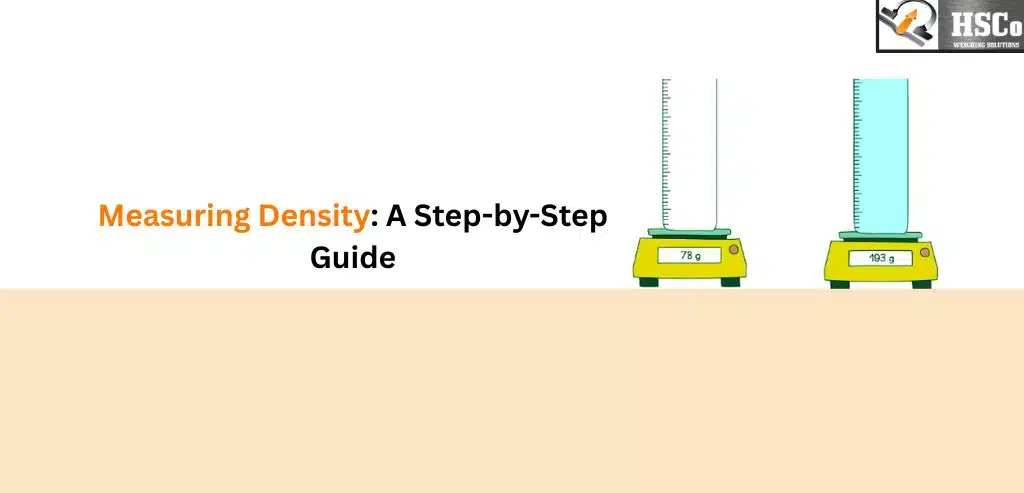
How do you define density?
Density is a key property of materials and describes how much mass is packed into a specific volume. Scientists and engineers usually report density in kilograms per cubic meter (kg/m³), grams per cubic centimeter (g/cm³), or grams per milliliter (g/mL). These units fit a wide range of laboratory, industrial, and commercial settings.
Measure density with an HSCo instrument
Compare HSCo's density and viscosity meters. Tell the team what material you test and the measurement method required. See density meters
Density reveals how tightly or loosely the small particles or molecules of a substance fill a given space. When a sample is denser, its particles are packed closer together. When it is less dense, the particles are spaced further apart.
What are the possible applications of measuring density?
Density measurements support many tasks across different fields. Here are a few main applications:
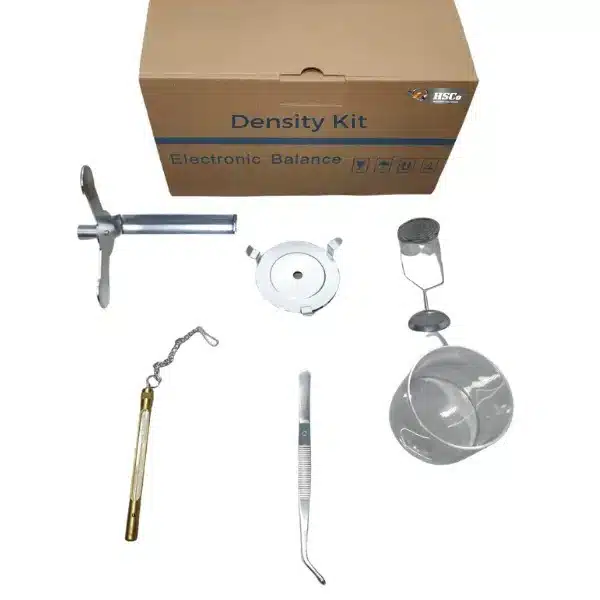
Material Identification: Each substance has a characteristic density that acts like a fingerprint. Analysts use this property to confirm or match unknown samples in chemistry, geology, and recycling.
Quality Control: In medicine, food processing, and oil refining, measuring density helps make sure that finished products have uniform composition, preventing defects and ensuring safety.
Meeting regulatory guidelines demands product labels and measurable performance metrics, and both hinge on steady density values.
Process Efficiency: Operations such as bulk transport, phase separation, and mixing harness density variations to fine-tune throughput. Precise density readings cut energy use and curb material waste, driving smoother, cheaper processes.
Buoyancy and Maritime Logistics: Density guides the design and load planning of ships and flotation devices. For loading calculations, it adjusts cargo stowage and fine-tunes fuel blends, ensuring stability and cutting fuel costs.
Correlation to Material Traits: Density directly reflects purity, alloy mix, and concentration, letting technicians use it as a fast, indirect substitute for weighing or titrating in both qualitative and quantitative assays.
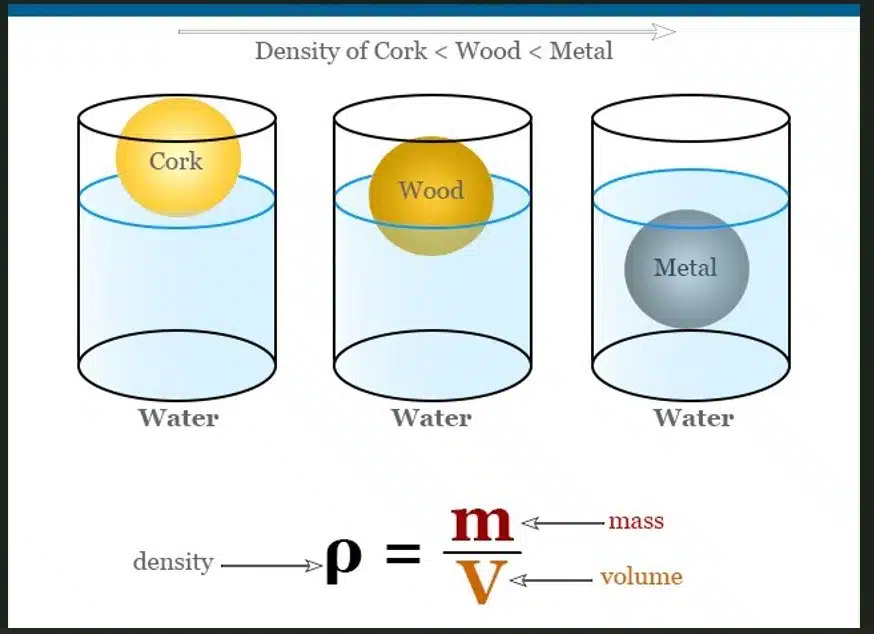
Basic Density Equation
Here’s the fundamental relationship:
ρ = m / V, and V = m / ρ,
where:
– ρ = density (rho, the Greek letter)
– m = mass (grams, kilograms, etc.)
– V = volume (litres, cm³, etc.)
Example:
A solid block weighs 500 grams and occupies 200 cm³. Its density calculates as:
ρ = 500 g / 200 cm³ = 2.5 g/cm³, or in reciprocal volume terms: V = 200 cm³ / 500 g = 2.5 g/cm³.
• Important: For liquids, density is given in g/mL, and remember, 1 mL equals 1 cm³.
In final thoughts
Measuring density is a key skill in research labs and in industry. It helps to identify, track, and refine different materials. The simple ratio of mass to volume is a building block for both practical methods and deeper theoretical studies. Mastering density measurements opens the door to better material characterization and to innovation in materials science.
Types of devices for measuring density
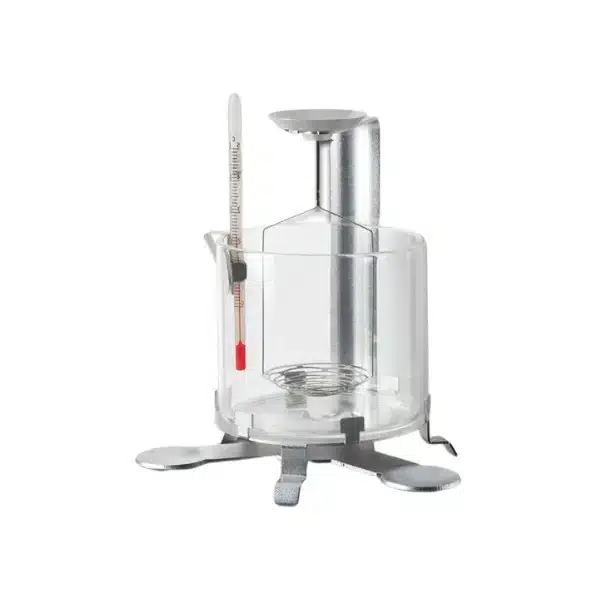
Many different instruments can measure the density of liquids and solids very precisely. They use different scientific principles and are calibrated for different levels of accuracy. Their design, intended application, and budget can also vary widely.
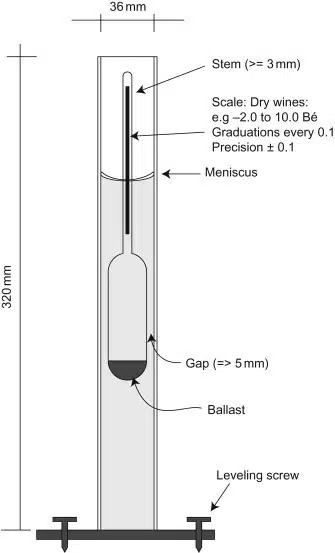
Water meters
• Principle: This device uses Archimedes’ principle of buoyancy. When the graduated glass float is lowered into the liquid being tested, it sinks until buoyant force balances the float’s weight. The marked level at which the float stops shows the density of the liquid.
• Use Case: Water meters are ideal for determining the density of large liquid volumes. They are fast, simple, and inexpensive, making them practical for routine testing.
You’ll see both techniques used in brewing or winemaking, in checking those big batteries at the shop, and in routine tests for milk, acids, and other milky or liquid things.

Float Densitometer
How it Works: A buoyant float naturally rises and falls with the liquid. The position of the float tells you the density based on simple buoyancy laws.
Where You’d Use It: You’ll find it on the brewing scale, in checkpoints for grape juice, and any time someone wants a quick dip check on electrolyte levels.
Pros: It stays alive for years, costs less than a dinner date, and doesn’t ask for a plug. Its straightforward pipes make it friendly on the wallet.
Cons: You need to remember that heat changes liquid volume on your own. If you need a laser-sharp reading, other gizmos are better. The device also stumbles with dark, thick, or bubbly liquids that hide the float line.
Pycnometer
How it Works: You fill a tiny cali-glass globe of known size, weigh it, and the density pops out by dividing the added weight by the known globe size.
Where You’d Use It:Perfect for perfumes, super-refined sugars, or a pinched sample of powdered recharge for your lab scale.
Strengths:It’s the champion of lab nerds, needing only a drop to deliver results you can trust over and over, and it pairs nicely with ultra-accurate balances.
Limitations: The globe is break-up-prone, cleaning is a slow dance, and if your juice fizzes or changes fast, you’ll need a tough jacket of glass or steel to keep it honest.
Digital Density Meters (Using U-Tube Oscillating Technology)
• How It Works: To start, you fill a U-shaped tube that vibrates at a set frequency with your liquid sample. The moment you add the sample, the oscillation frequency changes. The amount of that shift is directly tied to the mass of the liquid, and an electronic circuit turns the frequency change into a density reading.
• Best Places to Use: These meters handle both gases and liquids and are most accurate in the food and beverage field, the pharma sector, and the petrochemical industry.
• Upsides: You get a reading in under a minute with an accuracy of ±0.0001 g/cm³. They come with temperature control, need only a tiny sample volume, and can send density data straight to your digital records.
• Downsides: The initial cost is high. You will also need to calibrate and maintain the unit now and then to keep it running at that top level of precision. It works best with samples that can be easily obtained and handled.
Specific Gravity Balances
• How It Works: You fill a liquid bath with a known density liquid and place a precise balance in it. The balance weighs the sample both in air and when submerged. The results are plugged into a formula to give you the sample’s density.
• Best Places to Use: Labs that check the density of powders, pastes, and irregular solids use these balances a lot.
• Upsides: You get accurate readings down to ±0.0002 g/cm³, with no need for complex electronics.
• Downsides: They are not great for fast-paced production lines. The operator must ensure the bath liquid is stable and the temperature uniform. If the known density liquid drifts, the reading drifts too.To measure specific gravity, you first weigh the sample in air, then weigh it again after it’s completely underwater. The balance automatically figures out the specific gravity using those two weights.
Where to Use:You’ll find specific gravity balances checking the quality of elastomers, polymers, rubber, and various chemical blends.
Pros:The screen is clear, and it shows results right away, making it perfect for frequent quality checks right on the production line.
Cons:The readings are not as accurate when used alongside density meters. They need to be calibrated often, and picking the right reference liquid is key. The method struggles with very small samples, where even tiny errors can matter a lot.

Instruments Based on Buoyancy (Archimedes’ Principle)
Method: The balance first weighs the solid in air and then underwater. The difference in weight gives the buoyant force, and that can be used with the weight of the liquid displaced to find the object’s density.
Where to Use: This technique is perfect for bulk materials, non-cubic structural items like minerals, for sorting plastic waste, and for weighing jewelry.
Benefits: It adapts easily to different sample types, achieves moderate to very high accuracy, and performs even better with fully automatic setups.
Drawbacks: You may need to correct for buoyancy drift in air, it’s sensitive to temperature, and it usually measures slower than most digital meters.

Ultrasonic and Coriolis Density Sensors
Ultrasonic Density Meters
•How It Works: Ultrasound pulses pass through the liquid in between short intervals. If they travel slower, the liquid is denser.
• Where It’s Used: Common in mining and chemical sectors to keep an eye on slurries without slowing down the continuous flow.
• Pros: Handles corrosive and gritty slurries, copes with dense suspensions, has no moving parts for higher durability, and gives real-time results.
•Cons: Accuracy may drop if temperature and pressure aren’t managed, and it’s not the best choice for high-precision lab samples.
Coriolis Density Meters
• How It Works: Liquid moving through a curved tube changes the tube’s minute vibration pattern. The shift reveals the liquid’s density.
Changes in frequency and phase of oscillation let us gauge a fluid’s inertial effect. By doing this, we can measure both mass flow and fluid density.
- Use Case: This method is handy for nonstop monitoring of mass and density in chemical formulations, during custody transfer in oil and gas, and for bulk food processing.
- Pros: It provides mass flow and density readings at the same time.