

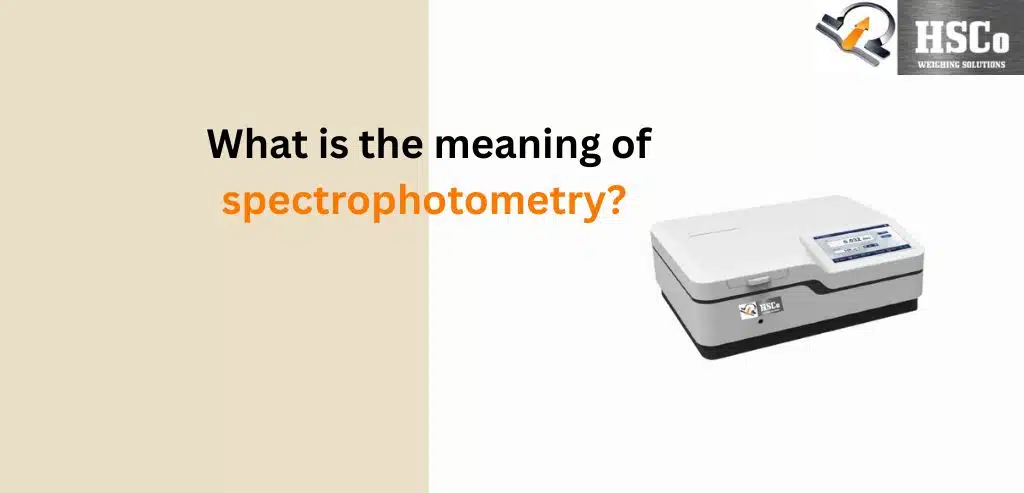
Spectrophotometry is a way to quantify the amount of electromagnetic radiation that gets weaker as it goes through a uniform solution. Absorbance is a dimensionless value that depends on the concentration of the analyte and the specific electronic transitions of its parts. It is calculated by comparing the incident intensity with the transmitted intensity to see how much the light intensity has changed. The resulting absorbance profile, which can be either a continuous or discrete spectrum, acts as a molecular fingerprint that lets you identify several species in a combination both qualitatively and quantitatively.
See HSCo spectrophotometers
See HSCo's spectrophotometers. Compare the models and send your measurement requirements for a quotation. See spectrophotometers
What does UV-Vis mean?
Ultraviolet-visible spectrophotometry, or UV-Vis for short, is the part of the electromagnetic spectrum that goes from about 190 to 800 nanometres. The first part, from 190 to 400 nanometres, is ultraviolet radiation, while the second part, from 400 to 800 nanometres, is the visible spectrum. We test absorbance in this range because the photons that hit the sample have enough energy to move electrons from lower to higher molecular orbitals. The absorption peaks and minima that come out of this are unique patterns that link chemical identity to concentration, making it possible to do a complete compositional analysis. When radiation in this range hits a sample, some wavelengths are absorbed because the distributions of molecular electrons are changed.
UV-Vis absorption spectroscopy moves molecules from a lower (ground) electronic state to a higher (excited) electronic state. The amount of light that is absorbed at each wavelength depends on both the quantity of the molecules that absorb it and the unique electrical structure that sets them apart from other types of molecules. The Beer–Lambert Law explains this effect in numbers. It says that the amount of light that is absorbed is directly related to the concentration of the absorbing species and the distance the light travels through the medium that absorbs it. Modern spectrophotometers measure this absorption by comparing the brightness of light that hits a sample to the brightness of light that comes out of it.
How it relates to current scientific research
UV-Vis spectrophotometry is now a key method in fields including chemistry, biochemistry, environmental research, medicine, and materials science since it offers a number of useful features:
• The method needs modest amounts of samples and doesn’t change the sample much, yet it is very sensitive to a wide range of analyte types.
• Analyses may be done quickly and cheaply, making it easy to both qualitatively identify and accurately measure concentration.
• The approach can be used on thin films, liquids, solid materials, and gaseous mixtures.
• Important for figuring out molecule shape, reaction rates, sample purity, and how far the reaction has gone.
UV-Vis spectrophotometry is now a standard tool in both academic and industrial labs around the world since it is easy to use and can analyse a wide range of samples.
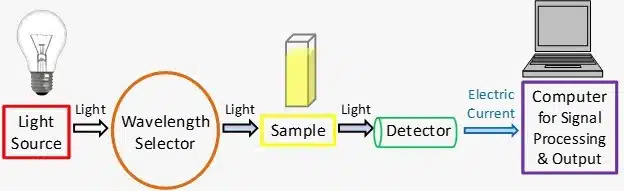
How UV-Vis Spectrophotometers Work
• The Beer-Lambert Relationship, Absorbance, and Transmission
A UV-Vis spectrophotometer measures the amount of light that is absorbed by the sample (A) and the amount of light that comes out of the sample (T). Transmission (T) is the ratio I/I0, where I0 is the strength of the beam before it hits the sample and I is the strength of the beam after it passes through the sample. The logarithmic formula A=−log10(T) gives us absorbance. The Beer-Lambert Law makes the connection between absorbed light, analyte concentration (c), pathlength (L), and molar absorptivity (ε) clear:
A = εLc.
This connection lets you accurately determine concentrations by linking absorbance at certain wavelengths to analyte density when used in calibrated domains.
• Light Sources Made of Tungsten and Deuterium
• Deuterium Lamp: Sends out a steady stream of ultraviolet light from roughly 190 to 400 nm.
• Tungsten-Halogen Lamp: It gives off light in the visible and near-infrared range, from 340 to 1100 nm.
At 340 nm, spectrophotometers automatically switch between these sources to make sure that the UV-Visible spectrum is always covered.
Parts: cuvette, monochromator, and detector.
Monochromator: Uses either diffraction gratings or prisms with holes on opposite sides to pick out a narrow band of wavelengths from the lamp’s larger emission.
Cuvette: A clear container that holds the sample. Quartz cuvettes are the standard for measuring UV light between 200 and 400 nm. Standard glass cuvettes work for the visible range. The average length of an optical path is 1 cm.
Detector: Uses either photomultiplier tubes or photodiodes to turn the amount of light that goes through the sample into an electrical current. After that, this current is turned into numbers that show how much light is absorbed or transmitted.

Range of wavelengths:
– Ultraviolet: 190 to 400 nm;
– Visible: from 400 to 700 nm;
Some systems can reach the near-infrared range, coming close to 1100 nm.
How to measure:
1. A blank cuvette with just the solvent sets the zero absorbance reference.
2. After putting the sample in the cuvette, the equipment scans or steps through the user-defined wavelength range one by one, measuring transmittance at each chosen λ.
3. After that, the acquired transmittance data are processed to make a plot of absorbance (A) versus λ. Using the Beer–Lambert Law, concentrations are then found at certain absorbance maxima.
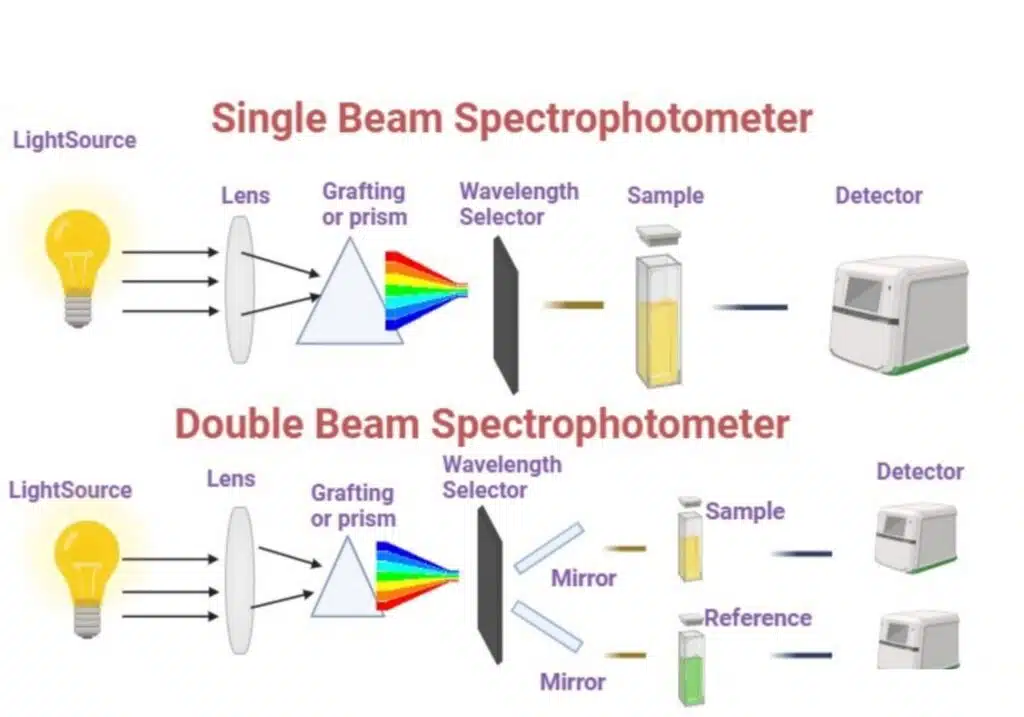
Instruments with a double-beam design can detect both the sample and the reference beams at the same time. This dual measurement makes up for any changes in light intensity over time, giving you more steady and accurate absorbance readings.
These engineering properties let UV–Vis spectrophotometers do quick, non-destructive, and very accurate tests that are needed in chemical, biological, environmental, and industrial labs.
There are a number of different instrument setups in the UV–Vis category.

1. One Beam vs. Two Beams
– UV–Vis Spectrophotometer with One Beam
In this setup, collimated light passes through the sample cuvette, and the intensity of the light that comes through is measured both before and after the sample is added. This design is easy to use, cheap, and small, but it requires human baseline correction, which means that the solvent blank and the sample solution must be measured one after the other.
Instruments that use the UV-Vis principle are very sensitive to changes in the source’s intensity over time.
Two-Beam UV-Vis Spectrophotometers
In this setup, the light that hits the sample is split into two paths. One path goes through the sample solution, and the other goes through a reference blank. So, two complimentary signals are either picked up at the same time or mixed together at a high frequency. This plan automatically gets rid of both long-term drift and changes in lamp intensity that don’t depend on wavelength, which makes measurements more accurate. Because of these unavoidable complexities and the need for more optical and detector parts, double-beam systems tend to be big and expensive. This limits their use to high-accuracy quantitative spectrophotometric applications.

2. Portable UV-Vis Spectrophotometers for the Bench
Benchtop spectrophotometers are bigger than other types and have better optical parts that improve their spectral bandwidth, which usually ranges from 190 to 1100 nm. Their design often allows for better wavelength resolution and more than one detection method, making them useful for applications that need accuracy, like research labs, quality assurance labs, and complex analytical protocols. On the other hand, handheld and portable spectrophotometers are small, light, and usually run on rechargeable batteries. This makes it easy to take measurements quickly in remote locations or on the manufacturing floor.
They take up less space on the bench and are easier to use than regular laboratory spectrophotometers, but they have shorter wavelength coverage, lesser resolution, and fewer programmable choices. Their biggest benefit is that they can give quick, direct readouts. This makes them great for field screening, compliance-level environmental sampling, and pre-analytical quality assurance when it’s not possible to get to a lab.
Scanning spectrophotometers move a single-color beam across the entire wavelength range in steps to obtain full absorption spectra. Fixed-wavelength spectrophotometers, on the other hand, send out a monochromatic beam that is centred on a set wavelength. For research, scanning devices are necessary for breaking down complicated mixtures, finding unknown analytes, and making detailed quantitative calibration curves. In contrast, fixed-wavelength devices are great for routine assays where the analyte of interest is known to absorb the most at a certain wavelength. They are faster and cheaper. Common uses include testing proteins at 280 nm in clinical labs and keeping an eye on process-grade chemicals in factories. Their straightforward design makes them work well in places where the pathlength and sample matrix stay the same.
Microvolume and NanoDrop UV-Vis spectrophotometers are made just for tests that only need a few microlitres of sample. This lets you measure very small amounts without using standard cuvettes.
Analysts can find out how much analyte is in samples as small as 1 to 2 µL by using custom sample discs or using the concepts of surface tension to make the liquid column. This method saves both chemicals and waste, which means that typical cuvettes are no longer needed. Being able to measure proteins and nucleic acids from very little amounts of sample is especially useful in the field of molecular biology. In high-throughput settings, the system’s quick measurement cycles, easy sample insertion, and simple surface cleaning with only one wipe all make it far more efficient.
There are two types of spectrophotometers: those that are connected to a computer and those that stand alone. The first group benefits from special software that manages complex protocols for standardisation, does complicated math, and stores large amounts of data. Because they work well with laboratory information management systems, it’s easy to get data and run batch-processing programs. On the other hand, freestanding devices combine all of the control logic and display parts into one unit. This lets them work on their own in places where there isn’t always a computer available and gives rapid results on their built-in screen.
You can add more features, such the ability to analyse numerous samples one after the other and to program, save, and recall your own measurement techniques.
• Spectrophotometers that work on their own.
• These stand-alone tools have their own control hardware and display panels, so they don’t need to be connected to other computers.
• Their simple interface and practical design make them easy for operators who don’t have any analytical training to use.
• They come in small, portable, and bench-mounted variants, and they are designed to do regular analytical tasks.
• Many fields use the UV-Vis spectrophotometric method widely.
• The method gives a precise, sensitive measurement of the amount of chemicals that absorb UV and visible light. This summary shows some common uses for UV-Vis equipment, such as checking quality, developing formulations, identifying species, and doing research.
• Drugs.
• In the pharmaceutical industry, UV-Vis spectrophotometers check the identification and purity of active pharmaceutical ingredients (APIs) and make sure that samples from different batches are all the same. The method measures APIs in both solid and liquid forms, describes and measures the breakdown products, and keeps an eye on the release of species during dissolution testing.
These measurements are necessary to make sure that bioavailability standards are met, that rules are followed, and that patient safety is protected.
• Biotech
• Biotechnology labs often use UV-Vis spectrophotometric technologies to get accurate measurements of proteins and nucleic acids. By measuring absorbance at specific wavelengths—260 nm for nucleotides and 280 nm for proteins—the method lets you quickly and safely find out both the concentration and purity. This ability is essential for every step of the process of expressing heterologous proteins, amplifying nucleic acids, and sequencing. It also makes sure that the techniques for processing samples stay linear and can be repeated, which reduces variability in later applications.
• Watching the environment
• Environmental labs use UV-Vis spectrophotometry to check the quality of air, water, and sediment. Analysts measure major pollutants, such as nitrate species, phosphate esters, heavy-metal complexes, and some organic xenobiotics, by looking at changes in absorbance. Routine spectrophotometric screening of samples obtained in the field checks that the limits for effluent discharge are being met and gives time-based statistics that show how well ongoing remediation efforts are working.
• Drinks and food
• In the food and drink industry, UV-Vis spectrophotometers are used to measure colour, count legal additives, and find impurities that should not be in the final product.
This method finds out how much antioxidant is in a sample, counts the chlorophyll and carotenoid pigments, and looks for signs of spoilage and pollutants. Customers are still happy with juices, wines, and carbonated drinks that keep their expected colours and stay stable over time, thanks to reproducible absorbance data.
• Chemicals made from oil
• Petrochemical factories use UV-Vis spectrometry to figure out what kinds of fuel they have and how much sulphur is in it. Composite UV absorption spectra show how hydrocarbons are spread out and how much of each type there is. Targeted sulphate assays check for both thiophenic and non-thiophenic sulphur species. These are important for engine performance and following emissions restrictions set by the government. These numbers help make refining operations better and make sure that the resulting fuel passes cleanliness standards.
• Colours and paints
• Paint and pigment makers employ UV-Vis spectrophotometry to measure how well dyes and dispersions absorb light. Important factors are the peak absorption wavelengths, the amount of pigment, and how stable the pigment is when exposed to light for a long time. This information controls the improvement of formulations, regular quality checks, and meeting customer-specific colour tolerances.
• Labs for research and school
• UV-Vis spectrophotometers are important tools in universities and research labs because they give accurate absorbance readings that are used in many fields of study.
They make regular tests like enzyme assays, reaction kinetics measurements, and serial dilution preparation easier, which standardises procedures across labs. Their wide range of optical specifications makes them necessary in many fields, such as molecular biology, analytical chemistry, environmental monitoring, and characterising nanomaterials. They allow for the creation of spectral datasets that are reproducible, accurate, and useful for interpretive learning.
• Beauty and Personal Care
Cosmetic formulators use UV-Vis spectrophotometry to measure how well creams, lotions, and emulsions block UV rays. We look at how stable the absorption spectrum is and how well physical blockers like zinc oxide and titanium dioxide scatter light. These tests show that the formulations meet the requirements for photoprotection set by the government and international safety and labelling standards. This proves that they are safe for consumers.
Clinical labs utilise UV-Vis spectrophotometry to detect the amount of haemoglobin, keep an eye on enzyme kinetics, and find a lot of other biomarkers in clinical fluids. These tests make it easier to accurately diagnose diseases, keep an eye on patients’ health over time, and evaluate biochemical targets that help make personalised treatment decisions.

How to Choose a UV-Vis Spectrophotometer
When picking a UV-Vis spectrophotometer, some important criteria to think about are the spectrum bandwidth, wavelength accuracy, photometric precision, and the number of programmable sampling modes.
This guide is for both lab workers and procurement professionals who want reliable information.
Range of wavelengths and accuracy
Wavelength Range: Most equipment can measure wavelengths from 190 to 400 nm in the ultraviolet and from 700 to 800 nm in the visible range. Some modern designs can detect things in the near infrared, up to 2,500 to 3,200 nm for applications that need this kind of detection.
Wavelength Accuracy: Research-grade tools can be accurate to within ±0.1 to ±0.5 nm. It is necessary to calibrate the wavelength scale in a systematic and careful way to make sure that measurements can be repeated and that they meet regulatory archival criteria.
Spectral Bandwidth
Definition: Spectral bandwidth measures how wide the wavelength range is that can pass through the monochromator when it is set to a nominal wavelength. The full width at half maximum (FWHM) of the transmitted intensity profile is how it is shown.
Typical Values: Academic and high-end lab instruments usually have bandwidths of 1 nm or less, which makes it easier to find spectral characteristics that are close together. Entry-level devices, on the other hand, may have widths of 2 to 5 nm, which can make it hard to tell the difference between nearby absorbance peaks.
Effect: When the bandwidths are smaller, the spectral resolution and measurement accuracy go up.
These changes make absorbance measurements more accurate, which is important for kinetic investigations and looking at complicated biological mixtures.
Making Optical Pathways: Quartz Cuvettes vs. Plastic Cuvettes
• Quartz cuvettes: Needed for absorbance measurements below 340 nm, where other materials don’t let much light through. They let a lot of UV light through (190–2,500 nm), are very resistant to solvents and high temperatures, and can be cleaned several times.
• Glass cuvettes: These only work with the visible spectrum, letting light through from 340 to 2,500 nm. They are appealing since they are cheaper, but they can only be used to detect visual absorbance.
• Quartz Cuvettes vs. Plastic Cuvettes: They are cheap and easy to use once, and they lower the risk of cross-contamination. They can transmit light in the visible and near-UV ranges (around 300–900 nm), but you need to be careful since the absorbance can change from batch to batch if the cuvette material absorbs UV light differently.
Putting together software and data management
• Modern spectrophotometer software packages include with components for collecting data automatically, storing it securely, interpreting it, and making reports that are easy to read.
Tools now make it easy to export to Excel, PDF, and Laboratory Information Management Systems (LIMS).
• Compliance: A lot of solutions have auditing, role-based access, and e-signature features that are in line with FDA 21 CFR Part 11 and other related rules. These make it easier to get to important data safely, with a record of who accessed it, and make changes to it.
• Data Security: To keep the integrity of measurements and make audits easier to trace in regulated contexts, features like encryption, data time-stamping, and user access controls are built into the architecture.
Size of the sample and auto sampling
Standard cuvettes need 1 to 3 mL, whereas microvolume instruments like the NanoDrop can handle 1 to 2 µL. Cuvettes with adjustable pathlengths increase the dynamic measurement range, making it possible to accurately analyse both very concentrated and very dilute solutions without having to recalibrate.
Automated samplers make the workflow easier by going through sample tubes or vials in a set order. By connecting them to analytical instruments, they speed up processing, lower the risk of cross-contamination, and lower the unpredictability of the analysis that comes with hand pipetting.
There are a lot of different holders for tubes, vials, and inline flow cells. This makes it possible to utilise them for a wide range of tasks, from regular quality checks to analysing huge sets of samples at the same time.
It is the job of laboratories that work on developing and ensuring the quality of pharmaceuticals to thoroughly test analytical instruments and keep records of compliance. To follow FDA 21 CFR Part 11’s rules about electronic records, you need the following: