


One of the most important things you can do for your lab is choose the right centrifuge. But many people don’t realize that the type of rotor you select can significantly affect how well your centrifuge performs. The rotor inside the machine decides what samples you can run, how fast you can spin them, and even how clean your final separation will be, even if the two machines look the same on the outside.
See HSCo centrifuges and rotors
HSCo's centrifuge range includes refrigerated models. Compare the listed instruments and ask the team to confirm the rotor, speed and sample capacity for your work. See HSCo centrifuges
Fixed-angle rotors and swing-bucket rotors are the two types of rotors that are used the most. Each one has its own pros and cons, as well as its best uses. Don’t worry if you’re not sure which one your lab needs. By the end of this blog, you’ll know for sure.
What Does a Rotor Really Do? Understanding the Basics
The rotor is the part of the centrifuge that holds your tubes and spins them quickly. This rotation creates centrifugal force that separates particles based on their density.
But the way your tubes are positioned inside the rotor makes a big difference in how separation happens. That’s where the real difference between swing-bucket and fixed-angle rotors comes in.
Fixed-Angle Rotors: Quick, Strong, and Perfect for Pelleting
What They Do
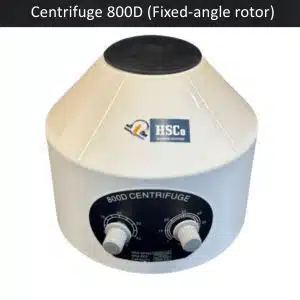
Fixed-angle rotors keep tubes at a steady angle, typically between 25° and 40°. This angle changes how particles move and settle inside the tube.
Because the tubes are angled, particles move quickly toward the outer wall, accelerating separation and making it more effective. This is why people think fixed-angle rotors are fast.
When They Are Most Useful
2. Making lifting operations safer
Fixed-angle rotors are great for the following uses:
- Pelleting cells, bacteria, yeast, or organelles
- Taking DNA and RNA out
- Precipitation of proteins
- Quick spin-downs after vertexing
- Applications that need high speed or ultra speed
Why Labs Like Them
- Faster separations because the pellet forms quickly
- Faster than swing-bucket rotors
- Better for pellets that are small and dense
- Usually stronger and more stable
A Short Example from Real Life
A fixed-angle rotor is the best tool for isolating genomic DNA and making a tight pellet at the bottom of the tube. It’s quick, dependable and gives clear results.
Swing-Bucket Rotors: Great for Even Layering, Flexible, and Versatile
How They Work
When the rotor is still, swing-bucket rotors start in a vertical position. The buckets swing out to the side as the centrifuge begins to spin. This movement makes the path longer for particles to travel, which can be useful in some situations.
Because the tubes swing to a true horizontal position while they spin, the samples spread out evenly along the length of the tube. This is very helpful when you need to work with gradients or make precise layers.
Where They Really Shine
Swing-bucket rotors are great for:
- Centrifugation with a density gradient
- Separating blood samples
- Processing large amounts of
- Work with cell cultures
- Apps that need clear, straight lines of separation
Why Labs Pick Them
- Better separation for samples with layers
- Can hold tubes of many different sizes and shapes
- Great for soft, controlled separations
- Good for bigger sample sizes
A Real-Life Example
A swing-bucket rotor is the right tool for processing blood bags or using Ficoll gradients to separate PBMCs. It makes smooth separation layers without affecting the sample.
A Simple Comparison of Fixed-Angle and Swing-Bucket Rotors
Fixed-Angle Rotor vs Swing-Bucket Rotor
- Tube Position: Set at a steady angle / Changes to horizontal during spin
- Speed Limit: Faster speeds / Average speeds
- Best For: Pelleting, quick spins, DNA/RNA / Gradients, layering, blood samples
- Pellet Quality: Small, tight pellet / Soft pellet, spread out along the bottom
- Sample Volume: Small to medium / Medium to large
- Flexibility: Not as useful / Very flexible
It’s easier to tell which rotor is made for which kind of work after this quick comparison.
How to Choose the Right Rotor for Your Lab
The best rotor for you depends on what you plan to do with it most of the time. This is a simple guide to help you choose.
Pick a Fixed-Angle Rotor If You:
- Isolate DNA, RNA, or proteins
- Often pellet cells or tiny living things
- Need fast performance
- Want things to happen quickly
- Handle samples of small to medium size
Choose a Swing-Bucket Rotor If You:
- Work with serum, plasma, or blood
- Run density gradients
- Need clean layers of separation
- Handle samples with high volume
- Want to use different tube sizes
Many centrifuges let you switch between rotor types so that you can do both kinds of work in your lab.
Common Mistakes to Avoid When Choosing a Rotor
Mistake 1: Only Looking at Speed
It doesn’t matter how fast the RPM is if the rotor type doesn’t work for your needs. For instance, gradients don’t do well at high speeds; they need stability.
Mistake 2: Picking Based Only on Price
Choosing a less expensive option now could limit what your lab can do later.
Mistake 3: Not Paying Attention to Tube Capacity
Some fixed-angle rotors can’t hold blood bags or tubes that are too big. First, check whether they work together.
Mistake 4: Not Thinking About Future Needs
Choose a rotor that can handle the growth if your lab plans to do more molecular or clinical work.
Advice on Choosing the Right Centrifuge and Rotor Combo
- Choose the right rotor type for the tasks you do most often
- Not just RPM, but also maximum RCF
- Find rotors that can handle tubes of different sizes
- Think about how much space and noise you need
- Pick a model that makes it easy to put on and take off the rotor
- Check whether replacement rotors and parts are in stock
These little things can make lab work go much more smoothly every day.
Conclusion
It doesn’t have to be hard to choose between a swing-bucket rotor and a fixed-angle rotor. Once you know how they work, the choice is surprisingly easy because each rotor has a clear purpose. If you want to spin fast and get tight pellets, a fixed-angle rotor is the best choice.
For clean layers, gradients, and big volumes, a swing-bucket rotor is the best choice. Think about the samples you have, how you work and what kind of results you want. Your centrifuge works better, and your experiments are more reliable when you use the right rotor for the right job.
FAQs
Can I buy one centrifuge and use both kinds of rotors?
Yes. Many centrifuges can use different rotors, but you should always check compatibility before you buy.
Which rotor works better with blood samples?
Swing-bucket rotors are the best choice because they make smooth, horizontal separation layers.
Do fixed-angle rotors always spin faster?
Yes, most of the time. They are made to work better at higher RCF and make pellets faster.
Which rotor is better for getting DNA out?
Most of the time, a fixed-angle rotor is better because it quickly makes a tight pellet.
Is it harder to take care of swing-bucket rotors?
Not really; all they need is for their hinges and buckets to be cleaned. Routine care is easy and quick.