

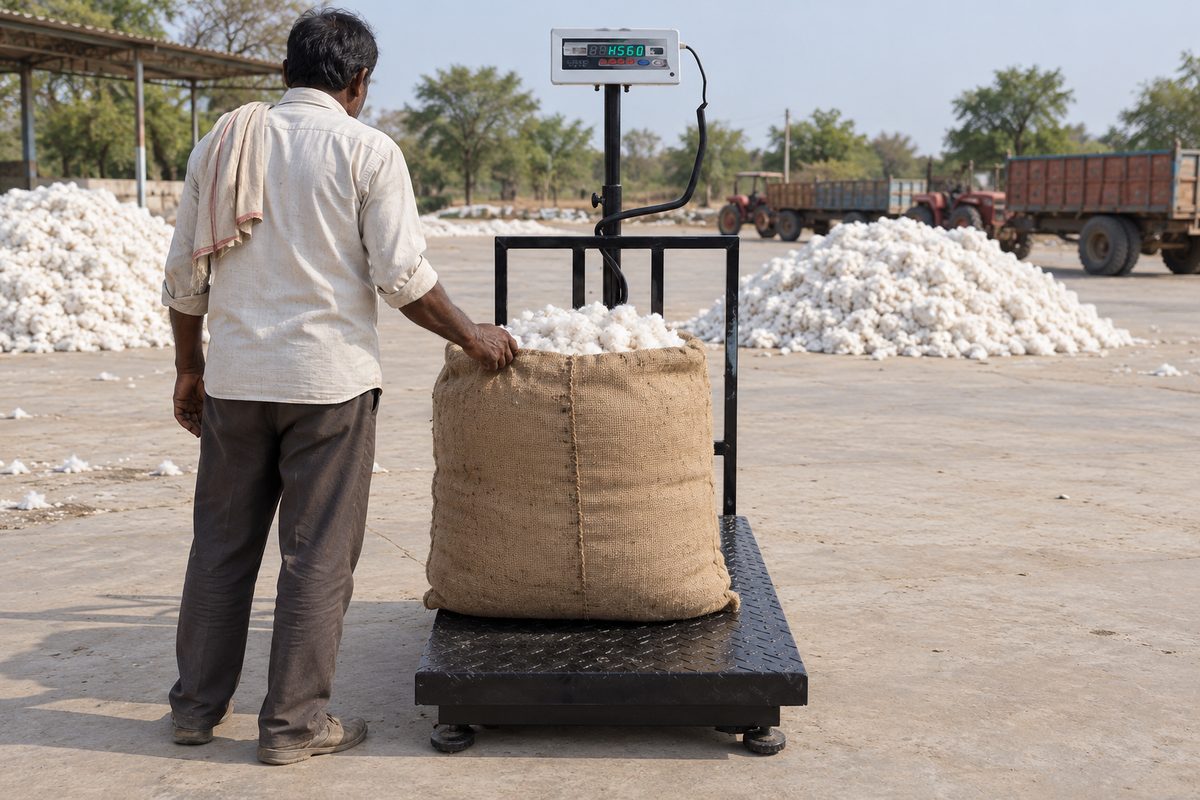
Fibre2Fashion reported on 3 August 2026 that the 2026-27 cotton MSP order keeps 8% as the base cotton moisture for kapas, with proportionately lower prices from above 8% up to 12%, incentives below 8%, and no MSP buying above 12% [2]. At one CCI centre in 2025-26, Navbharat Live reported prices that work out to about 1% of the rate per point of moisture [4]. On the ₹8,667 long staple rate [1], that is an illustrative ₹86.67 a quintal per point.
IANS reported on 28 September 2026 that Gujarat cotton farmers had until 31 October 2026 to register on the Kapas Kisan app of the Cotton Corporation of India (CCI) for 2026-27 MSP sales [3]. Fibre2Fashion reported on 3 August 2026 that CCI would buy from 1 October 2026 whenever market prices fell below MSP [2].
What is the cotton moisture limit for MSP in 2026-27?
The base is 8%, and the ceiling for MSP buying is 12%, according to Fibre2Fashion’s report on the 2026-27 order [2]. Fibre2Fashion also reported that kapas with moisture above 8% and up to 12% receives proportionately lower prices, and that kapas below 8% qualifies for incentives [2].
Fibre2Fashion reported 2026-27 rates from ₹7,767 a quintal for short staple to ₹9,867 for Suvin, an extra long staple; the rate depends on staple length and micronaire [2]. The two benchmark rates are ₹8,267 for medium staple and ₹8,667 for long staple, each ₹557 more than in 2025-26 [1].
How much does each point of moisture above 8% cost?
About 1% of the rate on average, going by one CCI centre’s prices in 2025-26. Navbharat Live reported on 14 November 2025, from a CCI centre at Anjangaon Surji in Maharashtra, that the price set for kapas at 8% moisture was ₹8,010 a quintal and for kapas at 12% was ₹7,689 [4]. That is about 4% less for 4 points. The table below assumes the same 1% cut at every point.
Illustrative rate at m% moisture = MSP × (100 − (m − 8)) ÷ 100, with m = 9 for 9%
| Moisture | Illustrative rate per quintal | Less than at 8% |
|---|---|---|
| 8% | ₹8,667 | – |
| 9% | ₹8,580 | ₹87 |
| 10% | ₹8,494 | ₹173 |
| 11% | ₹8,407 | ₹260 |
| 12% | ₹8,320 | ₹347 |
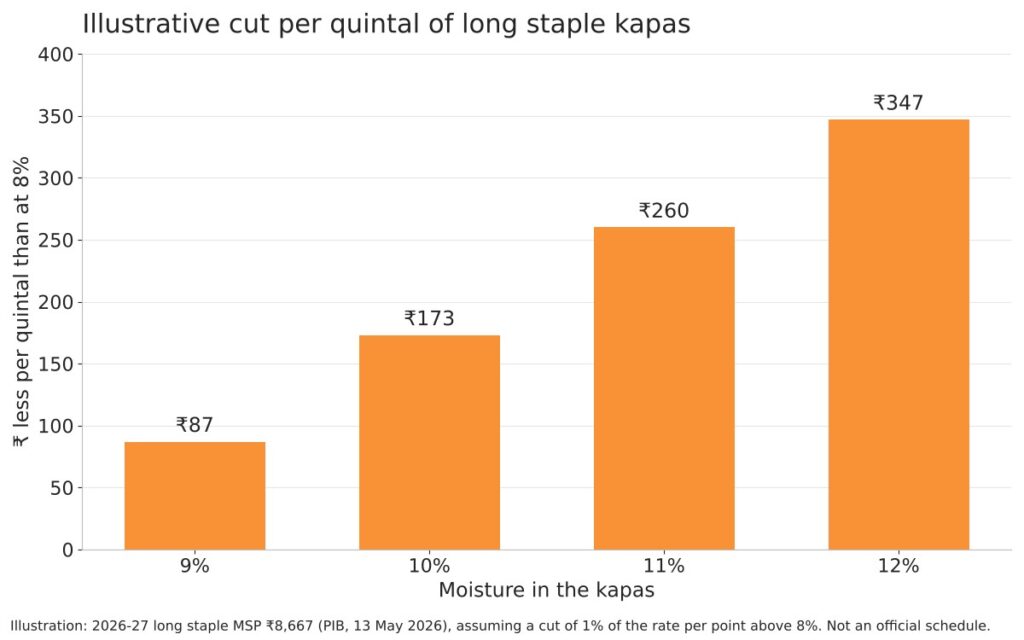
Take two lots of 25 quintals, one at 12% and one at 8%. On this assumed schedule the 12% lot fetches about ₹8,667 less (25 × ₹346.68).
Does drying kapas from 12% to 8% pay?
Drying takes water out, so the lot weighs less. This worked example assumes moisture read on a wet basis, as a share of total weight, and that only water leaves.
Weight at 8% = weight now × (100 − moisture now) ÷ 92
| Moisture now | 100 kg dries to | Water that leaves |
|---|---|---|
| 9% | 98.91 kg | 1.09 kg |
| 10% | 97.83 kg | 2.17 kg |
| 11% | 96.74 kg | 3.26 kg |
| 12% | 95.65 kg | 4.35 kg |
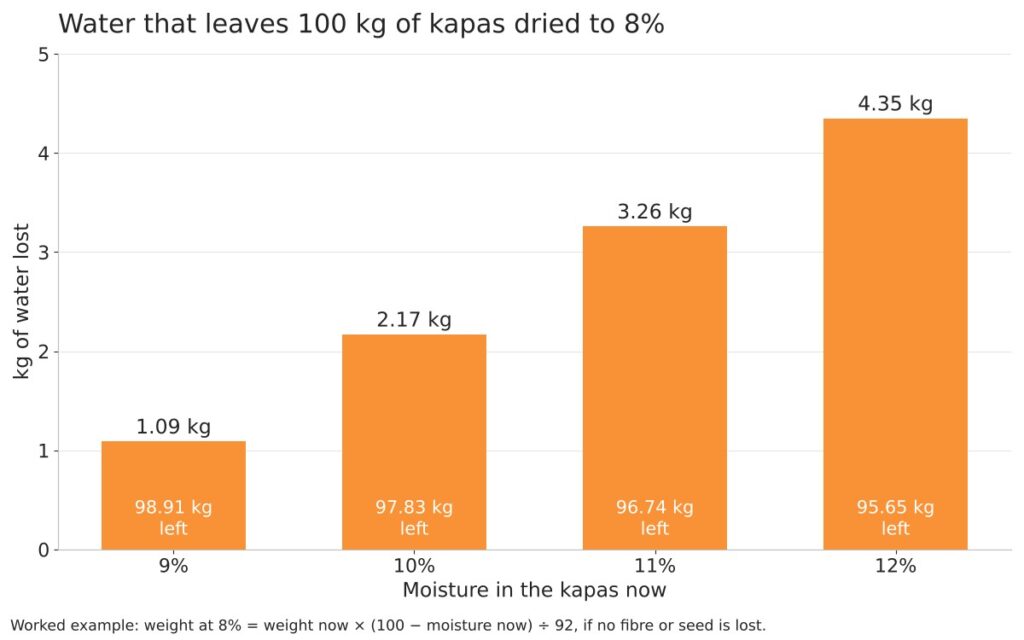
For 100 kg of long staple kapas at 12%, selling as it is fetches about ₹8,320, and drying to 8% leaves about 95.65 kg worth about ₹8,290 at ₹86.67 a kg. On these assumptions, and before drying costs, drying this 12% lot to 8% returns about ₹30 less per 100 kg, because the 4% price cut is smaller than the 4.35% weight lost. On the same basis, drying a 10% lot to 8% returns about ₹15 less. Under the 12% limit Fibre2Fashion reported, a lot above 12% is not accepted at MSP until its moisture is 12% or below [2].
How do you check kapas moisture and weight before the centre does?
Fibre2Fashion reported that procurement agencies have been directed to assess micronaire and other fibre quality parameters scientifically at purchase centres [2]. These pre-checks are our suggestions; CCI’s own test procedure may differ.
- Sample kapas from the top, middle and bottom of the heap.
- Note which basis your meter reads. A halogen moisture analyzer weighs the sample, dries it with a halogen heater and gives the moisture in minutes instead of hours in an oven [9]. Its reading may still differ from the centre’s method.
- Weigh the lot on a scale with a valid Legal Metrology stamp. Section 24 of the Legal Metrology Act, 2009 requires a weight or measure used in a transaction to be verified before use [5]. Under Rule 27(1) of the Legal Metrology (General) Rules, 2011, an electronic platform scale used in a transaction must be verified and stamped, and Rule 27(2)(c) sets its re-verification period at 12 months [6, 10, 11].
- Note the moisture and weight at loading, to compare with the purchase slip.
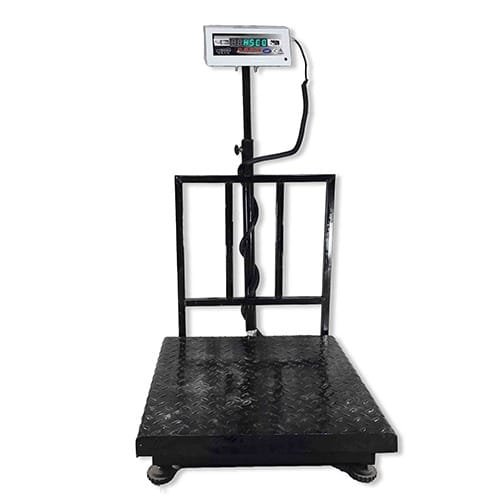
Which HSCo scales and analyzer fit a cotton purchase centre?
Our suggestions for weighing at the yard and lab moisture checks:
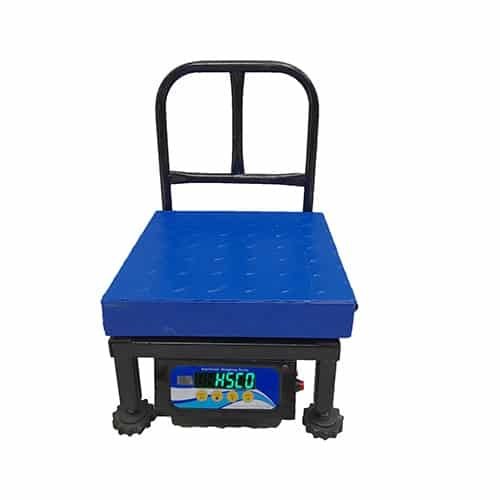


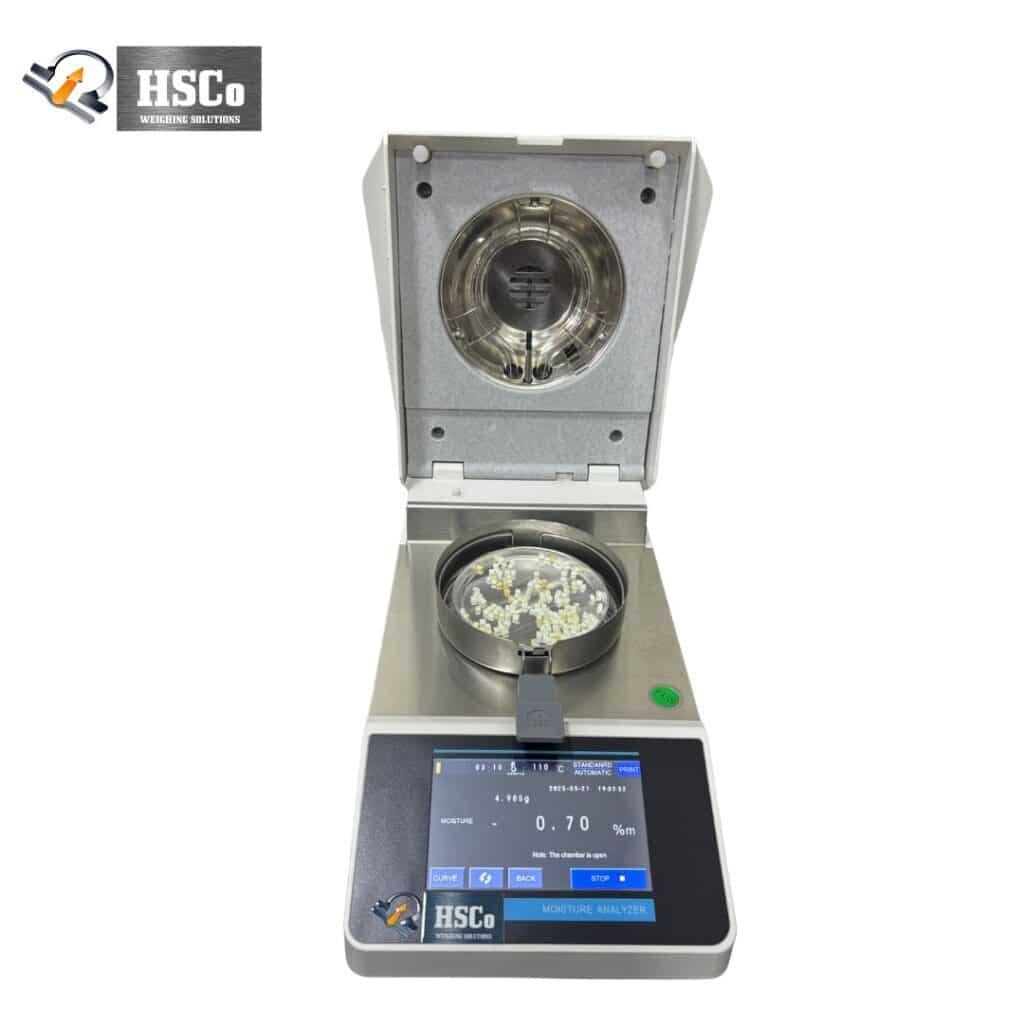
More farm and mandi scales are on our weighing scales for agriculture page, and our guide to stamping explains the stamp. Tell us what you weigh and how many trolleys a day by calling +91-7045922250 or writing to hsc@hindustanscale.com.
Frequently asked questions
What is the moisture limit for selling cotton at MSP?
Fibre2Fashion reported on 3 August 2026 that, for the 2026-27 cotton MSP, the base moisture for kapas stays at 8%. Fibre2Fashion also reported that kapas above 8% and up to 12% gets proportionately lower prices, kapas below 8% qualifies for incentives, and kapas above 12% is not accepted under MSP procurement [2]. Moisture is one condition; MSP rates also depend on staple length and micronaire [2].
What is the cotton MSP for 2026-27?
The 2026-27 cotton MSP benchmark rates are ₹8,267 a quintal for medium staple kapas and ₹8,667 a quintal for long staple kapas, each ₹557 higher than in 2025-26 [1]. Fibre2Fashion reported rates for the other classes from ₹7,767 a quintal for short staple to ₹9,867 for Suvin, an extra long staple; the rate depends on staple length and micronaire [2].
How much weight does kapas lose when it dries from 12% to 8% moisture?
With moisture read on a wet basis and only water leaving, kapas at 12% moisture loses about 4.35 kg of water in every 100 kg as it dries to 8%, leaving about 95.65 kg. The weight at 8% is the weight now multiplied by (100 minus the moisture now) and divided by 92. On the same basis, kapas at 10% loses about 2.17 kg per 100 kg.
How do cotton farmers register to sell at MSP in 2026-27?
IANS reported on 28 September 2026 that Gujarat cotton farmers had until 31 October 2026 to register on the Kapas Kisan app of the Cotton Corporation of India for 2026-27 MSP sales [3]. Rules and dates can differ by state, so ask your nearest procurement centre.
Sources
- Press Information Bureau, “Cabinet approves Minimum Support Prices (MSP) for Kharif Crops for Marketing Season 2026-27” (pib.gov.in, 13 May 2026).
- Fibre2Fashion, “India fixes cotton MSPs; Suvin gets highest support at $103/quintal” (fibre2fashion.com, 3 August 2026).
- Free Press Journal (IANS), “Gujarat Cotton Farmers Can Register For MSP Sales Till October 31” (freepressjournal.in, 28 September 2026).
- Navbharat Live, “अंजनगांव सुर्जी में CCI द्वारा कपास खरीद की उत्साहपूर्ण शुरुआत,किसानों में संतोष की भावना” (navbharatlive.com, 14 November 2025). In Hindi
- India Code, Government of India, “The Legal Metrology Act, 2009, Section 24” (indiacode.nic.in).
- Legal Metrology Department, Government of Meghalaya, “The Legal Metrology (General) Rules, 2011, Rule 27” (megweights.gov.in). Gazette text of 2011
- Hindustan Scale Company, “PLCHQB Platform Scale 500/1000 kg, Chequered” (hindustanscale.com).
- Hindustan Scale Company, “Mobile Platform Scale PLCHQCHI, on Wheels” (hindustanscale.com).
- Hindustan Scale Company, “MA110.5E Halogen Moisture Analyzer 110 g” (hindustanscale.com).
- Department of Consumer Affairs, Government of India, “Legal Metrology (General) (Amendment) Rules, 2021 (G.S.R. 149(E)), substituting Rule 27(1)” (consumeraffairs.gov.in, 3 March 2021).
- Ministry of Consumer Affairs, Food and Public Distribution, “Legal Metrology (General) Seventh Amendment Rules, 2025 (G.S.R. 905(E)), substituting Rule 27(2)(a)” (18 December 2025). Gazette of India, Extraordinary, Part II, Section 3(i), No. 819, 18 December 2025