


A courier weight discrepancy is the extra charge raised when the courier’s own weighing or measuring of your parcel comes out higher than the details you booked. To avoid it, weigh the sealed parcel and measure the packed box before handover, enter both figures correctly, and keep dispatch photos in case the charge still arrives. The courier bills the higher of the actual weight and the volumetric weight, and its rate card rounds that up to a billing step, such as 500 g.
The big online festive sales begin on 8 October 2026, one of them with early access for members that day [1, 2]. Our page on weighing scales for warehouse, shipping and e-commerce covers which scale suits each packing station; this guide works through the courier’s arithmetic and the dispute itself.
How does a courier work out the weight it bills?
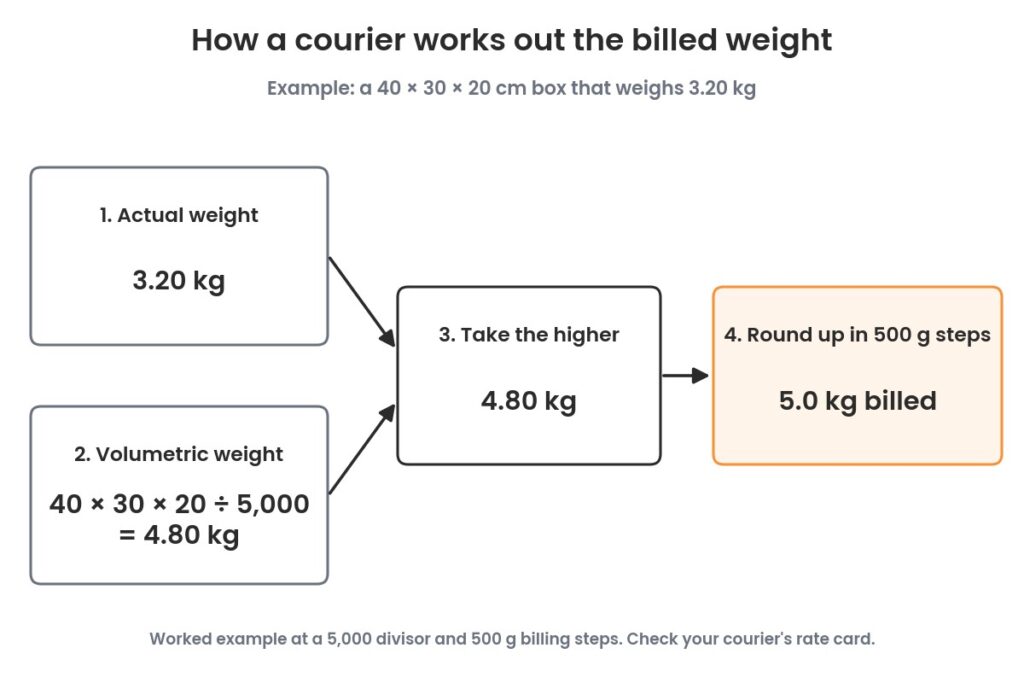
The courier compares the actual weight of the packed parcel, with box, filler and tape, against its volumetric weight, which prices the space the box takes up:
Volumetric weight (kg) = length × breadth × height (cm) ÷ 5,000
One large Indian courier divides by 5,000 for both its surface and express parcels [3]. The divisor varies by courier and service, and a smaller one makes the same box count as heavier, so check the rate card for every service you book [4, 5].
You pay for the higher figure [3, 4], rounded up to the rate card’s billing step: with 500 g steps, a parcel of 0.62 kg is billed as 1 kg. Some services set a higher minimum, and one large courier charges flyer packets up to 1 kg on actual weight alone [3, 6].
Why does a courier weight discrepancy happen?
The causes are ordinary packing habits [7, 8]:
- The weight is copied from the product listing, without the box, the bubble wrap and the tape.
- The carton bulges once it is filled, so the packed box measures bigger than the empty one.
- Dimensions are rounded down, or taken from the empty carton instead of the packed parcel.
- The scale has drifted, or nobody set it to zero before the parcel went on.
The courier weighs and measures the parcel again at its hub, and a higher figure is billed to your account as a courier weight discrepancy [3, 7].

How do box size and billing steps change the charge?
Here are three boxes worked out at a 5,000 divisor and 500 g billing steps:
| Box (cm) | Actual weight | Volumetric weight | Billed weight |
|---|---|---|---|
| 20 × 15 × 10 | 0.62 kg | 0.60 kg | 1.0 kg |
| 30 × 25 × 10 | 1.10 kg | 1.50 kg | 1.5 kg |
| 40 × 30 × 20 | 3.20 kg | 4.80 kg | 5.0 kg |
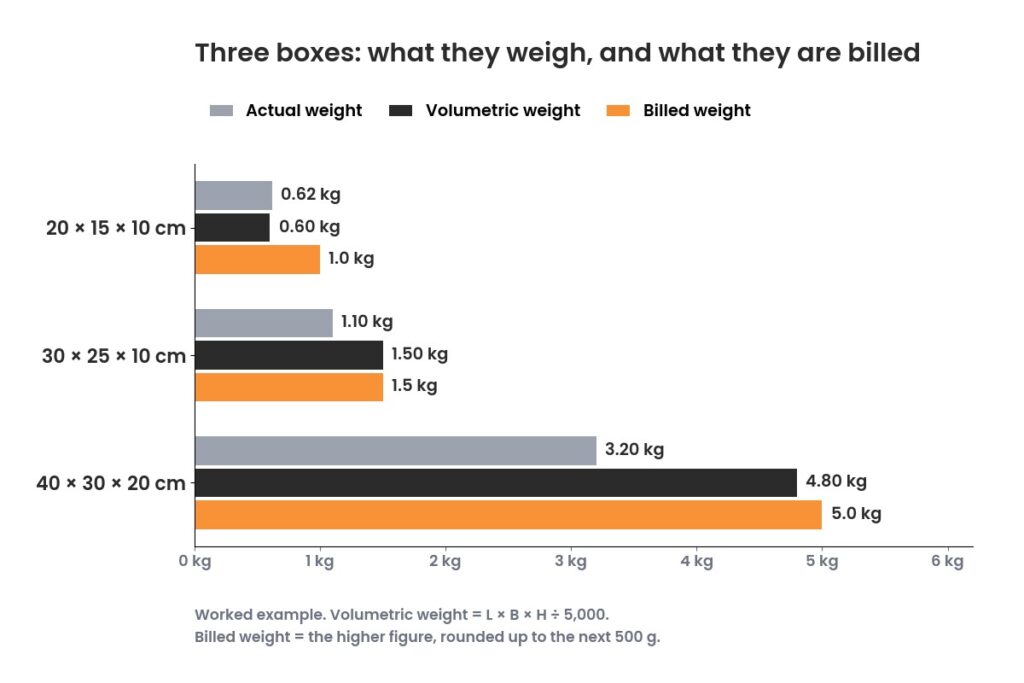
In the last row the parcel weighs 3.2 kg but takes up the space of 4.8 kg, so it is correctly billed as 5.0 kg; the box size drove the charge. In the first row both figures sit just above 500 g. Packing that brings both to 500 g or less halves the billed weight; a 20 × 12.5 × 10 cm box, for example, is exactly 0.5 kg volumetric.
What evidence supports a courier weight discrepancy dispute?
Couriers ask for the packed parcel’s weight, its dimensions and photos of the package, and they set deadlines for raising a dispute [3, 6, 8]. Build these steps into packing:
- Set the scale to zero with nothing on it, then weigh the sealed parcel, not the product alone.
- Measure the packed box at its widest points in centimetres, and round up.
- Enter the packed weight and the measured dimensions in their own booking fields; the booking system works out the chargeable weight.
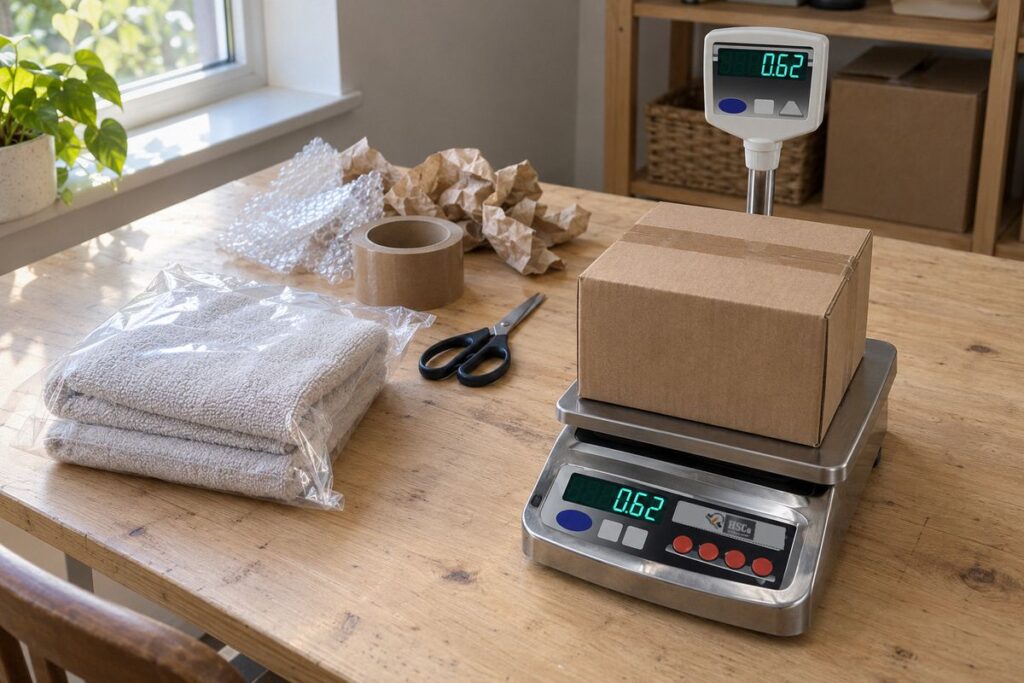
- Photograph the parcel on the scale with the reading and the shipping label in one frame, then the tape against each side.
- When a discrepancy notice lands, raise the dispute with these photos inside the courier’s window, which can be as short as seven days, and keep the files by AWB or order number until the case is closed [6, 8].
A dispute photo needs an accurate scale in it. Section 24 of the Legal Metrology Act, 2009 requires a weighing instrument used in any transaction to be verified before it is put to use [9, 10], and Rule 27 of the Legal Metrology (General) Rules, 2011 requires an electronic scale to be re-verified every 12 months [11]. Keep the current stamping certificate with your dispute records. Every new Hindustan Scale Company (HSCo) scale ships with one year of Legal Metrology stamping, and we arrange re-verification anywhere in India (what government stamping is and why it matters) [12].
Which HSCo scale fits a packing table?
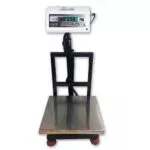
HSCo makes table-top, platform and roller scales for packing tables and dispatch lines. Choose by your heaviest parcel and how many you pack in a day.



For scales across the rest of a transport business, see weighing scales for logistics and transport. Tell us your heaviest parcel and your daily volume: call +91-7045922250 or write to hsc@hindustanscale.com.
Frequently asked questions
Do all couriers use 5,000 to work out volumetric weight?
Couriers do not all use the same volumetric divisor. One large Indian courier divides length × breadth × height in centimetres by 5,000 for surface and express parcels; others use different figures, listed in their rate cards. A smaller divisor makes the same box count as heavier.
Is a 10 g difference worth worrying about?
A 10 g difference matters when it crosses a billing step. With 500 g steps, a chargeable weight of 1.50 kg is billed as 1.5 kg and 1.51 kg as 2 kg. Weighing to the gram shows when lighter filler or a smaller box keeps a parcel inside its step.
What evidence helps in a courier weight dispute?
Couriers ask for the packed parcel’s weight, its dimensions and photos of the package, and the dispute window can be as short as seven days. Photograph the parcel on the scale with the reading and the shipping label in one frame, plus the tape against each side, and file the photos by AWB.
Does a parcel scale need a Legal Metrology stamp?
Section 24 of the Legal Metrology Act, 2009 requires a weighing instrument used in a transaction to be verified before use, and Rule 27 of the Legal Metrology (General) Rules, 2011 requires an electronic scale to be re-verified every 12 months. Every new HSCo scale ships with one year of stamping.
Sources
- Amazon India newsroom, “When is Amazon Great Indian Festival 2026? Dates revealed” (aboutamazon.in).
- Flipkart, “Flipkart Announces Big Billion Days 2026” (stories.flipkart.com, 16 September 2026).
- Delhivery Help Centre, “Volumetric weight calculation” and “Weight dispute” (help.delhivery.com).
- Blue Dart, Conditions of Carriage (bluedart.com).
- DTDC, Support Service Guide (dtdc.com).
- Shiprocket, weight discrepancy SOP (sites.google.com/shiprocket.com).
- Shiprocket, “How Shiprocket handles weight discrepancies” (shiprocket.in).
- Shipmozo, terms and conditions on weight disputes (shipmozo.com).
- India Code, The Legal Metrology Act, 2009 (official PDF).
- Department of Consumer Affairs press note of 6 May 2014 quoting Section 24(1), hosted by the Ministry of Food Processing Industries (official PDF).
- The Legal Metrology (General) Rules, 2011, Rule 27(2): re-verification every 12 months for electronic weighing instruments.
- Hindustan Scale Company, “What Is Government Stamping And Why Is It So Important?” (hindustanscale.com).