

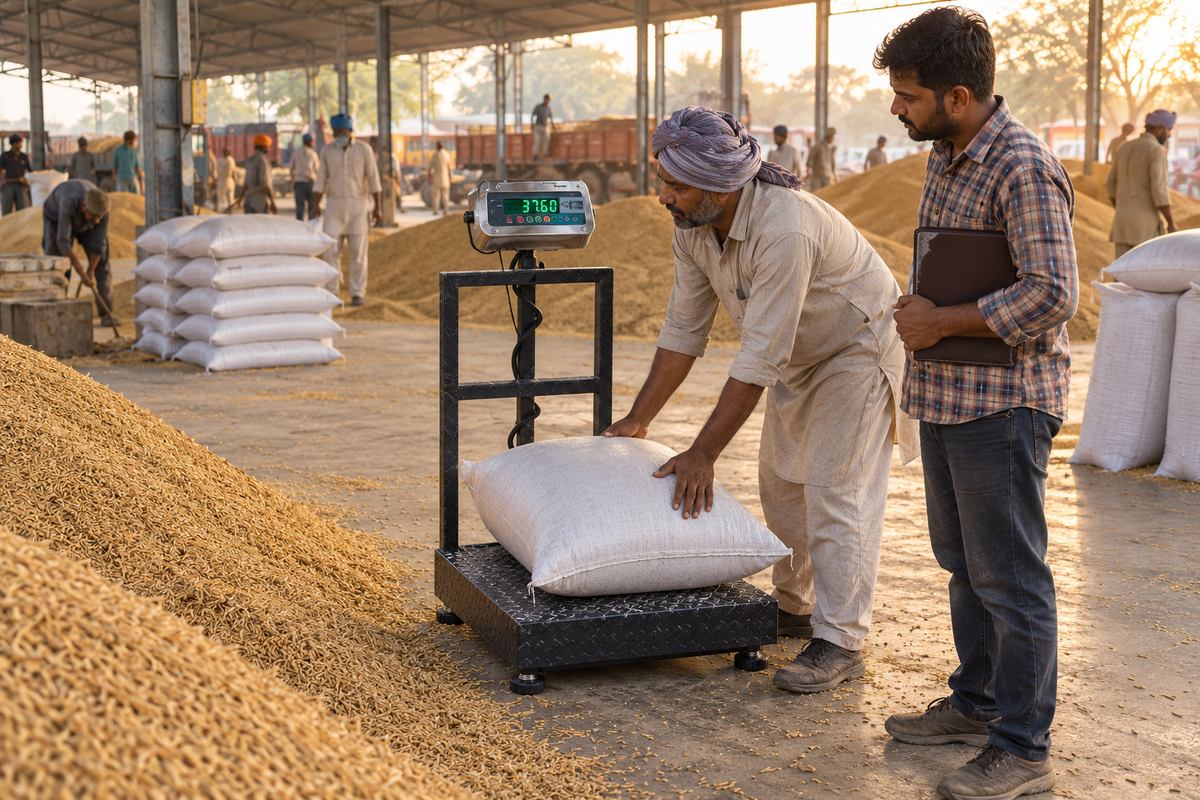
Government agencies in India buy paddy with up to 17% moisture [1, 2]. Wetter paddy has to dry before they will buy it, and drying takes weight off. A 100 kg lot at 20% paddy moisture weighs about 96.4 kg once it is down to 17%. Test the moisture at the heap before the paddy is bagged, and weigh it on a stamped scale.
Buying for the 2026-27 season opened in Haryana on 29 September 2026, two days earlier than planned [3, 4, 5], and in Punjab on 1 October [6, 7]. The minimum support price is ₹2,441 a quintal for common paddy and ₹2,461 for Grade A [8, 9]. Rain had delayed the harvest, and on the first day high moisture meant buying could not start at every grain market in Karnal district, The Tribune reported [5].
Why does paddy moisture decide whether it is bought?
The government’s uniform specification for paddy for the 2026-27 season asks for grain that is dry, clean and free from moulds and weevils. It sets 17% as the most moisture it accepts for both Grade A and common paddy, and its moisture test follows the Indian Standard IS 4333 (Part 2):2017 [1, 10].
A farmers’ union in Haryana has asked for the limit to be raised to 20%, saying combine-harvested paddy comes in wetter and many farmers cannot dry it, The Tribune reported [11].
How much weight does paddy lose when it dries to 17%?
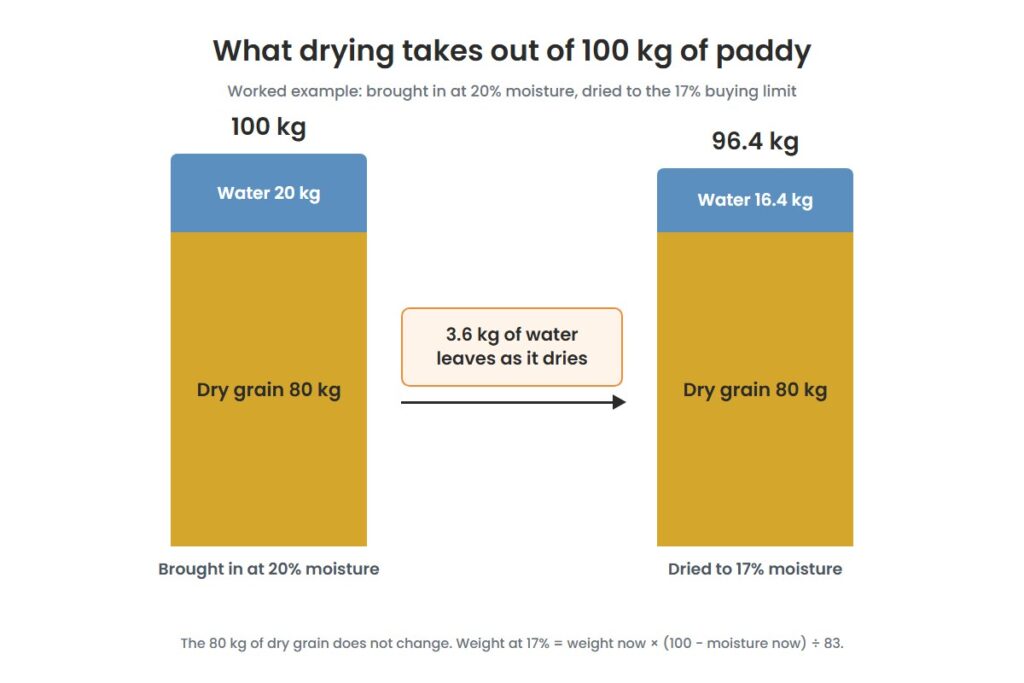
The working below assumes only water leaves, with no grain or handling losses, so the dry grain stays the same. Moisture is on a wet basis, meaning water as a share of the total weight. The weight after drying then follows:
Weight at 17% = weight now × (100 − moisture now) ÷ 83
For 100 kg at 20%, that is 100 × 80 ÷ 83 = 96.4 kg. The other 3.6 kg is water that leaves the heap as it dries.
| Moisture now | 100 kg dries to | Water that leaves | That weight at ₹2,441 a quintal, for comparison |
|---|---|---|---|
| 18% | 98.8 kg | 1.2 kg | ₹29 |
| 19% | 97.6 kg | 2.4 kg | ₹59 |
| 20% | 96.4 kg | 3.6 kg | ₹88 |
| 22% | 94.0 kg | 6.0 kg | ₹147 |
| 24% | 91.6 kg | 8.4 kg | ₹206 |
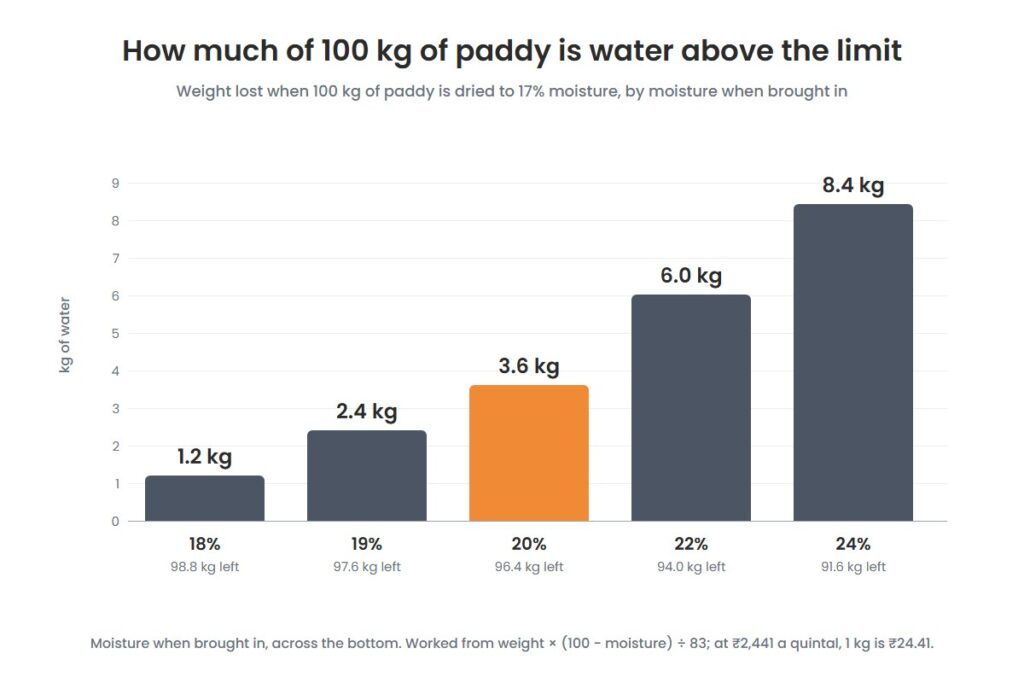
On a 100-quintal lot at 20%, drying to 17% takes off about 361 kg, which at ₹2,441 a quintal comes to ₹8,823. This is a comparison at one price, not a deduction or a drying charge. Under the specification, agencies do not buy paddy above 17%; a buyer who pays for wet paddy by weight at the dry-paddy rate pays for that water.
How is paddy moisture tested at the mandi and at the mill?
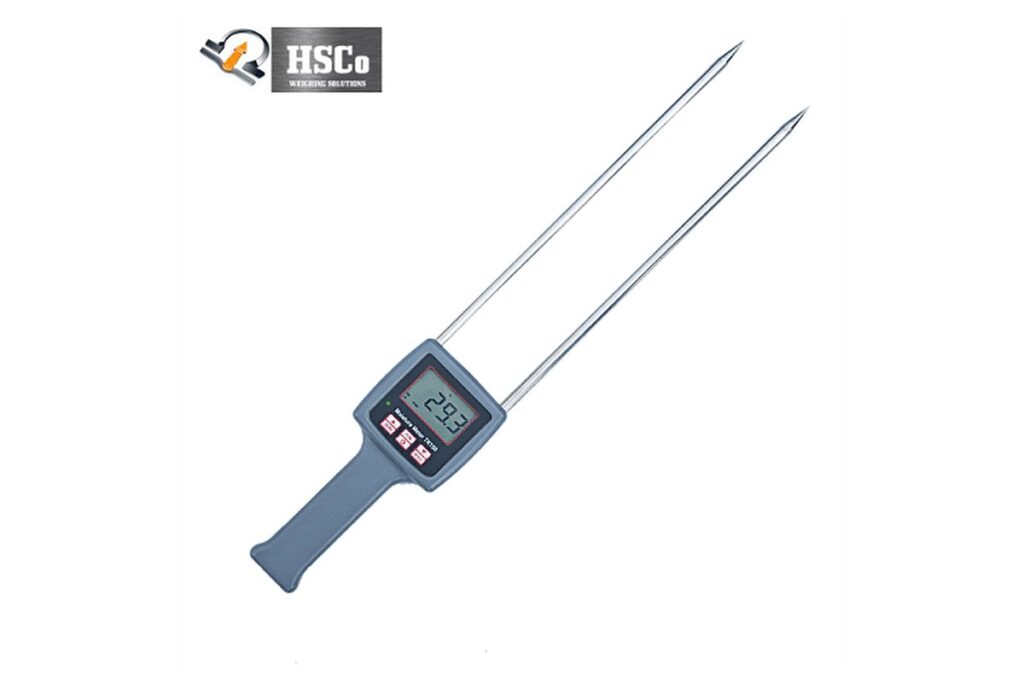
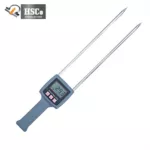
At the mandi the quick test is a hand-held meter. Its two probes go into the heap and the reading comes up in under a minute; the TK100 meter from Hindustan Scale Company (HSCo), sold for grain, hay and fibre materials, reads 0 to 80% in 0.1 steps, accurate to ±0.5% [12]. In Karnal district, officials were directed to check moisture at the grain-market entry gates this season, The Tribune reported [11].
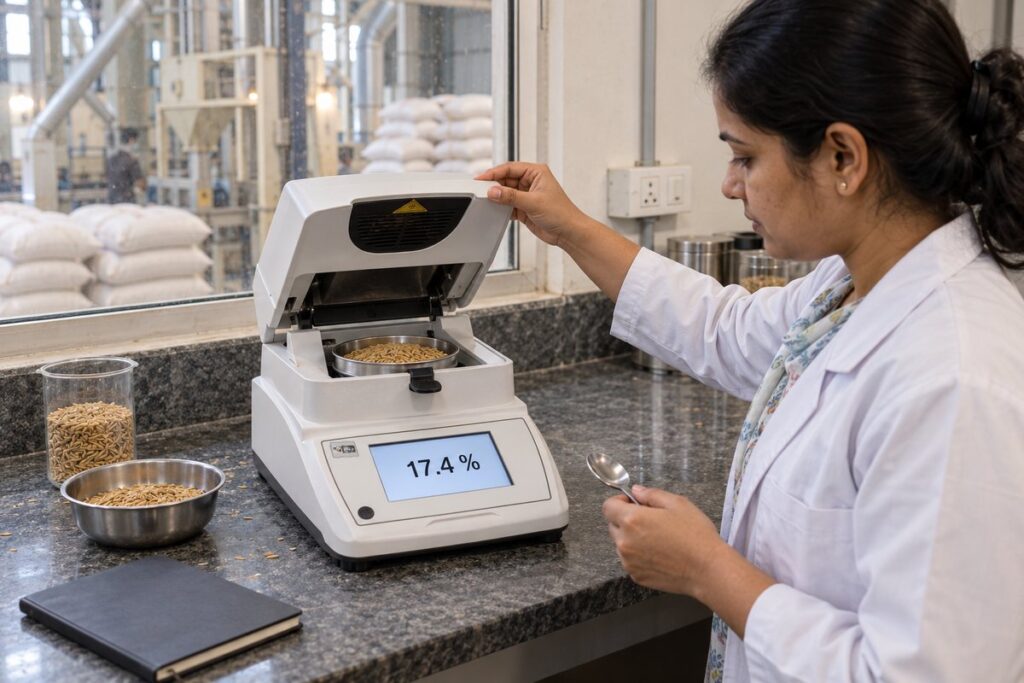
The Indian Standard IS 4333 (Part 2) measures moisture by weighing a sample, drying it in an oven and weighing it again; the weight lost is the moisture [10]. A halogen moisture analyser works on the same principle and gives a result in minutes. It weighs the sample, dries it under a halogen lamp and shows the moisture directly [13].
At the start of each season, check the hand-held meter, and the halogen analyser if the mill uses one, against oven results by the IS 4333 method on the same paddy samples. Take grain from the top, middle and bottom of the heap, not only from the surface.
How do you weigh paddy so the number holds up?
- Test the moisture first, then weigh. The same bag weighs less once it dries.
- Set the scale to zero with nothing on it, and weigh one empty bag of the same kind so its weight can be taken off.
- Put each bag fully on the platform with nothing touching it, and write the reading against the lot.
- Use a scale with a current Legal Metrology stamp.
Section 24 of the Legal Metrology Act, 2009 requires a weighing instrument used in a transaction to be verified before use [14], and Rule 27(2)(c) of the Legal Metrology (General) Rules, 2011 requires an electronic scale to be re-verified every 12 months [15]. Our post on government stamping explains the visit and the certificate, and mandi boards moving to electronic weighbridges can read our white paper Fair Weight Is Fair Price.
Which HSCo instruments fit a mandi or a rice mill?
HSCo makes an instrument for each check between the heap and the mill:

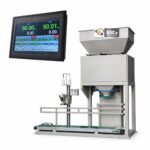
- HSC-FSBM filling scale: fills and weighs 10 to 50 kg bags, accurate to ±0.1% to ±0.5% depending on the product, at 200 to 600 bags an hour depending on the product and bag size. For bagging at the mill.


More scales for farms and grain stores are on our weighing scales for agriculture page. Tell us what you weigh and how many bags a day: call +91-7045922250 or write to hsc@hindustanscale.com.
Frequently asked questions
What is the paddy moisture limit in 2026?
Government agencies buy paddy with up to 17% moisture, for both Grade A and common paddy, under the uniform specification for the 2026-27 season [1]. A farmers’ union in Haryana has asked for 20%, The Tribune reported, but the buying limit this season is 17% [11].
Does drying paddy reduce its weight?
Yes. Drying takes water out while the dry grain stays the same, so the weight falls. Paddy at 20% moisture loses about 3.6 kg in every 100 kg as it dries to 17%, and paddy at 24% loses about 8.4 kg, if no grain is lost along the way.
How accurate is a hand-held moisture meter?
HSCo’s TK100 reads to ±0.5% moisture, with 0.1 resolution and automatic temperature compensation [12]. A probe meter reads the grain around its probes, so test several places in a heap, and check the meter against oven results by the IS 4333 method on the same samples at the start of the season.
Does a mandi scale need a Legal Metrology stamp?
Yes, when it is used to buy or sell. Section 24 of the Legal Metrology Act, 2009 requires verification before use, and Rule 27(2)(c) of the Legal Metrology (General) Rules, 2011 requires an electronic scale to be re-verified every 12 months [14, 15]. Every new HSCo scale ships with one year of stamping [18].
Sources
- Department of Food & Public Distribution, “Uniform specification of all varieties of paddy (Kharif Marketing Season 2026-27), letter No. 8-1/2022-S&I” (as circulated by the Government of Odisha, foododisha.in, 17 August 2026).
- Deputy Commissioner, Rupnagar, “Deputy Commissioner appeals to farmers to bring only dry paddy with moisture content up to 17 percent in the market” (rupnagar.nic.in, 22 September 2026).
- The Tribune, “Centre advances paddy procurement in Haryana by two days to September 29 amid farmers’ demand” (tribuneindia.com, 28 September 2026).
- UNI, “Centre allows Haryana to start Kharif procurement from Sept 29, reiterates safeguards against irregular purchases” (uniindia.com, 28 September 2026).
- The Tribune, “Paddy procurement begins in Haryana, high moisture content slows purchases” (tribuneindia.com, 30 September 2026).
- The Tribune, “Paddy purchase begins in Punjab amid storage space shortage” (tribuneindia.com, 1 October 2026).
- Government of Punjab press note, carried by Punjab News Express, “Food, Civil Supplies and Consumer Affairs Minister Lal Chand Kataruchak initiates paddy procurement from Batala Grain Market” (punjabnewsexpress.com, 1 October 2026).
- Press Information Bureau, “Cabinet approves Minimum Support Prices (MSP) for Kharif Crops for Marketing Season 2026-27” (pib.gov.in, 13 May 2026).
- Business Standard, “Govt raises paddy MSP by ₹72 to ₹2,441/quintal for 2026-27 Kharif season” (business-standard.com, 13 May 2026).
- Bureau of Indian Standards, “IS 4333 (Part 2):2017, Methods of analysis for foodgrains: determination of moisture content”.
- The Tribune, “Karnal: Farmers seek 20% moisture limit for paddy procurement” (tribuneindia.com, 21 September 2026).
- Hindustan Scale Company, “TK100 hand-held moisture meter” (hindustanscale.com).
- Hindustan Scale Company, “MA110.1 halogen moisture analyser” (hindustanscale.com).
- India Code, “The Legal Metrology Act, 2009” (indiacode.nic.in).
- The Legal Metrology (General) Rules, 2011, “Rule 27(2)(c): re-verification every 12 months for weights and measures other than those in clauses (a) and (b)”.
- Hindustan Scale Company, “PLCHQB platform scale” (hindustanscale.com).
- Hindustan Scale Company, “HSC-FSBM filling scale / bagging machine” (hindustanscale.com).
- Hindustan Scale Company, “What Is Government Stamping And Why Is It So Important?” (hindustanscale.com).