
Blogs
Scrap weight by crane scale: what to record for every lift of a lot

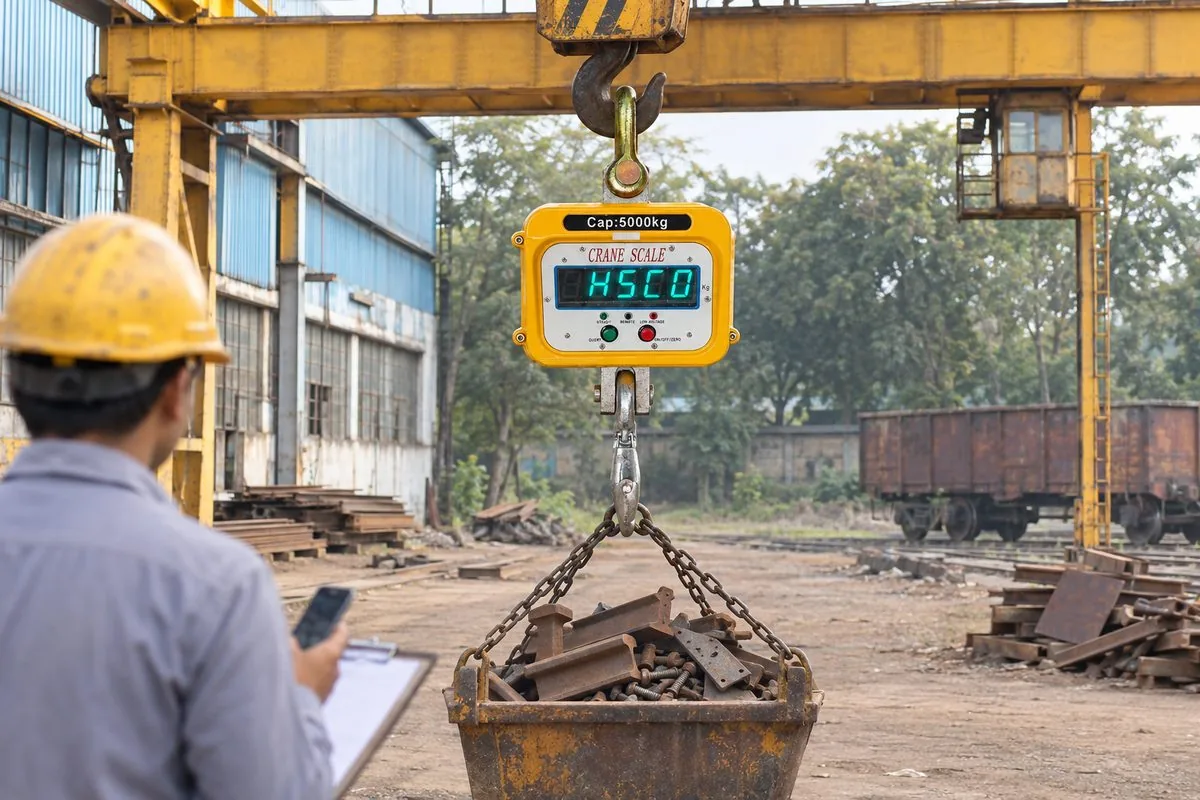
To check the scrap weight of a lot that leaves in several crane lifts, write one line per lift: the lift number, gross reading, tare of the bucket and chains, net weight and time. Add the net weights and match the number of lines to the number of lifts. In the worked example below, a 240 kg tare left in adds 1,440 kg to an 11,780 kg lot.
Indian Railways ran Special Campaign 6 from 2 to 31 October 2026 and earned ₹628.49 crore from scrap disposal against a target of ₹600 crore, the Ministry of Railways said in a release on 9 November 2026 [1]. Railway scrap is sold in lots, and the Railways’ own Stores Code says all materials sold shall be weighed or counted before delivery [2].
How do the Railways record the weight of scrap they sell?
The Stores Code asks the Stock Verifier to keep a Field Book with the lot number, description, rate, gross weight, actual tare, net weight and the purchaser’s details for each delivery [2]. The Stock Verifier and a Stores Supervisor supervise the weighment, a representative of the purchaser may attend, and an authorised representative of the Railway Protection Force should witness it [2].
The Code says non-ferrous scrap should be weighed on electronic weighing scales and the weight of each consignment recorded in detail [2]. For ferrous scrap, loaded wagons should pass over a weighbridge, and the scrap weight is the loaded weight less the tare marked on the wagon [2]. For a lot that takes several crane lifts, we suggest a scrap yard keep the same gross, tare and net columns, one line per lift.
What should you write down for each crane lift?
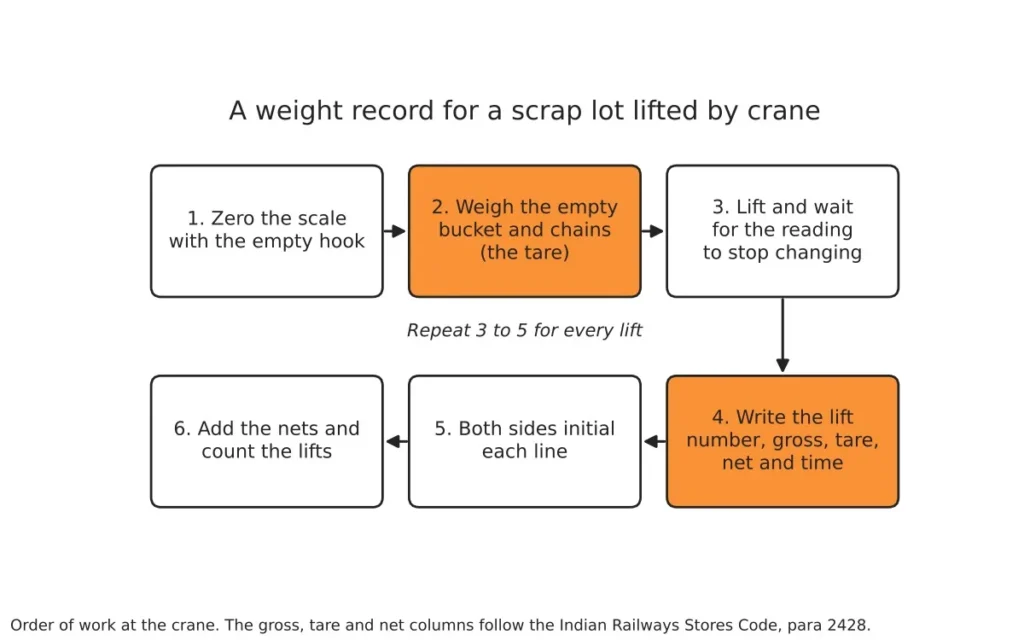
- The lot number and the lift number, written before the load goes up.
- The tare: the empty bucket and chains, or the sling, that hang below the scale. Weigh it once at the start, after zeroing the scale with the empty hook, and again if you change them.
- The gross reading, with the tare key not in use, taken when the load hangs still and the figure stops changing.
- The net weight, which is gross minus tare, worked out at the crane before the next lift.
- The time, and the initials of one person from each side.
- A last line with the number of lifts and the sum of the net weights.
If you press the tare key with the empty bucket and chains on the hook instead, the display goes to zero and every loaded reading is already net. Do not subtract the tare again. Write the tare once at the top of the sheet, so the buyer can check it.
How much can one missed line change the scrap weight?
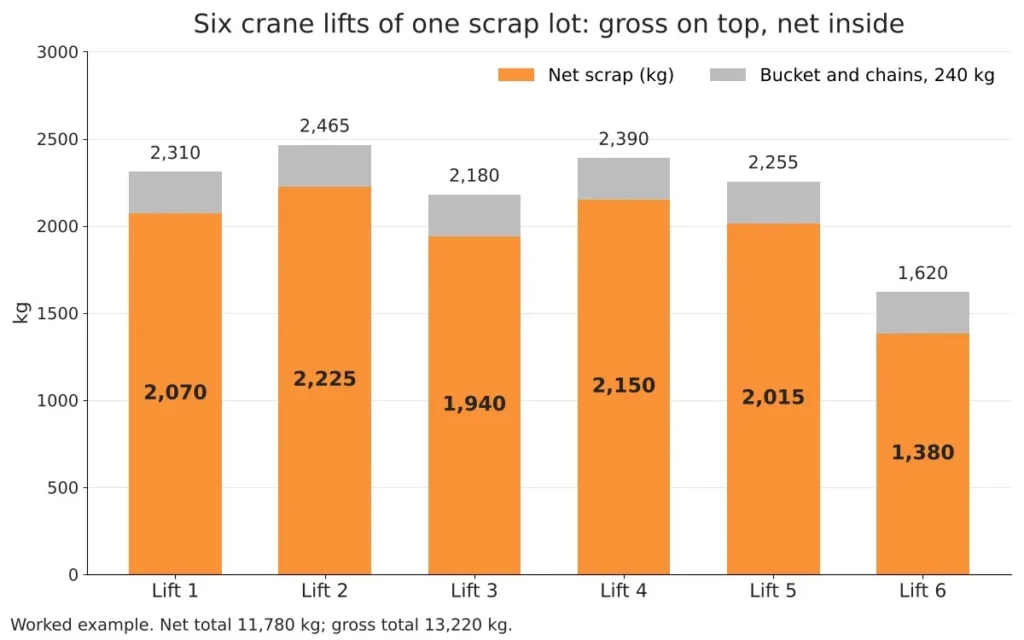
Take a lot that leaves in six lifts, in a bucket and chains that weigh 240 kg together.
| Lift | Gross reading | Tare | Net weight |
|---|---|---|---|
| 1 | 2,310 kg | 240 kg | 2,070 kg |
| 2 | 2,465 kg | 240 kg | 2,225 kg |
| 3 | 2,180 kg | 240 kg | 1,940 kg |
| 4 | 2,390 kg | 240 kg | 2,150 kg |
| 5 | 2,255 kg | 240 kg | 2,015 kg |
| 6 | 1,620 kg | 240 kg | 1,380 kg |
| Total, 6 lifts | 13,220 kg | 1,440 kg | 11,780 kg |
Net weight of the lot = sum of gross readings − (number of lifts × tare) = 13,220 − (6 × 240) = 11,780 kg
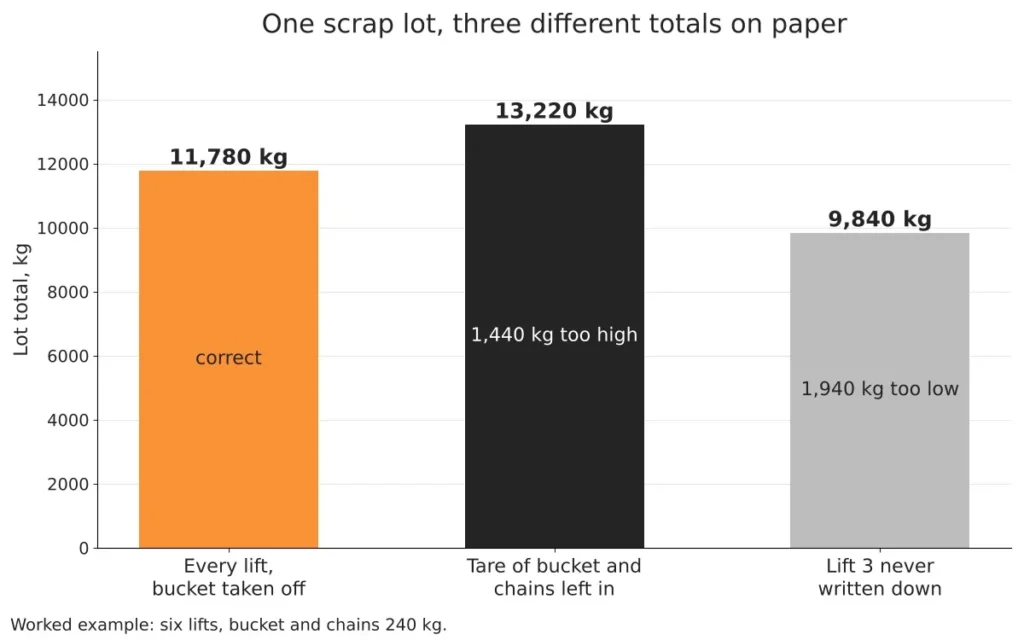
Forget to take off the 240 kg tare and the lot reads 13,220 kg, which is 1,440 kg or 12.2% more scrap than the buyer gets. Miss lift 3 on the sheet and the lot reads 9,840 kg, which is 1,940 kg short for the seller. Counting the lifts catches a missing line. Checking that each line takes off the 240 kg tare once catches the other error.
Does a crane scale used to sell scrap need a stamp?
Yes. Rule 27 of the Legal Metrology (General) Rules, 2011 says every weight or measure used in a transaction shall be verified and stamped, and re-verified at periodical intervals [3]. A crane scale falls in the rule’s general class, which is re-verified every twelve months [3]. A scale repaired before its due date must be re-verified and stamped before it is used again [3]. Ask to see the stamp and its date before the first lift. Our post on government stamping explains how stamping works.
Which HSCo scale fits scrap lifted by crane?
Pick a crane scale rated above the scrap, bucket and chains together, since taring the bucket adds no capacity. Use a platform scale for scrap weighed on the ground.
 CRHBT5K Bluetooth crane scale: weighs up to 5,000 kg in 1 kg steps and can send weights to the HSCo Android app over Bluetooth, with a jumbo display and a hand remote that works up to 10 m [4].
- CRHBT20K Bluetooth crane scale: weighs up to 20,000 kg with 5 kg accuracy, with the same Bluetooth link to the HSCo Android app and a hand remote that works up to 10 m [5]. Pick it when scrap, bucket and chains together weigh more than 5,000 kg and no more than 20,000 kg.
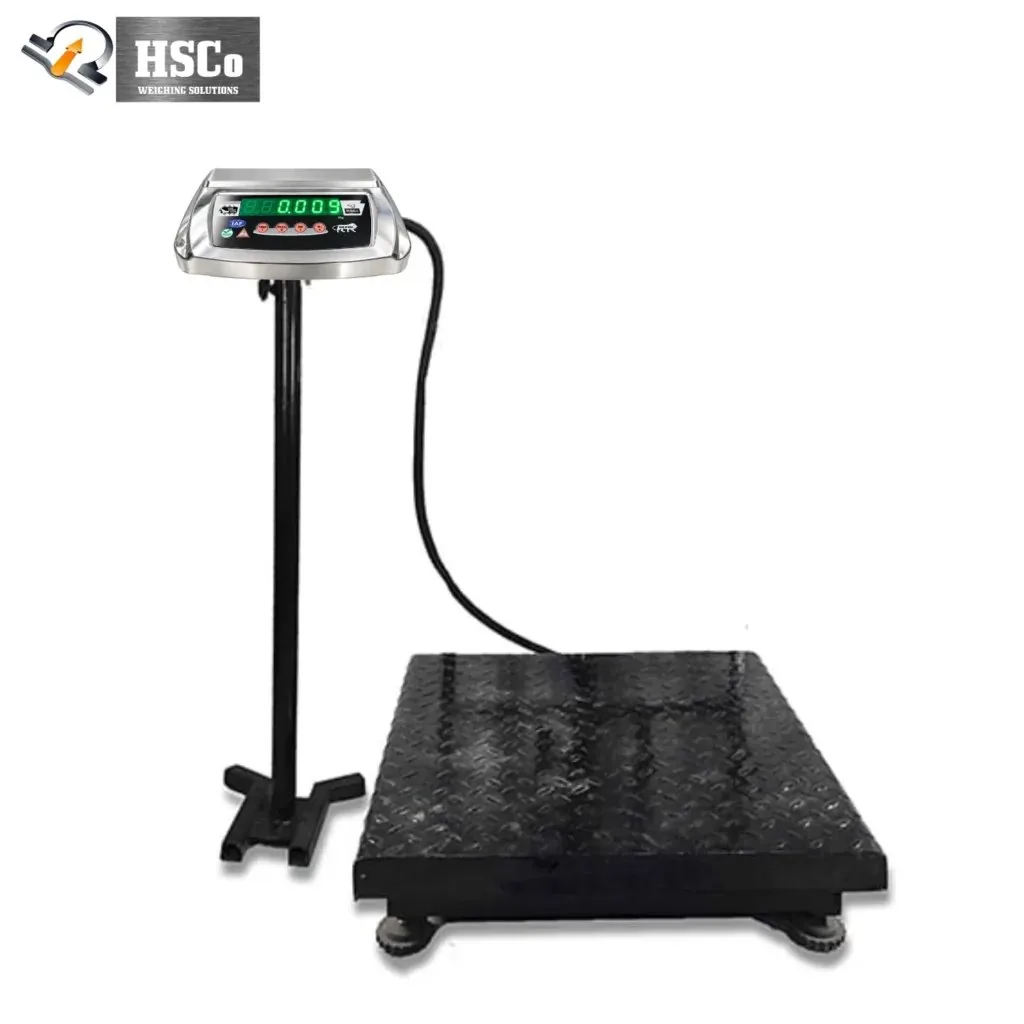
- PLCHQHB heavy duty platform scale: comes in 2,500 kg, 3,000 kg and 5,000 kg capacities, on chequered mild-steel platforms from 100 × 100 cm to 150 × 150 cm, with a display at the back that faces the customer [6].

All three scales are Legal Metrology stamped [4, 5, 6].
Scales for yards and loading bays are on our logistics and transport page. Tell us your heaviest lift and how many lifts a lot takes: call +91-7045922250 or write to hsc@hindustanscale.com.
Frequently asked questions
How do you weigh scrap with a crane scale?
To weigh scrap with a crane scale, zero the scale with the empty hook and weigh the empty bucket and chains as the tare. With the tare key not in use, write each lift’s gross reading once the figure stops changing, and take off the tare. If you tare the bucket on the scale instead, readings are already net. Number every lift and add the net weights at the end.
Does a crane scale need Legal Metrology stamping?
A crane scale used to buy or sell goods needs Legal Metrology stamping. Rule 27 of the Legal Metrology (General) Rules, 2011 says a weight or measure used in a transaction shall be verified and stamped, and re-verified at periodical intervals, which is twelve months for a crane scale [3]. A crane scale repaired before its due date must be re-verified and stamped before use [3].
How much did Indian Railways earn from scrap in Special Campaign 6?
Indian Railways earned ₹628.49 crore from scrap disposal in Special Campaign 6, held from 2 to 31 October 2026, against a target of ₹600 crore, the Ministry of Railways said in a release on 9 November 2026 [1]. The same release reported ₹10.43 crore from more than 1.50 lakh units of e-waste [1].
What is tare weight when you weigh with a crane scale?
Tare weight in crane weighing is the weight of everything that hangs below the crane scale apart from the goods, such as the bucket, chains or sling. Subtract the tare from each gross reading to get the net weight. In a worked example of six lifts with a bucket and chains weighing 240 kg, leaving the tare in overstates the lot by 1,440 kg.
Sources
- Press Information Bureau, Ministry of Railways, “Indian Railways Successfully Concludes Special Campaign 6; Over 1 Lakh Cleanliness Drives Conducted” (pib.gov.in, 9 November 2026).
- Railway Board, Indian Railways, “Indian Railways Code for the Stores Department, Volume II, Chapter XXIV: Scrap and Auction Sales, paragraphs 2426 to 2431” (rb.indianrailways.gov.in).
- Ministry of Consumer Affairs, Food and Public Distribution (Gazette of India, copy on megweights.gov.in), “The Legal Metrology (General) Rules, 2011, Rule 27: Periodical verification of weights or measures” (megweights.gov.in, 7 February 2011).
- Hindustan Scale Company, “CRHBT5K Bluetooth Crane Scale – 5,000 kg × 1 kg, Android App, Jumbo Display, Remote” (hindustanscale.com).
- Hindustan Scale Company, “CRHBT20K Bluetooth Crane Scale 20 t – Android App, Remote, Jumbo Display” (hindustanscale.com).
- Hindustan Scale Company, “PLCHQHB Heavy Duty Platform Scale – 2,500 to 5,000 kg, Chequered MS Platform, 4 Load Cells” (hindustanscale.com).