


A price computing scale multiplies the displayed weight after any tare deduction by the rate you key in and shows the total. When onions sell at ₹65 a kg [1], each 1 g step is worth 6.5 paise and each 5 g step 32.5 paise. The same 10 g error on 200 sales adds up to ₹130 of onions a day, before price rounding.
Onmanorama reported on 14 October 2026 that retail onion prices in India ranged from ₹50 to ₹65 a kg, nearly double the level a year earlier, and were expected to ease toward the end of October as fresh harvests reach markets [1]. Earlier, PTI reported on 6 September 2026 that the Centre was selling buffer onions at ₹35 a kg in selected cities, and that Department of Consumer Affairs data put the all-India average retail price at ₹50.79 a kg [2].
How much is one gram of onion worth at ₹35 to ₹65 a kg?
At ₹65 a kg, one gram of onion is worth 6.5 paise [1].
Value of one step (₹) = rate per kg (₹) × step (g) ÷ 1,000
| Onion rate | 1 g step | 5 g step | 50 g |
|---|---|---|---|
| ₹35 a kg [2] | 3.5 paise | 17.5 paise | ₹1.75 |
| ₹50 a kg [1] | 5 paise | 25 paise | ₹2.50 |
| ₹65 a kg [1] | 6.5 paise | 32.5 paise | ₹3.25 |

Should a price computing scale for vegetables read in 1 g or 5 g steps?
A 1 g scale shows weight in 1 g steps and a 5 g scale in 5 g steps, so the 1 g scale has less potential rounding in the weight it displays. In an ideal case with no other error, a bag that weighs 1.002 kg shows as 1.000 kg on a 5 g scale and as 1.002 kg on a 1 g scale.

The HSCo PRCPT price computing scale reads 30 kg × 1 g in its 30 kg model and 50 kg × 5 g in its 50 kg model [7]. The ABSWR waterproof scale comes with 1 g or 5 g accuracy, and you choose which when you order [5].

What does a 10 g error cost a vegetable shop in a month?
A 10 g error at ₹65 a kg is worth 65 paise of onion per sale, before price rounding [1]. If the scale reads 10 g low on all 200 bags you sell in a day, you give away about ₹130 of onions a day and ₹3,900 in 30 days. If it reads 10 g high on every sale, your customers are billed about the same for onions they did not get.
| Onion rate | Per sale (before rounding) | 200 sales (same error) | 30 days |
|---|---|---|---|
| ₹35 a kg [2] | 35 paise | ₹70 | ₹2,100 |
| ₹50 a kg [1] | 50 paise | ₹100 | ₹3,000 |
| ₹65 a kg [1] | 65 paise | ₹130 | ₹3,900 |
An untared paper bag adds the same kind of error. A 20 g bag at ₹65 a kg adds ₹1.30 of billed value to each sale, before price rounding [1].

Does a shop price computing scale need Legal Metrology stamping?
Yes. Section 24(1) of the Legal Metrology Act, 2009 requires a weight or measure used in a transaction to be verified before it is put to use [3]. An electronic shop weighing scale used for trade falls under Rule 27(2)(c) of the Legal Metrology (General) Rules, 2011, so it is re-verified every 12 months [4]. The three scales recommended below are Legal Metrology stamped [5, 6, 7], and our government stamping guide covers what the stamp means.
How do you check a price computing scale at the counter?
- Switch the scale on with the pan empty and wait for it to show zero. If it does not, press zero before anything goes on the pan.
- Put the empty bag or tray on the pan and press tare, so the reading returns to zero and the customer pays only for the onions.
- Key in the rate, weigh a bag and multiply weight × rate on a calculator. The total should match the display, allowing for the way the scale rounds the price.
- Look at the due date on the stamping certificate and have the scale re-verified by then. A scale that has been repaired must also be re-verified before it is used again [4].
- If any of these checks fails, or the reading will not settle, stop selling on that scale and have it checked.

Which HSCo price computing scale fits a vegetable counter?
All three scales below show the weight, the rate and the total, and all three are Legal Metrology stamped [5, 6, 7].

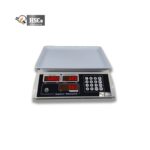
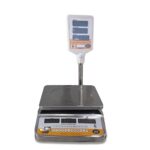
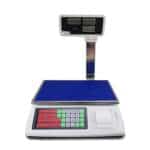

More shop scales are in our table top scales range. Tell us what you sell: call +91-7045922250 or write to hsc@hindustanscale.com.
Frequently asked questions
What is a price computing scale?
A price computing scale is a shop scale that multiplies the displayed weight after any tare deduction by the rate per kg keyed in and shows the total price. The HSCo PRCSSP price computing scale, for example, shows weight, rate and total on displays for both the operator and the customer, weighs up to 30 kg in 1 g steps and stores 6 product prices [6].
How often must a shop weighing scale be re-verified in India?
An electronic shop weighing scale used for trade falls under Rule 27(2)(c) of the Legal Metrology (General) Rules, 2011, so it is re-verified every 12 months [4]. Section 24(1) of the Legal Metrology Act, 2009 requires a weight or measure to be verified before it is used in a transaction [3]. Rule 27(4) also requires a repaired scale to be re-verified before it is used again [4].
Is a 5 g scale accurate enough for selling onions?
A 5 g scale shows weight only in 5 g steps, so at ₹65 a kg each step is worth 32.5 paise, against 6.5 paise for a 1 g step [1]. Step size alone does not show whether a scale is accurate enough. Kerala’s Legal Metrology Department says its officers test a scale at several points across its range and reject it if it errs beyond the permissible limits [8]. Sell only on a scale with valid verification [3, 4].
How much is 10 g of onion worth at ₹65 a kg?
Ten grams of onion is worth 65 paise at ₹65 a kg, the top of the retail range Onmanorama reported on 14 October 2026 [1]. The sum is 10 g × ₹65 ÷ 1,000. If a scale reads 10 g wrong in the same direction on 200 sales a day, that adds up to ₹130 of onions a day before each bill is rounded.
Sources
- Onmanorama, “Onion prices sting across India during festive season; fresh arrivals may ease rates” (onmanorama.com, 14 October 2026).
- PTI (via ThePrint), “Govt sells 4,000 tonnes of buffer onions across 17 cities in 10 days to cool prices” (theprint.in, 6 September 2026). PTI report citing Department of Consumer Affairs data
- India Code, Government of India, “The Legal Metrology Act, 2009, Section 24” (indiacode.nic.in).
- India Code, Government of India, “The Legal Metrology (General) Rules, 2011, Rule 27” (indiacode.nic.in).
- Hindustan Scale Company, “ABSWR Waterproof Price Computing Scale – 30 kg, Weight, Rate and Total” (hindustanscale.com).
- Hindustan Scale Company, “PRCSSP Price Computing Scale – 30 kg × 1 g, 6 Price Memories” (hindustanscale.com).
- Hindustan Scale Company, “PRCPT Price Computing Scale with Built-in Printer – 30 kg / 50 kg” (hindustanscale.com).
- Legal Metrology Department, Kerala, “Verification of Weights and Measures” (lmd.kerala.gov.in).