

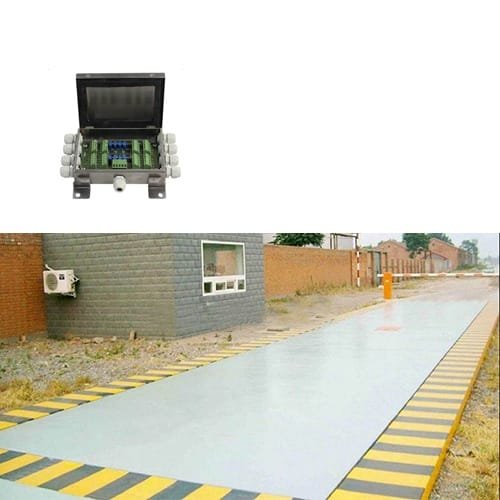
A sugarcane weighbridge weighs the loaded vehicle and then the same vehicle empty, and the mill pays for the difference. At the 2026-27 fair and remunerative price (FRP) of ₹365 a quintal at 10.25% recovery, every 100 kg the weighbridge misses costs the grower ₹365 [1, 2]. A weighbridge used for this payment must be verified and stamped under the Legal Metrology law [8, 9].
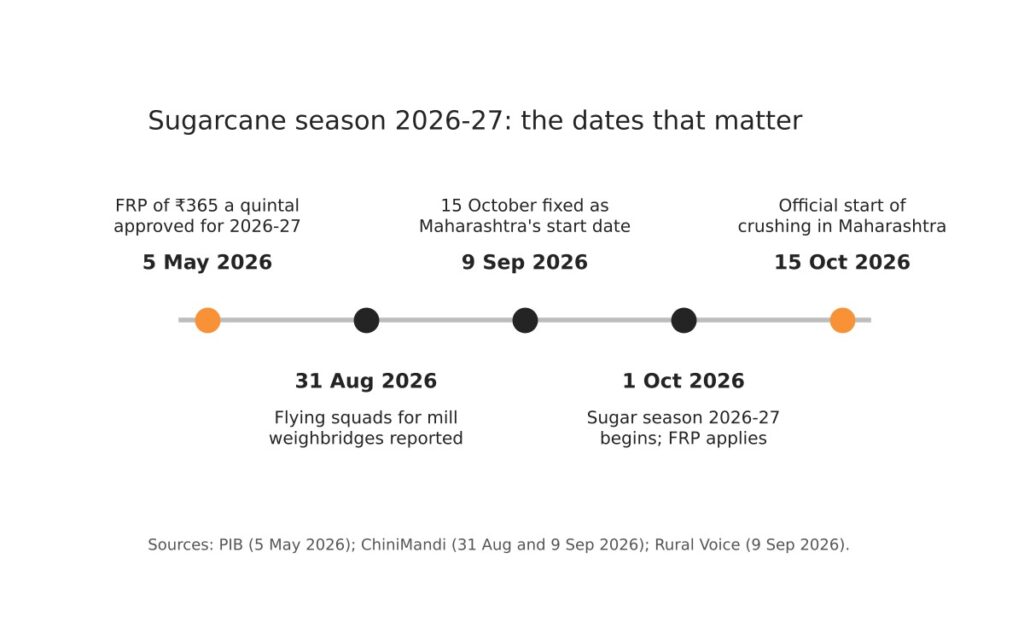
Maharashtra fixed 15 October 2026 as the start of its 2026-27 crushing season [3, 4]. ChiniMandi reported on 14 October 2026, citing the state’s cooperative sugar factories federation, that 55 mills had already started crushing by 13 October [5]. Ahead of the season, ChiniMandi also reported that the state Sugar Commissioner directed district collectors to form flying squads for surprise checks of mill weighbridges, after complaints of alleged under-weighing of cane [6, 7].
How does a sugarcane weighbridge decide what the grower is paid?
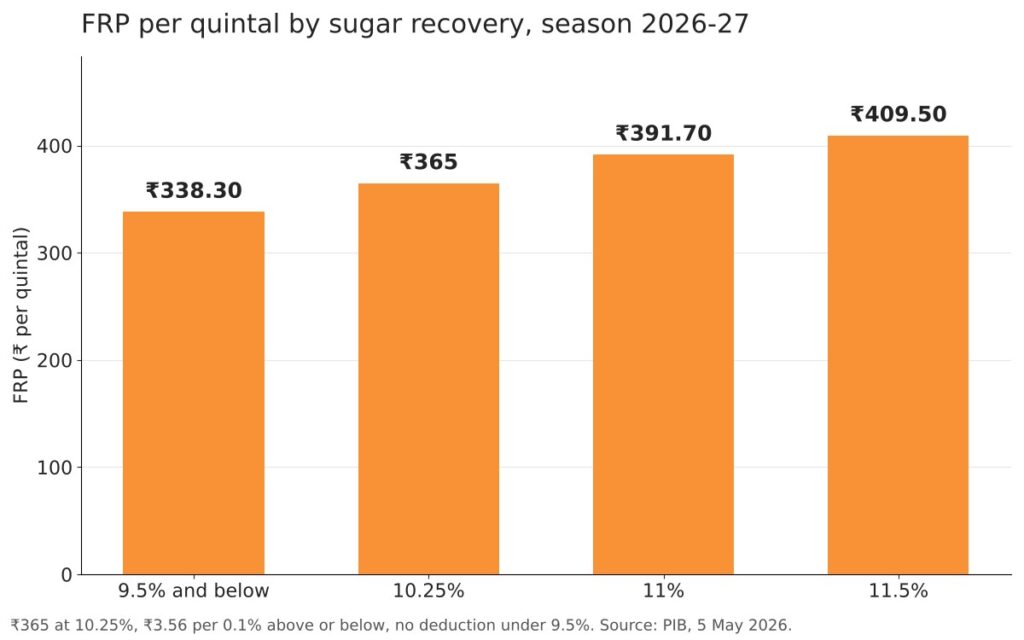
The mill pays for the net weight of cane. The weighbridge records the gross weight of the loaded tractor or truck, then the tare weight of the same vehicle after unloading, and the slip shows the net weight as gross minus tare. The rate per quintal comes from the FRP: ₹365 at a basic recovery of 10.25%, ₹3.56 more for every 0.1% of recovery above that, ₹3.56 less for every 0.1% below, and no further deduction under 9.5%, where growers get ₹338.30 [1, 2]. The Press Information Bureau release says this FRP applies to cane bought in the 2026-27 season starting 1 October 2026 [1].
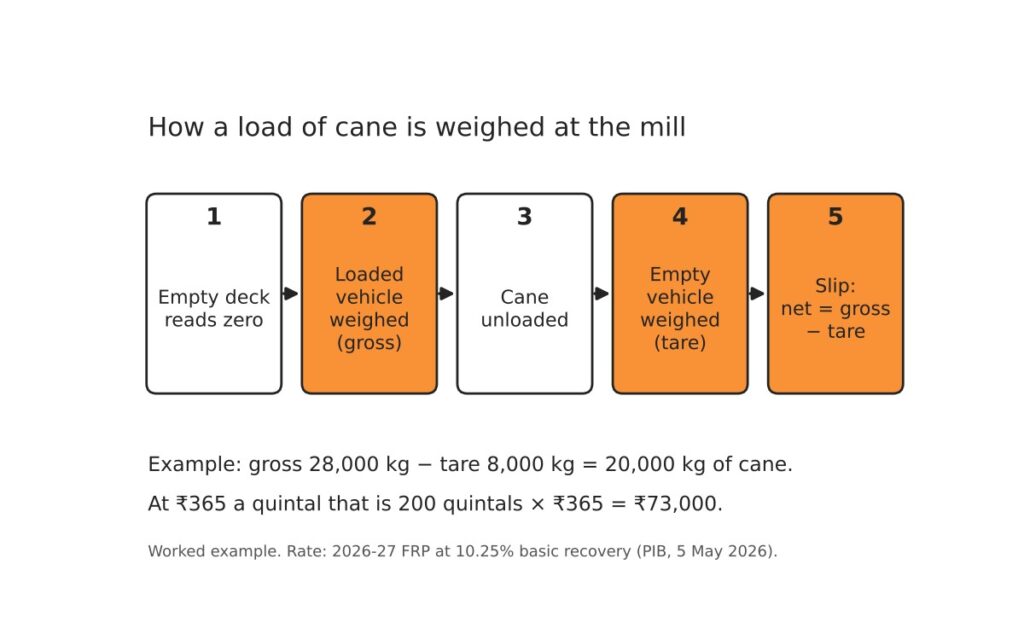
The weight is taken afresh on every trip at the mill’s own weighbridge, and it is the one figure on the slip that the grower can check at the gate.
What does a weighing error cost at the 2026-27 FRP?
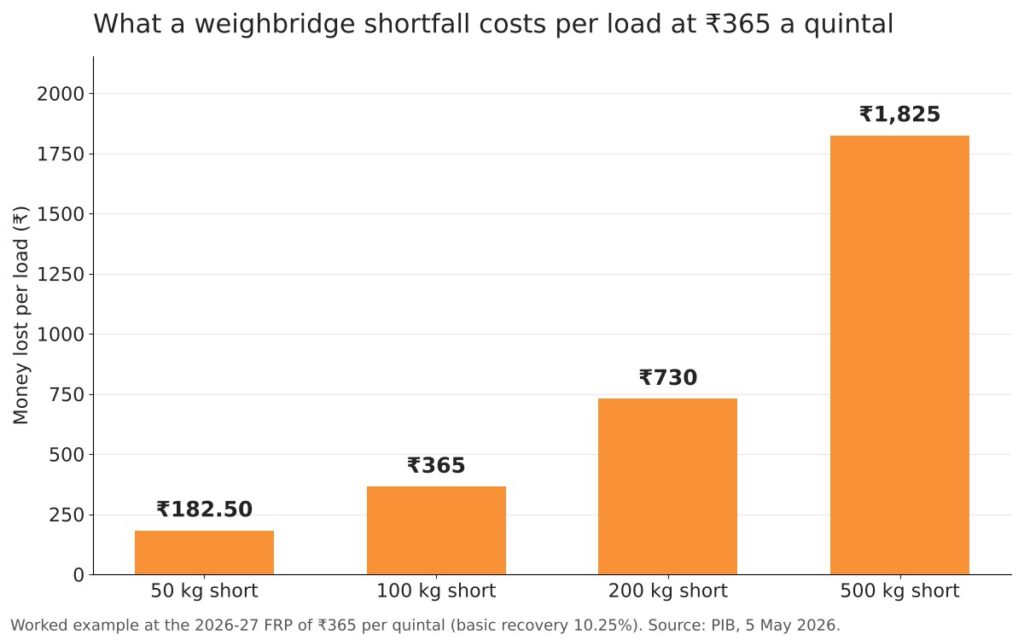
At ₹365 a quintal, cane is worth ₹3,650 a tonne, or ₹3.65 a kg [1]. A shortfall on the slip costs the grower that rate on every missing kilogram. The table works it out for an example load of 20,000 kg of cane.
Money lost = kg short × ₹365 ÷ 100
| Short on the slip | Share of a 20,000 kg load | Money lost per load |
|---|---|---|
| 50 kg | 0.25% | ₹182.50 |
| 100 kg | 0.5% | ₹365 |
| 200 kg | 1% | ₹730 |
| 500 kg | 2.5% | ₹1,825 |
A grower who sends 100 tonnes of cane and is shorted 1% on every slip loses 1 tonne, worth ₹3,650 at the basic FRP. A higher recovery raises the rate per quintal, so the same shortfall costs more at a mill with better recovery [1].
How often must a sugar mill weighbridge be stamped?
Section 24 of the Legal Metrology Act, 2009 requires a weight or measure that will be used in a transaction to be verified before it is used [8]. Rule 27(2)(c) of the Legal Metrology (General) Rules, 2011 sets re-verification every 12 months for weights and measures outside the 24-month and 60-month groups, and an electronic weighbridge sits in that 12-month group [9]. Each new Hindustan Scale Company (HSCo) scale ships with one year of stamping [10].
For the 2026-27 season in Maharashtra, ChiniMandi reported that Legal Metrology officials were told to inspect, calibrate and seal the cane weighbridges in the presence of farmer representatives [6, 7]. The same reports say the flying squads include revenue, police and Legal Metrology officials, IT experts, regional sugar officials and farmer representatives [6, 7]. ChiniMandi’s 4 September 2026 report adds that the squads are to make sure growers get receipts showing the weight of their cane [7].
How can a grower check the weight of a cane load?
These five checks take a few minutes at the gate.
- Look for the Legal Metrology verification certificate and the seal on the weighbridge, and check that the verification date is less than 12 months old [9].
- Watch the display read zero with the deck empty before your vehicle drives on.
- Make sure every wheel of the vehicle is on the deck and nobody is standing on it when the weight is taken.
- Ask for the slip with gross, tare and net weight, and keep it until you are paid [7].
- Now and then, weigh the same loaded vehicle on another stamped weighbridge before it reaches the mill and compare the two gross weights. If a gap keeps coming back, report it to the district flying squad, whose names and contact details are to be made available to farmers [7].
A truck weighbridge shows weight in fixed steps. The 50/60 t size of the HSCo HSCMTW reads in steps of 5 kg and 10 kg [12], so a gap of one step can come from rounding. A 200 kg gap on a 20,000 kg load is 40 steps of 5 kg.
Which HSCo weighbridge fits a sugar mill gate?
A mill gate weighs loaded tractor-trailers and trucks, then weighs them again empty. These two HSCo weighbridges come in sizes from 10 t to 120 t [11, 12].


Every size is on our weighbridges page, and scales for farms and grain stores are on the weighing scales for agriculture page. Tell us the longest vehicle and the heaviest load you weigh: call +91-7045922250 or write to hsc@hindustanscale.com.
Frequently asked questions
How much is the sugarcane FRP for 2026-27?
The fair and remunerative price (FRP) of sugarcane for the 2026-27 sugar season is ₹365 a quintal at a basic recovery of 10.25%. Each 0.1% of recovery above 10.25% adds ₹3.56 a quintal, and each 0.1% below takes ₹3.56 off. Mills with recovery under 9.5% make no further deduction, so growers there get ₹338.30 a quintal [1, 2].
How often is a sugar mill weighbridge stamped?
An electronic weighbridge used to pay for cane must be verified before use under Section 24 of the Legal Metrology Act, 2009, and re-verified every 12 months under Rule 27(2)(c) of the Legal Metrology (General) Rules, 2011 [8, 9]. For the 2026-27 season in Maharashtra, ChiniMandi reported that Legal Metrology officials would calibrate and seal cane weighbridges in front of farmer representatives [6].
How much is 100 kg of sugarcane worth at FRP?
At the 2026-27 FRP of ₹365 a quintal at 10.25% recovery, 100 kg of sugarcane is worth ₹365, a tonne is worth ₹3,650 and a kilogram is worth ₹3.65 [1]. A weighbridge that shorts a 20,000 kg load by 1%, or 200 kg, costs the grower ₹730 on that load.
Sources
- Press Information Bureau, “Cabinet approves Fair and Remunerative Price of Rs.365/qtl for Sugarcane Farmers for season 2026-27” (pib.gov.in, 5 May 2026).
- Onmanorama, “Explained | Fair and Remunerative Price (FRP) of sugarcane” (onmanorama.com, 6 May 2026).
- Rural Voice, “Maharashtra Sets Oct 15 as Start of 2026-27 Sugarcane Crushing Season” (eng.ruralvoice.in, 9 September 2026).
- ChiniMandi, “Maharashtra to start sugarcane crushing season from October 15” (chinimandi.com, 9 September 2026).
- ChiniMandi, “Sugar season 2026-27: 55 mills already crushing in Maharashtra, pace set to pick up from October 15” (chinimandi.com, 14 October 2026). Cites the Maharashtra State Cooperative Sugar Factories Federation.
- ChiniMandi, “Maharashtra orders cane transport safety checks, flying squads for mill weighbridges” (chinimandi.com, 31 August 2026). Based on a Times of India report.
- ChiniMandi, “Maharashtra steps up monitoring of sugar mill weighing scales; flying squads to conduct surprise checks” (chinimandi.com, 4 September 2026). Based on a Lokmat report.
- India Code, Government of India, “The Legal Metrology Act, 2009 (Section 24)” (indiacode.nic.in).
- Legal Metrology Department, Meghalaya, “The Legal Metrology (General) Rules, 2011 (Rule 27)” (megweights.gov.in).
- Hindustan Scale Company, “What is government stamping” (hindustanscale.com).
- Hindustan Scale Company, “Electronic Weighbridge HSCRCTWB product page” (hindustanscale.com).
- Hindustan Scale Company, “Electronic Weighbridge HSCMTW product page” (hindustanscale.com).