
Blogs
Weighbridge weight difference: comparing the error limits of two weighbridges

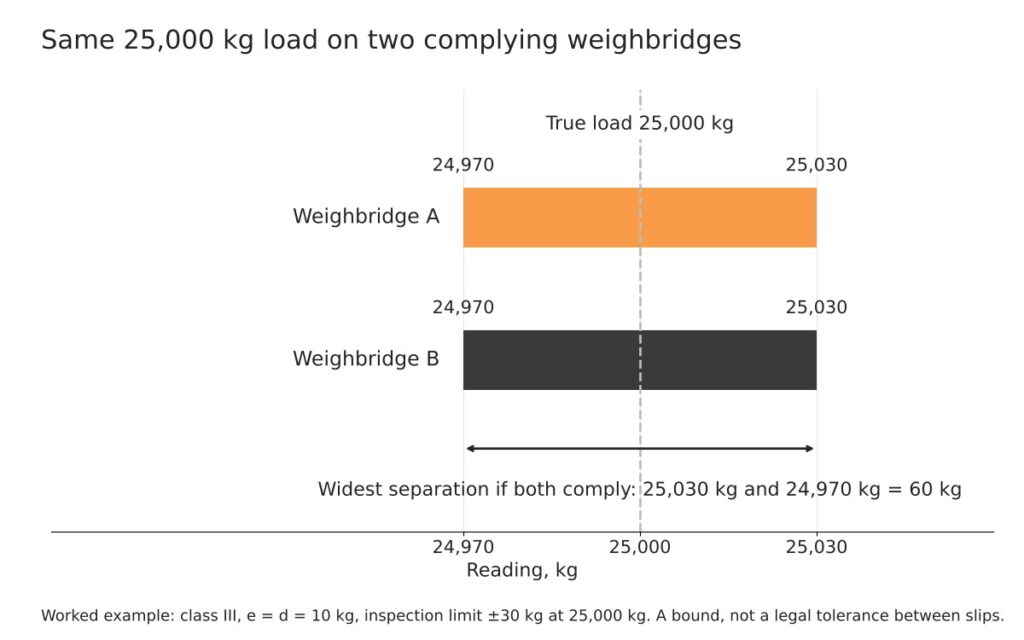
A weighbridge weight difference between two stamped weighbridges can come from the small error each is allowed. The Legal Metrology (General) Rules, 2011 set that limit for each weighbridge on its own, and in service it is twice the verification limit [1]. If two class III weighbridges with 10 kg steps both meet their limits and weigh the same 25,000 kg load, their readings can be up to 60 kg apart.
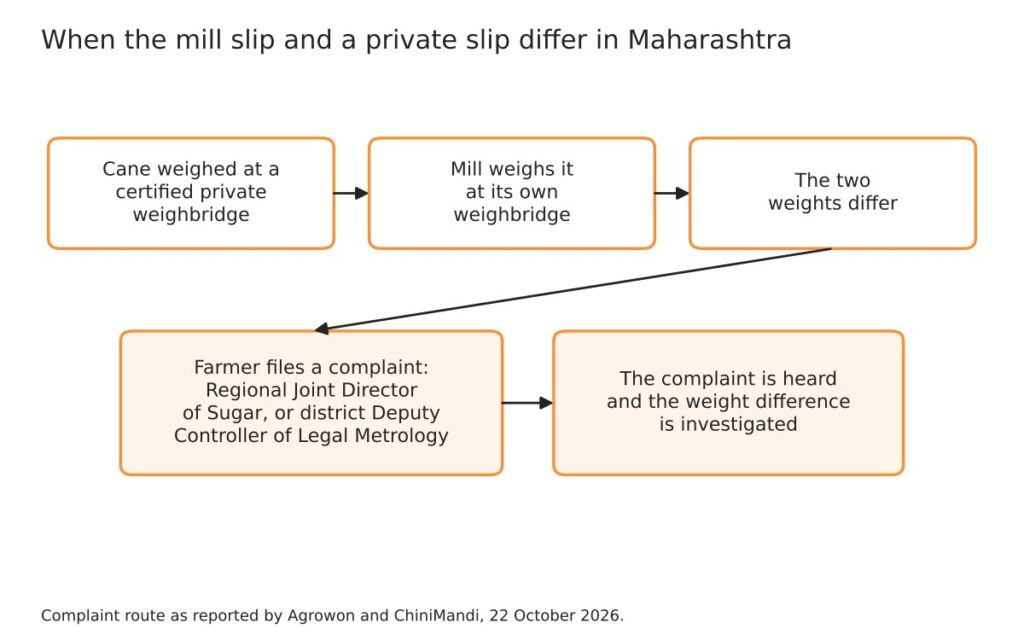
ChiniMandi reported on 22 October 2026, citing Agrowon, that Maharashtra’s Sugar Commissionerate had said sugar mills could not reject cane solely because it had been weighed at a private weighbridge certified by the Legal Metrology Department [2, 3]. The report said a farmer whose private and mill weights differed could complain, and that the complaint would be heard [3].

Can a sugar mill refuse cane weighed at a private weighbridge?
In Maharashtra, a mill could not refuse cane on that ground alone, ChiniMandi reported, citing Agrowon [2, 3]. The same report said mills also could not act against the farmer, driver or labour contractor for weighing at a private weighbridge, deliberately bypass those vehicles in the queue because they used a private weighbridge, or cancel the farmer’s registration for the next season or cooperative membership [3]. Anywhere in India, Section 24 of the Legal Metrology Act, 2009 requires a weighbridge used in a transaction to be verified before that use [6].
What error does the law allow on each weighbridge?
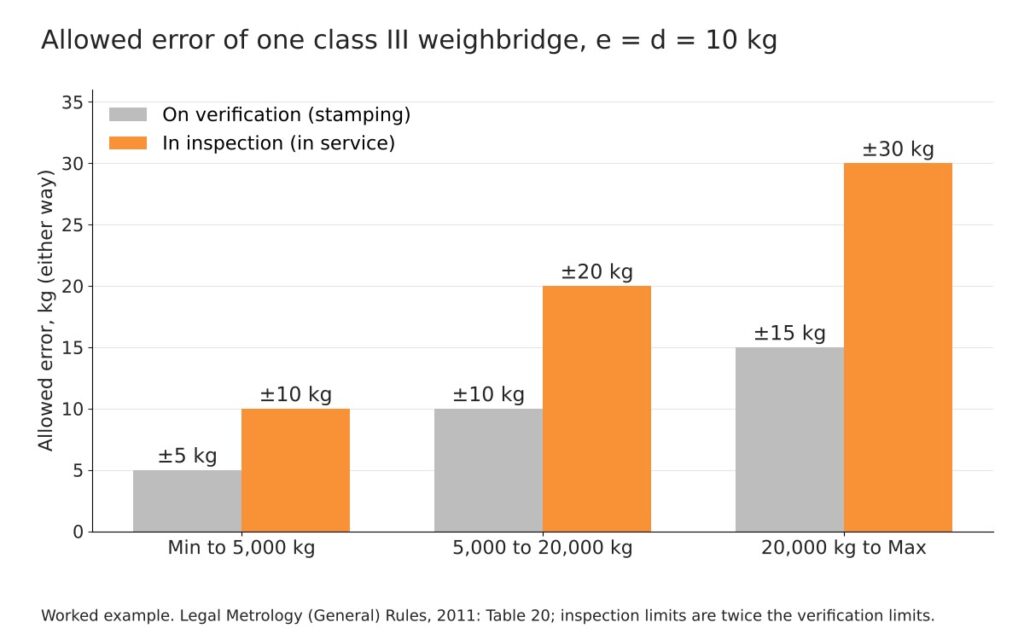
The limit depends on the load and on the verification scale interval, e. On a weighbridge display with no auxiliary indicating device, e is the step the reading moves in [1]. For class III, Table 20 allows ±0.5e from the marked Min up to 500e, ±1e above 500e up to 2,000e and ±1.5e above 2,000e up to 10,000e on verification and re-verification, within the marked Max [1]. During inspection of a weighbridge in service, the same Schedule sets twice those limits [1].
How do you work out a weighbridge weight difference from two error limits?
If both weighbridges meet their inspection limits, read in the same 10 kg step and weigh the same unchanged load, the widest gap comes when one reads its full limit high and the other low. This is a worked bound; the Rules set no tolerance between two slips, and two weighbridges that agree closely can still share one error. The table assumes class III, e = d = 10 kg and loads within both marked Min and Max [1].
Widest gap if both comply, same 10 kg step = inspection limit of weighbridge A + inspection limit of weighbridge B
| Load on the deck | Load in steps of 10 kg | Limit on verification | Limit in inspection | Widest gap if both comply |
|---|---|---|---|---|
| 4,000 kg | 400e | ±5 kg | ±10 kg | 20 kg |
| 15,000 kg | 1,500e | ±10 kg | ±20 kg | 40 kg |
| 25,000 kg | 2,500e | ±15 kg | ±30 kg | 60 kg |
| 45,000 kg | 4,500e | ±15 kg | ±30 kg | 60 kg |
At the 2026-27 fair and remunerative price of ₹365 a quintal at 10.25% recovery [4, 5], 60 kg of cane is worth ₹219 and 200 kg is worth ₹730. Payment follows the net weight. Net weight is gross minus tare, so if both slips carry the same tare, the gap in net weight equals the gap in gross weight. In this class III, e = d = 10 kg example, a 200 kg gap at 25,000 kg is more than three times the widest gap two complying weighbridges can show.
What should you check when two weighbridge slips do not match?
- Read each weighbridge’s data plate for accuracy class, Max, Min and e, and check the load sits between Min and Max [1].
- Compare the gross weight of the same loaded vehicle on both slips, with nothing added or removed in between. A net weight worked out from separate loaded and empty weighings carries the errors of both.
- If both weighbridges read in the same step, look up the inspection limit for the load on each and add the two [1]. These limits bound the error found by the change-point test in paragraph 9(1) of the Seventh Schedule [1].
- Check each weighbridge’s stamping certificate and seal.
- Keep both slips. The same report said a farmer in Maharashtra could take a weight difference to the Regional Joint Director of Sugar or the district Deputy Controller of Legal Metrology [3]. The report specified no minimum gap.
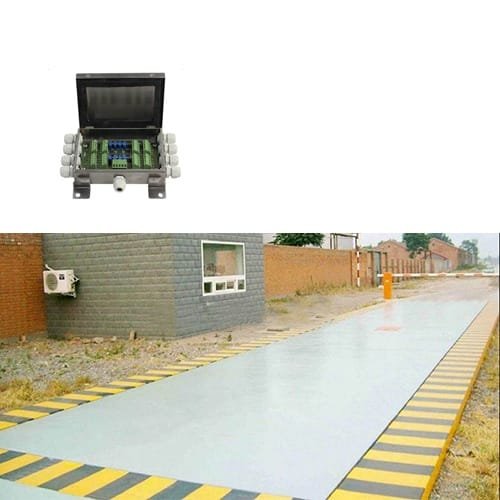
Which HSCo weighbridge fits a mill gate or a private weighing yard?
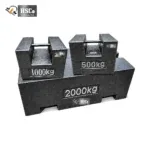
Hindustan Scale Company (HSCo) offers road weighbridges and heavy test weights to check them [7, 8, 9].

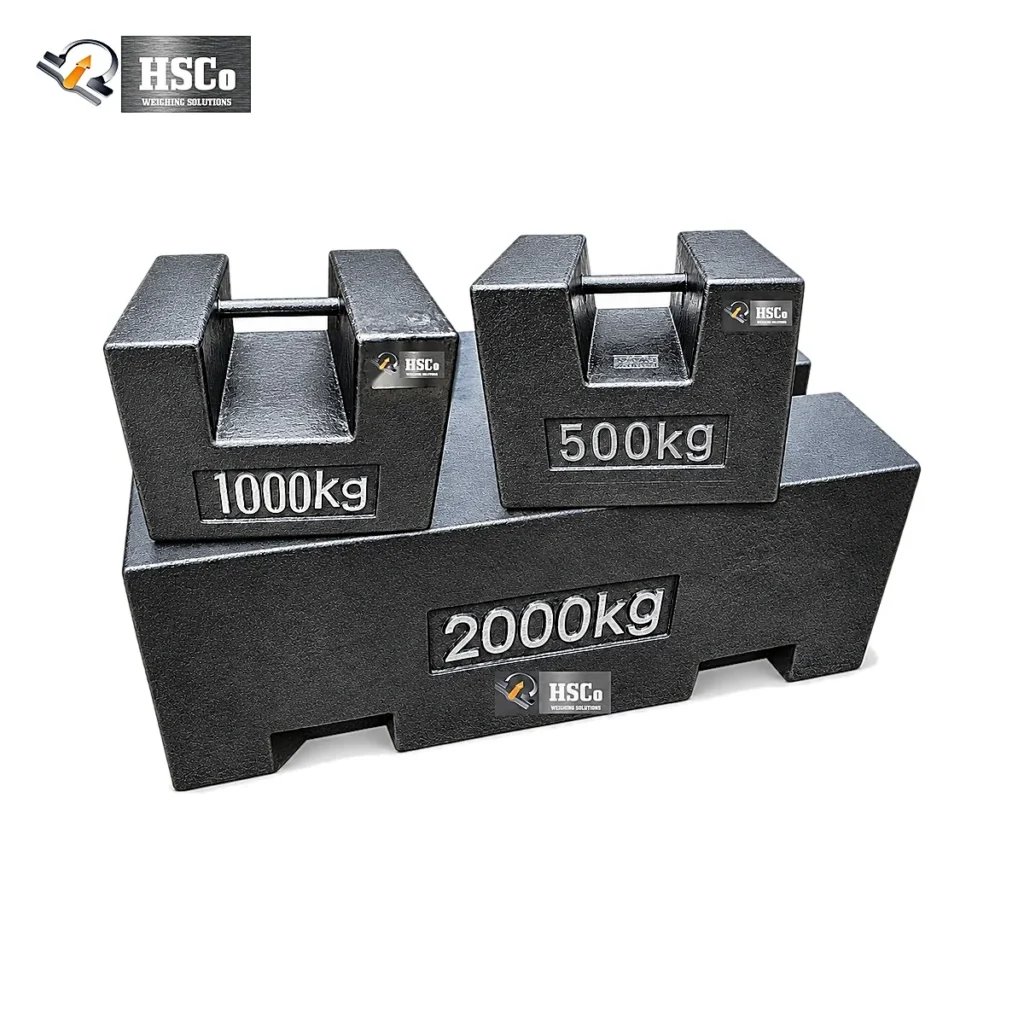
- Heavy duty cast iron test weights, 500 to 2,000 kg: class M1 cast iron blocks of 500 kg, 1,000 kg and 2,000 kg with lifting handles, moved by forklift, crane or hoist. For testing weighbridges, heavy platform scales and crane scales [9].

Our sugarcane weighbridge post works out what a short weight costs at the mill gate, and our weighbridge verification post covers test weights. More vehicle scales are on our logistics and transport scales page. Tell us your longest vehicle and heaviest load: call +91-7045922250 or write to hsc@hindustanscale.com.
Frequently asked questions
Why do two weighbridges show different weights for the same truck?
Two stamped weighbridges can show different weights for the same truck because the Legal Metrology (General) Rules, 2011 allow each one a small error, and in service that limit is twice the verification limit [1]. If two class III weighbridges with 10 kg steps both meet their limits and weigh the same unchanged 25,000 kg load, their readings can be up to 60 kg apart. A small gap does not prove either weighbridge is accurate.
Is there a legal tolerance between two weighbridge slips?
The Legal Metrology (General) Rules, 2011 set an error limit for each weighbridge on its own; they set no tolerance between two slips [1]. On a class III weighbridge with 10 kg steps, the inspection limit is ±10 kg up to 5,000 kg, ±20 kg above that up to 20,000 kg and ±30 kg above 20,000 kg, within its marked Min and Max [1]. Adding two such limits gives 20 kg, 40 kg or 60 kg as a worked bound.
Can a sugar mill in Maharashtra reject cane weighed at a private weighbridge?
Agrowon and ChiniMandi reported on 22 October 2026 that a Maharashtra sugar mill could not reject cane only because it had been weighed at a private weighbridge certified by the Legal Metrology Department [2, 3]. A farmer whose weights differed could complain to the Regional Joint Director of Sugar or the district Deputy Controller of Legal Metrology, ChiniMandi reported [3].
Sources
- Department of Consumer Affairs, Government of India (copy on Legal Metrology Department, Meghalaya website), “The Legal Metrology (General) Rules, 2011 (Seventh Schedule, Heading A, Part II, paragraph 3(6)(ii), tables 16 and 20, paragraph 9(1))” (megweights.gov.in, 7 February 2011). G.S.R. 71(E).
- Agrowon, “Private weighbridge: sugarcane cannot be rejected, farmers can complain; Sugar Commissionerate decision (in Marathi)” (agrowon.esakal.com, 22 October 2026).
- ChiniMandi, “Sugar mills cannot reject sugarcane weighed at certified private weighbridges: Maharashtra Sugar Commissionerate” (chinimandi.com, 22 October 2026). Cites Agrowon.
- Press Information Bureau, “Cabinet approves Fair and Remunerative Price of Rs.365/qtl for Sugarcane Farmers for season 2026-27” (pib.gov.in, 5 May 2026).
- Onmanorama, “Explained | Fair and Remunerative Price (FRP) of sugarcane” (onmanorama.com, 6 May 2026).
- Government of India (India Code), “The Legal Metrology Act, 2009 (section 24)” (indiacode.nic.in, 13 January 2010). Act No. 1 of 2010.
- Hindustan Scale Company, “Weighbridge HSCRCTWB 10-120 t, 11 Sizes” (hindustanscale.com).
- Hindustan Scale Company, “Electronic Weighbridge 10-120 Ton, HSCMTW” (hindustanscale.com).
- Hindustan Scale Company, “Heavy Duty Cast Iron Test Weights, 500 kg, 1,000 kg and 2,000 kg, Class M1” (hindustanscale.com).