
Blogs
Weighbridge verification: how much standard weight is needed after July 2026

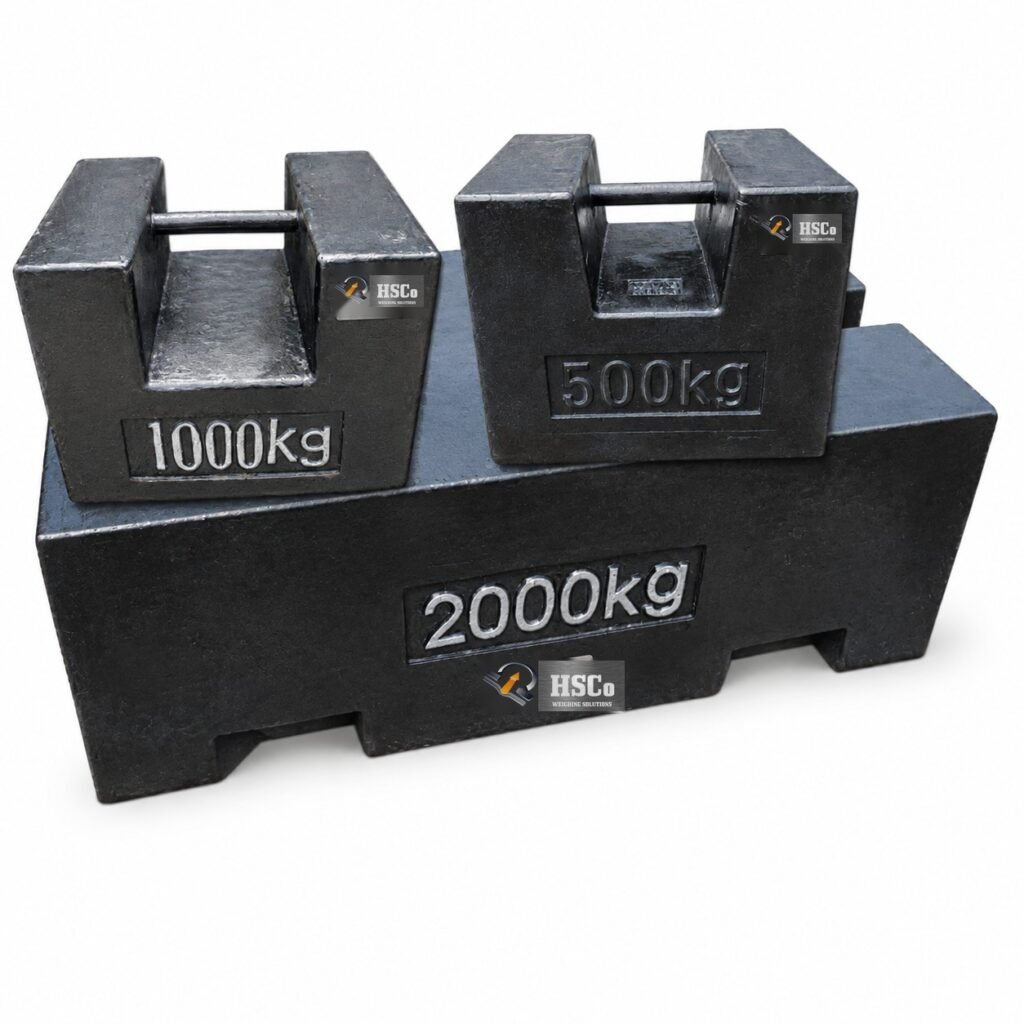
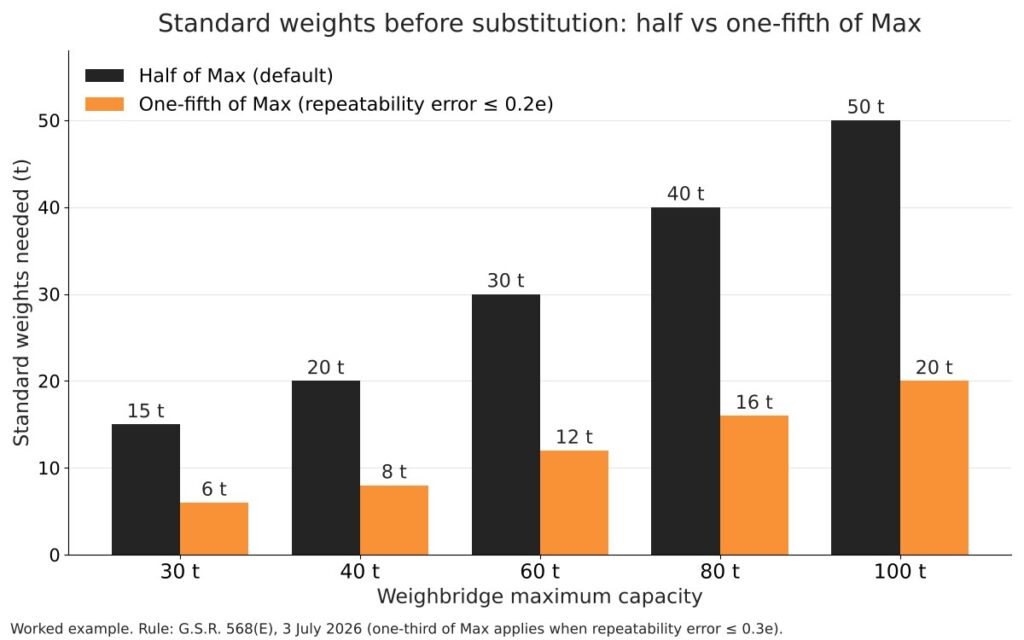
Weighbridge verification in India starts with real standard weights, and the rest of the load up to full capacity may be any constant load. Under the July 2026 amendment, a non-automatic weighbridge whose repeatability error is within 0.2e, where e is the verification scale interval, may use standard weights of one-fifth of its maximum capacity, down from half [1, 12]. For a 60 t weighbridge, that is 12 t instead of 30 t.
On 19 October 2026, the Ministry of Consumer Affairs, Food and Public Distribution said in a press release that India would host the 61st meeting of the International Committee of Legal Metrology (CIML) in New Delhi from 26 to 28 October 2026, for the first time, with the International Organization of Legal Metrology (OIML) [3, 4, 5]. OIML R 76, the international recommendation for non-automatic weighing instruments, sets the same one-half, one-third and one-fifth levels [6].
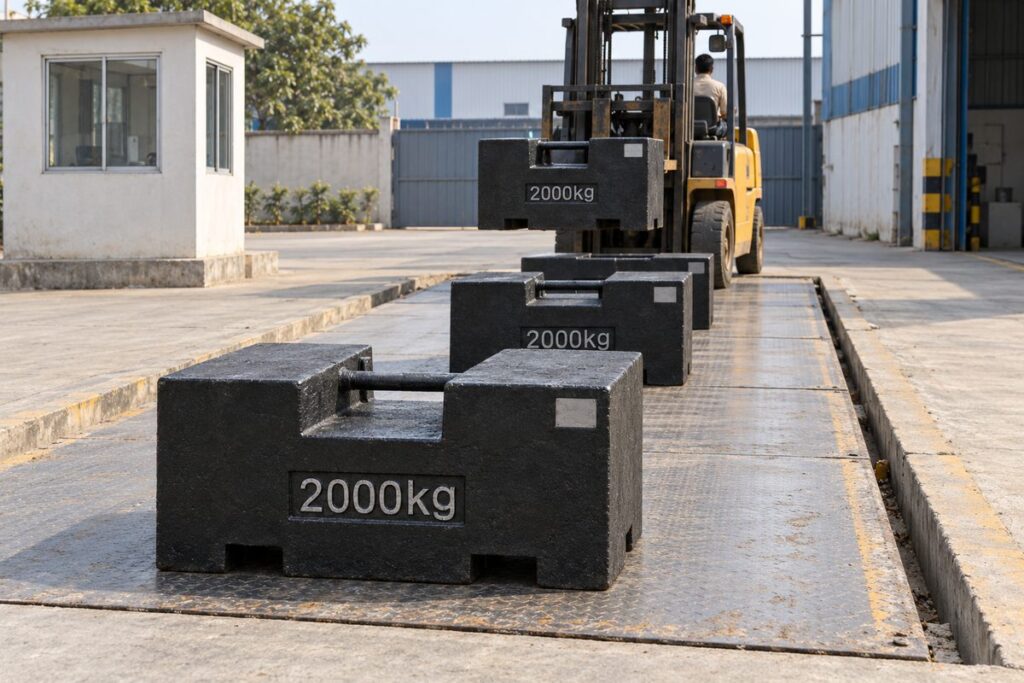
What changed in weighbridge verification in July 2026?
Before the change, the Legal Metrology (General) Rules, 2011 allowed any constant load in place of standard weights while verifying an instrument with a maximum of 1 tonne and more, provided standard weights of at least 1 tonne or 50% of maximum, whichever is greater, were used [7]. The Legal Metrology (General) Fourth Amendment Rules, 2026, notified as G.S.R. 568(E) on 3 July 2026, replaced that clause [12]. At the place of use, standard weights of not less than one half of the maximum capacity are needed. This may be reduced to one third where the repeatability error does not exceed 0.3e, and to one fifth where it does not exceed 0.2e [12]. The ministry announced the change on 6 July 2026 [1, 2].
How many tonnes of standard weights does a weighbridge need under the July 2026 amendment?
Multiply the maximum capacity (Max) by 0.2 if the repeatability error is within 0.2e, by 1/3 if it is within 0.3e, and by 0.5 otherwise [12].
Minimum standard-weight mass = Max ÷ 5 if repeatability error ≤ 0.2e; Max ÷ 3 if above 0.2e and ≤ 0.3e; Max ÷ 2 otherwise
| Weighbridge Max | Half of Max | One-fifth of Max (error ≤ 0.2e) | 1,000 kg blocks, half / one-fifth |
|---|---|---|---|
| 30 t | 15 t | 6 t | 15 / 6 |
| 40 t | 20 t | 8 t | 20 / 8 |
| 60 t | 30 t | 12 t | 30 / 12 |
| 80 t | 40 t | 16 t | 40 / 16 |
| 100 t | 50 t | 20 t | 50 / 20 |
What is the repeatability test before substitution?
The amended rule asks for a load of approximately the value at which substitution is made, placed on the load receptor three times [12]. On a weighbridge with e = 10 kg, the one-fifth level needs a repeatability error of 2 kg or less (0.2e), and the one-third level 3 kg or less (0.3e). A display that steps in 10 kg cannot show a 2 kg difference, so the rounding error is removed with small extra weights at the change-over point [6].
How does a substitution test reach the full capacity?
OIML R 76 sets out the steps below [6]. Indian rules ask for 5 test loads during verification and 3 during inspection, including Max, Min and values at or near those at which the maximum permissible error changes [7].
- Check repeatability with a load near the value where substitution will be made, placed 3 times [6].
- Load the standard weights from zero up to their full quantity and note the error [6].
- Remove the weights until the no-load indication returns, or about 10e on an instrument with zero-tracking [6].
- Put on substitution material until the indicator reaches the same change-over point used for the error [6].
- Repeat the weights-then-material cycle until Max of the instrument is reached [6].
- Unload in reverse order: take off the weights and find the change-over point, put the weights back, then remove material to the same point, until zero [6].
What error is allowed at each test load?
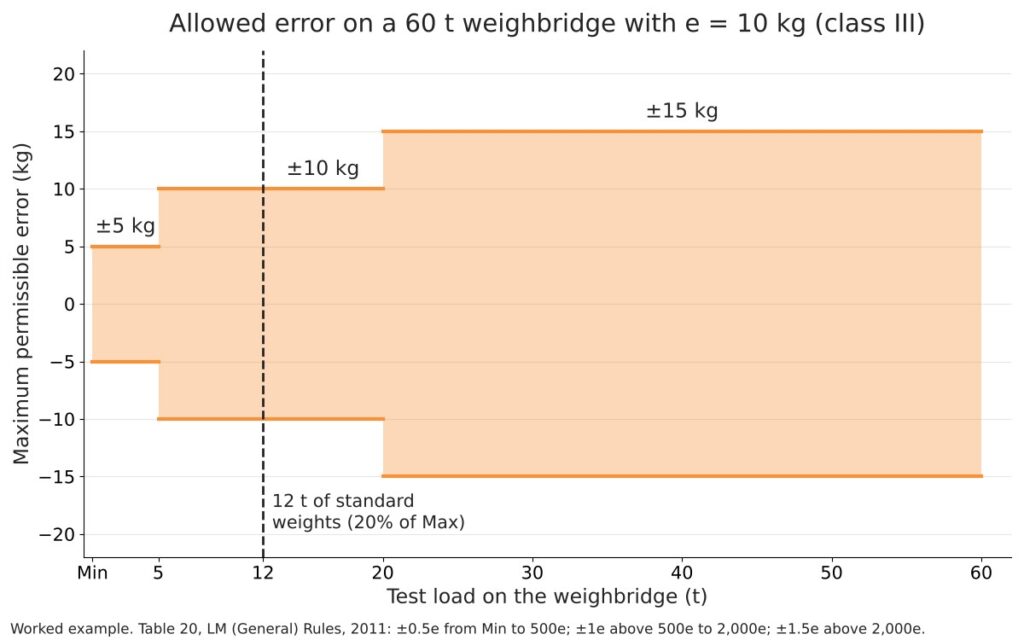
For a class III instrument, the Legal Metrology (General) Rules, 2011 allow ±0.5e from Min up to 500e, ±1e above 500e up to 2,000e and ±1.5e above 2,000e up to 10,000e on verification and re-verification [7]. On a 60 t weighbridge with e = 10 kg, that works out to ±5 kg from the marked Min up to 5 t, ±10 kg above 5 t up to 20 t and ±15 kg above 20 t up to 60 t.
How often must a weighbridge be re-verified?
Section 24 of the Legal Metrology Act, 2009 requires a weight or measure used in a transaction to be verified before it is put to that use [8]. Under Rule 27(2)(c) of the Legal Metrology (General) Rules, 2011, a weighbridge used in transactions or for protection is re-verified every 12 months [7]. A 2021 proviso exempts such instruments from periodic re-verification when industries use them internally and they do not affect the quantity delivered to consumers [13]. Rule 27(3) adds that an instrument verified in place must be re-verified before use if it is dismantled and re-installed before the due date [7].
Which HSCo weights and weighbridge suit a verification day?
Hindustan Scale Company (HSCo) offers cast iron test weights for building up test loads on a weighbridge, and the weighbridge itself.


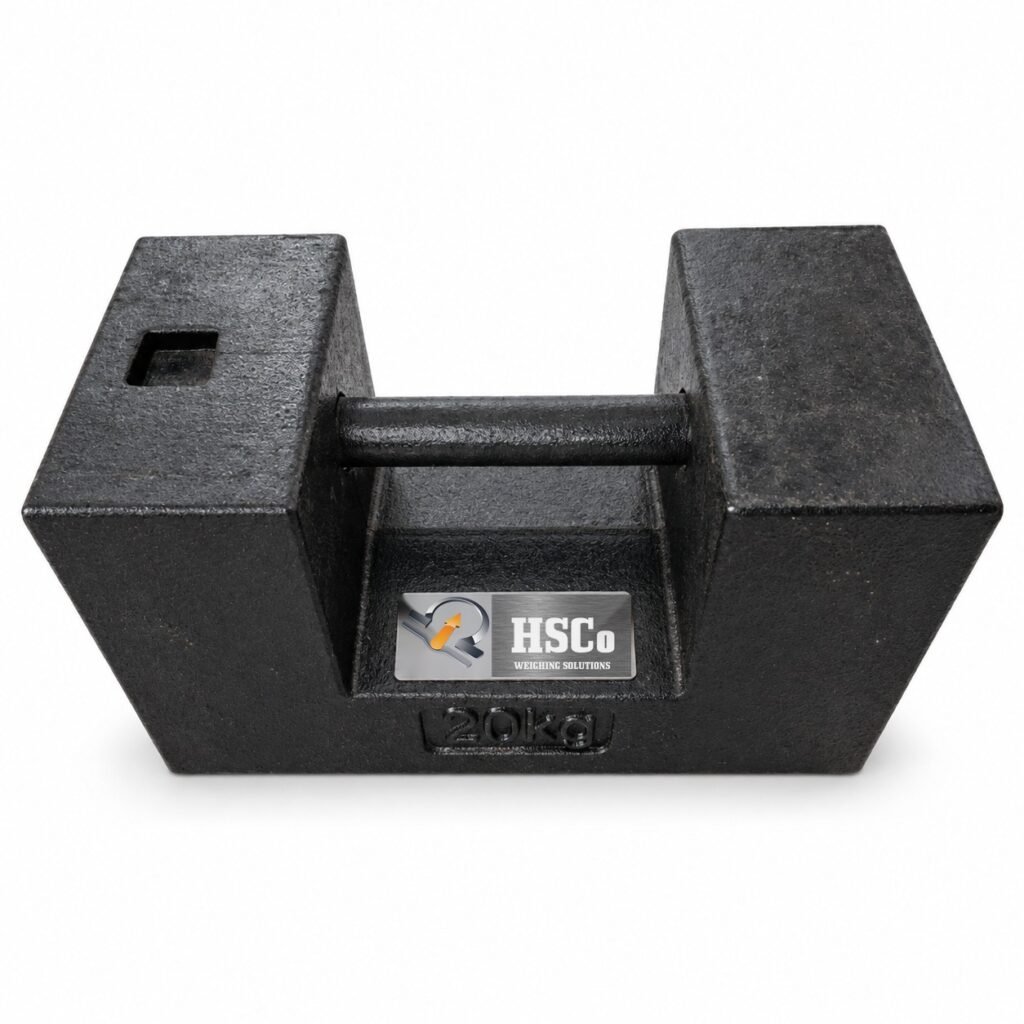
More vehicle and heavy-duty scales are on our logistics and transport scales page, and our sugarcane weighbridge post works out what a short weight costs at a mill gate. Tell us your weighbridge capacity and the test load you need: call +91-7045922250 or write to hsc@hindustanscale.com.
Frequently asked questions
How much standard weight is needed to verify a 60 tonne weighbridge?
A 60 tonne weighbridge may use 12 tonnes of standard weights before substitution if its repeatability error is within 0.2e, under the July 2026 amendment [12]. Before July 2026, the Legal Metrology (General) Rules, 2011 asked for 30 tonnes, half of the maximum capacity [7].
Can a weighbridge be tested with a load other than standard weights?
Yes, in part. Indian verification rules allow any constant load in place of standard weights at the place of use once the required share of standard weights has been used [12]. That share is half of maximum capacity, one-third if the repeatability error is within 0.3e, and one-fifth if it is within 0.2e [12]. The constant load is matched to the same change-over point as the weights [6].
How often must a weighbridge be stamped in India?
A weighbridge used in trade must be verified before use under Section 24 of the Legal Metrology Act, 2009 [8]. Rule 27(2)(c) of the Legal Metrology (General) Rules, 2011 sets re-verification every 12 months for a weighbridge used in transactions or for protection [7]. A weighbridge used only for an industry’s internal purposes that do not affect the quantity delivered to consumers is exempt from periodic re-verification under a 2021 proviso [13].
Sources
- Press Information Bureau, “Department of Consumer Affairs Amends Legal Metrology Rules for Verification of High-Capacity Weighing Instruments” (pib.gov.in, 6 July 2026).
- News On AIR, “Govt amends Legal Metrology Rules for verification of high-capacity weighing instruments” (newsonair.gov.in, 6 July 2026).
- News On AIR, “India to host 61st Meeting of International Committee of Legal Metrology in New Delhi” (newsonair.gov.in, 19 October 2026).
- Press Information Bureau, “India to Host 61st Meeting of International Committee of Legal Metrology for the First Time in New Delhi from 26–28 October 2026” (pib.gov.in, 19 October 2026).
- International Organization of Legal Metrology, “61st CIML Meeting” (oiml.org). oiml.org/en/structure/ciml/61st-ciml-meeting; meeting dates 26-28 October 2026; not linked by site rule
- International Organization of Legal Metrology, “OIML R 76-1 Edition 2006 (E), Non-automatic weighing instruments, Part 1” (oiml.org). oiml.org/en/files/pdf_r/r076-1-e06.pdf; clauses 3.7.3, 3.5.3.2 and A.4.4.5; not linked by site rule
- Ministry of Consumer Affairs, Food and Public Distribution, “The Legal Metrology (General) Rules, 2011” (megweights.gov.in, 7 February 2011). Rule 27 and the Seventh Schedule for non-automatic weighing instruments; scanned copy, about 31 MB
- India Code, “The Legal Metrology Act, 2009” (indiacode.nic.in). Section 24
- Hindustan Scale Company, “Heavy Duty Cast Iron Test Weights, 500 kg, 1,000 kg and 2,000 kg, Class M1” (hindustanscale.com).
- Hindustan Scale Company, “Cast Iron Weight 20 kg, Class M1, Rectangular with Handle” (hindustanscale.com).
- Hindustan Scale Company, “Electronic Weighbridge HSCMTW, 10 t to 120 t, 11 Sizes, IS 2062 Steel” (hindustanscale.com).
- Department of Consumer Affairs, “Legal Metrology (General) Fourth Amendment Rules, 2026, G.S.R. 568(E)” (consumeraffairs.gov.in, 3 July 2026). Gazette of India, Extraordinary; substitutes Seventh Schedule, Heading-A, Part II, paragraph 9(2)(ii)
- Department of Consumer Affairs, “Legal Metrology (General) (Amendment) Rules, 2021, G.S.R. 149(E)” (consumeraffairs.gov.in, 3 March 2021). Inserts the proviso to rule 27(2) on internal industrial use