
Blogs
Analytical balance cost: what to compare on a 0.1 mg balance

Quick answer
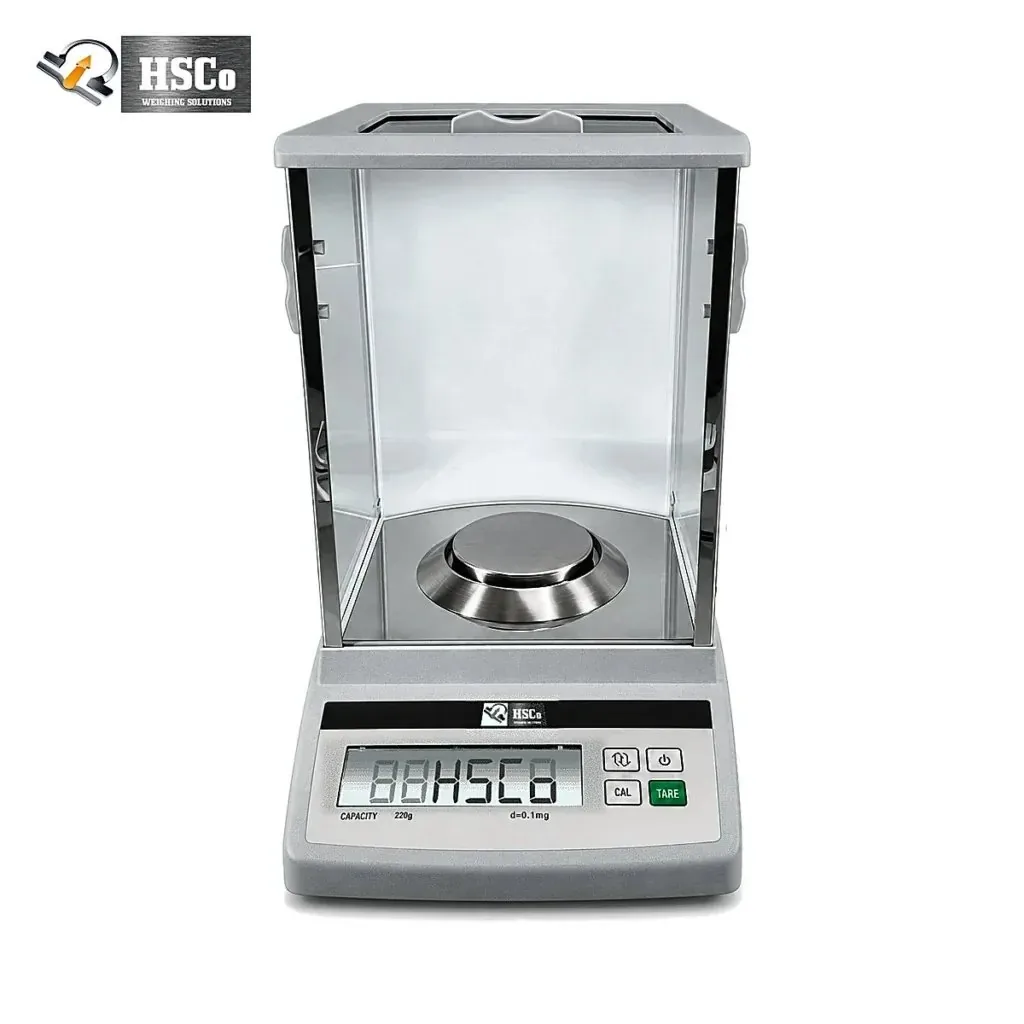
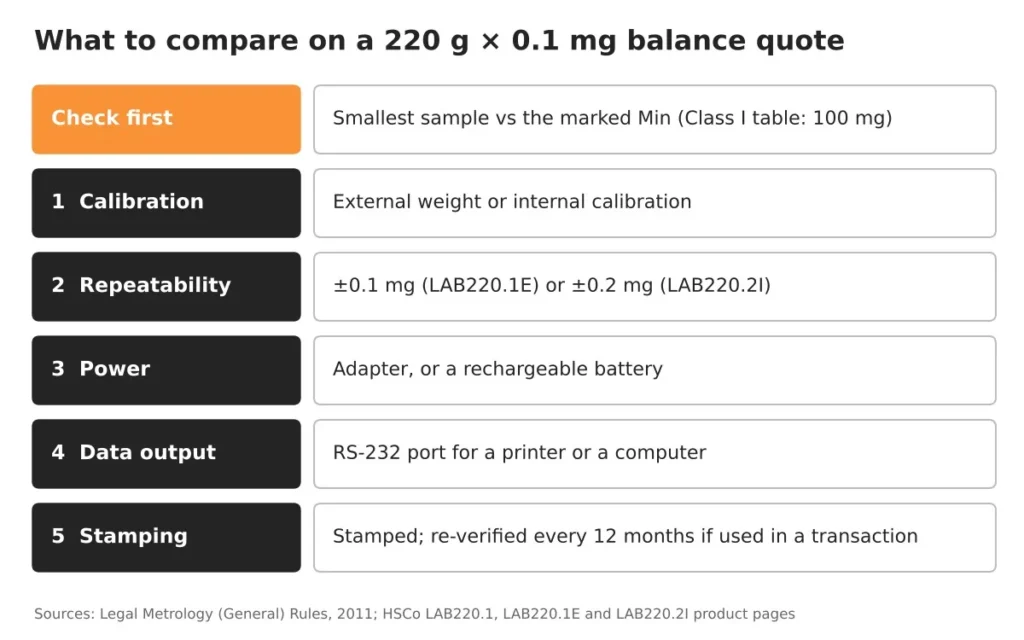
To compare analytical balance cost for an entry-level lab, put quotes for a 220 g × 0.1 mg balance side by side on five points: calibration method, repeatability, power, data output, and stamping and certificates [2, 3, 4]. Check your smallest sample against the minimum capacity (Min) marked on the balance. For a stamped Class I balance of this kind, the classification table in the Rules gives 100 mg [1].
The rule behind that number is in the Legal Metrology (General) Rules, 2011, notified on 7 February 2011. For a Class I (special accuracy) instrument with a display step finer than 1 mg, the Rules fix the verification scale interval e at 1 mg [1]. The 0.1 mg on the display is the display step, d. At verification the error limits are counted in e, and the classification table gives a Class I instrument a minimum capacity of 100 e [1].
What separates one 0.1 mg analytical balance from another?
Compare 0.1 mg balances on calibration, repeatability, power and data output. The three HSCo models below all read 220 g × 0.1 mg and carry the same stamping and certificates [2, 3, 4].
- Calibration method. The LAB220.1E is calibrated with an external weight [3]. The LAB220.2I has internal calibration [4].
- Repeatability and linearity. The LAB220.1E has repeatability ±0.1 mg and linearity ±0.2 mg [3]. The LAB220.2I has ±0.2 mg for both [4].
- Power. The LAB220.2I has a rechargeable battery [4], and the LAB220.1E can also run on one [3]. The LAB220.1 runs on an adapter with a 100 to 240 V AC input [2].
- Data output. The LAB220.1E and the LAB220.2I have an RS-232 port [3, 4], so readings can go to a printer or a computer.
- Stamping and certificates. All three come stamped, with HSCo’s own test certificate free and a NABL calibration certificate at extra cost [2, 3, 4].
How small a sample can an analytical balance weigh?
On a stamped Class I balance with e = 1 mg, the classification table in the Rules gives a minimum capacity of 100 e, which is 100 mg [1]. Check the Min marked on the balance. The Rules define minimum capacity as the load below which the weighing results may be subject to an excessive relative error [1]. Your lab’s own tolerance can call for a larger sample.
Example, assuming the balance is marked Min = 100 e: Min = 100 × 1 mg = 100 mg
The table below divides one display step by the sample weight. The 20 mg and 50 mg rows sit below 100 mg, the value the Rules’ classification table gives for a stamped Class I balance, and are there only for comparison.
| Sample | One step on a 0.1 mg balance | One step on a 1 mg balance |
|---|---|---|
| 20 mg, below the 100 mg table value | 0.5% | 5% |
| 50 mg, below the 100 mg table value | 0.2% | 2% |
| 100 mg | 0.1% | 1% |
| 500 mg | 0.02% | 0.2% |
| 1 g | 0.01% | 0.1% |
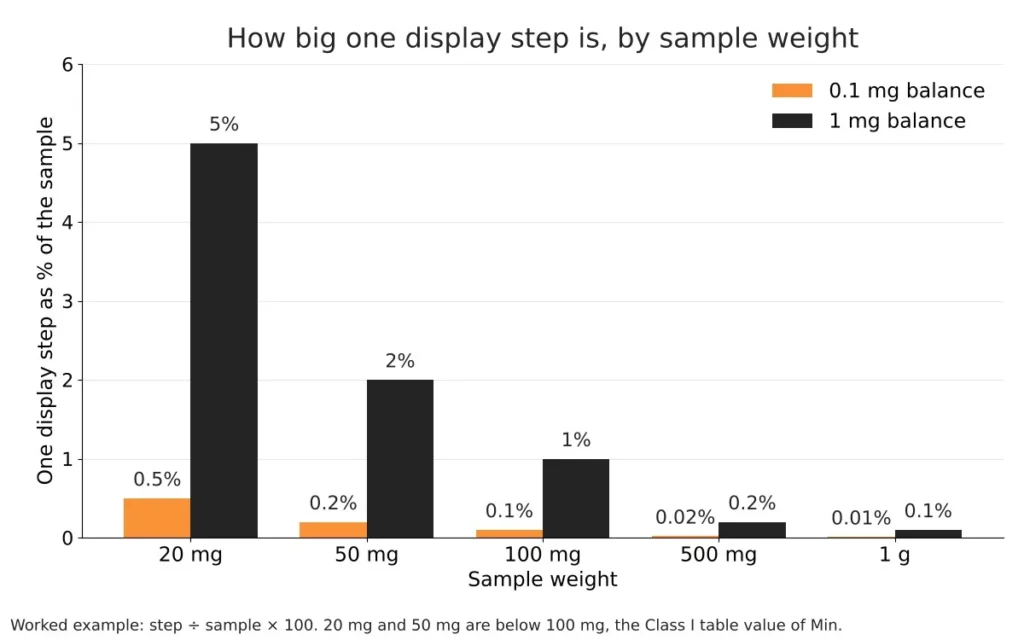
Pick a balance whose display step is small enough for the tolerance your method sets, and keep each sample between the minimum and maximum capacity. The LAB301 reads 1 mg up to 300 g [5], so on a 1 g sample its display step is 0.1% of the sample.
How much error does stamping allow on a 220 g × 0.1 mg balance?
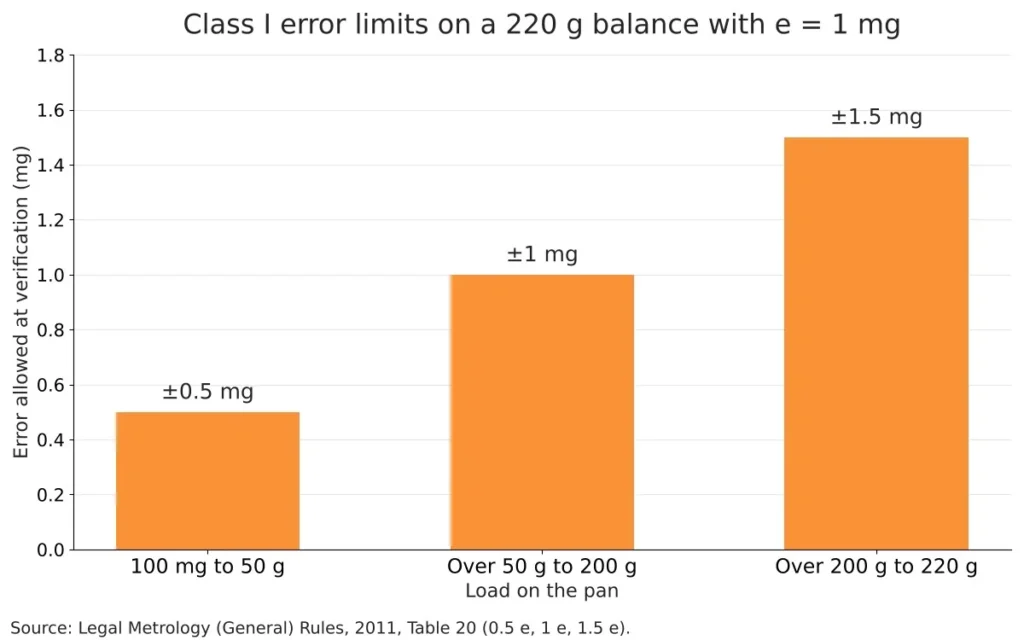
At verification and re-verification, a Class I instrument may be off by at most 0.5 e up to 50,000 e, 1 e above that up to 2,00,000 e, and 1.5 e beyond [1]. The table below assumes a 220 g Class I balance with e = 1 mg and a marked Min of 100 mg. The balance has 220 g ÷ 1 mg = 2,20,000 verification scale intervals, above the Class I minimum of 50,000 [1].
| Load on the pan | Load in e | Error allowed at verification |
|---|---|---|
| 100 mg to 50 g | 100 e to 50,000 e | ±0.5 mg |
| Over 50 g to 200 g | Over 50,000 e to 2,00,000 e | ±1 mg |
| Over 200 g to 220 g | Over 2,00,000 e | ±1.5 mg |
Our post on scale accuracy classes explains the other classes.
Should you choose internal or external calibration?
Choose external calibration if your lab already keeps test weights and someone checks the balance on a schedule. The LAB220.1E is calibrated with an external test weight, so you can check it yourself [3]. The LAB220.2I has internal calibration with a built-in calibration weight [4]. With either model, plan regular checks with external test weights.
What does an analytical balance cost after you buy it?
If the balance is used in a transaction, for example selling gems by the carat, rule 27(2)(c) of the Legal Metrology (General) Rules, 2011, as notified, sets re-verification every 12 months for a weighing instrument of this kind [1]. A lab that calibrates with its own weights needs weights of the right class, and our E2 weights page names class E2 for analytical and precision balances in labs [6]. The 1-year warranty on the LAB220.1E and the LAB220.2I excludes spares and glassware [3, 4].
Which HSCo analytical balance fits a QC lab?
Pick by your smallest sample first and your calibration routine second.
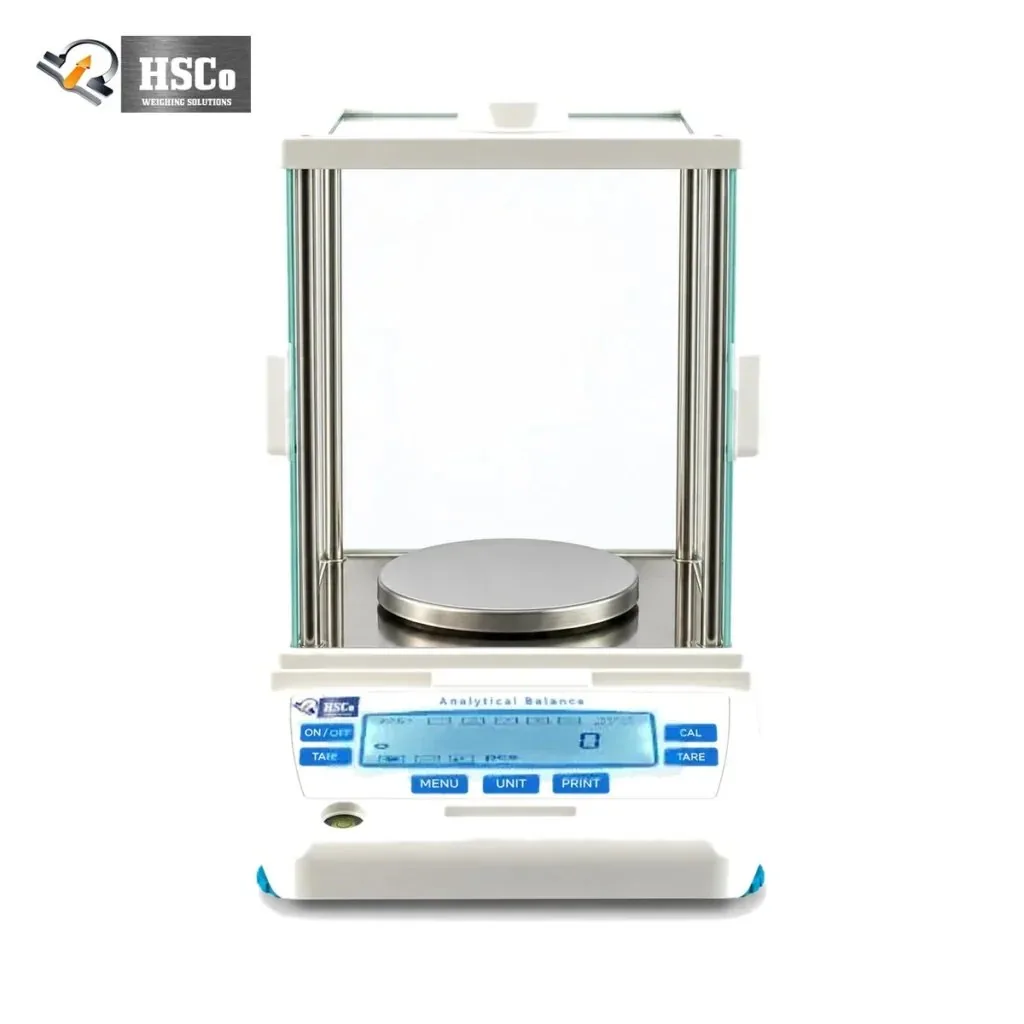
 LAB220.1 Analytical Balance: reads 0.1 mg up to 220 g, with an electromagnetic monoblock sensor, a glass draft shield and a calibration weight in the box. For pharma, formulation and gemmology labs [2].
- LAB220.1E Analytical Balance: 220 g × 0.1 mg with external calibration, repeatability ±0.1 mg, an 80 mm pan and an RS-232 port. For labs that calibrate with an external weight [3].
- LAB220.2I Analytical Balance: 220 g × 0.1 mg with internal calibration, a response of 2 seconds or less, 17 units and a rechargeable battery. For labs with frequent power cuts [4].
- LAB301 Laboratory Balance: reads 1 mg up to 300 g, with battery backup and an RS232 port [5].
All our lab balances are on the precision scales page. Tell us your smallest sample and how often you calibrate: call +91-7045922250 or write to hsc@hindustanscale.com.
Frequently asked questions
What is the minimum weight on a 0.1 mg analytical balance?
On a 0.1 mg analytical balance stamped as Class I, the verification scale interval e is 1 mg, and the classification table in the Legal Metrology (General) Rules, 2011 gives a minimum capacity of 100 e, which is 100 mg [1]. Check the Min marked on the balance. The Rules describe minimum capacity as the load below which results may carry an excessive relative error [1].
Is a 0.1 mg analytical balance accurate to 0.1 mg?
Not necessarily. A 0.1 mg analytical balance reads in 0.1 mg steps, but on Class I the error limits at verification are counted in the verification scale interval e, which is 1 mg [1]. On a 220 g balance with a marked Min of 100 mg, the limits are ±0.5 mg from 100 mg up to 50 g, ±1 mg above 50 g up to 200 g, and ±1.5 mg above 200 g up to 220 g [1].
How often must a stamped analytical balance be re-verified?
A stamped analytical balance used in a transaction must be re-verified every 12 months under rule 27(2)(c) of the Legal Metrology (General) Rules, 2011 [1]. Clauses (a) and (b) of the same rule set longer periods for weights, beam scales and storage tanks, among other items [1]. If you sell gems or other goods by weight on the analytical balance, plan the re-verification date when you buy it.
Sources
- Ministry of Consumer Affairs, Food and Public Distribution (copy hosted by the Legal Metrology Department, Meghalaya), “The Legal Metrology (General) Rules, 2011 (Gazette of India text)” (megweights.gov.in, 7 February 2011). G.S.R. 71(E); rule 27; Seventh Schedule, non-automatic weighing instruments, Tables 15, 17 and 20
- Hindustan Scale Company, “LAB220.1 Analytical Balance – 220 g × 0.1 mg, Electromagnetic Sensor” (hindustanscale.com). product page
- Hindustan Scale Company, “LAB220.1E Analytical Balance 220 g × 0.1 mg, External Calibration” (hindustanscale.com). product page
- Hindustan Scale Company, “LAB220.2I Analytical Balance – 220 g × 0.1 mg, Glass Draft Shield” (hindustanscale.com). product page
- Hindustan Scale Company, “LAB301 Laboratory Balance – 300 g × 1 mg, Battery Backup and RS232” (hindustanscale.com). product page
- Hindustan Scale Company, “E2 Class Stainless Steel Weights – 1 mg to 50 kg, for Analytical Balances” (hindustanscale.com). product page