
Blogs
Which moisture analyzer for resin granules, and what sample size should you use?

Quick answer
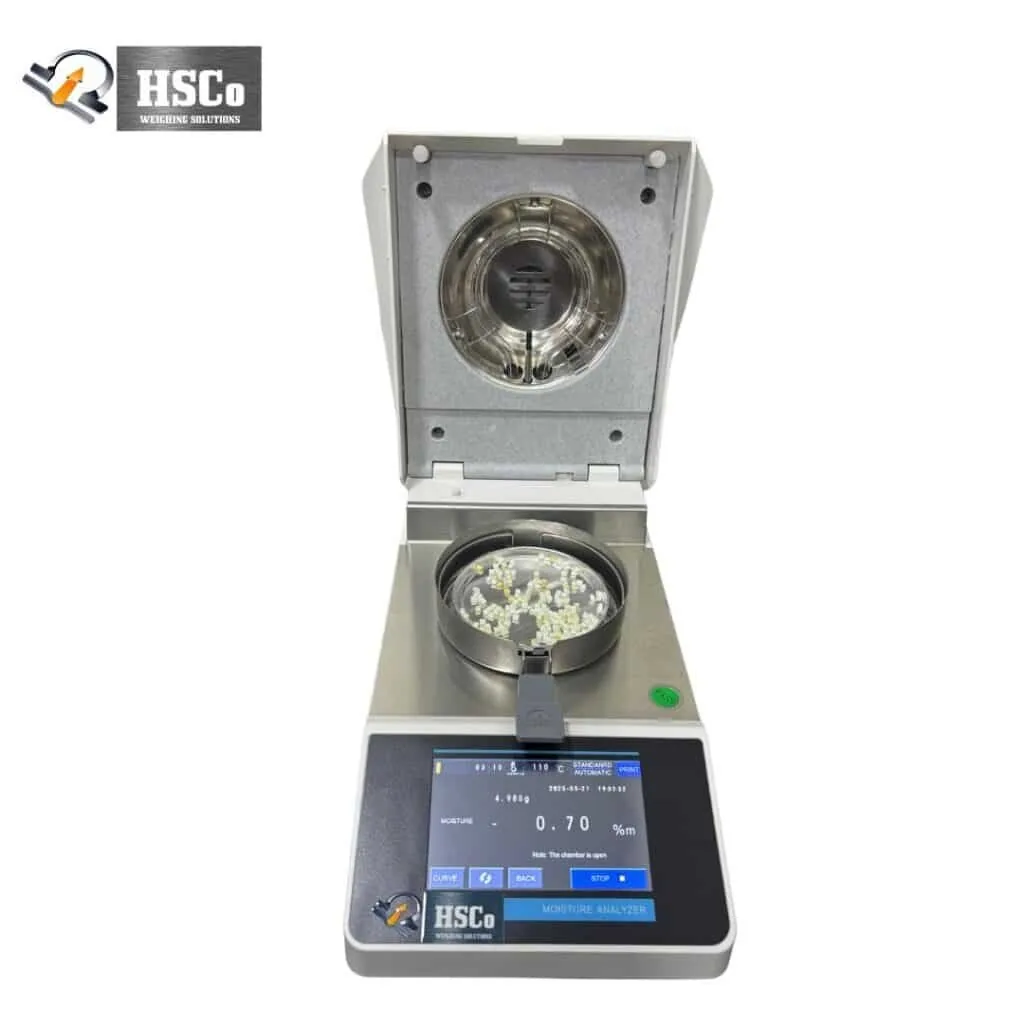
A halogen moisture analyzer for resin granules weighs a sample before and after drying [1]. Its readability divided by the sample weight gives a nominal step: on the MA110.1 from Hindustan Scale Company (HSCo), which reads 0.001 g, 10 g gives 0.01% per balance step [1]. Polycarbonate is often dried to 0.02% or less [9, 10], close to that step, so check the method on your grade.
ISO 15512:2019, the standard for water in plastics, gives each of its methods a lower limit: Method A goes down to 0.1%, Methods B, C and D to 0.01%, and Method E to 0.001% [5]. The standard adds that these limits depend also on the largest sample mass a method can take [5, 6].
Which resins need a moisture check before moulding?
Wet granules cause bubbles, splay and weak parts, so a plastics plant checks granule moisture before moulding [4]. Nylon and polycarbonate both take up water from the air, so they are checked and dried before processing when the grade and its measured moisture call for it [9]. In nylon, too much water at melt temperature lowers the molecular weight of the polymer, and the moulded parts lose strength [7, 9].
What moisture level should resin granules reach before moulding?
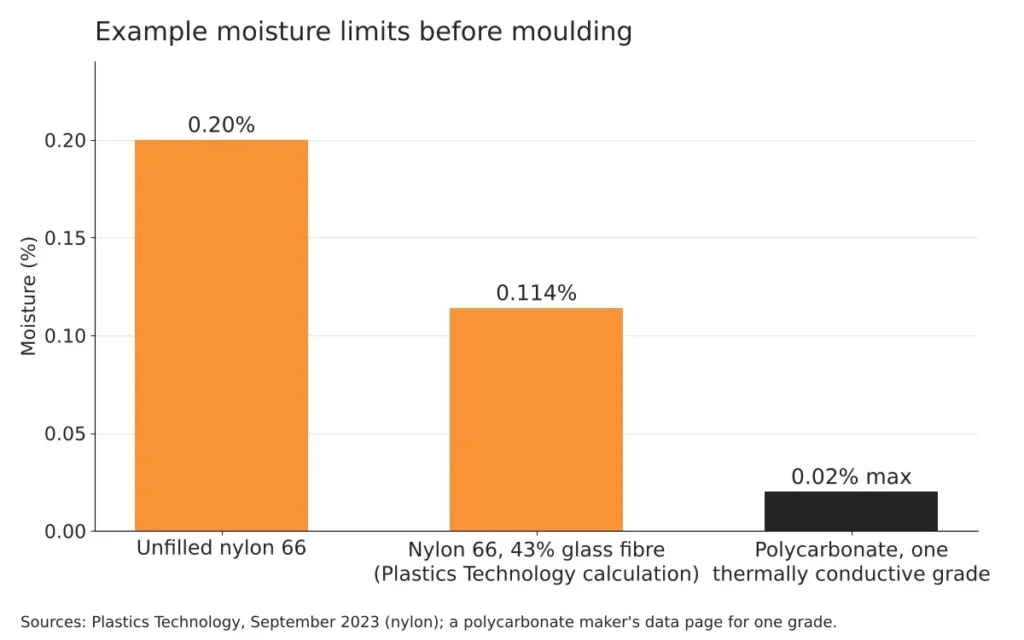
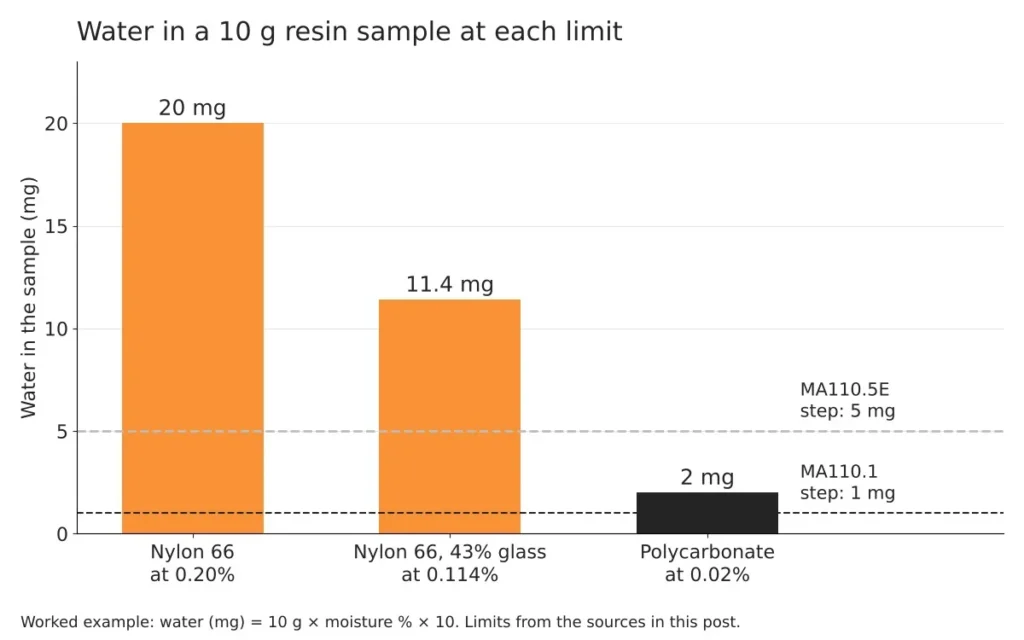
Your resin supplier’s datasheet sets the limit for each grade. A datasheet for unfilled nylon 66 cited by Plastics Technology allows up to 0.20%, and a nylon compounder’s guide gives 0.02% to 0.20% as the typical window for unfilled nylon [7, 8]. The Madison Group, a plastics engineering consultancy, puts resins dried against hydrolysis, the breakdown of the polymer by water, at typically under 0.02% [9]. One polycarbonate maker’s data page for a thermally conductive grade lists a maximum of 0.02% moisture [10].
Glass fibre lowers the nylon limit. Plastics Technology published a method that multiplies the unfilled limit by the share of the compound that is polymer: if 0.20% suits the unfilled grade, a nylon 66 with 43% glass fibre gets 0.20% × 57% = 0.114% [7]. The same column ties these limits to control of melt temperature and barrel residence time [7].
How small a moisture change can a moisture analyzer for resin show?
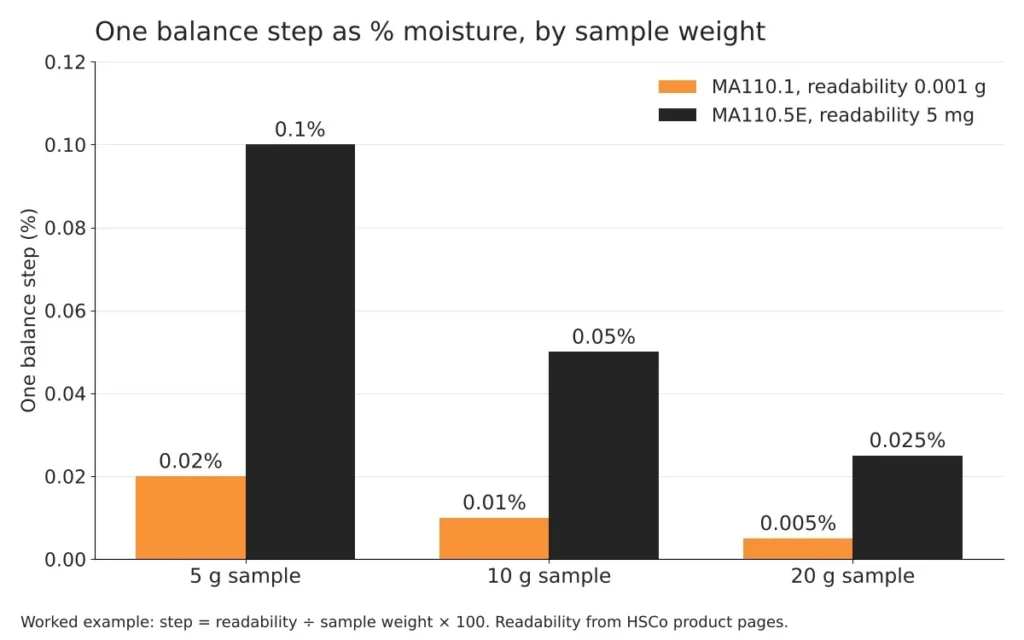
A halogen analyzer weighs the sample, dries it with a halogen lamp and reads the weight lost as moisture [1]. Each balance step is a fixed weight, set by the readability: 0.001 g on the MA110.1 [1] and 5 mg on the MA110.5E [2]. A heavier sample turns that balance step into a smaller percentage. The table shows this ideal weight equivalent, not the accuracy you will get on a resin.
One balance step (% moisture) = readability (g) ÷ sample weight (g) × 100
| Sample weight | MA110.1 balance step (0.001 g) | MA110.5E balance step (5 mg) | Water in the sample at 0.02% |
|---|---|---|---|
| 5 g | 0.02% | 0.1% | 1 mg |
| 10 g | 0.01% | 0.05% | 2 mg |
| 20 g | 0.005% | 0.025% | 4 mg |
Unfilled nylon 66 at 0.20% has 20 mg of water in a 10 g sample: 20 balance steps on the MA110.1 and 4 on the MA110.5E.
Does a halogen moisture analyzer measure only water in resin?
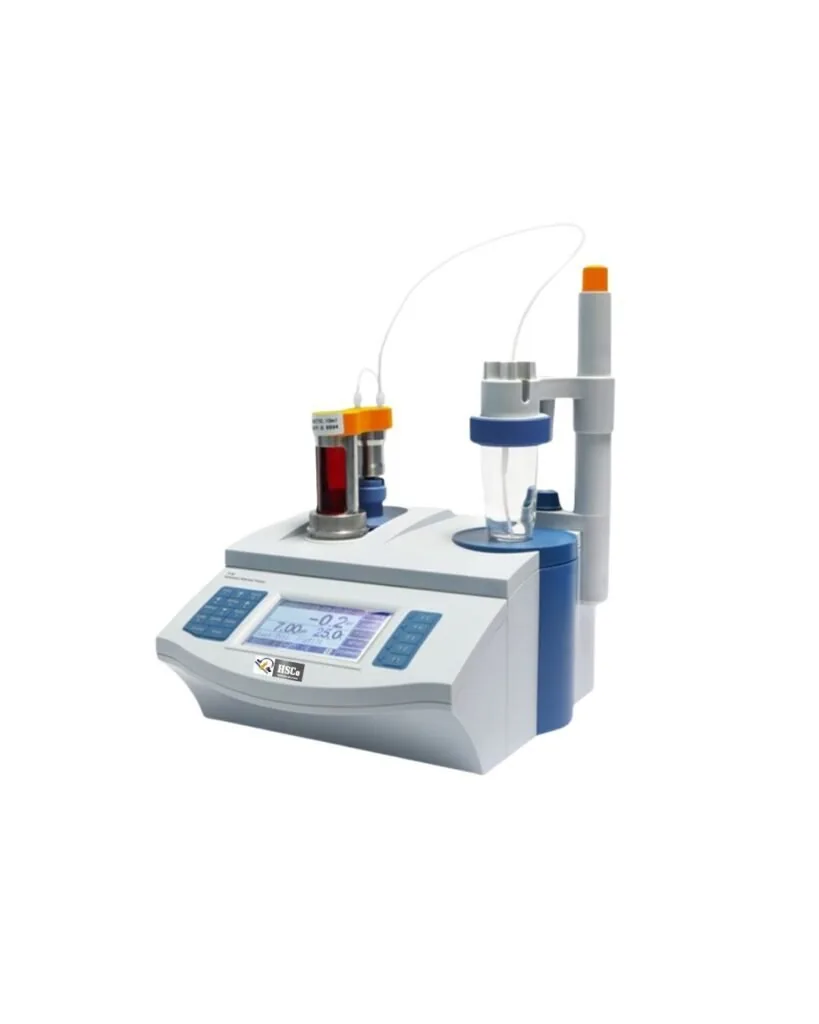
A halogen analyzer counts all the weight the sample loses while it heats, including volatiles other than water [1, 8]. A moisture-specific method targets the water instead [8]. Not every method in ISO 15512 is water-specific: the standard says its manometric Method C does not suit plastics that hold other volatiles in amounts that add significantly to the vapour pressure [5]. Method A of ISO 15512 extracts the water with methanol and measures it by Karl Fischer titration [5]. When your customer’s specification names a Karl Fischer method of ISO 15512, or your limit sits below what your sample weight can resolve, ask us about the HSC-KFT and the sample preparation that method needs. Its coulometric model measures from 10 µg of water up to 5% water [3].
How do you test resin granules on a halogen moisture analyzer?
- Take the sample from the dryer just before moulding and keep it covered until you weigh it, as dried resin takes up moisture from room air [9].
- Keep the sample weight fixed. On the MA110.1, 10 g makes one balance step 0.01%; on the MA110.5E, 20 g makes it 0.025%.
- Before routine use, test separate portions of several lots on the halogen analyzer and by your customer’s reference method, across the moisture range you expect, and agree how large a difference you will accept. Spread the granules evenly on the pan. The MA110.1 dries at 40 to 180 °C, stores 12 methods and sends results through RS232 [1].
Which HSCo moisture analyzer fits a plastics plant?
Our plastics industry page lists the MA110.1 against bubbles and splay from wet granules [4]. HSCo tests a buyer’s sample free of charge before the purchase [1].



Compare the three on our halogen moisture analyzers page, or see other equipment for moulders on our plastics industry page. To arrange a free test of your resin sample, call +91-7045922250 or write to hsc@hindustanscale.com.
Frequently asked questions
What moisture level is acceptable for nylon before moulding?
A datasheet for unfilled nylon 66 cited by Plastics Technology allows up to 0.20% moisture before moulding, and the column calls that appropriate when melt temperature and residence time are controlled [7, 8]. Glass-filled nylon needs less. Plastics Technology multiplies 0.20% by the polymer share, so nylon 66 with 43% glass fibre gets 0.114% [7]. Your resin supplier’s datasheet for the exact grade sets the final limit.
Can a halogen moisture analyzer test polycarbonate granules?
Yes, if the drying method is checked on your grade. Polycarbonate is often dried to 0.02% or less [9, 10]. On the MA110.1, which reads 0.001 g [1], a 10 g sample at 0.02% holds 2 mg of water, two nominal balance steps. This is a worked example, not a detection limit. For a certificate or a dispute, use the method your customer names, and ask us how the HSC-KFT [3] is set up for it.
Why can a moisture analyzer read higher than Karl Fischer on the same resin?
A halogen moisture analyzer reads every milligram the resin loses while it heats, including volatiles other than water [1, 8]. Karl Fischer titration targets the water, so with sample preparation that keeps other volatiles from interfering, it can read lower than a halogen result on a resin that gives off such volatiles [3, 8].
What sample size should I use in a moisture analyzer for resin?
No single weight suits every resin. On a 0.001 g analyzer such as the MA110.1 [1], 10 g gives an ideal 0.01% per balance step and 20 g gives 0.005%. On a 5 mg analyzer such as the MA110.5E [2], 20 g gives 0.025%. Confirm the weight against a reference method on your own resin.
Sources
- Hindustan Scale Company, “MA110.1 Halogen Moisture Analyzer – 110 g x 0.001 g, 5-inch Touchscreen” (hindustanscale.com). Product page
- Hindustan Scale Company, “MA110.5E Moisture Analyzer – 110 g x 5 mg, Halogen, Touch Screen” (hindustanscale.com). Product page
- Hindustan Scale Company, “Karl Fischer Titrator HSC-KFT – Coulometric or Volumetric Moisture Analysis” (hindustanscale.com). Product page
- Hindustan Scale Company, “Weighing Scales for the Plastics and Polymer Industry” (hindustanscale.com). Industry page
- International Organization for Standardization, “ISO 15512:2019 Plastics – Determination of water content” (iso.org, 30 April 2019). Abstract of the standard
- Estonian Centre for Standardisation and Accreditation, “EVS-EN ISO 15512:2019 Plastics – Determination of water content” (evs.ee, 17 June 2019). Scope of the European adoption of ISO 15512:2019
- Plastics Technology, “What is the Allowable Moisture Content in Nylons? It Depends (Part 1)” (ptonline.com). Column by Michael Sepe, September 2023 issue
- Teknor Apex, “6 FAQs: Drying Nylon Resin for Injection Molding” (www.teknorapex.com, 30 June 2021). Blog post by Dan Mesyn; https://www.teknorapex.com/en-us/resources/blogs/6-faqs-drying-nylon-resin-for-injection-molding
- The Madison Group, “Drying of the Resin in Plastic Manufacturing” (madisongroup.com, 19 January 2023). Article by Erik Foltz
- Covestro, “Makrolon TC110” (covestro.com). Product data page, thermally conductive polycarbonate: moisture content max. 0-0.02%, dry 4 h at 120 °C