
Blogs
Moisture meter readings that differ on the same paddy, and which one counts

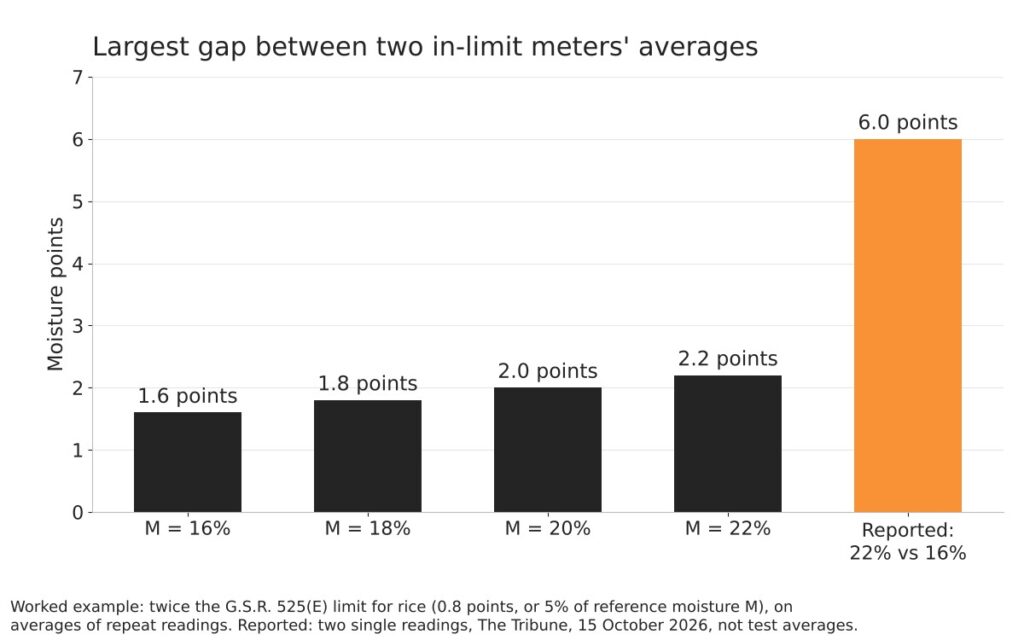
Since 1 January 2026, India’s Legal Metrology rules allow a grain moisture meter for rice, pulses and corn an error at verification or inspection of 0.8 points, or 5% of reference moisture where larger, on the average of repeat readings [1]. Averaged moisture meter readings from two in-limit meters can differ by at most twice that. A Ludhiana official called Punjab Mandi Board meters final, The Tribune reported [2].
Farmers in Punjab said agencies, Mandi Board officials, commission agents and rice millers tested paddy on their own machines and got clashing readings, The Tribune reported on 15 October 2026 [2]. One meter showed 22% and another 16% for the same lot, farmers said, and alleged that some buyers rejected paddy or deducted about ₹250 a quintal on the higher reading [2]. In Rupnagar district, the Deputy Commissioner directed on 22 September 2026 that, for government procurement in the 2026-27 kharif season, only paddy meeting the prescribed standards with no more than 17% moisture would be bought [5].
How far apart can two moisture meter readings be?
About twice the limit for one meter, comparing each meter’s average of repeat readings under the conditions the rules set [1]. Agreement between two meters does not prove either is accurate.
Allowed error = the larger of 0.8 points or 0.05 × reference moisture M
| Reference moisture M | Limit on one meter’s average error | Most two in-limit averages can differ |
|---|---|---|
| 16% | ± 0.8 points | 1.6 points |
| 18% | ± 0.9 points | 1.8 points |
| 20% | ± 1.0 points | 2.0 points |
| 22% | ± 1.1 points | 2.2 points |
If the paddy truly held 22%, the reported 6-point gap is about 2.7 times the bound in the last column [1, 2]. Those were two single readings farmers quoted, not averages, so the gap alone does not prove either meter breaks the rules. To find the meter that is off, compare each meter’s average of repeat readings with a reference method, such as the air oven, on portions of the same sample [1]. Both may prove to be off.
Why do two meters read the same paddy differently?
A rapid grain moisture meter measures an electrical or optical property of the grain and predicts moisture through a calibration for each grain type [1, 10]. Four things move that prediction:
- The grain setting. A meter set to another grain is outside its calibration [10].
- The crop year. The effect of moisture on the grain’s properties can change with the crop, so the rules provide for calibration updates [1].
- Temperature. A meter must cope with at least a 10 °C difference between sample and meter, within limits the maker states [1].
- The sample. Density, chemical make-up and impurities interfere with the signal from water [10].
What does a 6-point moisture gap mean for a quintal of paddy?
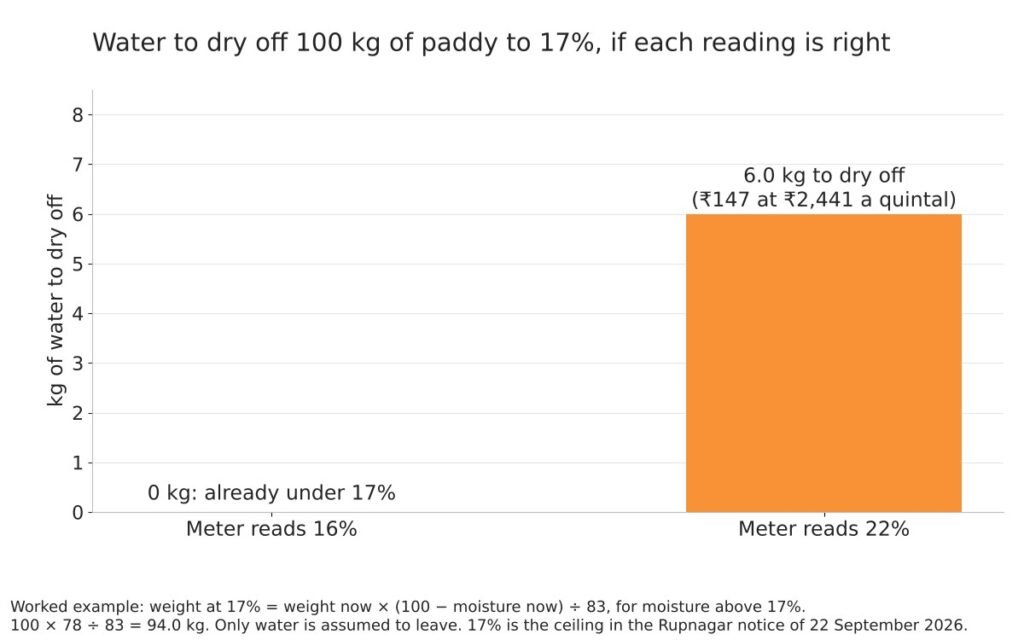
It can decide whether the paddy is bought as it is or dried first. If the 22% reading is right, each 100 kg must shed about 6 kg of water to reach 17%, the procurement ceiling in the Rupnagar notice [5]; if the 16% reading is right, no further drying is needed to meet that ceiling. Only water is assumed to leave.
Weight at 17% = weight now × (100 − moisture now) ÷ 83, for wet-basis moisture above 17%
| If the 22% reading is right | 1 quintal (100 kg) | 50 quintals |
|---|---|---|
| Weight once dried to 17% | 94.0 kg | 4,699 kg |
| Water to dry off | 6.0 kg | 301 kg |
| Water weight priced at ₹2,441 a quintal, for comparison only | ₹147 | ₹7,352 |
₹2,441 a quintal is the minimum support price for common paddy for 2026-27 [3, 4]. The priced row is hypothetical, not a revenue loss, drying charge or authorised deduction.
Which moisture meter reading counts at the mandi?
In Ludhiana, the District Mandi Officer said the Punjab Mandi Board’s moisture meters were considered the legal and final authority, calibrated by Punjab Agricultural University, The Tribune reported on 15 October 2026 [2].
- Ask for the reading on the meter the buying agency treats as final before you accept a cut; in Ludhiana, the officer named the Mandi Board’s meter [2].
- Check that each meter is set to paddy, since calibrations are made per grain [10].
- Test the same sample on both meters, with the sample and the meters inside the temperature limits the makers state [1].
- At a mill, keep a weight-loss check as a second opinion. A halogen moisture analyser weighs, dries and reads moisture from the weight lost [9].
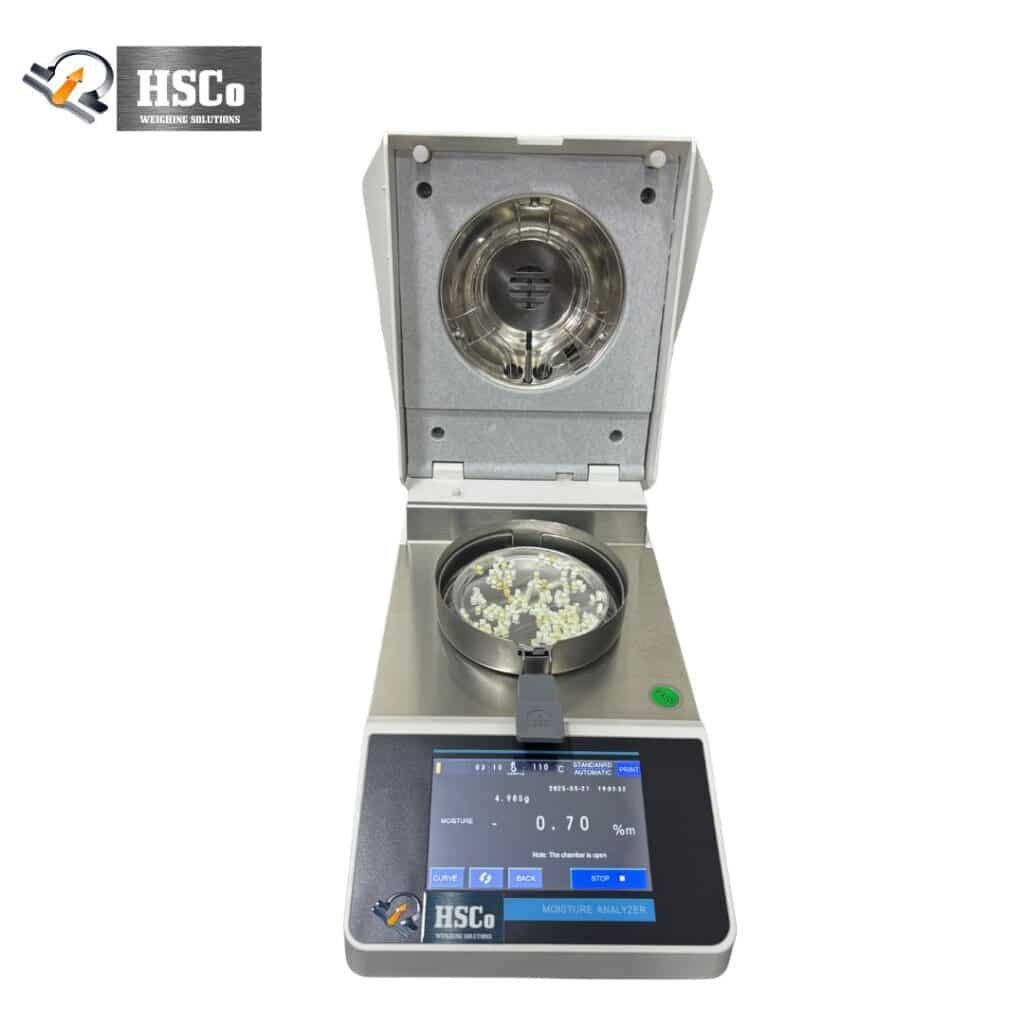
Which HSCo instruments help settle a moisture reading?
The first two read moisture; the third weighs the bags.

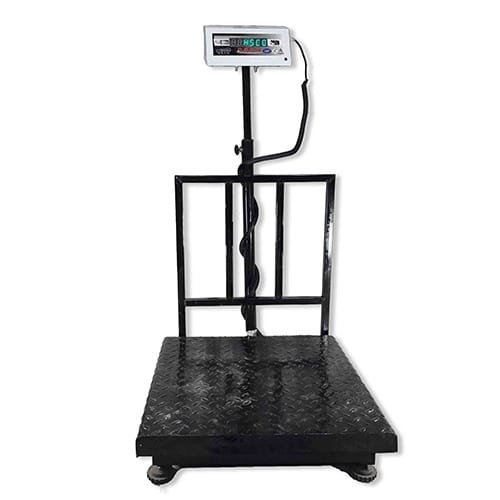
Our post on paddy moisture and weight works through drying losses from 18% to 24%; more farm instruments are on our weighing scales for agriculture page. Tell us what you test and how many lots a day: call +91-7045922250 or write to hsc@hindustanscale.com.
Frequently asked questions
How accurate should a grain moisture meter be?
Under Part XII of the Eighth Schedule to the Legal Metrology (General) Rules, 2011, in force from 1 January 2026, a grain moisture meter for corn, oats, pulses, rice, sorghum or sunflower may be off by 0.8 points, or 5% of the reference moisture if larger, at verification or inspection [1]. The error is taken on the average of repeat readings, so at 20% the limit is 1.0 point.
Why does my moisture meter read differently from the mandi’s meter?
A rapid grain moisture meter predicts moisture from an electrical or optical signal through a calibration for each grain type, and the grain setting, crop year, temperature and the sample’s density and impurities can all move the reading [1, 10]. In Ludhiana, an official called the Mandi Board’s meters the final authority, The Tribune reported on 15 October 2026 [2].
What is the moisture limit for buying paddy in Rupnagar in 2026?
In Punjab’s Rupnagar district, the Deputy Commissioner directed on 22 September 2026 that, for government procurement in the 2026-27 kharif season, only paddy meeting the prescribed standards with no more than 17% moisture would be bought [5]. The notice asked farmers to dry the crop well, bring it clean, and have moisture tested before the heaps enter the mandi [5]. The minimum support price for common paddy in 2026-27 is ₹2,441 a quintal [3, 4].
How is grain moisture measured by the oven method?
The air oven method heats a weighed grain sample at a set temperature for a set time and weighs it again; the mass lost is counted as water. The Legal Metrology rules note that most air oven methods take hours or days [1]. A halogen moisture analyser works on the same weight-loss idea and gives a result in minutes [9].
Sources
- Department of Consumer Affairs, Government of India, “G.S.R. 525(E), Legal Metrology (General) Fourth Amendment Rules, 2025 (Eighth Schedule, Part XII: Moisture meters for cereal grains and oilseeds)” (consumeraffairs.gov.in, 4 August 2025). In force from 1 January 2026
- The Tribune, “Farmers flag moisture meter discrepancies in paddy procurement in Ludhiana” (tribuneindia.com, 15 October 2026).
- Press Information Bureau, “Cabinet approves Minimum Support Prices (MSP) for Kharif Crops for Marketing Season 2026-27” (pib.gov.in, 13 May 2026).
- Outlook Business, “Govt Hikes Paddy MSP by ₹72 to ₹2,441/qtl; Sunflower Seed Sees Steepest Rise at ₹622” (outlookbusiness.com, 13 May 2026). PTI
- Deputy Commissioner, Rupnagar, “Deputy Commissioner appeals to farmers to bring only dry paddy with moisture content up to 17 percent in the market” (rupnagar.nic.in, 22 September 2026).
- Hindustan Scale Company, “Hand-Held Fibre Moisture Meter TK100 – 0 to 80%, ±0.5%, Long Probes, Backlit LCD” (hindustanscale.com). Checked October 2026
- Hindustan Scale Company, “MA110.5E Moisture Analyzer – 110 g × 5 mg, Halogen, Touch Screen” (hindustanscale.com).
- Hindustan Scale Company, “PLCHQB Platform Scale – Chequered MS Plate, 500 / 1,000 kg, Dual Display” (hindustanscale.com).
- Hindustan Scale Company, “MA110.1 Halogen Moisture Analyzer – 110 g × 0.001 g, 5-inch Touchscreen” (hindustanscale.com). How a moisture analyser works
- International Organization of Legal Metrology (OIML), “OIML R 59-1:2016, Moisture meters for cereal grains and oilseeds. Part 1: Metrological and technical requirements” (oiml.org). Edition 2016; Introduction