
How direct load-cell tank weighing removes the temperature-correction chain that volume custody transfer depends on, and how traceable, logged records close the reconciliation gap that un-logged measurement leaves behind for oil & gas, edible-oil and bulk-liquid custody-transfer managers.
Custody transfer settled on volume carries two independent exposures a temperature-driven correction chain that volume measurement cannot escape, and reconciliation gaps that open wherever measurement records are not traceably logged and weighing the product directly, against a logged record, retires both.
For a custody-transfer manager moving crude, refined product or edible oil, the number that settles the invoice and the royalty is the quantity that changed hands.
This white paper makes two distinct arguments and keeps them distinct. First, the physics: liquid hydrocarbons and oils expand when warm and contract when cool, so volume custody transfer must be corrected to a 15 °C reference using a Volume Correction Factor under API MPMS Chapter 11.1 whereas mass is conserved and needs no temperature or pressure correction at all. Second, the records: where a measurement end lacks traceable, logged audit trails, reconciliation gaps persist regardless of how the quantity is measured as India’s Comptroller and Auditor General found when ONGC crude ran consistently short between offshore dispatch and the Uran inlet even though both ends measured at the same 15 °C.

1. Custody transfer is the one measurement where an error becomes money the moment it is recorded.
For oil & gas, edible-oil and bulk-liquid operations, the custody-transfer reading is the figure that settles the invoice, the royalty and the duty. How that figure is produced and whether it can be defended decides whether what you ship is what you are paid for.
Every custody transfer reduces a tank or pipeline movement to a single quantity that an invoice, a tax filing and an audit all inherit. If that quantity is derived from volume, it is hostage to temperature until it is corrected; if the record of it is not logged with a traceable trail, a persistent shortfall cannot be told apart from measurement scatter. Both exposures sit on the same reading, and most operations manage neither deliberately.
Three risks, one custody figure

Treat the first as a metering problem, the second as a paperwork problem and the third as an operations problem, and a single contested reading leaks into three separate disputes which is exactly how custody loss becomes permanent.
A volume reading tells you how much space the product fills at today’s temperature. A weighed reading tells you how much product there is. Only one of those two numbers is still true tomorrow, and only one of them does not need a correction table to be believed.
2. The standards fix the physics and the audits expose the records both point the same way.
Two forces have converged: a settled metrology standard that makes the temperature-correction burden of volume measurement explicit, and a public audit that shows what happens when measurement records are not traceably logged.
The standard: volume must be corrected, mass need not
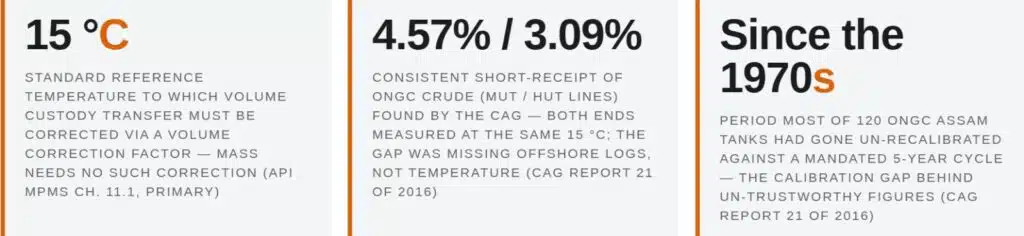
API MPMS Chapter 11.1 codifies the physics. Because liquid hydrocarbons and oils expand when warmer and contract when cooler than the reference temperature, gross observed volume must be multiplied by a Volume Correction Factor also termed the Correction for the effect of Temperature on Liquid to obtain net volume at a standard reference temperature of 15 °C (the 60 °F point the standard is named around). This correction is required for fiscal and royalty measurement. Direct mass measurement requires no such correction, because mass is conserved.
The audit: records, not metering, decide the gap
India’s Comptroller and Auditor General, in Report No. 21 of 2016, found that ONGC crude dispatched from offshore platforms consistently exceeded crude received at the Uran inlet an average difference of 4.57% on the Mumbai-Uran Trunk line and 3.09% on the Heera-Uran Trunk line over August 2014 to August 2015.
And calibration had lapsed for decades

Average short-receipt over Aug 2014–Aug 2015 with both ends measured at the same 15 °C; the gap is attributed to missing offshore logs, not temperature. Source: CAG Report No. 21 of 2016.

3. A custody quantity fails in five predictable ways and volume-only, un-logged measurement is open to all five.
A wrong custody figure rarely announces itself. It arrives through a small, repeatable set of gaps that exploit the temperature-dependence of volume and the absence of a traceable record.
None of these is dramatic on a single transfer, which is exactly why they compound into real quantity and real money before anyone investigates.
1. Temperature left uncorrected
A gross observed volume settled without correcting to the 15 °C reference under API MPMS 11.1 so the same product reads as a different quantity warm versus cool, and the invoice moves with the weather.
2. Mis-applied correction factor
3. No traceable log at one end
4. Lapsed calibration
Instruments drift un-checked, as the CAG found with ONGC’s Assam tanks un-recalibrated since the 1970s against a 5-year cycle, so a reading looks authoritative while being quietly out of tolerance.
5. Gap written off blind
A persistent short-receipt is absorbed into a standing loss allowance, mixing genuine handling loss, measurement scatter and possible human error into one figure that is never reconciled or recovered.
Why the fix is mass plus a logged record, not five patches
Failures 1 and 2 live in the temperature-correction chain; failures 3, 4 and 5 live in the record. Measuring mass directly removes the first chain entirely, and a traceable, immutable log with exception alerts closes the second which is why the answer is two deliberate controls, not five manual workarounds scattered along the line.
Mechanism Note: this section describes operational failure modes. The CAG 4.57% / 3.09% short-receipt and the 1970s / 5-year calibration finding are attributed in the evidence base and reflect missing logs, human error and lapsed calibration not temperature, which the CAG states was controlled at 15 °C at both ends. The temperature-correction point is cited to API MPMS 11.1 separately. No quantified loss-recovery efficacy is claimed for mass measurement or logging, as none is within the verified evidence for this paper.
4. Mass is conserved, so weighing the product retires the temperature-correction chain altogether.
The physical answer to the temperature half of the problem is to stop inferring quantity from a volume that changes with the thermometer, and to weigh the product directly at the vessel.
Why mass does not move with temperature
When a liquid warms it expands and when it cools it contracts, so its volume changes while its mass does not. That is why volume custody transfer must run the VCF chain back to a 15 °C reference under API MPMS 11.1 and why a direct mass measurement needs no temperature or pressure correction at all. Weighing the product converts the custody quantity into the one property that the thermometer cannot touch.
Load cells read the contents at the vessel
Load-cell tank weighing places compression or S-type modules under a tank’s legs or supports and derives product mass directly from the vessel a standard industrial technique for batching, inventory and transfer accountability. Because the reading is a weight, it is unaffected by the density shifts, thermal expansion and reference-temperature bookkeeping that volume methods must account for. HSCo markets this category as the Industrial IBC Tank Weighing Scale, the Static Indoor Tank Weighing System and the Static Outdoor Tank Weighing System (specifications manufacturer-stated; see Section 06).
A weighed figure is a simpler defence
A volume figure is only as defensible as the correction applied to it: the temperature reading, the density, the table version and the arithmetic all have to be right and all have to be shown. A weighed figure carries none of that derivation it is what the scale read, traceable to calibration, captured once. Fewer steps between the product and the number mean fewer places for a custody dispute to take hold.

Volume is a measurement of how much space the product takes up at a temperature; mass is a measurement of how much product there is. Settle custody on the second and the correction table and the argument over which version of it applied simply never enters the conversation.

5. A weighed figure only closes the gap once it is captured once and logged where it cannot be quietly changed.
Direct mass measurement answers the physics.
Capture each weighing once, automatically
IoT data capture takes each tank weighing with its timestamp and the identity of the calibrated instrument it was taken on no manual key-in, no re-entry into a separate ledger. This removes the transcription step where the CAG found the likely human error, and it makes both ends of a transfer record the same way, so their figures are comparable rather than contestable.
Write to an immutable, traceable log
With the Blue Whale Technology cloud layer, every weighing becomes an attributable, immutable record who, what, when, how much, on which instrument the electronic log and audit trail the CAG found present and tallying at ONGC’s Uran inlet and absent at the offshore dispatch end. One source of truth a dispatcher, a counterparty and an auditor can all read the same way is what turns a custody figure from an assertion into evidence.
Feed the settlement systems without re-keying
The verified figure flows into ERP and e-way-bill workflows directly, so the quantity that settles the invoice and the duty is the quantity that was weighed not a number retyped along the way. Exception alerts raise an out-of-tolerance transfer as a specific, investigable event rather than letting it disappear into a standing loss allowance.

6. A weighed custody figure is only as defensible as the calibration and the record behind it.
The physics and the data layer produce a number.
Calibrate traceably, on the schedule the law expects
A weighed figure is only trustworthy if the instrument behind it is traceable to national standards. Calibration against weights traceable to national standards, performed by a NABL-accredited service with digital certificates, catches drift on a schedule rather than letting it masquerade as transfer loss precisely the discipline whose absence the CAG flagged when most ONGC Assam tanks went un-recalibrated since the 1970s against a mandated 5-year cycle.
Specify the assembly to your tanks
HSCo’s tank-weighing range is positioned for the vessel and the environment. The table below sets out the manufacturer-stated attributes of the relevant products; capacity, accuracy class, IP rating and load-cell type are quoted to requirement rather than fixed, and none is asserted here as an independently verified or legal-for-trade specification.


Manufacturer-stated capacity span for IBC sizes; illustrative, not an independently verified specification. Source: HSCo tank-weighing product range (manufacturer-stated).
7. Seventy years of weighing, certified for the sites you transfer across.
For an instrument whose reading settles an invoice, a royalty and a duty, accreditation is not decoration each standard answers a question a serious oil & gas, edible-oil or bulk-liquid custody-transfer manager must ask.
What each credential assures you


Built on seven decades, certified across the stack
Hindustan Scale Co. has manufactured weighing instruments since 1955; the Blue Whale Technology division adds the connected, audit-grade data layer. For a custody-transfer control, the assurances that matter most are PESO suitability for hazardous areas, NABL-traceable calibration behind the weighed figure, and the attributable, tamper-evident Blue Whale record the three that decide whether a custody number will stand up. The wider roster maps each credential to a question a custody-transfer manager is right to ask before trusting a number that moves money.
Certifications and accreditations are held by Hindustan Scale Co. / Blue Whale Technology at company or product-range level; the specific certification applicable to a given product configuration is confirmed at the point of supply. No OIML R76 or Indian Legal Metrology legal-for-trade / custody-transfer approval is claimed for the tank-weighing units in this paper.
8. A volume-only, un-logged transfer carries recurring exposure; weighing against a logged record is set up once.
Set the exposure a volume-only, un-logged custody transfer carries against what direct weighing and an immutable log return, and the payback is rarely in doubt.
What it costs you today
- A custody quantity that moves with temperature, settled through a VCF chain that has to be correct and shown every time.
- Figures with no traceable, time-stamped log indefensible the moment two ends disagree.
- Persistent short-receipts absorbed as ‘normal’ loss, with no specific transfer to investigate or recover against.
What protection returns
- A weighed figure that does not change with the thermometer and needs no temperature correction at all.
- Each reading captured once and written to an immutable Blue Whale audit log the logged trail the CAG found missing offshore.
- Exception alerts and ERP / e-way-bill feed that turn an out-of-tolerance transfer into a specific, recoverable event.
Next Step: A custody-transfer measurement review. We assess how your transfer quantity is produced and recorded today volume correction or direct mass, calibration status and traceability, where records are logged and where they are not, and the path into your ERP and e-way-bill workflow then scope load-cell tank weighing tied to an immutable, traceable Blue Whale audit log with exception alerts. Talk to Hindustan Scale Co. and Blue Whale Technology to schedule it.
References & sources.
Figures, standards and audit findings cited here are current as of June 2026. Primary sources are attributed; the temperature-correction physics (API MPMS 11.1) and the reconciliation-gap finding (CAG) are kept strictly distinct, as the CAG records both ONGC ends measured at the same 15 °C; manufacturer-stated and single-entity figures are identified as such. Direct mass measurement and logged records are presented as HSCo/Blue Whale’s recommended approach, supported by the cited evidence, not as separately quantified efficacy claims.
- API MPMS Chapter 11.1 — Temperature and Pressure Volume Correction Factors — American Petroleum Institute (primary standard).
- CAG Report No. 21 of 2016 — ONGC crude measurement, MUT / HUT short-receipt — Comptroller and Auditor General of India (primary).
- CAG Report No. 21 of 2016 — missing offshore logs and audit trails — Comptroller and Auditor General of India (primary).
- CAG Report No. 21 of 2016 — Assam tank calibration lapse — Comptroller and Auditor General of India (primary).
- Custody transfer — mass measurement for multi-field / offshore allocation — Wikipedia (secondary, contextual).
- HSCo tank-weighing product range (manufacturer-stated) — Hindustan Scale Company (manufacturer).
- Consumer Protection Act 2019 & 1986 (India) — short delivery as deficiency in service — Government of India / Consumer Dispute Redressal Commissions.
- Legal Metrology Act, 2009 (India) — Government of India.