
Blogs
Jowar price per kg at ₹100: how much does a short weight cost?

Quick answer
When the jowar price per kg is ₹100, every 10 g missing from a sale is worth ₹1, and every 1 kg missing from a sack is worth ₹100. Jowar reached that price in parts of North Karnataka in November 2026 [1, 2]. Weigh each sack on a stamped platform scale before you pay, and sell loose jowar on a stamped counter scale.
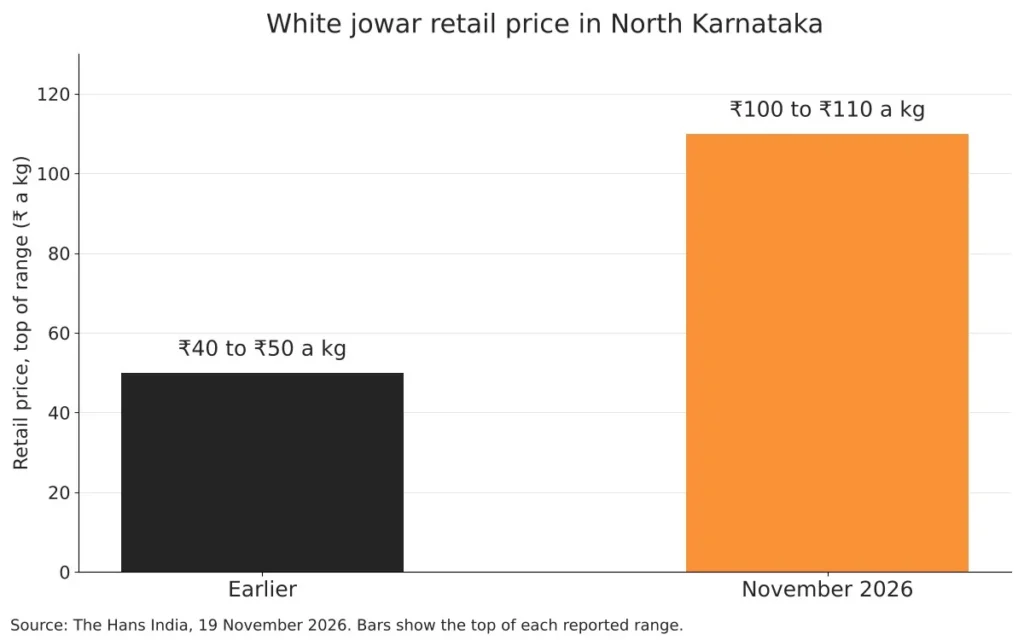
Asianet Newsable reported on 16 November 2026 that jowar had crossed ₹100 a kg in parts of North Karnataka [1]. The Hans India reported on 19 November 2026 that white jowar sold at ₹100 to ₹110 a kg in retail, up from ₹40 to ₹50, with wholesale rates above ₹10,000 a quintal against about ₹5,000 before [2]. Both reports name a smaller area under jowar and poor rain as causes, and say owners of khanavalis, the eateries that serve jolada rotti, fear they may have to raise meal prices [1, 2].
What does a short weight cost when the jowar price per kg is ₹100?
At ₹100 a kg, the loss in rupees is the number of grams short divided by 10. A quintal is 100 kg, so a wholesale rate of ₹10,000 a quintal is also ₹100 a kg [2]. The table shows the loss at ₹50, ₹100 and ₹110 a kg.
Money lost (₹) = grams short × price per kg ÷ 1,000
| Jowar short | At ₹50 a kg | At ₹100 a kg | At ₹110 a kg |
|---|---|---|---|
| 10 g | ₹0.50 | ₹1 | ₹1.10 |
| 50 g | ₹2.50 | ₹5 | ₹5.50 |
| 500 g | ₹25 | ₹50 | ₹55 |
| 1 kg | ₹50 | ₹100 | ₹110 |
| 2 kg | ₹100 | ₹200 | ₹220 |
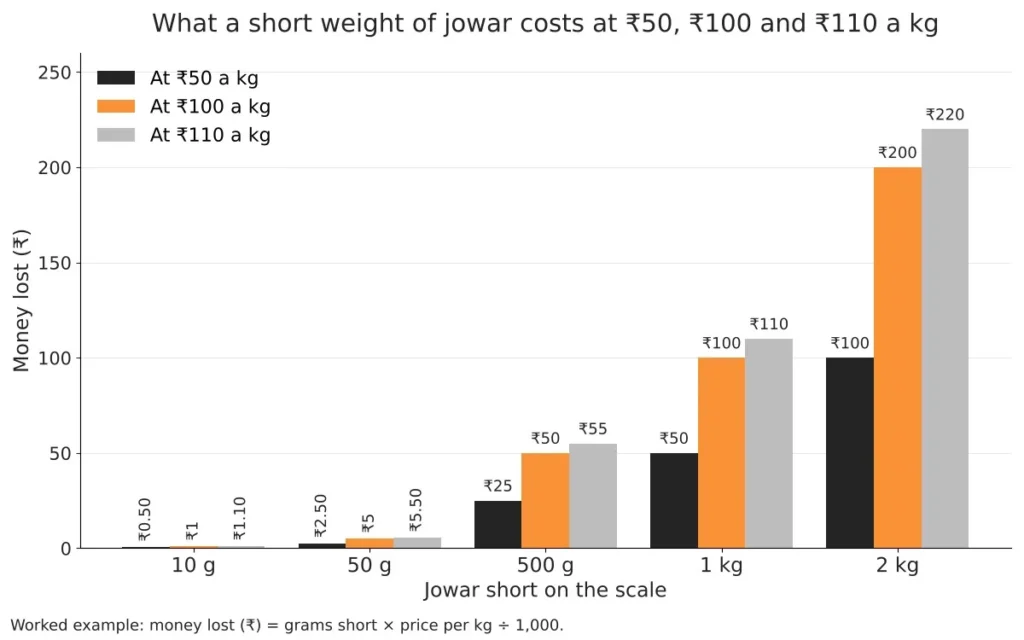
For the same weight short, the money lost rises in step with the price per kg. At ₹100 a kg it is twice the loss at ₹50, and two and a half times the loss at ₹40 [2].
How do you check the net weight of a jowar sack?
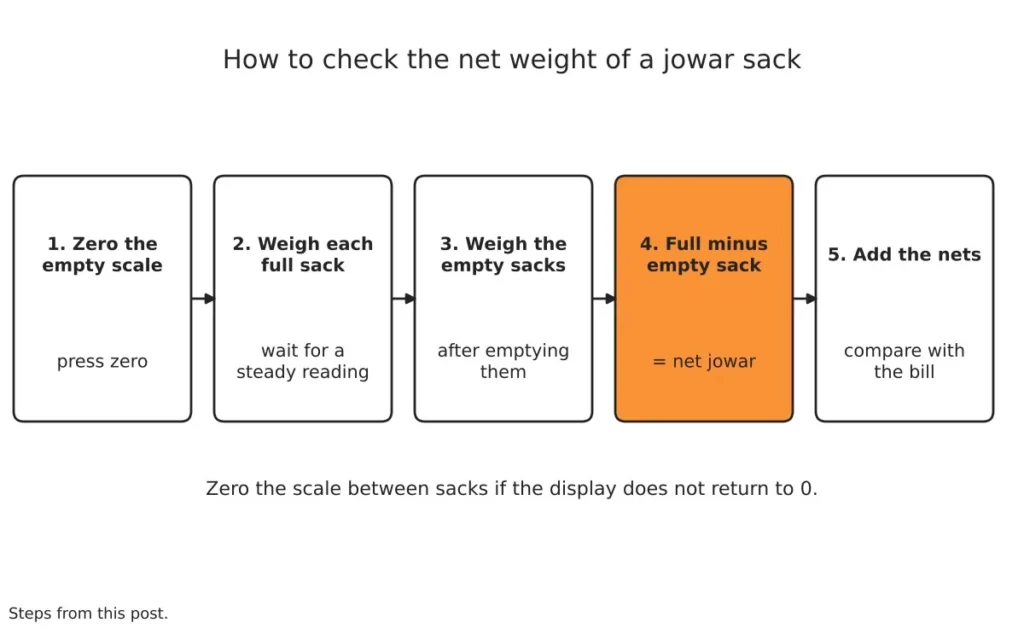
Weigh the full sack, take off the weight of the empty sack, and compare the result with the bill. Do it at delivery, before the money changes hands.
- Switch on the platform scale with nothing on it and press zero.
- Weigh each full sack in turn. Wait for the reading to settle before you write it down, and zero the scale between sacks if the display does not return to 0.
- Empty the sacks and weigh each empty sack. If you cannot empty them all, weigh a few empty sacks of the same kind, use their average, and treat the result as an estimate.
- Take each empty sack’s weight away from its full weight to get the net jowar.
- Add the net weights and compare the total with the kg on the bill.
A lot billed as 10 sacks of 50 kg is 500 kg, or ₹50,000 at ₹100 a kg. If each sack holds only 49.5 kg of grain, the lot is 5 kg short and ₹500 of the bill is for jowar you did not get.
Which scale should a kirana shop use to sell loose jowar?
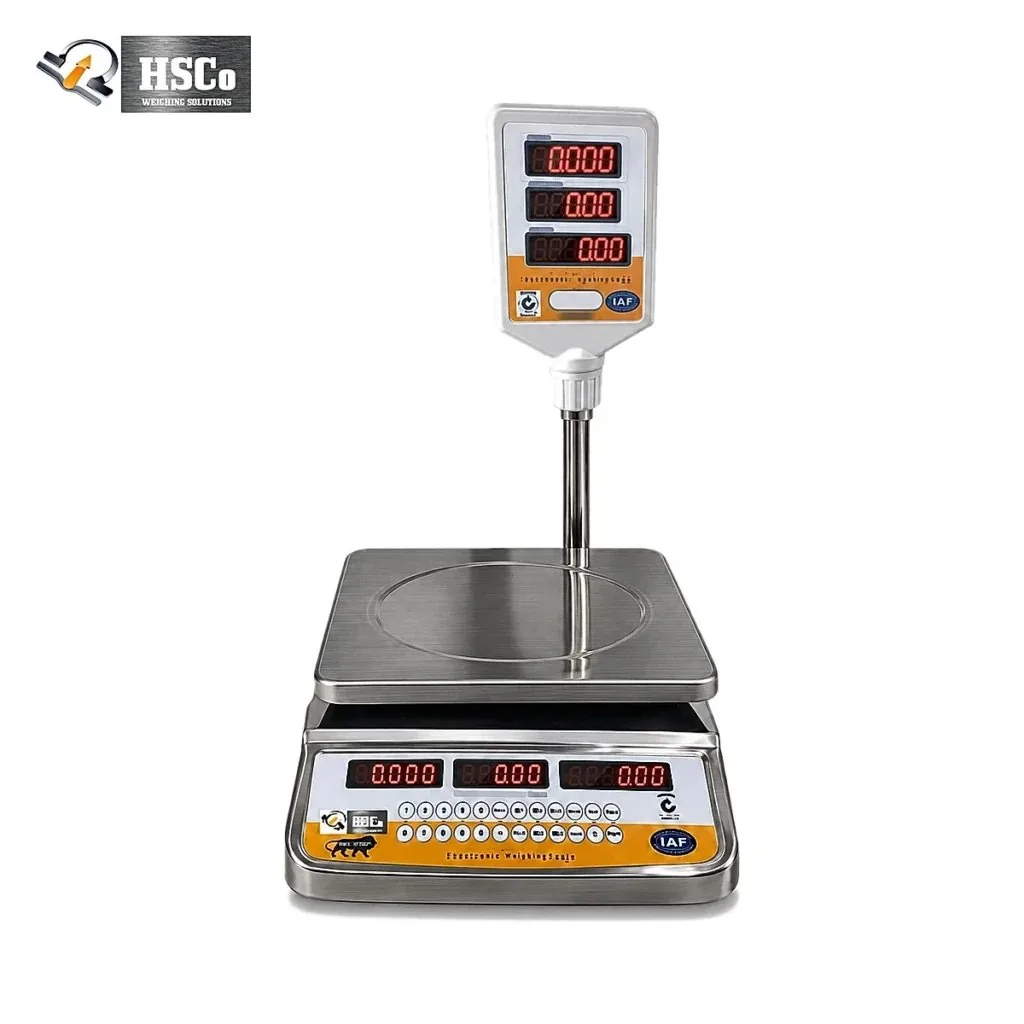
A counter scale that reads in 1 g steps and shows the price to the customer suits loose jowar. A price computing scale multiplies the weight by the rate you enter, so a 750 g sale at ₹110 a kg shows ₹82.50 without mental sums [6]. Our earlier post on what 1 g and 5 g steps cost works out the value of each step for onions.
Use the tare key for the bowl or bag. If you zero the empty tray, put jowar in a paper bag on it and skip tare, the displayed weight includes the bag, and the customer pays the jowar price for it.
Does the shop scale need a Legal Metrology stamp?
Yes, if you sell by weight. Section 24 of the Legal Metrology Act, 2009 requires a weight or measure that is used, or likely to be used, in a transaction to be verified [3]. Rule 27(2) of the Legal Metrology (General) Rules, 2011 sets 24 months for weights, capacity and length measures, beam scales and counter machines [4, 8], and 60 months for storage tanks [4]. The 18 December 2025 amendment added fuel dispensers for petrol and diesel to the 24-month list [8]. An electronic shop scale is in neither list, so the twelve months of clause (c) applies to it [4]. Rule 27 also requires re-verification before use if a stamped scale is repaired before its due date [4]. Between verifications, place a stamped calibration weight on the scale and compare the reading with the value marked on the weight [7].
Which HSCo scale fits a grain shop or a khanavali store room?
For a grain shop, pair a platform scale for sacks with a counter scale for loose sales, and keep a calibration weight to check them. A khanavali that buys jowar by the sack can use the platform scale to check each delivery. Choose a capacity above the whole load, sack and all, so a 50 kg sack needs the 100 kg model or larger. Choose a platform the sack sits on fully.
 PLCHQS electronic platform scale: comes in 50, 100, 150, 250 and 300 kg, with an accuracy of 10 g on the 100 and 150 kg models, a chequered steel platform, tare and a display on both sides [5]. For checking sacks at delivery.
- PRCSSP price computing scale: weighs up to 30 kg in 1 g steps on a 250 × 300 mm stainless tray and shows weight, rate and total to you and the customer, with 6 price memories [6]. For loose jowar at the counter.
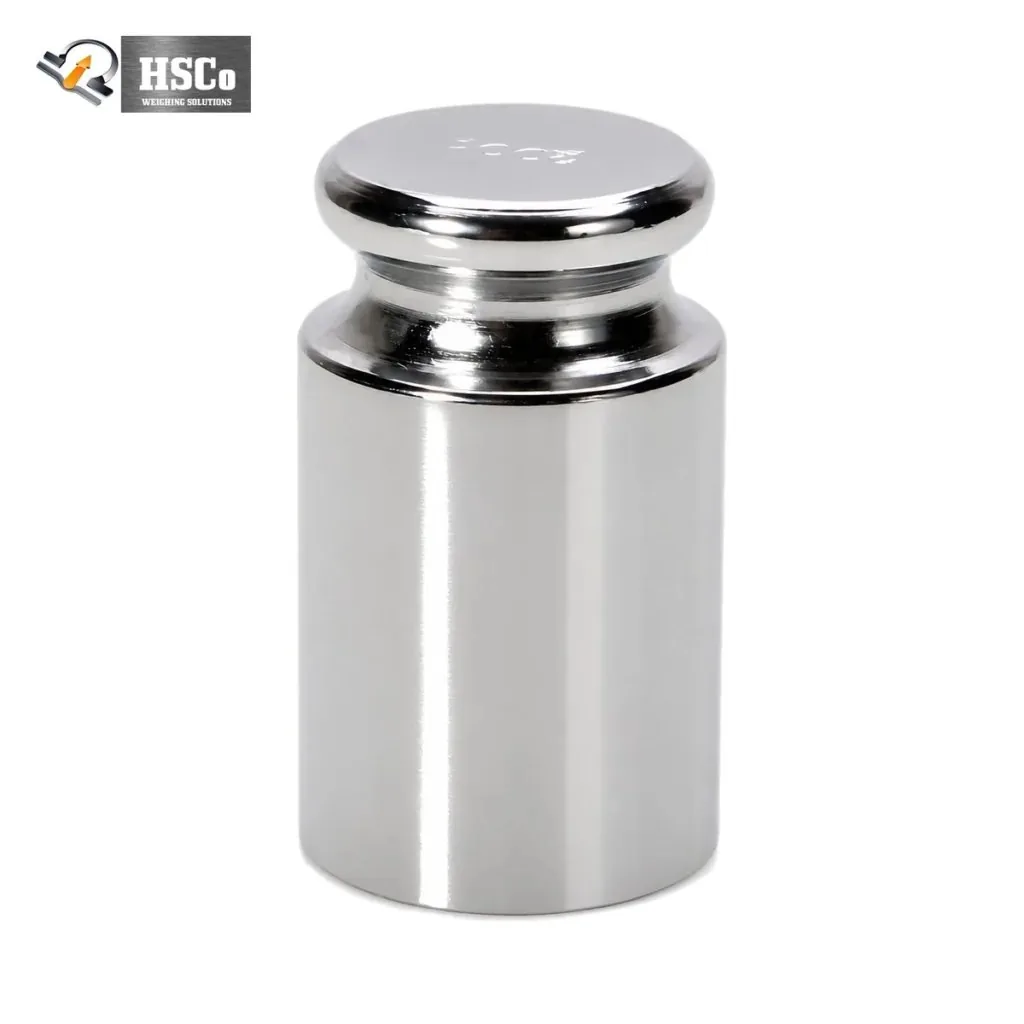
- Stainless steel calibration weights: come as single pieces from 1 g to 50 kg in non-magnetic 304 stainless steel, class M2, with two years of government stamping included [7]. For checking your shop scale against a known weight.
Our post on cumin sack weight shows a second way to check a lot of sacks. Tell us how many sacks you receive and how much you sell loose each day: call +91-7045922250 or write to hsc@hindustanscale.com.
Frequently asked questions
Why did the jowar price rise in North Karnataka in November 2026?
Asianet Newsable and The Hans India reported in November 2026 that North Karnataka farmers grew less jowar and that poor rain cut yields [1, 2]. The Hans India put retail white jowar at ₹100 to ₹110 a kg, up from ₹40 to ₹50, and wholesale jowar above ₹10,000 a quintal [2].
How much is 100 g of jowar worth at ₹100 a kg?
At ₹100 a kg, 100 g of jowar is worth ₹10. Suppose a shop scale shows 1 kg when 1.1 kg of jowar is on the tray, and the same 100 g error repeats at every sale. The shop then gives away ₹10 of jowar per sale, or ₹100 over ten sales. If the scale shows 1 kg for 900 g, the customer loses ₹10 per sale.
How often must a shop weighing scale be stamped in India?
An electronic shop weighing scale used for sales in India is re-verified every twelve months under Rule 27(2)(c) of the Legal Metrology (General) Rules, 2011, because it is not in the 24-month or 60-month lists [4, 8]. Section 24 of the Legal Metrology Act, 2009 requires verification for any scale used in a transaction [3]. Your local Legal Metrology office can confirm the category and due date.
Sources
- Asianet Newsable, “North Karnataka Jowar Price Hike: Rates Cross ₹100 Per Kg, Khanavalis Fear Jolada Rotti Meal Costs May Rise” (newsable.asianetnews.com, 16 November 2026).
- The Hans India, “White jowar price crosses Rs 100 per kg in north Karnataka” (thehansindia.com, 19 November 2026).
- India Code, Government of India, “The Legal Metrology Act, 2009” (indiacode.nic.in, 13 January 2010). Section 24
- Department of Consumer Affairs, Ministry of Consumer Affairs, Food and Public Distribution, Government of India, “The Legal Metrology (General) Rules, 2011” (megweights.gov.in, 7 February 2011). Rule 27(2); G.S.R. 71(E), Gazette page 323; copy hosted by the Legal Metrology Department, Meghalaya
- Hindustan Scale Company, “PLCHQS Electronic Platform Scale – 50 to 300 kg, Chequered Plate, Double Display” (hindustanscale.com).
- Hindustan Scale Company, “PRCSSP Price Computing Scale – 30 kg × 1 g, 6 Price Memories” (hindustanscale.com).
- Hindustan Scale Company, “Stainless Steel Calibration Weights – 1 g to 50 kg, Government Stamped” (hindustanscale.com).
- Department of Consumer Affairs, Government of India, “Legal Metrology (General) Seventh Amendment Rules, 2025 (G.S.R. 905(E))” (consumeraffairs.gov.in, 18 December 2025). Substitutes rule 27(2)(a)