
Blogs
Rubber lot weight records: how to track each grower’s kg from purchase to sale

Quick answer
A rubber dealer can show which grower supplied each kilogram sold by weighing every grower’s bundles on arrival, tagging them, stacking them apart, and writing on each sale note whose tagged bundles went into it and how many kilograms. Rubber lot weight records kept this way follow the rubber from the day the dealer buys it to the day it is sold.
ETSustainability reported in November 2026 that the Rubber Board had opened self-registration for growers on its Bharat Sustainable Natural Rubber (BSNR) portal [1]. The portal is meant to map supply chains, capture transactions and produce traceability records that can be used to show compliance with the European Union’s deforestation regulation, the EUDR, the report said [1].
What weight does the EUDR require?
For rubber entering or leaving the EU market, the EUDR requires the quantity in kilograms of net mass, with the geolocation of every plot the rubber came from and the date or time range of production [2]. Operators must keep this information for five years from the date of placing or export [2]. Natural rubber is on the EUDR’s list of covered commodities [2].
An operator is a person or company that places rubber on the EU market or exports it from there, and downstream operators are not counted [2]. Micro or small primary operators that are established in a country classed as low risk under the EUDR, and grew the rubber themselves on plots there, may give the postal address of all the plots instead of the geolocation [2]. For rubber, the EUDR’s main duties apply from 30 December 2026, and from 30 June 2027 for operators that are natural persons or micro or small undertakings and were established as such by 31 December 2024 [2].
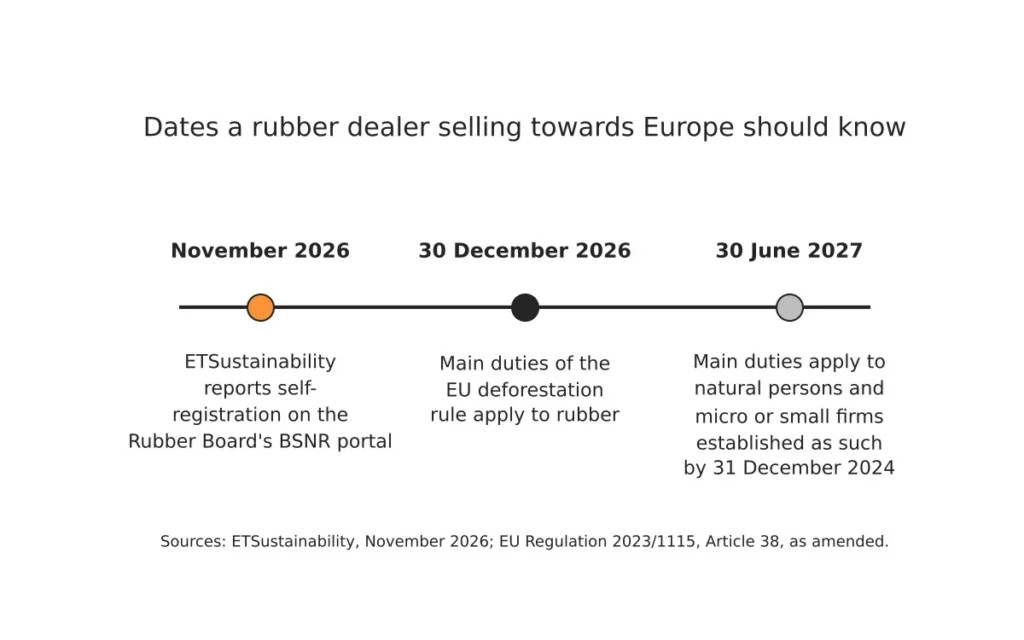
ETSustainability also reported that the BSNR framework calls for segregation at every stage, from growers and dealers to processors, manufacturers, traders and exporters, so that certified rubber is tracked apart from rubber that is not certified [1]. In a dealer’s godown, keep certified and other rubber in separate, marked stacks, and let the lot record show what came in, from whom, and where it went.
How do you keep rubber lot weight records?
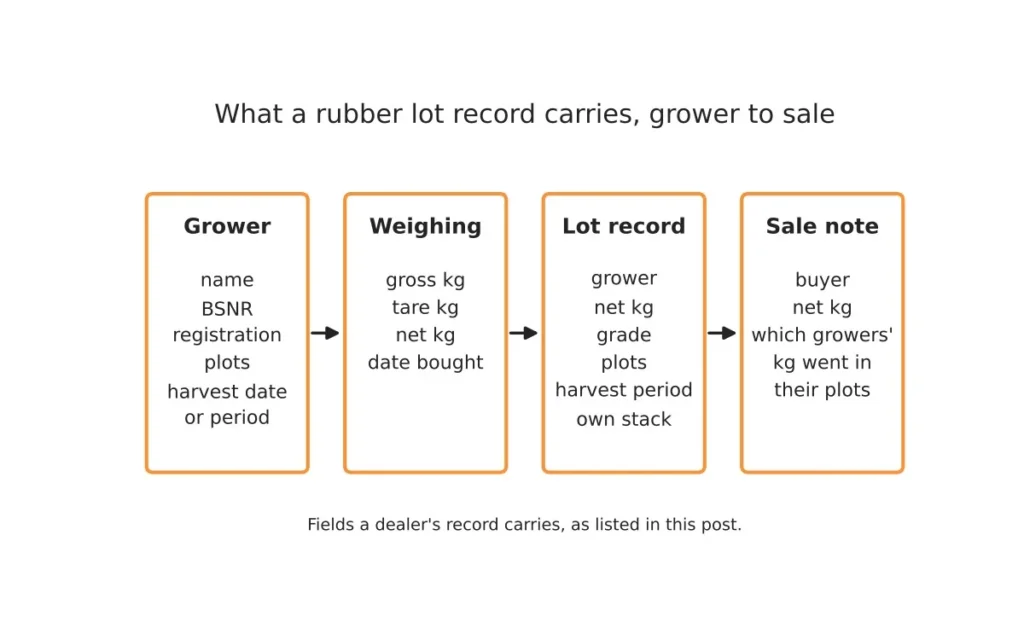
- Weigh each grower’s sheets on their own, and tag the bundles with the grower’s name, plots and harvest period before they go into the godown.
- Write the grower’s name, BSNR registration if the grower has one, every plot the sheets came from, the harvest date or period of the latex, the date you bought them, the grade, and the gross, tare and net weight.
- Keep each grower’s tagged bundles in their own stack until they are sold. The grower’s net weight is one line of the lot record.
- When you sell, write on the sale note the buyer’s name, which growers’ tagged bundles went into it with their plots, and how many kilograms of each.
- Each evening, check that opening stock plus kilograms bought equals kilograms sold plus closing stock plus any weight loss you have written down.
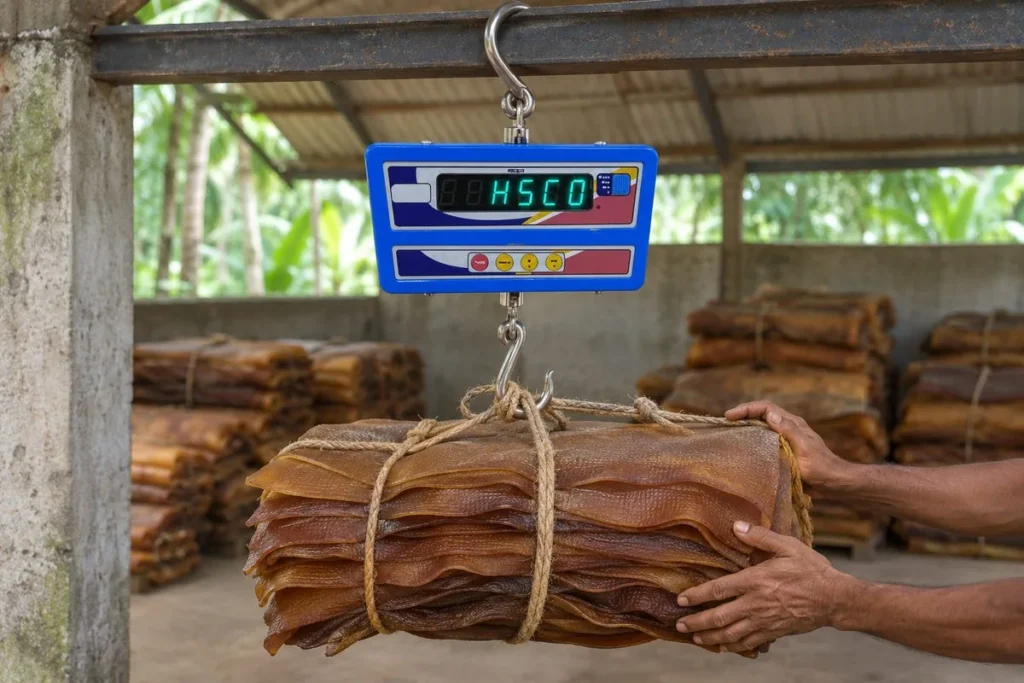
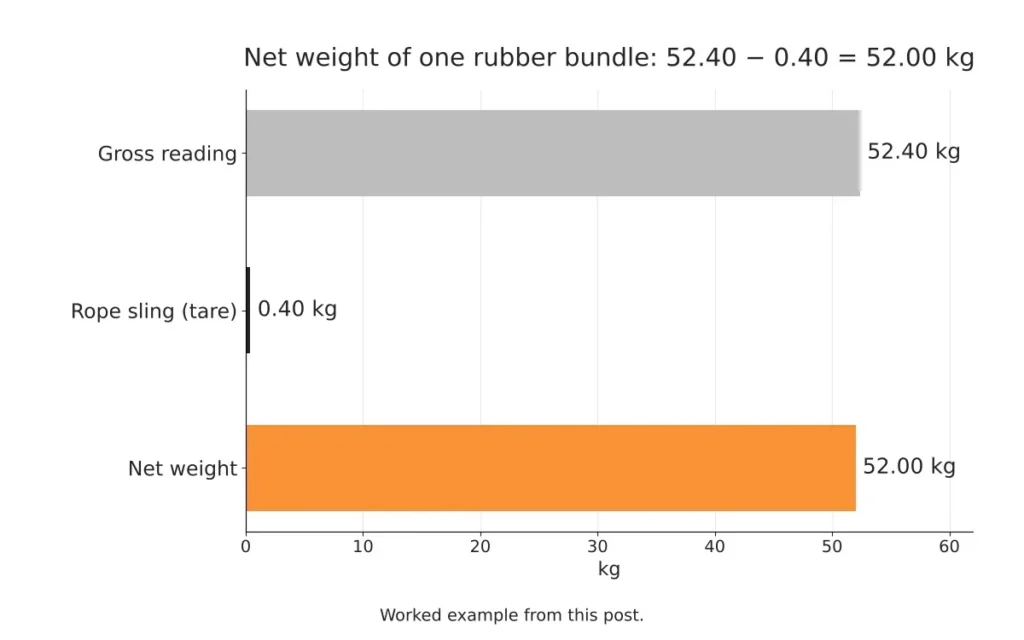
A bundle that reads 52.40 kg gross, hung on a rope sling that weighs 0.40 kg, goes into the lot record as 52.00 kg.
Net weight = gross weight − tare (sack, rope or sling)
How do you split a rubber lot between buyers and keep each grower’s share?
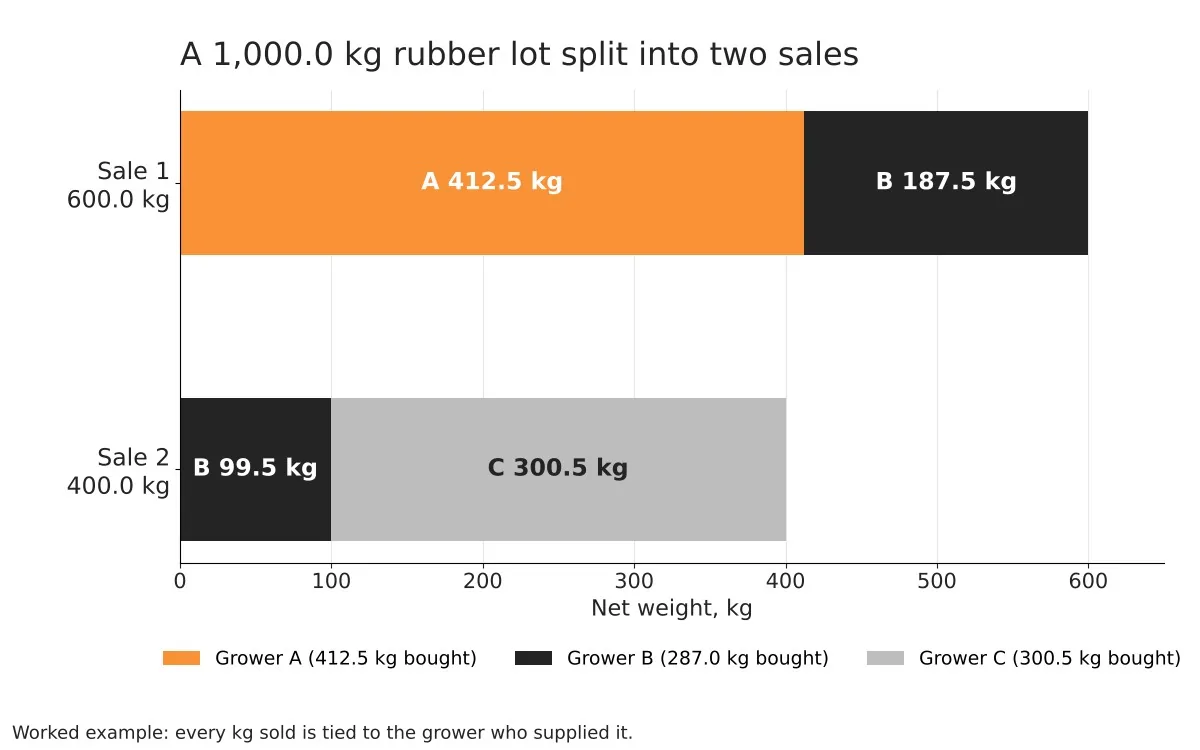
Take a 1,000.0 kg lot of tagged bundles bought from three growers and sold to two buyers, 600.0 kg in Sale 1 and 400.0 kg in Sale 2. Grower B’s bundles, 287.0 kg in all, go into both sales, so each sale note carries B’s share. The split holds because every bundle kept its grower’s tag. A mixed stack with no tags could not show that Sale 1 had none of C’s rubber.
| Grower | Bought, net kg | In Sale 1, kg | In Sale 2, kg |
|---|---|---|---|
| A | 412.5 | 412.5 | – |
| B | 287.0 | 187.5 | 99.5 |
| C | 300.5 | – | 300.5 |
| Total | 1,000.0 | 600.0 | 400.0 |
In this lot record every row and every column adds up. If your note says 400.0 kg for Sale 2 and the buyer’s scale reads 404.5 kg, the two records disagree by 4.5 kg. Settle that difference with the buyer before the sale is closed, starting with the tare each side took off and the stamp on each scale.
HSCo’s stamping guide says the Legal Metrology stamp on an electronic scale is renewed every year, and new HSCo electronic scales ship with one year of stamping [5]. Copy the renewal date from the stamp certificate into the lot record too, so the scale is re-verified before the stamp runs out.
Which HSCo scale fits a rubber dealer’s godown?
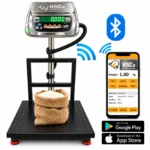
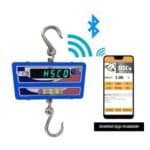
Both scales below send the displayed weight over Bluetooth to an Android app [3, 4]. Take off the tare first, and the net reading goes into the app without being copied by hand. You still write the grower’s name and the lot against each reading.
 Bluetooth platform scale PLCHQBT: comes in 50 to 1,000 kg, with an MS chequered plate on an MS frame, displays front and back, and Bluetooth to the HSCo BT Bluetooth Smart Weighing Scale app on Android, which keeps bills and report history [3]. For sheet bundles on the godown floor.
More scales for farms and godowns are on our weighing scales for agriculture page, and our stamping guide explains the stamp certificate. Tell us how many growers bring sheets each day and how you sell: call +91-7045922250 or write to hsc@hindustanscale.com.
Frequently asked questions
How do rubber growers register on the BSNR portal?
ETSustainability reported in November 2026 that the Rubber Board had opened self-registration on its BSNR portal, so growers can register directly on the portal [1]. Growers who need help can go to the Rubber Board’s regional offices, the report said [1]. A dealer should still tag each grower’s bundles and write that grower’s net weight in the lot record.
What weight does the EUDR need for natural rubber?
The EUDR requires operators to keep the quantity of rubber entering or leaving the EU market in kilograms of net mass, with the geolocation of all plots of production, for five years [2]. Micro or small primary operators established in a low-risk country that grew the rubber themselves there may give the postal address instead [2]. Downstream operators fall outside these duties and keep separate records [2]. Net mass is the rubber alone, without the sack or rope.
How should a rubber dealer record a split lot?
A rubber dealer should keep each grower’s bundles tagged and stacked apart, write each grower’s net weight as a separate line in the lot record and, for every sale, list which growers’ tagged bundles went into it. In a 1,000.0 kg lot sold as 600.0 kg and 400.0 kg, one grower’s 287.0 kg of bundles can go out as 187.5 kg and 99.5 kg, with both sale notes showing that grower’s share.
Sources
- ETSustainability (The Economic Times), “Rubber Board widens digital push for export-ready natural rubber” (sustainability.economictimes.indiatimes.com, 13 November 2026). Cites The Hindu BusinessLine
- European Union (EUR-Lex), “Regulation (EU) 2023/1115 on deforestation-free products, consolidated text of 18 September 2026” (eur-lex.europa.eu, 18 September 2026). Articles 2(15), 2(15a), 4a(5), 5, 9 and 38, Annex I
- Hindustan Scale Company, “PLCHQBT Bluetooth Platform Scale, 50 to 1,000 kg, Chequered Plate, Android App, Two Displays” (hindustanscale.com).
- Hindustan Scale Company, “CRSBT Bluetooth Hanging Scale, 100 to 500 kg, Android App” (hindustanscale.com).
- Hindustan Scale Company, “What Is Government Stamping And Why Is It So Important?” (hindustanscale.com).