
Crane Scale Ethernet Output: Putting Hook Weights on the Plant Network
Wi-Fi is for phones. The plant network is for machines.
A crane scale Ethernet output takes that seriously. The indicator in the crane bay gets a cable and a fixed address on the plant’s own machine network, and every hook weight leaves it as one plain line of text that the PLC or SCADA reads directly — no phone in the loop, no router to argue with, nobody typing a number shouted across a bay. Below: why the plant backbone is still a cable, what the output sends, what a bay does to cabling, what weighing law says, and how to trial one crane in thirty days.
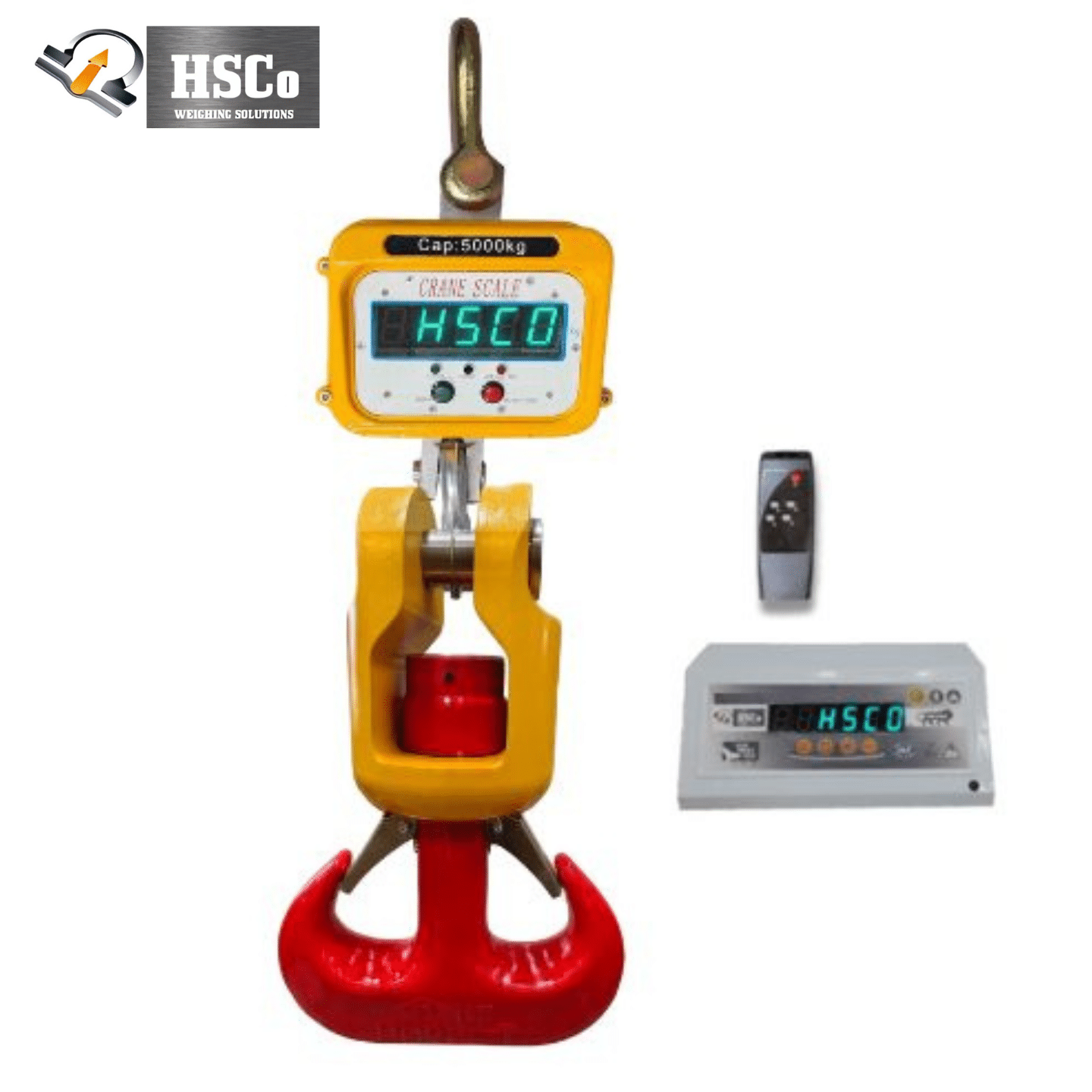
Why the plant backbone is still a cable
A 2026 industry study of newly installed industrial network nodes, published by HMS Networks, found industrial Ethernet on 79 % of new nodes, fieldbus on 14 % and wireless on 7 % — and it calls wireless a complement to the wired network, most useful for equipment that moves. The split is one publisher’s count, so treat it as indicative; the direction is not in doubt: a separate trade body, PROFIBUS & PROFINET International, counted 10.4 million new PROFINET nodes in 2025 alone, taking its installed base to 89.2 million.
Security guidance agrees. NIST’s 2023 guide to operational-technology security recommends keeping the machine network apart from the office network, putting any wireless device in its own segment and deploying it “only where the residual risks to health, safety, the environment, and finances are low”. It rates most wireless field networks “inherently less reliable than their wired counterparts”, and a separate NIST engineering guide lists why: reflections off metal machines, “metal canyons” under gantries, motor noise and phone hotspots.
A crane scale is a fixed instrument in a fixed bay feeding fixed machines. If any device in the plant belongs on the cabled backbone, it is this one.
And in India the bays are multiplying. The country made 149.4 million tonnes of crude steel in 2024 — second only to China, according to the World Steel Association — is the world’s second-largest primary aluminium producer at about 4.2 million tonnes a year, and is aiming for 300 million tonnes of steel capacity by 2030–31.
What does a crane scale Ethernet output actually send?
Three things, and they are deliberately simple.
A fixed address. An office PC can change address every morning; nobody calls it. A machine that other machines call cannot. ODVA, the EtherNet/IP consortium, puts it plainly in its 2026 addressing guidance: for an industrial device that is the target of requests, “the IP address can’t change at each power up”. So the indicator holds a fixed IP and comes back on it after every power cut.
A line of text per reading. Hindustan Scale Company’s CRH crane-scale indicator, fitted with the Ethernet (LAN) option, streams the displayed hook weight as plain text over a TCP connection at that fixed address. Whatever is on the display goes down the cable, with its unit.
A standard way to read it. The main PLC makers ship built-in socket instructions for exactly this class of device — one maker’s manual describes them as the way to talk to “barcode scanners, RFID readers, or other standard Ethernet devices” that do not speak the PLC’s native protocol. SCADA packages have a generic TCP/ASCII driver for the same job. Where a plant standardises on Modbus registers (port 502; about 5 % of new nodes in the same 2026 study), a register map can be added; the text feed is the delivered, catalogue product.

What a metals bay does to a cable — and how the cable copes
A smelter or steel bay is the harshest cabling environment the standards recognise. The industrial cabling standards (ISO/IEC 11801, ANSI/TIA-1005 and IEC 61918), as reproduced in ODVA’s 2026 installation manual, grade every plant area from class 1 (an office) to class 3 (the worst). In the top electromagnetic class a cable is expected to live with radiated fields of 10 V/m, fast transients of 1,000 V on its data lines and mains-frequency magnetic fields of 30 A/m — the standards’ worst case, not a survey of your bay. The manual’s advice for such areas is direct: screened copper or optical fibre, sealed connectors, and cable routed away from motor-drive power, among the noisiest conductors in a plant.
The indicator is built for the same environment. OIML R 76-1, the standard behind crane-scale type approval, type-tests an indicator’s data lines against 500 V electrical bursts and adds a surge test for signal lines longer than 30 m; the reading must stay within one verification interval or the fault must be detected.
Then there is distance. A copper Ethernet run is limited to 100 m end to end — 90 m of fixed cable plus two 5 m cords — and heat shortens it: the manual’s worked example puts a standard unscreened cable at 60 °C at about 86 m. A 150 m bay needs a plant switch on the way or a fibre pair — not a longer cable and hope.

Who must see the weight, and where are they standing?
That question, not the technology, decides the link — and a crane scale usually needs more than one answer, which is why the CRH carries several outputs.
| Who reads it | Where they stand | The right link | Indicative add-on (before GST) |
|---|---|---|---|
| The PLC or SCADA | Control room, permanently | Ethernet (LAN) — fixed-IP text feed | ₹4,500 |
| A PC or batching controller | Beside the bay | RS-232 (standard) or RS485 for long runs | RS485 ₹3,000 · USB ₹1,800 |
| The slinger or supervisor | On the move, within 30 m | Hand-held display, or Bluetooth to a phone | quoted with the scale |
| The whole bay | Within about 200 m | Wireless remote or jumbo display | quoted with the scale |
Prices are HSCo’s indicative September 2026 configuration prices, before GST. The wireless readouts and the Ethernet output are not rivals. The hand-held is for a person who moves; the cable is for a machine that does not. Fit both, and the slinger reads the hook from a safe distance while the PLC logs the same weight untouched.
Weighing law already allows a data port — and regulates it
A trade scale with a network cable is not a legal grey area. OIML R 76-1 says an instrument “may be equipped with interfaces” to computers and other equipment — on one condition: the interface must not let the connected equipment, or any disturbance on the line, falsify a weight or adjust the instrument. A one-way text feed of the displayed weight is the textbook case.
OIML D 31:2023, the guidance for software-controlled instruments, says what a transmitted record should carry — the value with its unit, a timestamp, the place, the instrument’s identity and a consecutive number — and that if the network drops, “no measurement data shall be lost”. The US code, NIST Handbook 44, adds a rule every SCADA screen should respect: all digital values of like value in a system must agree.
In India it is simpler still. Under the Legal Metrology Act 2009 a trade weighing instrument is verified and stamped before use, and crane scales are re-verified every 12 months. The stamped indicator in the bay remains the legal instrument; the number on the SCADA screen is a repeat of it. (See what is government stamping.)
What a crane scale Ethernet output is not
It is not a case against wireless. HSCo sells Bluetooth crane scales, remote displays and hand-held readouts, and for a person walking the bay they are the right tool. The case here is only the permanent link from a fixed indicator to fixed machines, where a cable is available.
It is not a native automation-protocol node. HSCo does not claim EtherNet/IP, PROFINET or Modbus conformance for it. It is a text feed at a fixed IP — which is a feature: any PLC socket instruction or SCADA driver reads it, with no gateway or licence in between.
It is not a replacement for the stamped display. The verified indicator stays the legal weight; the network copy repeats it.
It is not the ERP. It feeds one. Once the weight is on the plant network, the ERP and billing integration layer takes it into SAP, Tally or a custom endpoint, and data logging and reports keeps a time-stamped lift record.
What changes on Monday morning
Nobody re-types a hook weight. Today’s path in most bays: the slinger reads the display, shouts or scribbles it, and a clerk keys it into the PLC or ERP later. A 2012 study of 21,887 fields in PLoS One found hand-written numbers keyed in by one operator produced 6.7 errors per 1,000 fields, against 0.046 per 1,000 for automated capture of structured, machine-generated data — exactly what a scale transmits. A 2011 study in Computers in Human Behavior found visual checking was 29–58 % worse than double entry and no better than not checking. The Ethernet feed does not check harder; it removes the keying.
The charge weight and the record are the same number. Ladle, scrap bucket, coil or ingot bundle — the PLC records what the hook saw, when, from which crane.
The control room sees every lift as it happens. One tile per crane: last weight, last seen, which indicator has gone quiet.
The office network is not involved. The indicator sits on the machine segment, where NIST says it should be. No phone hotspot, no guest Wi-Fi.

How to start: one crane, thirty days
- Pick one crane — the one whose hook weight is written down most often.
- Ask your automation team for three things: a fixed IP on the machine segment, a switch port within 100 m of the indicator (or fibre if the bay is longer), and the socket instruction or SCADA driver they already use for scanners.
- Fit the CRH with the Ethernet (LAN) option and cable it with screened industrial Ethernet, routed clear of drive power.
- Log every lift for thirty days beside the existing manual record. Count the mismatches, the minutes saved and the disputes that did not happen.
- Roll out crane by crane — only what the numbers justify.
Hindustan Scale Company has made weighing scales in Mumbai since 1955 and builds the indicator, the Ethernet feed and the ERP layer itself; a crane indicator with this feed went into a metals plant in 2026. The scale is the electronic crane scale CRH — 1 t to 10 t as standard, 20 t and 50 t on request. The crane scale buying guide covers capacity and safety first.
Frequently asked questions
What is a crane scale Ethernet output?
A wired network port on the crane-scale indicator. The indicator is given a fixed IP address on the plant’s machine network and sends each hook weight as one plain line of text, which a PLC or SCADA system reads directly. No phone, Wi-Fi or re-typing is involved.
Does my PLC need a special driver to read the crane scale?
Usually not. The main PLC families have built-in socket instructions for reading plain TCP text from “standard Ethernet devices” such as barcode scanners, and SCADA packages have a generic TCP/ASCII driver. The crane-scale feed is the same kind of device. If your site standardises on Modbus registers, a register map can be added.
Can I use Wi-Fi instead of a cable for the crane scale?
For a person on the move, yes — a hand-held display, a remote display or Bluetooth to a phone is the right tool. For the permanent link from a fixed indicator to a PLC, plant-security guidance from NIST recommends a cable on the separate machine network, because metal structures, motors and phone hotspots make wireless in a bay less reliable.
How far can the Ethernet cable run from the crane indicator?
The standard limit for a copper run is 100 m end to end: 90 m of fixed cable plus two 5 m cords. Heat shortens it — an unscreened cable at 60 °C is good for about 86 m. Beyond that, put a plant switch on the way or use a fibre pair; do not simply run a longer cable.
Does an Ethernet port affect the government stamping of the scale?
No. Weighing law allows a data interface as long as nothing connected to it can alter the weight or the calibration, and a one-way text feed cannot. The stamped indicator remains the legal instrument, re-verified every 12 months in India; the PLC or SCADA copy is a repeat of it.
What does the Ethernet option cost on an HSCo crane scale?
As an indication, before GST: about ₹4,500 for the Ethernet (LAN) port, ₹3,000 for RS485 and ₹1,800 for USB, on HSCo’s September 2026 configuration prices. RS-232 is standard on the CRH. The exact figure depends on the scale and the indicator.
Next step
Tell us which crane’s hook weight gets re-typed the most, and we will propose a thirty-day Ethernet pilot for it — one indicator, one fixed IP, one PLC tag.
Hindustan Scale Company (HSCo) · Mumbai · est. 1955 · www.hindustanscale.com · hsc@hindustanscale.com
Sources
- HMS Networks — Industrial network market shares 2026 (16/06/2026): industrial Ethernet 79 % of newly installed nodes, fieldbus 14 %, wireless 7 %; wireless “a complement to wired industrial networks”; Modbus TCP 5 %.
- PROFIBUS & PROFINET International — press release “Strong Foundation, Clear Direction” (17/04/2026): 10.4 million new PROFINET nodes in 2025, installed base 89.2 million.
- NIST — SP 800-82 Rev. 3, Guide to Operational Technology (OT) Security (September 2023), sections 5, 5.2.3 and 6.2.9; NIST — AMS 300-4, Guide to Industrial Wireless Systems Deployments (2018).
- ODVA — EtherNet/IP Media Planning and Installation Manual, PUB00148R1 (June 2026): MICE environmental classes reproduced from ISO/IEC 11801-1, ANSI/TIA-1005 and IEC 61918; 100 m channel limit and temperature de-rating. Wikipedia — “Ethernet over twisted pair” and “Industrial Ethernet” (secondary, citing IEEE 802.3).
- ODVA — Recommended IP Addressing Methods for EtherNet/IP Devices, PUB00028R1 (May 2026); a major automation vendor’s Ethernet Reference Manual, publication ENET-RM002D (2019), Table 4.
- IANA — Service Name and Transport Protocol Port Number Registry, entries “mbap” (port 502) and “mbap-s” (port 802); a major automation vendor’s Socket Interface Application Technique, publication ENET-AT002E (2023); a second automation vendor’s TCP/IP function-block documentation (TF6310, 2026).
- OIML R 76-1:2006 — Non-automatic weighing instruments, Part 1, clauses 3.10.3 and 5.3.6, Annex B.3; OIML D 31:2023 — General requirements for software-controlled measuring instruments, clauses 6.3.5.2 and 6.3.5.4.
- NIST Handbook 44 (2026) — General Code G-S.2, G-S.5.2.2, G-N.2; The Legal Metrology Act, 2009, s.24 and s.33; The Legal Metrology (General) Rules, 2011, r.27.
- World Steel Association — World Steel in Figures 2025; IBEF — Steel industry in India (September 2026, citing the Ministry of Steel and the Joint Plant Committee).
- U.S. Geological Survey — Mineral Commodity Summaries 2026, Aluminum; IBEF — Metals & Mining.
- Paulsen A., Overgaard S., Lauritsen J. M. — “Quality of Data Entry Using Single Entry, Double Entry and Automated Forms Processing”, PLoS One 7(4): e35087 (2012); Barchard K. A., Pace L. A. — “Preventing human error: The impact of data entry methods on data accuracy and statistical results”, Computers in Human Behavior 27(5) (2011).
- Hindustan Scale Company — Electronic Crane Scale CRH product page; scale configurator price list (September 2026, indicative, before GST); IoT Connected Weighing Scales page.