
Crane Scale With Printer: A Weight Slip at the Indicator, Not a Notebook at the Hook
The rigger should never hold a pen and a load at the same time.
Yet that is how most hook weights are still recorded: somebody reads the display under the load, walks to a register and writes the number down. A crane scale with printer ends that habit. The weight leaves the hook by radio, the reading lands on an indicator at the desk, and a thermal slip prints there — date, time, gross, tare, net and the scale’s own number. Here is why the record belongs at the indicator, what a slip must carry by law, who keeps it, and how the same record reaches your ERP untyped.
The rigger’s hands belong to the load
Every lifting code says the same thing. India’s IS 13367 (Part 1), the Bureau of Indian Standards’ code for the safe use of cranes, gives the slinger two jobs — attach and detach the load, and direct the crane — and adds that all persons should stand clear of the load being lifted. The US crane rules (29 CFR 1910.179 and 1926.1425) forbid carrying loads over people and allow nobody in the fall zone except those hooking, unhooking or guiding the load — and nobody directly under it. The UK Health and Safety Executive’s code for lifting equipment (L113) asks employers to lay out the workplace so that no one works under a suspended load.
None of these codes mentions a notebook. They do not have to. The person at the hook already has both hands and full attention on the sling, the tag line and the driver. Reading a display and writing a number is a second job, and it pulls them exactly where the codes say they must not be.
The Health and Safety Executive’s official statistics for Great Britain, published on 01/07/2026, count 126 workers killed in 2025/26 (provisional); on the five-year average, being struck by a moving object accounts for 22 deaths a year — 17 per cent. The US Bureau of Labor Statistics’ census of fatal occupational injuries for 2024, released on 19/02/2026, records 5,070 deaths, 756 of them (14.9 per cent) from contact with objects and equipment. Neither body counts crane-scale readings separately, but a swinging or dropped load is exactly this kind of accident, and a printer at the indicator removes one reason for anyone to be near it.

What does a crane scale with printer actually print?
A weight slip from a trade scale is a regulated document, not a courtesy. Three separate rule-books — the international recommendation OIML R 76-1, India’s Legal Metrology (General) Rules, 2011 (Seventh Schedule) and the US NIST Handbook 44 (2026 edition) — say what the printer may and may not do, and they agree:
| What is on the slip | Why it is there |
|---|---|
| Weight, printed only when stable | No printing while the load swings; India’s rules even define the test (5 seconds, no more than two adjacent values). |
| The unit, beside the value | “12480” is not a weight. “12480 kg” is. |
| Figures at least 2 mm high | Legible on a dusty slip in a truck cab. |
| Gross, tare and net marked G, T, N | Net and tare must be identified when printed together; a calculated value carries a C. |
| Scale number, date and time | Ties the slip to one serial-numbered instrument and one weighment; OIML D 31 requires the same identity on transmitted data. |
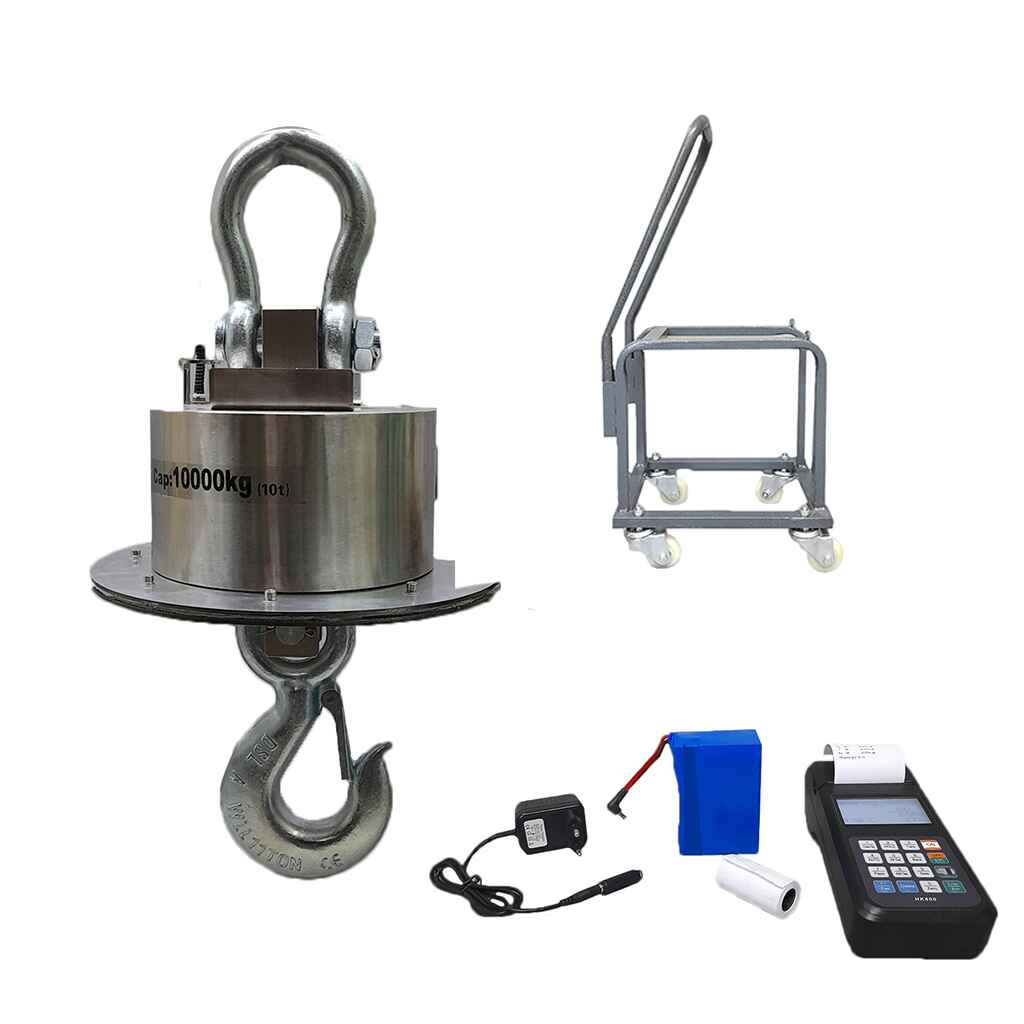
On a Hindustan Scale Company crane scale from the CRH range, this is how it is built. The hook unit measures. The weight travels by radio to a remote desktop indicator, and the thermal printer sits at that indicator — or pairs to it by Bluetooth — and prints date, time, gross, tare, net and the scale number on each slip. A hand-held remote with a built-in printer does the same for a supervisor walking the bay, and the heat-resistant foundry versions work the same way.

The stable-weight rule is where a printer beats a notebook. A rigger reads whatever the display shows — including a number still settling. The printer, by law and by design, waits.
Who keeps the slip, and for how long?
Three things carry a hook weight, and only one of them is paper.
The slip goes with the load — in the truck cab or stapled to the delivery challan. NIST Handbook 44 puts it plainly: recorded values are made available to the customer in hard copy unless the customer says otherwise.
The record stays with you, and must outlast the slip. Under section 36 of the CGST Act, 2017, the records behind an invoice are kept for 72 months after the due date of that year’s annual return; section 128(5) of the Companies Act, 2013 keeps books of account, with the vouchers behind every entry, for not less than eight financial years. A weight slip behind an invoice or a job-work challan is such a voucher. A slip is a hand-out; the durable record is the electronic one — the indicator’s stored weighments, exported or sent to a server.
The scale itself is part of the record. Under India’s Legal Metrology Act, 2009, any weighing instrument likely to be used in a transaction — sale, purchase, the assessment of work done or wages due — must be verified before use (section 24). Using an unverified instrument carries a fine of ₹2,000 to ₹10,000, and up to a year’s imprisonment for a second offence (section 33); short delivery is an offence in its own right (section 30). A slip from an unverified scale is evidence of an offence, not a defence. That is why the scale number is printed on it — and why government stamping comes before the printer.
Why the number should travel as data, not be retyped
The number on the slip is the number the law expects on every document that follows the load. Section 31 of the CGST Act requires a tax invoice showing the quantity of goods; rule 46 asks for the quantity and its unit; rule 55 requires a delivery challan to state the quantity; and rule 138 requires an e-way bill before any consignment worth more than ₹50,000 moves. Net on the slip becomes the quantity on all three. Every time a person copies it, there is a chance it changes.
How big a chance? A 2019 study in the Journal of the American Medical Informatics Association checked 6,930 instrument readings that staff had copied into a computer against the instrument’s own output: 260 — 3.7 per cent — were wrong. A 2025 controlled comparison in JAMIA Open found 100 errors in 3,023 hand-entered values (3.3 per cent) against 1 in 4,768 when the instrument wrote the record itself — 99 per cent fewer. Take 1 in 100 as a conservative working figure for a reading copied on a shop floor. The fix the studies agree on is not more checking. It is less copying.

And the tonnage is enormous. India is the world’s second-largest producer of crude steel — the Ministry of Steel’s Annual Report 2025-26 and the World Steel Association each rank it second behind China — and almost every tonne is lifted and weighed on its way to an invoice. One wrong digit per hundred lifts is not a rounding error.
On an HSCo crane indicator the same record that prints can leave over RS232, Ethernet or Bluetooth into your weighing software or ERP, so the challan line is filled from the weighment, not retyped from a slip — see ERP and billing integration and data logging and reports.
What a crane scale with printer is not
It is not a replacement for the stamped display. In trade use the verified indicator reading remains the legal weight. The slip and the data record are faithful copies of it.
It is not the archive. The printed copy goes with the load or to the customer. The record you must keep for 72 months or eight years lives in the indicator’s memory, the export file or the ERP.
It does not make an unverified scale legal. A printer prints what the scale measures; if the scale is not stamped, the slip documents the offence.
It is not a phone app in disguise. A phone in a rigger’s hand is still a second job at the hook. The printer and the display sit at the indicator — desk, cabin or the supervisor’s hand — deliberately away from the load. (The Bluetooth crane scale puts the reading on a phone for the same reason: the reader is not the person under the hook.)
What changes for you on Monday morning
- Nobody stands under a load to read it. The rigger slings, signals and steps clear. The number appears at the desk.
- Every lift leaves a slip and a record — date, time, G, T, N, scale number — printed only once the weight is stable.
- The challan, the invoice and the e-way bill carry the weighment, not a copy of it. The figure the customer sees is the figure the scale printed.
- Disputes take a minute, not a week. Which scale, which time, which load — on the slip and in the database, and they agree.
Put an indicative number on it. Picture a bay doing 150 lifts a day, each hand-written entry taking 15 to 30 seconds to read, walk, find the row and write. That is a rule of thumb, not a measurement, but on that assumption it is about 40 to 75 minutes a day at a register, plus one or two wrong weights a day that somebody must find later. Measure your own bay before you believe anyone’s arithmetic, including ours.
How to start: one crane, thirty days
- Pick one crane whose weights end up on an invoice or a challan — the one whose readings are copied most often.
- Check the scale’s verification stamp and note its serial number. That number goes on every slip.
- Fit the remote indicator and printer at the desk, not the hook. Decide who tears off the slip and where it goes.
- Connect the indicator’s data output to your weighing software or ERP, or export the stored records weekly, so the durable record exists from day one.
- Count for thirty days: lifts read at the hook (should be zero), minutes spent writing, wrong weights found, disputes raised. Roll out only when the numbers say so.
Hindustan Scale Company has made weighing scales in Mumbai since 1955 and builds the hook unit, the remote indicator, the printer pairing and the data output itself — one supplier answers from hook to invoice. See the full crane scale range.
Frequently asked questions
Does a crane scale with printer print the weight while the load is still swinging?
No. Under OIML R 76-1, India’s Legal Metrology (General) Rules, 2011 and NIST Handbook 44, a trade instrument may print only when the reading is stable — within one division of its final value. The printer waits; a person reading the display may not.
Where should the printer be — at the hook or at the indicator?
At the indicator, every time. The weight leaves the hook unit by radio, and the printer sits at the desktop indicator, pairs to it by Bluetooth, or is built into a hand-held remote. Nobody has to stand near the load to get the slip.
What has to be on a crane scale weight slip in India?
The weight with its unit beside it, in figures at least 2 mm high; gross, tare and net marked G, T and N when they appear together; and enough to trace the slip to one instrument and one weighment — the scale number, date and time. These come from the Legal Metrology (General) Rules, 2011, OIML R 76-1 and OIML D 31.
Who keeps the slip, and how long must the record be kept?
The slip goes with the load or to the customer. The record behind an invoice must be kept for 72 months after the annual-return due date under the CGST Act, and books with their vouchers for at least eight financial years under the Companies Act — so keep the electronic weighment record, not a box of slips.
Can the same weight go straight into the ERP?
Yes. The indicator’s data output (RS232, Ethernet or Bluetooth) sends the same record that prints — value, unit, time, scale number — to weighing software or an ERP, so the delivery challan, invoice and e-way bill are filled from the weighment rather than retyped from the slip.
Does the printer make the weight legally valid?
No. The verified, stamped indicator reading is the legal weight; the slip is a copy of it. A scale used in any sale, purchase, job-work or wage calculation must be verified before use under the Legal Metrology Act, 2009, and the slip’s scale number is what ties it to that verification.
Next step
Tell us which crane’s weights end up on an invoice, and we will propose a thirty-day printer-at-the-indicator pilot for it.
Hindustan Scale Company (HSCo) · Mumbai · est. 1955 · www.hindustanscale.com · hsc@hindustanscale.com
Sources
- Bureau of Indian Standards — IS 13367 (Part 1):1992, Safe use of cranes — Code of practice, Part 1: General, clauses 6.2.1, 6.2.2 and 13.3.
- US OSHA — 29 CFR 1910.179 (Overhead and gantry cranes) (n)(3)(vi); 29 CFR 1926.1425 (Keeping clear of the load) (b) and (e), eCFR current text.
- UK Health and Safety Executive — L113, Safe use of lifting equipment, LOLER 1998 Approved Code of Practice (2nd edition, 2014), paras 230–234.
- UK Health and Safety Executive — Work-related fatal injuries in Great Britain, 2026 (01/07/2026); US Bureau of Labor Statistics — Census of Fatal Occupational Injuries 2024, news release and Table A-1 (19/02/2026).
- OIML R 76-1:2006 (E) — Non-automatic weighing instruments, Part 1, clauses 4.4.2, 4.4.5, 4.6.11 and 7.1.2; OIML D 31:2023 (E) — Software controlled measuring instruments, clause 6.3.5.2.
- Government of India — Legal Metrology (General) Rules, 2011, Seventh Schedule, Heading A, Part II, paras 4(4)(v), 4(4)(vi) and 4(xi).
- NIST Handbook 44 (2026 edition) — General Code G-S.1 and G-S.5.6; Scales code S.1.8.5 and S.2.5.1.
- The Legal Metrology Act, 2009 — sections 2(u), 2(w), 24, 30 and 33 (India Code; Indian Kanoon).
- Central Goods and Services Tax Act, 2017 — sections 31, 35 and 36; CGST Rules, 2017 — rules 46, 55 and 138 (CBIC; GST Council consolidated text; Indian Kanoon).
- The Companies Act, 2013 — section 128(5) (India Code; Indian Kanoon).
- Mays J. A., Mathias P. C. — “Measuring the rate of manual transcription error in outpatient point-of-care testing”, JAMIA 26(3) (2019); Patruno A. et al. — “Evaluating the impact of EHR-to-EDC technology on workflow efficiency: a site perspective”, JAMIA Open 8(5) (2025).
- Ministry of Steel, Government of India — Annual Report 2025-26 (April 2026); World Steel Association — press releases of 24/01/2025 and 24/08/2026.
- Hindustan Scale Company — CRH electronic crane scale, Bluetooth crane scale, crane scale range, ERP and billing integration, and data logging and reports pages (September 2026).