
A worker reads 5.2 kg and types 2.5 kg. Nobody notices until the customer does.
The scale was right. The record is wrong. And a wrong weight does not stay in one place: it becomes a wrong stock figure, a wrong bill and a wrong batch record before anyone looks twice. This article puts numbers on manual data entry errors weighing down Indian plants — how often a typed weight is wrong, what the typing costs in operator time, why checking harder does not fix it, and what changes when the reading leaves the scale on its own.
How often is a hand-typed weight wrong?
About one in a hundred. That is the working figure, and it sits at the cautious end of what has been measured.
Studies of people keying numbers once — into a calculator, a register, a form — land between 0.2 and 4 errors per 100 entries, depending on speed and how much checking follows. A University of Hawaii compilation of laboratory studies, a 2012 study in PLoS ONE and a 2012 study in BMC Research Notes all sit inside that band — and the faster the keying, the more errors.
The two closest analogues to an operator copying a scale display are sobering. In a 2019 study in the Journal of the American Medical Informatics Association, staff copied an instrument’s reading into a computer 6,930 times; 3.7 per 100 did not match the instrument’s own value, and one in seven of those was off by more than 20 per cent. A 2025 controlled comparison in JAMIA Open had trained data managers type 3,023 values: 100 were wrong, 3.3 per 100.
A busy shop floor measures higher, a well-run laboratory with a checking step lower. And the error is rarely dramatic. Indicative figures from a classic Dutch analysis of keying errors, republished by the Indian Academy of Sciences, suggest about 79 per cent are one wrong digit and about 10 per cent are two neighbouring digits swapped — 5.2 becoming 2.5. Both look plausible on a register page. That is why they survive.

One wrong weight is three wrong records
Trace a single slip and it lands in three places at once.
Stock. The 2.7 kg weighed but not recorded is now missing from the book, and the book is trusted until a physical count contradicts it. In retail chains, where it has been measured, 65 per cent of nearly 370,000 stock records at one retailer were wrong (Management Science, 2008) and average accuracy across 500 stores of another was 51 per cent (IIE Transactions, 2005). Factories are not retail, but the mechanism — many small hand-entered movements, no immediate check — is the same.
Bill. On the invoice, the customer is billed for 2.5 kg of a 5.2 kg delivery, or the reverse. The Legal Metrology Act 2009 penalises delivering less than the quantity contracted or paid for when selling by weight — a fine up to ₹10,000, and for a second offence imprisonment up to one year, a fine or both (Section 30). Nobody is fined for a typing slip as such; the exposure is that the slip creates the short delivery the Act is written for.
Batch. In a pharmaceutical or food plant the weighed quantity of each material is the batch record. India’s revised Schedule M, in force since 01/01/2025, requires each dispensed weight to be independently checked and recorded, records to be made when the action is taken, and critical data entered by hand to be checked again by another operator or by the system itself (clauses 14.19, 17.2.7, 17.2.8 and 20.6). US rule 21 CFR 211.101 says the same: a second person verifies every weighed component unless automated equipment did the weighing. A weight typed in later from a slip fails the regulator’s test of a sound record — contemporaneous and original — twice over.
What manual data entry errors weighing down a plant really cost
Two costs; only one shows up in a ledger.
The visible one is time. Take a plant that does 200 weighments a day: read the display, turn to the terminal or register, find the row, type, confirm. Call it 20 seconds all-in — a working assumption, not a measured figure; we found no factory time-and-motion study of scale-to-keyboard entry. What is measured is the core of it: about 6 seconds to key one value screen to screen (derived from the 2025 JAMIA Open study) and about 2.5 seconds merely to check one by eye (a 2012 University of Nevada study).
| Item (illustrative) | Figure |
|---|---|
| Weighments a day | 200 |
| Typed weights a year (300 working days) | 60,000 |
| Wrong weights a year at 1 in 100 | about 600 (2 a day) |
| Wrong weights a year at the shop-floor rate of 3.3–3.7 in 100 | 2,000–2,200 (7 a day) |
| Operator time at 20 s per weighment | 67 min a day ≈ 333 hours a year |
| Operator time in rupees at ₹100 an hour | about ₹33,000 a year |
| Across the 2026 legal-floor band of ₹72–115 an hour | ₹24,000–₹38,000 a year |
The ₹100 an hour is a round number inside the 2026 legal minimum for a semi-skilled worker in a metro zone — about ₹72 an hour under the Maharashtra shops schedule from 01/07/2026, about ₹115 under the Central sphere order from 01/04/2026. Real plants pay more; put your own loaded rate in. The table rests on the 20-second assumption; if your operators take ten, halve it.
The invisible cost is the 600 wrong weights. Each is worth your price per kilogram times the gap — on the 5.2 kg typed as 2.5 kg, 2.7 kg left the plant unbilled. Multiply by your own price; it is the number that matters, and it is yours.
Why checking harder does not fix it
The instinctive answer is a second pair of eyes: the supervisor initials the register, the clerk glances at the challan. The evidence says this barely helps.
A University of Nevada Las Vegas study (Barchard and Pace, Computers in Human Behavior, 2011, as summarised by the same laboratory in 2012) compared typing data once, typing it and checking by eye, and typing it twice for a computer to compare. Visual checking produced 29 to 58 per cent more errors than double entry — and was not significantly better than a single unchecked entry. The Danish PLoS ONE study found single entry left about eight times more errors than double entry (0.37 against 0.046 per 1,000 fields). A Japanese clinical-trials study found double entry caught more than reading the numbers aloud to a partner.
Three laboratories, three countries, one conclusion. You do not reduce keying errors by checking the keying. You reduce them by typing everything twice — which doubles the cost above — or by removing the typing.
Most plants have not removed it: one 2024 survey of US manufacturers by the Manufacturing Leadership Council found 70 per cent still collect data manually. There is no equivalent Indian survey; walk your own floor.
What happens when the reading leaves the scale by itself
The instrument already has the right number. Automatic data logging simply moves it — the scale waits for a stable weight and writes that reading into the record with the date, time, product, batch and operator, with no keyboard between the two.
The measured effect is large. In the 2025 JAMIA Open comparison, values typed by hand produced 100 errors in 3,023; automatic transfer produced 1 error in 4,768 — 99 per cent fewer — and 58 per cent more records were captured in the same hour, because nobody was typing. A 1980s US Department of Defense study, LOGMARS, reported 4 errors in 1,266,444 barcode reads against about 1 in 300 keystrokes — a figure quoted second-hand ever since.

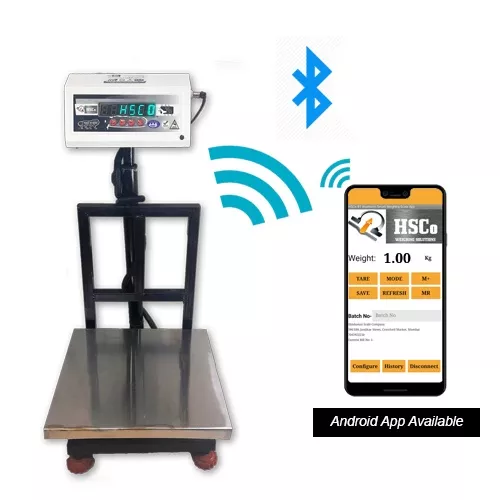
This is what Hindustan Scale Company’s data logging and reports solution does. Each stable weight is recorded automatically with date and time, product, batch and operator. The records roll up into daily, batch-wise, shift-wise, operator-wise and dispatch reports, export to PDF, Excel or CSV, and can flow into an ERP, SAP or Tally system so the bill is raised from the weight the scale saw. It works on HSCo’s connected scales — platform, weighbridge, crane, tank and laboratory scales with Bluetooth, Wi-Fi or serial output — and, through a scale-to-computer interface, on a scale you already own that has a data output. The log is time-stamped, operator-stamped and cannot be edited afterwards: designed to support the Schedule M and 21 CFR-style record keeping above, not to certify you for it.
What automatic logging is not
It is not a substitute for a verified scale. The stamped display is still the legal weight; the log is a faithful copy. If the scale is wrong, the record is now wrong faster.
It is not a new register. A log that records 5.2 kg but still asks the operator to type the product code has moved the typing, not removed it. Ask where every field comes from.
It is not an ERP or an accounting system. It feeds one — or, with no system at all, produces the daily and dispatch reports a system would.
And it is not a compliance certificate. It gives an auditor a contemporaneous, attributable, unaltered weight record; your quality system still says who reviews it.

What changes on Monday morning
- The number on the bill is the number the scale showed. The dispute about the 5.2 kg that arrived as 2.5 kg stops existing.
- About an hour of operator time a day comes back at 200 weighments — measured on your floor, not ours.
- The stock book agrees with the floor, because every movement that crossed a scale was recorded when it crossed.
- The batch record is complete when the batch is, with a time and an operator against each weighed material — no slip in a shirt pocket to be typed up at four o’clock.
- A supervisor reviews exceptions, not entries. Only the out-of-tolerance weight and the scale that went quiet reach a phone.
How to start: one scale, thirty days
- Count. Pick the scale whose readings are re-typed most often and count its weighments for a week.
- Time it. Stopwatch ten entries from display to confirmed record — your own figure instead of our 20-second assumption.
- Audit a hundred. Compare the last hundred register entries with the challans or batch sheets. The mismatches are your error rate.
- Connect that one scale to automatic logging and run both methods side by side for thirty days.
- Compare — minutes, mismatches, disputes — and roll out only what the numbers justify.
HSCo has made weighing scales in Mumbai since 1955 and builds the scales, interfaces and reporting software itself — one supplier from load cell to invoice.
Frequently asked questions
How often are hand-typed weights wrong?
About 1 in 100 as a working figure. Measured studies of single-entry keying range from 0.2 to 4 per 100; the two closest analogues — staff copying an instrument’s reading into a computer — measured 3.3 and 3.7 per 100. A disciplined laboratory with a checking step can reach 0.05 per 100.
Does a supervisor checking the register catch the errors?
Mostly not. In a 2011 controlled study, visual checking produced 29–58 per cent more errors than double entry and was not significantly better than an unchecked single entry. Only double entry — or removing the typing — measurably cuts the error rate.
How much time does typing weights actually take?
Pure keying of one number is about 6 seconds in measured studies; with turning to a terminal, finding the row and confirming, 15–30 seconds per weighment is a reasonable working assumption, not a measured factory figure. At 200 weighments a day and 20 seconds each, that is roughly an hour a day.
Is a wrong weight on an invoice a legal problem in India?
It can be. The Legal Metrology Act 2009, Section 30, penalises delivering less than the quantity contracted or paid for when selling by weight — a fine up to ₹10,000, and for a second offence up to one year’s imprisonment, a fine or both. The slip is not the offence; the short delivery it creates is the exposure.
Can my existing scale be connected to automatic logging?
Usually, if it has a data output. HSCo’s scale-to-computer interface reads the scale’s output and writes each stable reading into your record or system, so the scale you already own keeps working and the typing stops. A scale with a serial output can also be given a Bluetooth or Wi-Fi module; one with no data output is best replaced with a connected model when it is next due.
Does automatic logging satisfy Schedule M or 21 CFR Part 11?
It is designed to support them: each weight is recorded at the time, attributed to an operator and a scale, and cannot be altered afterwards, which is what the record-keeping clauses ask for. Compliance itself depends on your whole quality system — review, training, change control — not on any single device.
Next step
Tell us which scale gets re-typed the most and how many times a day, and we will propose a thirty-day side-by-side pilot for it.
Hindustan Scale Company (HSCo) · Mumbai · est. 1955 · www.hindustanscale.com · hsc@hindustanscale.com
Sources
- Mays J. A., Mathias P. C. — “Measuring the rate of manual transcription error in outpatient point-of-care testing”, Journal of the American Medical Informatics Association 26(3): 269–272 (2019): 3.7 % of 6,930 manually entered instrument readings wrong; 14 % of those off by more than 20 %.
- Patruno A. et al. — “Evaluating the impact of EHR-to-EDC technology on workflow efficiency: a site perspective”, JAMIA Open 8(5): ooaf139 (2025): manual 100 errors in 3,023 values; automatic 1 error in 4,768; 58 % more data in the same hour.
- Paulsen A., Overgaard S., Lauritsen J. M. — “Quality of data entry using single entry, double entry and automated forms processing”, PLoS ONE 7(4): e35087 (2012); Hoa N. B. et al., BMC Research Notes 5:75 (2012); Lam K. K. W. et al., Basic and Clinical Andrology 35:1 (2025).
- Barchard K. A., Pace L. A. — “Preventing human error: the impact of data entry methods on data accuracy and statistical results”, Computers in Human Behavior 27(5) (2011), as summarised in Erosa D. N. et al., “Visual checking: why take the risk?”, University of Nevada Las Vegas (2012); Kawado M. et al., Controlled Clinical Trials 24(5) (2003).
- Panko R. — Human Error Website, University of Hawaii, “Errors in trivial and simple nontrivial cognitive actions” (compilation of Smith 2005, Shaffer & Hardwick 1968, Baddeley & Longman 1973).
- Verhoeff J. (1969) error statistics, as republished in “Error Detection in Numeric Codes”, Resonance (Indian Academy of Sciences) 17(7): 653–671 (2012) — indicative, single origin.
- US Patent 6,027,022 (2000), quoting the US Department of Defense LOGMARS project report — 4 errors in 1,266,444 barcode reads against about 1 in 300 keystrokes (reported).
- DeHoratius N., Raman A. — “Inventory record inaccuracy: an empirical analysis”, Management Science 54(4) (2008); Kang Y., Gershwin S. B. — IIE Transactions 37(9) (2005).
- The Legal Metrology Act, 2009 — Sections 24, 30 and 33 (India Code, Government of India; Indian Kanoon).
- Revised Schedule M, Drugs Rules — G.S.R. 922(E) dated 28/12/2023, Ministry of Health & Family Welfare (CDSCO); MSME extension to 31/12/2025 via G.S.R. 127(E) of 12/02/2025 (Business Standard, 2025).
- US FDA — Data Integrity and Compliance With Drug CGMP: Questions and Answers (December 2018); 21 CFR 211.101(c)–(d) and 211.188(b).
- Office of the Chief Labour Commissioner (Central) — minimum wage / VDA order effective 01/04/2026 (as reproduced by StaffNews); Government of Maharashtra Labour Department — Shops & Commercial Establishments minimum wages 01/07/2026–31/12/2026 (as reproduced by ComplianceBook, Labour Law Help).
- Manufacturing Leadership Council / National Association of Manufacturers — “Seventy percent of manufacturers still enter data manually”, Manufacturing in 2030 “Data Mastery” survey (2024) — single source, US manufacturers.
- Hindustan Scale Company — Data Logging & Reports; ERP & Billing Integration; IoT Connected Weighing Scales pages (September 2026).