
Every smart scale is digital. Almost no digital scale is smart.
That one line settles most of the confusion in a purchase enquiry. “Digital” tells you how the weight is shown. “Smart” tells you what happens to it afterwards. A smart weighing scale — the connected, Internet-of-Things kind — weighs exactly as a digital scale does, then sends the reading somewhere useful on its own, keeps a record, raises an alarm when something is wrong, signs every reading with its own identity and can be updated without a service visit. This article explains where the two words come from, the five capabilities that separate them, what “smart” does not change (stamping, for one) and how to test it on one scale in thirty days.
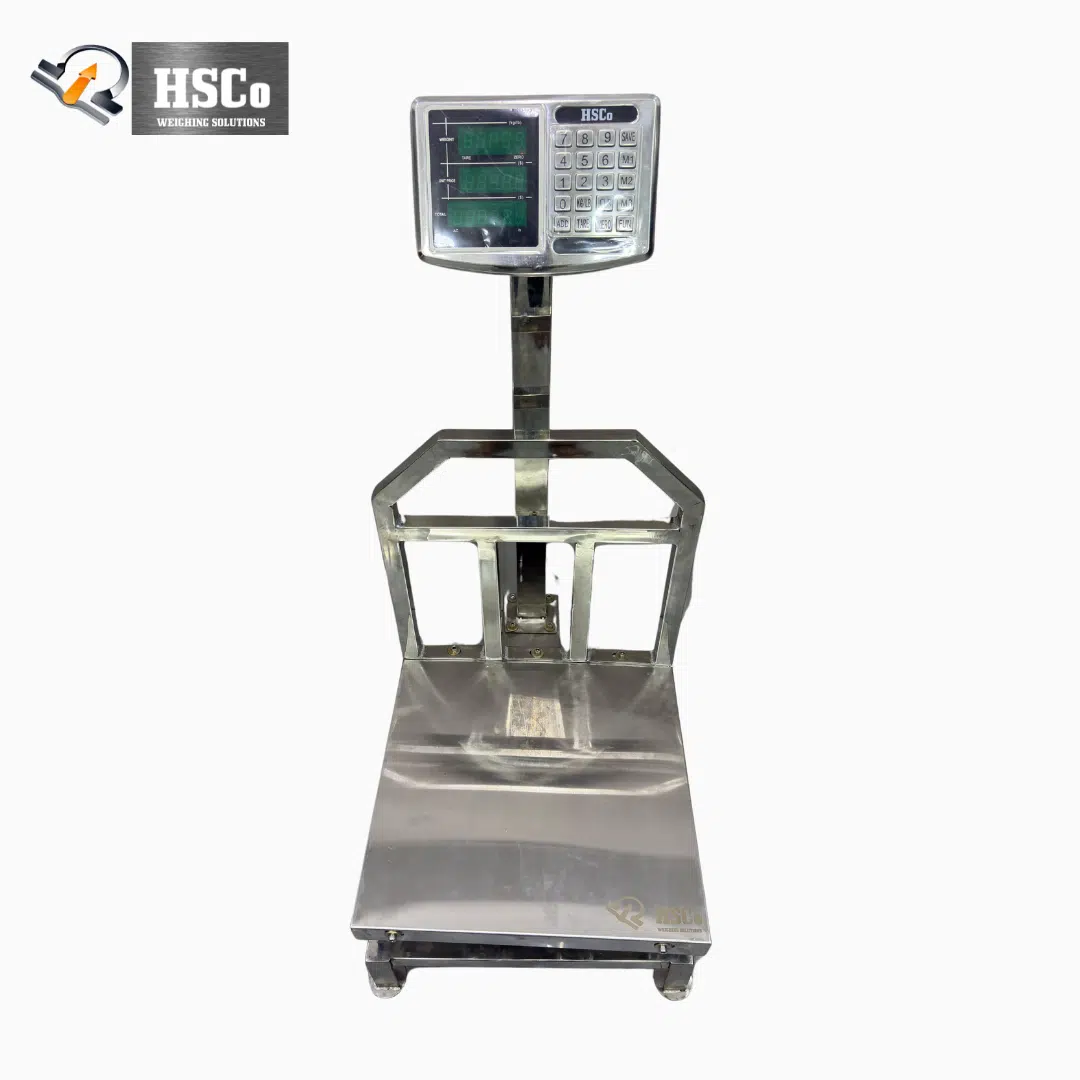
‘Digital’ describes the display, and nothing else
Look the word up in the rulebooks for trade scales and you find something surprising: it says nothing about data.
The international recommendation for non-automatic weighing instruments, OIML R 76-1, defines a digital indication as scale marks “composed of a sequence of aligned figures that do not permit interpolation” — a row of digits instead of a needle on a dial. The US NIST Handbook 44 says the same: in a digital indicating element “all values are presented digitally, or in numbers” and “there are no graduations”. The word “electronic” is thinner still: OIML defines an electronic instrument as one “equipped with electronic devices”, and that is the entire definition.
Every digital scale you own is digital because of its display. The load cell and the embedded controller behind it make a good number; the display shows it; the definition ends there. Whether the number then travels anywhere is a question the standards do not ask. (If it is the digital-versus-mechanical choice you are weighing up, HSCo’s guide to digital vs analog weighing scales covers it. This article picks up where that one stops.)
What does a smart weighing scale actually add?
Communication. Not as a feature — as the definition.
The International Telecommunication Union’s standard for the Internet of Things, ITU-T Y.2060, defines an IoT device as equipment “with the mandatory capabilities of communication and the optional capabilities of sensing, actuation, data capture, data storage and data processing”. Sensing is optional. Communication is mandatory. The US NIST’s IoT baseline (NISTIR 8259A, 2020) lands in the same place: what makes these devices new is “the combination of connectivity and the ability to sense and/or affect the physical world”. India’s Department of Telecommunications uses the same framing in its 2021 code of practice for consumer IoT devices.
A weighing scale is a sensor with a display. Add communication and it becomes a smart weighing scale by definition, not by marketing. And once a scale can communicate, four more things become possible that no digital scale can do at any price: it can record, alert, identify itself and be updated. Those five — transmit, record, alert, identify, update — are the whole difference. Everything a supplier calls “smart” should fit under one of them; ask which.

The five capabilities that earn the word
Each capability has a rule behind it. The rules are not Hindustan Scale Company’s own; they come from the bodies that write software requirements for measuring instruments (OIML D 31:2023 and Europe’s WELMEC 7.2 guide) and from the IoT security baselines (NIST, ETSI and India’s TEC). Here is what each asks for, and what it looks like on an HSCo scale.
| Capability | What the standards ask for | On an HSCo smart scale |
|---|---|---|
| 1. Transmit | A scale may feed a printer, second display, PC or data store, but the link must never let the outside device alter the weight (OIML R 76-1, 5.3.6). | The verified display stays in charge. Bluetooth, Wi-Fi, RS232 or Modbus carries the reading out; nothing comes back that can touch it. |
| 2. Record | Every stored or transmitted reading carries five fields — value with unit, time, place, instrument identity, consecutive number — protected against change and checked when read back (OIML D 31; WELMEC 7.2). | One record per weighment in the app, PC software or cloud dashboard, with all five fields, exportable to Excel. |
| 3. Alert | If the network drops, no reading may be lost: hold it in a queue until the receiver confirms. Warn the operator when storage is full or missing (OIML D 31; WELMEC 7.2). | A heartbeat about once a minute, a last-seen time per scale, an alert when a scale or server goes quiet, and a relay output for a lamp or buzzer. |
| 4. Identify | A unique software identification shown at start-up or on demand; every record names the instrument; each IoT device uniquely identifiable (OIML D 31; OIML R 76-1; NISTIR 8259A). | A factory-written number, locked once written, shown at power-on, used as the Bluetooth name and stamped on every record. |
| 5. Update | Updatable by authorised parties only, every update authenticated, integrity-checked and logged — a “traced update”, allowed over a network so long as it never touches calibration (OIML D 31; ETSI EN 303 645; TEC 31318). | The firmware family is designed to accept signed over-the-air updates, so a correction can be authenticated and logged rather than delivered by a visit. |
Record is where most “app scales” fall short. A number on a phone screen is not a record. OIML D 31 and WELMEC 7.2 give the same five fields, and both say stored data must be protected against change and traceable to the weighing that produced it. Pharmaceutical regulators say it in other words: the US FDA’s ALCOA test wants a record attributable, legible, contemporaneous, original and accurate. If an app drops any of the five fields, you have bought a display that happens to be on a phone.
Alert is the one nobody demonstrates in the showroom, because the showroom’s Wi-Fi works. OIML D 31 describes the right behaviour: a scale that cannot reach its server keeps each reading in a first-in-first-out buffer until the receiver confirms it has arrived. WELMEC adds that the operator must be warned when storage is full or removed. The step from “warn the operator” to “ring the owner’s phone” is where HSCo goes further than the rulebook.

What a smart weighing scale is not
It is not a replacement for stamping. In India any weight or measure used in a transaction must be verified and stamped before use (Legal Metrology Act 2009, section 24). The re-verification rule puts beam scales and counter machines at 24 months and every other weight or measure — which is where an electronic weighing instrument falls — at 12 months (Legal Metrology (General) Rules 2011, Rule 27). Using an unverified instrument carries a fine of ₹2,000 to ₹10,000 for a first offence, and up to a year’s imprisonment for the next. Nothing in a smart scale changes this. OIML R 76-1 says a secondary display merely “repeats the weighing result”: the app, dashboard and ERP entry are convenience copies; the verified indication on the scale remains the legal reading. HSCo’s guide to government stamping covers the procedure.
It is not a consumer gadget with an industrial sticker. A bathroom scale that syncs to a phone is smart by the ITU definition too. It is not a Class III trade instrument and carries no consecutive record number.
It is not “digital plus an app”. A dongle that mirrors the display to a phone gives you transmit and nothing else: no five-field record, no heartbeat, no identity, no update path. Ask for the other four before you pay for the word.
It is not set-and-forget. A smart scale is a small computer. India’s TEC code of practice expects such devices to be securely updateable, preferably over the air, with a published support period. Ask who signs the updates and how long they will keep coming.

Why the difference matters now
Two independent 2026 market reports put the growth of electronic weighing scales at roughly 6 % a year to 2030, and both name IoT-enabled, cloud-connected scales as the drivers: connectivity is becoming the default. The rulebooks have caught up: OIML D 31 was reissued in 2023 with clauses on transmission, cloud storage and remote updates, and NIST Handbook 44 now counts an electronic record as a “recorded representation” alongside a printed one. And the link is now the cheap part: on an HSCo scale Bluetooth is about ₹4,500 and Wi-Fi about ₹6,500 (indicative, September 2026, before GST). Insist on all five capabilities, because the radio is no longer where the value is.
What changes for you on Monday morning
- The number on the bill is the number on the scale. Nobody re-types a weight, so the copying error that peer-reviewed studies keep finding has nowhere to happen.
- Every weighment can be found. Time, place, scale number, serial number. A dispute becomes a search, not an argument.
- Silence is visible. A scale that stopped reporting on Tuesday shows as “last seen Tuesday”, and a phone knows before month-end does.
- You know which scale said what. Forty scales, one server, and every record carries the identity of the instrument that produced it.
- Corrections arrive without a visit. With a signed, logged update path, a firmware fix is designed to be a download rather than a service call — and the stamped calibration stays untouched.
A digital scale gives you the first half of the first point: a correct number. A smart scale gives you the rest.
How to start: one scale, thirty days
- Pick the scale whose reading travels furthest — the one copied onto a slip, walked to an office and typed into a bill.
- Score it against the five capabilities. Most digital scales score zero; most “app scales” score one.
- Add the missing capabilities, not a new scale. A scale with a serial output can be given Bluetooth or Wi-Fi for ₹4,500–₹6,500 (indicative, before GST), plus an app, PC software or dashboard.
- Test the alert on purpose. Switch the router off for an hour mid-shift, switch it back on, and check that every reading arrived, in order.
- Keep the stamp. Note the re-verification date on the scale before you start; nothing in the pilot moves it.
- Measure for thirty days — minutes spent on entry, wrong records found, disputes raised — and roll out only what the numbers justify.
Hindustan Scale Company has made weighing scales in Mumbai since 1955 and builds the connected hardware, the apps and the cloud platform itself, so one supplier answers for all five capabilities. The full menu is on the IoT connected weighing scales page; the record side is described under data logging and reports.
Frequently asked questions
What is the difference between a smart weighing scale and a digital weighing scale?
A digital scale shows the weight as a row of digits; that is the whole of the definition in the weighing standards. A smart scale is digital and also communicates — it transmits each reading, records it with time, place and scale identity, raises alerts, identifies itself on every record and can be updated remotely.
Is a smart weighing scale legal for trade in India?
Yes, provided the scale itself is verified and stamped like any other, and re-verified every 12 months for an electronic instrument. The app or dashboard is a convenience copy; the stamped display remains the legal reading, and the connection must not be able to alter it.
Can my existing digital scale be made smart?
Usually, if it has a serial output. A Bluetooth or Wi-Fi module carries the reading to a phone, PC or server, and the app or dashboard supplies the record. Identity and update capabilities depend on the scale’s own software, so ask before assuming.
What should a smart scale’s record contain?
Five fields, according to OIML D 31 and WELMEC 7.2: the value with its unit, a timestamp, the place, the identity of the instrument and a consecutive number. The record must be protected against change and checked for authenticity when it is read back.
What happens to readings when the Wi-Fi drops?
A properly designed smart scale keeps weighing, holds each reading in a queue and sends them in order once the link returns, so nothing is lost. A heartbeat tells the dashboard when the scale was last seen, so the outage is noticed rather than discovered at month-end.
How much does a smart weighing scale cost compared with a digital one?
The scale is the same; the difference is the add-ons. On an HSCo scale, indicatively and before GST: Bluetooth about ₹4,500, Wi-Fi about ₹6,500, a cable port ₹1,800–₹3,000, a relay output ₹3,500, an Android app about ₹18,000 and a cloud dashboard about ₹28,000.
Next step
Tell us which of your scales is “digital but not smart”, and we will score it against the five capabilities and propose a thirty-day pilot.
Hindustan Scale Company (HSCo) · Mumbai · est. 1955 · www.hindustanscale.com · hsc@hindustanscale.com
Sources
- OIML R 76-1:2006 — Non-automatic weighing instruments, Part 1: Metrological and technical requirements (International Organization of Legal Metrology): T.1.2.6 electronic instrument; T.5.1.3 digital indication; T.2.2.6 secondary display; T.2.3.5 peripheral devices; T.2.8.6 software identification; 5.3.6 interfaces.
- NIST Handbook 44 (2025) — Specifications, Tolerances, and Other Technical Requirements for Weighing and Measuring Devices, Appendix D: “digital type”, “analog type”, “recorded representation”, “recording element”.
- ITU-T Recommendation Y.2060 / Y.4000 (June 2012) — Overview of the Internet of things (International Telecommunication Union), clauses 3.2.1 and 3.2.2.
- NISTIR 8259A (May 2020) — IoT Device Cybersecurity Capability Core Baseline (US National Institute of Standards and Technology): Device Identification; Software Update.
- OIML D 31:2023 — General requirements for software-controlled measuring instruments: 6.1 software identification; 6.3.4 storage; 6.3.5 transmission; 6.3.8 software update (verified and traced update).
- WELMEC Guide 7.2:2022 — Software Guide (Measuring Instruments Directive 2014/32/EU): Extensions L (L1, L2, L8), T (T1, T8) and D (D1–D4).
- ETSI EN 303 645 V3.1.3 (September 2024) — Cyber Security for Consumer Internet of Things: Baseline Requirements, provisions 5.3-1, 5.3-2 and 5.3-10.
- TEC 31318:2021 — Code of Practice for Securing Consumer Internet of Things (Telecommunication Engineering Centre, Department of Telecommunications, Government of India, August 2021), clauses 3.1 and 3.3.
- US FDA — Data Integrity and Compliance With Drug CGMP: Questions and Answers (December 2018), ALCOA definition.
- The Legal Metrology Act, 2009 (India Code; Indian Kanoon), sections 24 and 33; the Legal Metrology (General) Rules, 2011, Rule 27(2); S.S. Rana & Co., Verification of Weights & Measures under the Legal Metrology Act (2025).
- Research and Markets — Electronic Weighing Scales Market Report 2026; The Business Research Company — Electronic Weighing Machines Global Market Report 2026: growth of about 6 % a year to 2030; IoT-enabled and cloud-connected scales as drivers.
- Paulsen A., Overgaard S., Lauritsen J. M. — PLoS One 7(4): e35087 (2012); Barchard K. A., Pace L. A. — Computers in Human Behavior 27(5) (2011): error rates of manual data entry (background only).
- Hindustan Scale Company — IoT Connected Weighing Scales page; Digital vs Analog Weighing Scales: Key Differences; What Is Government Stamping?; indicative configuration prices (September 2026, before GST).