
Wireless Crane Scale Remote Display: How the Two-Box System Works
One box hangs forty feet up. The other sits on your desk. They have to agree on every kilogram.
That is the whole design of a wireless crane scale remote display: one weighing instrument, built as two boxes. The box on the hook holds the load cell, the battery and a small radio — it measures. The box on the desk holds the display, the keys and the outputs — it shows, prints and records. Between them lie twelve metres of air and a bay full of steel. Here is what each box does, how the link keeps them honest, how zero, tare and calibration work from the desk, and what happens when one box goes quiet.
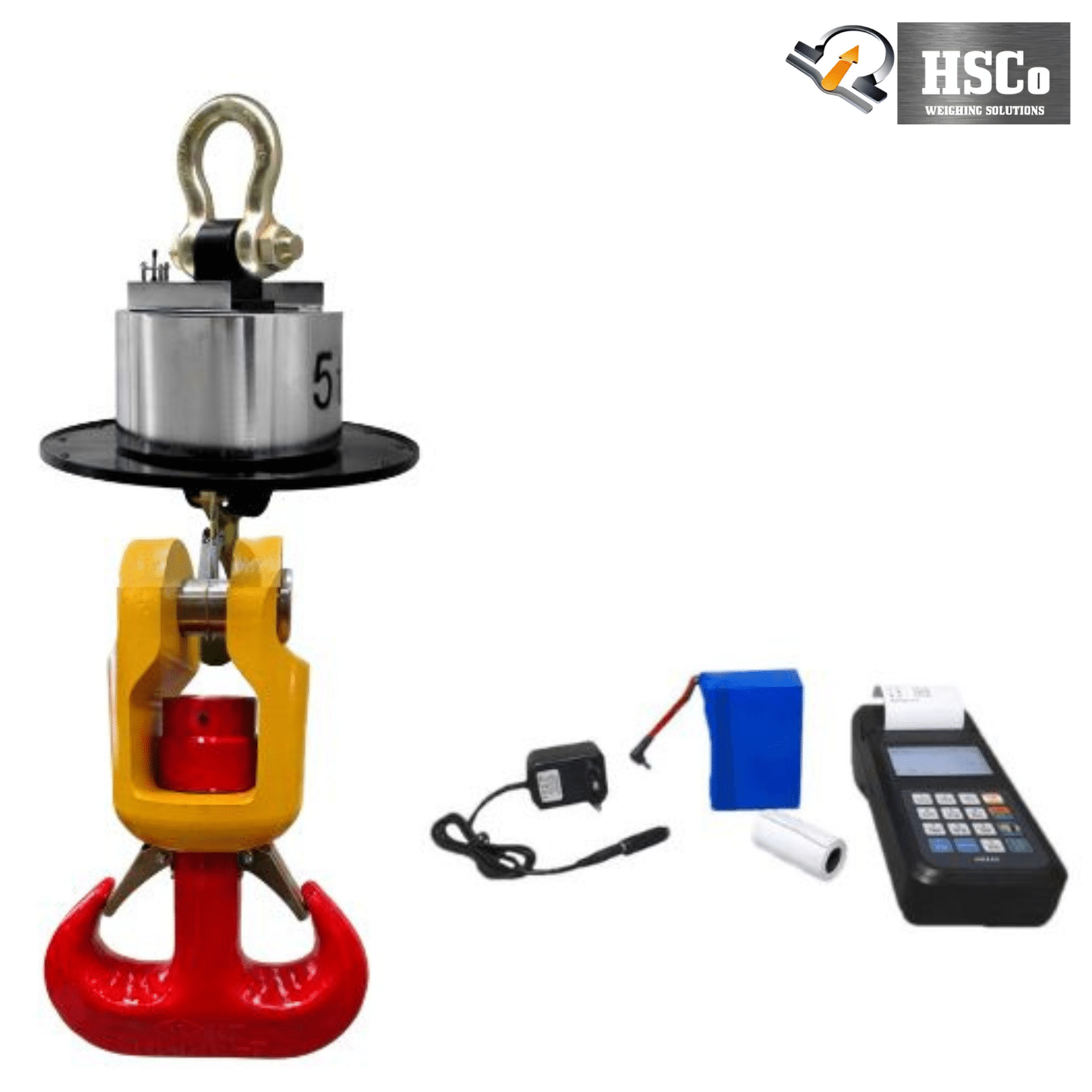
Two boxes, one instrument
A conventional crane scale puts everything in one housing under the hook; to read it, somebody walks under the load. The two-box design moves the half a person needs down to where the person is.
- The hook unit (transmitter): load cell, battery, embedded controller, radio. It measures, turns the signal into a number and sends it.
- The desk unit (receiver-indicator): display, keys — zero, tare, print — and outputs. It receives the number, shows it and passes it on.
Which output depends on who must see the weight, and where they stand. Hindustan Scale Company builds the desk unit in four variants:
| Desk-unit variant | Who sees the weight | Typical home |
|---|---|---|
| Jumbo display | The whole bay, from the crane cabin to the gate | Scrap yards, steel stockists, loading bays |
| RS232 serial output | A PC running weighing-station software | Dispatch desks, weighing stations |
| Ethernet output | The plant network and the ERP | Smelters, steel plants, control rooms |
| Built-in printer | The clerk at the desk, as a weight slip | Trade weighing, gate passes |
The CRHBT5K electronic Bluetooth crane scale is the 5 t member of the family; the crane scale range runs from 3 t to 50 t.
The weighing law treats such a scale as a modular instrument and budgets error between the modules: OIML R 76-1’s own worked example is an indicative split of 0.7 to the load cell, 0.5 to the indicator and 0.5 to the connecting elements. Note the last one — the standard budgets error for the cable between the boxes. A radio replaces that cable, and what crosses it is an already-formed number, not a millivolt signal; it arrives intact or not at all. Making sure of that is the link’s job.
How does a wireless crane scale remote display actually work?
It runs in a band anyone may use. The 2.4 GHz band (2400–2483.5 MHz) is open to low-power devices without a licence in India (WPC notification GSR 45(E) of 28/01/2005), the USA (47 CFR 15.247) and Europe (where ETSI EN 300 328 sets the limits). It is the band Wi-Fi and Bluetooth share — HSCo’s CRHBT5K uses a Bluetooth-family radio — so the link must expect company.
A steel bay is a hard place for radio. A 2017 survey by the US National Institute of Standards and Technology of an automotive plant, a machine shop and a steam plant (Technical Note 1951) called industrial environments “harsh”: dense reflective metal means a signal arrives many times over, bounced off girders, coils and crane rails. The authors added that wireless still works there — if the link is built for it.
So the link hops, checks and confirms. The Bluetooth family splits the band into 40 channels and changes channel constantly, steering around interference (Bluetooth SIG, 2020). Every packet carries a check code; one that fails the check is discarded, not displayed, and one that draws no reply is sent again. The legal-metrology software rules demand exactly this: OIML D 31 (2019) and WELMEC Guide 7.2 (2022) both require transmitted weighing data to carry an integrity check, the receiver to discard or flag anything irregular, and the sender to hold the reading until receipt is confirmed. Send-and-hope is not permitted for a weight.

Why the two boxes have to agree on every kilogram
Because the law says a scale has one weight, however many places it shows it. OIML R 76-1 clause 3.6.3: where an instrument has more than one indicating device, their difference for a given load may not exceed the maximum permissible error — and between a digital display and a printer it must be zero. The US code says it plainer: all digital values of like value in a system agree with one another (NIST Handbook 44, 2026 edition). Desk, jumbo, printer and PC all show one measurement made in one place — at the hook.
What does “agree” mean in kilograms? A crane scale in trade use is a class III (medium accuracy) instrument under OIML R 76-1. Take a 5 t scale with a verification division e of 2 kg. On initial verification the permitted error is ±1 kg up to 1 t, ±2 kg up to 4 t and ±3 kg above that; in service the law allows double. Two displays of that scale may differ by no more than that, and its display and its printer may not differ at all. (When two displays do disagree, suspect settings — decimals, counts, units — before the radio.)

Zero, tare and calibration from the desk
On the two-box scale the zero and tare keys live on the desk. Press TARE and the desk sends the command up; the hook unit carries it out and the net value comes back down. That is how HSCo’s scale behaves — but the desk commands and the hook decides, because the standards say so.
Under OIML R 76-1 and the US code alike, zero and tare may act only when the reading is stable; a swinging load is not, so a well-built hook unit simply waits. Zero-setting is capped at 4 % of capacity, so it cannot hide a hung-up sling. A tare must bring the display to zero within a quarter of a division and flag the reading NET (a primer: what the tare button does). And nothing may be printed while the reading is moving (R 76-1 clause 4.4.5; Handbook 44 S.2.5.1) — the desk’s print key obeys the same rule.
Calibration is the strictest of the three. An interface — the radio link is one — may start the instrument’s own built-in span-adjustment routine, but may not change an adjustment factor or falsify a result (R 76-1 clause 5.3.6.1). Adjustments sit behind a seal or an audit trail; the US code requires a device configured remotely by software to keep an event log — the parameter, the date and time, the new value (Handbook 44 Table S.1.11). India’s duties run the same way: model approval before an instrument is made or imported, and verification and stamping before it is used in any transaction — see government stamping. The desk starts the procedure. The seal, the log and the stamp keep it honest.
What each box does when the other goes quiet
A coil of steel parks between the hook and the desk. A welding set strikes up in the next bay. Sooner or later one box cannot hear the other. What it does next matters.
The rules are exact. Under disturbance an electronic weighing instrument must keep its reading within one division or detect the fault and act — shut down, or raise a visible or audible alarm until someone responds (OIML R 76-1 clause 5.2). The US code lists the acceptable reactions to radio interference: stay within one division, blank the display, show an error, or be so obviously unstable that the number cannot be read, stored or printed (Handbook 44 T.N.9). Not on the list: quietly holding the last good number as if it were live.
So a properly built desk unit shows a link-lost indication, not the last weight it heard, and its printer and outputs go quiet with it; the hook unit holds its reading until the desk confirms receipt, so when the link returns the weight measured is the weight that arrives. HSCo’s receiver-indicator is designed to this rule set.

What a two-box crane scale is not
It is not a repeater display bolted on to an ordinary scale. Europe’s weighing directive exempts a mere repeater only when a compliant part of the instrument records the result correctly (WELMEC Guide 2, 2023); here the receiver-indicator is the verified indicator.
It is not a way to calibrate a scale by password from anywhere. The link can start a sealed routine; it cannot alter the factors, and the change leaves a record.
It is not long-range telemetry; it is a short-range link built to cross a bay.
And it is not a substitute for the rigger’s judgement or the crane’s safe working load, which India’s Factories Act requires to be plainly marked and never exceeded.
What changes on Monday morning
- Nobody stands under the load to read it. US crane rules keep loads off people and employees out of the fall zone (29 CFR 1910.179 and 1926.1425); India’s Factories Act keeps a travelling crane six metres from anyone working near its track. Being struck by a moving object is a top-three cause of workplace death in Great Britain (HSE, 2026); US labour statistics counted 297 crane-related deaths in 2011–2017, 79 of them a worker hit by an object falling from or moved by a crane (one country’s count).
- The weight reaches the people who need it without being shouted across a bay — jumbo, printer, weighing software or ERP.
- Zero, tare and print happen at the desk, and only when the load is still.
- A dropped link shows as a dropped link. Nobody bills a stale number.
How to start: one crane, thirty days
- Pick the crane whose weights are argued about most.
- Decide who must see the weight and where they stand: the bay (jumbo), the clerk (printer), the weighing station (serial) or the plant network (Ethernet). That choice is the desk-unit variant.
- Put the desk unit where the operator would stand anyway, outside the fall zone.
- Before you sign, test three things under load: two displays showing the same number, a tare refused while the load swings, and the display during a deliberate link drop.
- Measure for thirty days: readings taken from the desk instead of under the hook, disputes raised, slips reprinted.
Hindustan Scale Company has built weighing instruments in Mumbai since 1955 and makes both boxes itself, so one supplier answers for the whole chain. Start with what a crane scale is if the family is new to you, or go straight to the crane scale range.
Frequently asked questions
What is a wireless crane scale with a remote display?
One weighing instrument built as two boxes: a hook unit with the load cell, battery and radio that measures the load, and a desk unit with the display, keys and outputs that shows, prints and records it. The two are linked by a short-range radio in the licence-free 2.4 GHz band, so nobody has to stand under the load to read the weight.
Can I zero and tare the crane scale from the desk?
Yes. The desk unit sends the zero or tare command up to the hook unit, which carries it out and returns the net value. By rule the command acts only when the load is stable, the zero range is limited to 4 % of capacity, and a tare must bring the display to zero within a quarter of a division and flag the reading NET.
Can the scale be calibrated over the wireless link?
Only as a triggered, sealed procedure. The standards allow an interface to start the instrument’s own built-in span-adjustment routine, but not to alter adjustment factors or results, and every adjustment must sit behind a seal or an audit trail. In India the instrument must also hold model approval and be verified and stamped before trade use.
What happens to the weight when the radio link drops?
A properly built desk unit shows that the link is lost rather than holding the last number as if it were live — the behaviour OIML R 76-1 and NIST Handbook 44 require under disturbance. The hook unit keeps its reading until the desk confirms receipt, so nothing measured is lost when the link returns.
Is a two-box crane scale legal for trade in India?
Yes, provided the instrument as a whole holds model approval and is verified and stamped before it is used in any transaction, like any other weighing instrument. The desk unit is the instrument’s verified indicator, not an accessory, and all of its displays and its printer must agree on the weight.
Which desk-unit variant should I choose?
Ask who has to see the weight and where they stand. A whole bay needs the jumbo display; a clerk issuing slips needs the built-in printer; a PC running weighing software needs the RS232 serial output; a plant network or ERP needs the Ethernet output. Many sites pair a jumbo with one of the other three.
Next step
Tell us which crane’s weights get argued about, and we will propose a thirty-day two-box pilot with the desk-unit variant that fits your bay.
Hindustan Scale Company (HSCo) · Mumbai · est. 1955 · www.hindustanscale.com · hsc@hindustanscale.com
Sources
- OIML R 76-1:2006 — Non-automatic weighing instruments, Part 1: Metrological and technical requirements — Tests: clauses 3.5 (Tables 3 and 6), 3.6.3, 3.10.2.1 and Table 7, 4.1.2.4, 4.4.5, 4.5–4.6, 5.1–5.3.6.
- NIST Handbook 44 (2026 edition) — Specifications, Tolerances, and Other Technical Requirements for Weighing and Measuring Devices: General Code G-S.5.2.2, G-S.8, G-UR.4.2; Section 2.20 Scales S.1.11 and Table S.1.11, S.2.1–S.2.5, Table 3 note 2, Table 7a, T.N.3.4, T.N.4, T.N.9.
- OIML D 31:2019 — General requirements for software controlled measuring instruments, clauses 6.2.5.1–6.2.5.3.
- WELMEC Guide 7.2 (2022) — Software Guide, Extension T (T2, T6, T7, T8).
- WELMEC Guide 2.1 Issue 4 (2001) — Guide for Testing Indicators; WELMEC Guide 2 (2023) — Guide for NAWI, AWI and MDMI (Directive 2014/31/EU, repeater displays).
- Telecommunication Engineering Centre, Department of Telecommunications (India) — Essential Requirements under the MTCTE Framework for Equipment operating in 2.4 GHz and 5 GHz frequency bands; WPC Regional Licensing Office Equipment Type Approval NR-ETA/3213 (03/11/2015), citing GSR 45(E) of 28/01/2005.
- 47 CFR 15.247 (FCC, USA) and ETSI EN 300 328 V2.2.2 (2019-07, Europe) — unlicensed operation in 2400–2483.5 MHz.
- Bluetooth SIG — Understanding Reliability in Bluetooth Technology, M. Woolley, v1.0.2 (02/12/2020).
- NIST Technical Note 1951 — Industrial Wireless Systems: Radio Propagation Measurements (Candell, Remley, Quimby et al., January 2017); Song, Shetty and Gopalpet — Coexistence of IEEE 802.11b and Bluetooth: An Integrated Performance Analysis (Springer, 2008).
- 29 CFR 1910.179 Overhead and gantry cranes and 29 CFR 1926.1425 Keeping clear of the load (OSHA, USA).
- The Factories Act, 1948 (India), section 29; The Legal Metrology Act, 2009, sections 2, 22, 24, 32 and 33; Jan Vishwas (Amendment of Provisions) Bill, 2025 (Lok Sabha Bill No. 108 of 2025).
- US Bureau of Labor Statistics — Fatal occupational injuries involving cranes, 2011–17; UK Health and Safety Executive — Work-related fatal injuries in Great Britain, 2026 (01/07/2026).