
Hand-Held Remote Display for Crane Scales: The Weight in the Supervisor’s Palm
The supervisor walks. The weight walks with him.
On an ordinary crane scale the display hangs from the hook, beside the load — the one place every crane code says nobody should stand. So somebody walks under a swinging five-tonne coil to read a number, or the driver squints at it from the cab. A hand held remote display crane scale pairing ends that: the scale stays on the hook, and the reading travels by radio to a palm-sized unit — with a printer and a USB port if you want them. This guide covers what the remote does, how far the radio really reaches inside a steel shed, what a proper weight slip carries, and how to choose between Hindustan Scale Company’s three versions.
Why the number cannot stay on the hook
Crane work kills, and it mostly kills by hitting people with the load. The US Bureau of Labor Statistics counted 297 crane-related work deaths between 2011 and 2017 — about 42 a year — and just over half involved a worker struck by an object or equipment. An earlier series, used by OSHA for its 2010 cranes rule, put the toll in US construction at 89 deaths a year, with “struck by load” the largest single cause at 32 %. India’s rules were written by people who had seen the same accidents.
The rules say two things. First: keep people away from the load. India’s code of practice for the safe use of cranes, IS 13367 (Part 1):1992, says all persons should stand clear of the load being lifted, and that the driver must have a clear, unrestricted view of it or work to a signaller. The Factories Act, 1948 keeps a travelling crane six metres from anyone near its track who could be struck. US rules forbid carrying loads over people and keep every employee out of the fall zone except those hooking, unhooking or guiding the load.
Second: know the weight before you lift. The same Indian code says the weight must be known with reasonable accuracy — and, if the load is still on a trailer or truck, “weigh it”. OSHA requires the operator to verify that a load is within rated capacity, and names a load-weighing device as an accepted way to do it.
Put the two together and the crane scale’s own display is in the wrong place: the number the codes want known before the lift is shown at the spot the codes want you to stay away from. A hand-held remote moves the number, not the person.
What a hand-held remote for a crane scale actually does
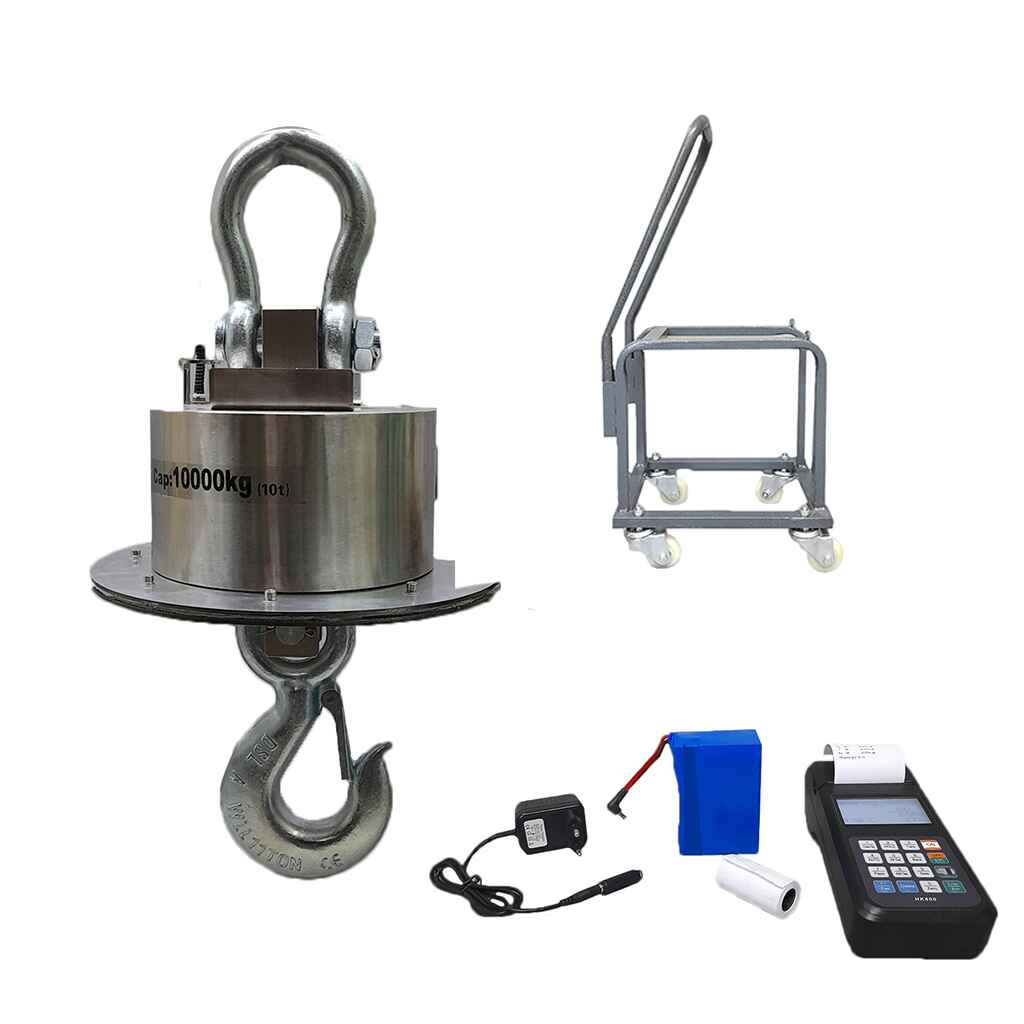
The crane scale on the hook still does the weighing. Its embedded controller waits for the reading to settle and sends it by radio to the remote in the supervisor’s hand, which repeats it in large digits — on HSCo’s HHRJDPU, high-contrast bright-red digits (the company quotes a 4/5-inch digit height). From the palm unit the supervisor can hold, tare and print without nearing the hook.
In the language of the weighing standard OIML R 76-1, a remote display or printer is a “peripheral device”: it repeats the weighing result, the difference between what the scale shows and what the peripheral shows must be zero, and its interface must not let in anything that could be mistaken for a weighing result. That is what makes a slip printed from the remote worth the paper: it is the scale’s number, not a re-typed version of it.

HSCo makes three versions, and the difference between them is what leaves the unit afterwards:
| Model | What it adds | Who it is for | Indicative price (before GST) |
|---|---|---|---|
| HHRJD | Jumbo display in the palm | The supervisor who needs to see the weight from a safe distance, and nothing more | ₹15,000 |
| HHRJDP | Jumbo display + built-in thermal printer | Loading bays and scrap yards where every lift needs a slip for the driver or the gate | ₹20,000 |
| HHRJDPU | Jumbo display + thermal printer + USB export to a PC or laptop | Anyone who bills, audits or reconciles from the weights and does not want them retyped | ₹25,000 |
Prices are HSCo’s website list prices on 14/09/2026, indicative and before GST; confirm the current figure in the configurator. All three pair with the CRH electronic crane scale, which covers 1,000 kg to 50,000 kg, runs up to 40 hours on a charge and tolerates 200 % overload. The HHRJDPU is stated to run about 15 hours on a charge, with fast charging, in a stainless-steel body rated IP65 or better — dust-tight and proof against water jets from any direction under IEC 60529 and its Indian adoption, IS/IEC 60529.

How far does a hand held remote display crane scale link really reach?
HSCo quotes up to 30 m for the hand-held display, up to 200 m for the desktop remote display and up to 20 m for the jumbo wall display. Every range figure any maker quotes is a line-of-sight number, and a steel shed is not a line-of-sight place.
Radio weakens with distance by a “path-loss exponent”, and the ITU’s indoor planning model (Recommendation P.1238-13, 2025) gives an industrial hall an exponent of 2.27 with line of sight and 2.80 without. As a rule of thumb, that makes the obstructed reach little more than half the line-of-sight reach: the loss the model gives at 30 m with a clear view, it gives at around 17 m with steel in the way — a model estimate, not a prediction for your bay; and it does not cover 200 m, so it says nothing about the desktop unit. Measurements agree: the US NIST found exponents of about 1.7–2.0 at an open test site and 3.6–7.1 inside an automotive plant full of tall metal machines (Technical Note 1951, 2017). Metal is effectively a mirror to radio; a steel sheet is opaque.
The practical rule is simpler. Stand where you can see the hook — what IS 13367 asks of the driver anyway — and the radio sees it too. Beyond 30 m, or through a wall, use the 200 m desktop remote instead.
What the printed slip must carry — and what it must not
A weight slip is a metrology document, and the standards say what it looks like. OIML R 76-1 requires printing that is clear and permanent for its intended use, figures at least 2 mm high, the unit — kg — beside the value or above the column, and printing inhibited until the reading is stable. The US NIST Handbook 44 (2026) asks the same: recorded values that are clear, agree with the display and do not easily become illegible. For a record that can be matched to an invoice, OIML D 31:2023 lists the fields: the value with its unit, the time, the place, the identity of the instrument, and a consecutive number.
In India there is a second condition. Under Section 24 of the Legal Metrology Act, 2009, a weighing instrument used in any transaction must be verified and stamped before it is put to that use; the State Legal Metrology departments do the stamping, and the Centre is unifying their portals into the national eMaap portal. If the slip will be used for billing, the crane scale it repeats must be a stamped instrument. The remote adds nothing to the number and takes nothing away — that is its whole legal standing.
A word on the paper. A thermal printer uses no ink or ribbon: the print head heats the paper, and a colourless dye in its coating reacts with a developer and turns dark (the US EPA described the chemistry in 2014; the EU banned the classic developer, BPA, from thermal paper in 2020). Thermal-paper makers advise that the image fades in direct sunlight and under prolonged fluorescent light, fades on contact with soft PVC, and that the paper starts to colour at about 60–100 °C — so a slip that lives in a truck cab in May is not an archive. That is the case for the USB port. Retyping slips into a register is the weak step: a 2012 study in PLoS One found single keying of hand-written numbers produced 6.7 errors per 1,000 fields against 0.37 for tick-boxes, and a 2011 study in Computers in Human Behavior found the entry method alone can change conclusions. Export the records to the PC; keep the slip for the driver.

What a hand-held remote is not
It is not a safety cut-off. It tells the supervisor the weight so the lift can be checked against the crane’s rated capacity; it does not stop the crane, and the crane’s own limits and inspections stay.
It is not the legal weight by itself. The stamped crane scale is the instrument; the remote repeats its reading.
It is not a permanent archive. A thermal slip is a receipt. The USB export is the record.
It is not unlimited range. Thirty metres is a line-of-sight figure; behind a stack of coils it is less, and the desktop remote exists for that.
What changes on Monday morning
- Nobody walks under the hook to read a number. The one person the code wants watching the load is the one holding the weight.
- The weight is known before the lift, not argued after. A load still on the truck can be weighed, and refused, without leaving the bay.
- Every lift can leave a slip — for the driver, the gate or the customer — printed from the scale’s own number.
- The weights reach the PC without a keyboard. The register, the bill and the dispatch note carry the figure the scale showed.
How to start: one crane, thirty days
- Pick one crane in one bay — the one where weights are most often read from under the hook or copied by hand.
- Choose the remote by what must leave it: a number only (HHRJD), a slip (HHRJDP), or a slip and a file (HHRJDPU). The full list is on the accessories for weighing scales page.
- Walk the bay with the remote on day one and mark where the digits hold and where they drop; that map is the real range figure for your shed.
- Print a slip for every lift for a fortnight, export the records by USB daily, and count what stops: walks to the hook, retyped weights, disputes at the gate.
- Roll out only what the count justifies.
Hindustan Scale Company has made weighing scales in Mumbai since 1955 and builds the crane scale, the remote and the software as one chain — one supplier answers from hook to slip. The HHRJDPU hand-held remote page carries the current specification.
Frequently asked questions
What is a hand-held remote display for a crane scale?
A palm-sized radio receiver that repeats the crane scale’s reading in large digits, so the supervisor reads the weight from a safe distance instead of under the hook. HSCo’s versions add a built-in thermal printer (HHRJDP) and a USB port for exporting the weight records to a PC (HHRJDPU).
How far does the remote work from the crane scale?
HSCo states up to 30 m for the hand-held remote, up to 200 m for the desktop remote display and up to 20 m for the jumbo wall display. These are line-of-sight figures; inside a steel shed the ITU’s indoor model suggests, as a rule of thumb, that the obstructed reach can be little more than half of that. Walk your bay with the unit and map where the digits hold.
Can the printed slip from the remote be used for billing?
Yes, if the crane scale it repeats has been verified and stamped by the State Legal Metrology department, as Section 24 of the Legal Metrology Act, 2009 requires for any instrument used in a transaction. The remote must repeat the stamped reading exactly, which is what the weighing standard OIML R 76-1 demands of any peripheral display or printer.
How long does the battery last?
HSCo states about 15 hours on a single charge for the HHRJDPU, with fast charging, and up to 40 hours for the CRH crane scale it pairs with. A remote charged overnight covers a double shift.
Which of the three remotes should I buy?
Buy the HHRJD if the supervisor only needs to see the weight. Buy the HHRJDP if each lift must leave a slip for a driver, a gate or a customer. Buy the HHRJDPU if the weights end up in a bill, an audit or a stock register — the USB export removes the retyping that causes most record errors.
Does the remote survive a scrap yard or a monsoon?
The HHRJDPU has a stainless-steel body rated IP65 or better: dust-tight, and protected against water jets from any direction under IEC 60529 / IS/IEC 60529. It is not a submersible; keep it out of standing water.
Next step
Tell us which crane’s weight is still read from under the hook, and we will propose a thirty-day hand-held remote pilot for that bay.
Hindustan Scale Company (HSCo) · Mumbai · est. 1955 · www.hindustanscale.com · hsc@hindustanscale.com
Sources
- IS 13367 (Part 1):1992 — Safe use of cranes: Code of practice, Part 1 General (Bureau of Indian Standards), clauses 5.2, 13.2, 13.3, 13.4.2 and 17.1.1.
- The Factories Act, 1948 (India), Section 29 — Lifting machines, chains, ropes and lifting tackles.
- US OSHA — 29 CFR 1910.179 Overhead and gantry cranes; 29 CFR 1926.1425 Keeping clear of the load; 29 CFR 1926.1417(o) Rated capacity.
- US Bureau of Labor Statistics — Fatal occupational injuries involving cranes, 2011–17 (CFOI factsheet, 2019).
- US OSHA — Cranes and Derricks in Construction, final rule, 75 FR 47906 (09/08/2010).
- OIML R 76-1:2006 — Non-automatic weighing instruments, Part 1, clauses 3.6.3, 4.4.2, 4.4.5, 5.3.6.1 and T.2.3.5.
- OIML D 31:2023 — General requirements for software-controlled measuring instruments, clauses 6.3.4.2 and 6.3.5.2.
- NIST Handbook 44 (2026 edition), Section 1.10 General Code, G-S.5.1, G-S.5.2.2, G-S.5.2.5 and G-S.5.6.
- The Legal Metrology Act, 2009 (India), Section 24; Press Information Bureau — National Legal Metrology Portal (eMaap), 04/12/2024.
- ITU-R Recommendation P.1238-13 (09/2025), Table 2; ITU-R Recommendation P.2040-4 (09/2025), Table 3 and equation 27.
- NIST Technical Note 1951 — Industrial Wireless Systems: Radio Propagation Measurements (Candell et al., 2017).
- US EPA — Partnership to Evaluate Alternatives to Bisphenol A in Thermal Paper (2014); Commission Regulation (EU) 2016/2235.
- Koehler Paper — functional principle of conventional thermal paper; Jujo Thermal — technical guide, correct storing (manufacturer guidance, illustrative).
- IEC 60529 (ed. 2.2, 2013) and IS/IEC 60529:2001 — Degrees of protection provided by enclosures (IP Code).
- Paulsen A., Overgaard S., Lauritsen J. M. — PLoS One 7(4): e35087 (2012); Barchard K. A., Pace L. A. — Computers in Human Behavior 27(5) (2011).
- Hindustan Scale Company — CRH electronic crane scale page; Accessories for weighing scales (price list); HHRJDPU product page (14/09/2026).