
Crane Scale Tare Over the Air: Zeroing Hook, Chains and Slings From the Ground
Say the chain sling on your crane hook weighs 40 kg. Your customer should not pay for it. And when the display reads zero with that sling still hanging, your crane driver should not believe it either.
That is the whole subject of a crane scale tare. A tare takes the hook block, chains and slings out of the number the customer pays for — while the scale, the crane and the record all keep knowing the tackle is there. Below: why zero is the wrong key, what a tare must legally do, why a minus reading is correct, what the slip must show, and what a radio-link tare may and may not do.
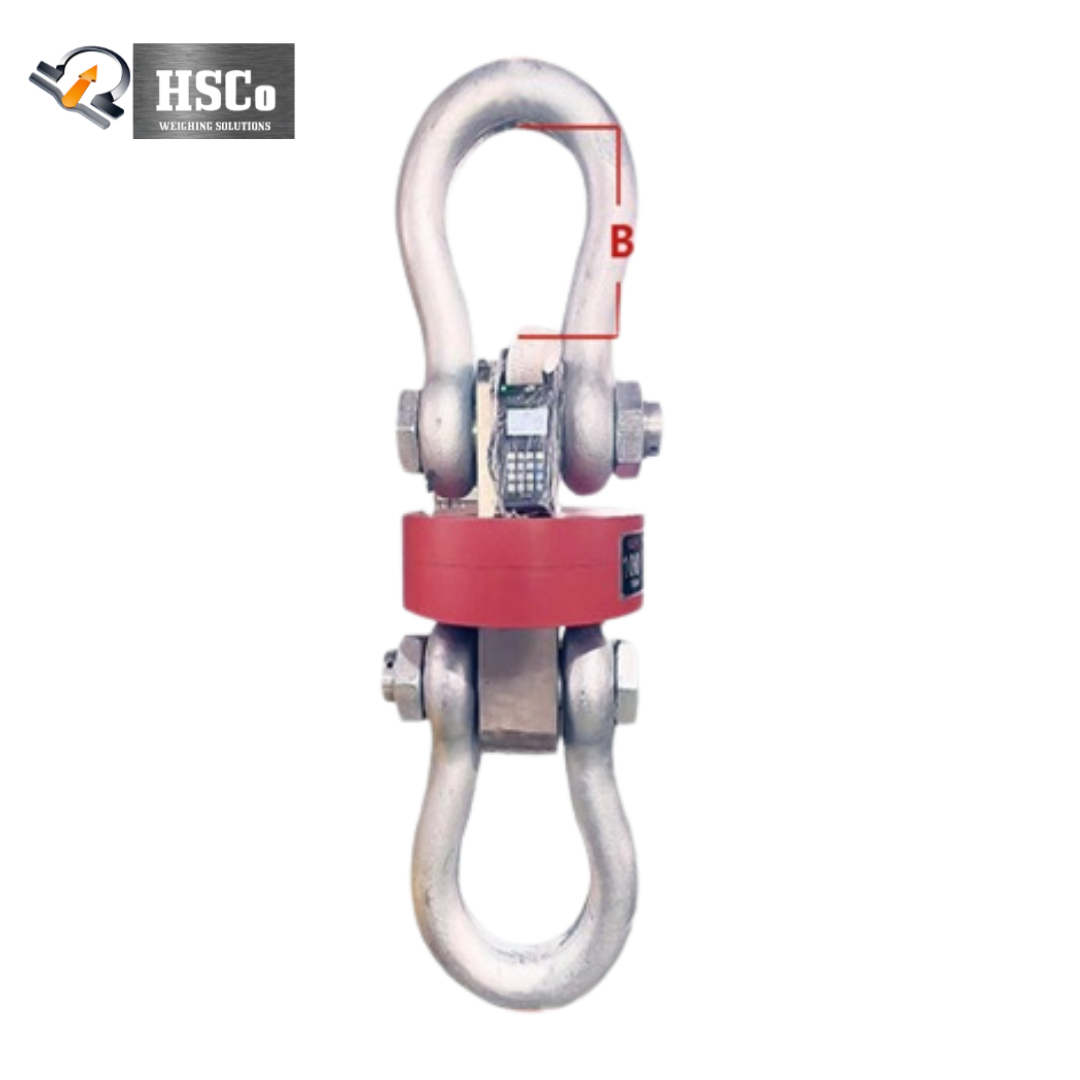
Zero is the wrong key for the hook block
Every crane operator has done it: hang the sling, press ZERO, lift, read. It works — until it silently stops, and the law is the reason.
A zero key may not absorb an unlimited load. OIML R 76, the international recommendation that India’s Legal Metrology (General) Rules 2011 copy word for word into their Seventh Schedule, caps the combined effect of zero-setting and zero-tracking at 4 % of the scale’s capacity; the one-off zero at switch-on may go to 20 %. Canada’s Weights and Measures Regulations set the same limit independently — “four per cent of the machine’s rated capacity” — and the US NIST Handbook 44 carries the same 20 % switch-on ceiling. Wherever a scale is verified, the zero key has a small budget.
Apply the 4 % rule to the Hindustan Scale Company CRH range and it works out to 40 kg on a 1,000 kg crane scale, 80 kg on 2 t, 120 kg on 3 t, 200 kg on 5 t and 400 kg on 10 t. Those figures are computed, not quoted. Look at the first one. A 40 kg sling set uses the entire zero budget of a 1 t scale. Add a shackle and the zero key stops responding.
One more condition matters on a crane: pressing zero cancels any tare in force — which is why R 76 and the Indian Schedule require separate zero and tare controls, and NIST allows a combined “0/T” key only on scales marked “Not for Direct Sales”.
Tackle heavier than the zero budget cannot be zeroed. It must be tared.

What does a crane scale tare actually do?
A tare, in the legal definition, sets the indication to zero “when a load is on the load receptor”. On a crane scale the receptor is the hook and the load already on it is the block, the chain and the slings. Three things follow. All are written into R 76 and the Indian Schedule; Canada’s regulations carry the first two, NIST Handbook 44 the first.
A subtractive tare shrinks the range. Tare 40 kg on a 1,000 kg scale and the largest net it can show is 960 kg.
The display must say NET. Whenever a tare is in force the net value must carry the sign NET. A reading without the NET flag is a gross reading, whatever the operator remembers pressing.
Only one kind of tare keeps a record. A tare-balancing device zeroes the tackle and forgets the value. A tare-weighing device stores it and can show or print it. For a scale that settles invoices, only the second will do: the chain’s weight must survive into the record, not vanish into a zero.
A known tackle weight may also be keyed in as a preset tare: it must use the scale’s own division (1 kg or 2 kg on the CRH range), show NET, stay viewable and print as “PT” beside the net. UK lifting guidance (HSE L113) asks for heavy accessories to be marked with their own weight — which makes this possible. One caution from R 76: the accuracy tolerances do not apply to a net calculated from a preset tare, so weigh the tackle when the invoice is large.

Why a minus reading after a tare is correct
Tare the tackle, set the block on the floor, and the display reads minus 40 kg. New operators think the scale is broken. It is doing what the law describes.
OIML R 76 says so in words: “an indication below zero (with minus sign) is possible when a tare device is in operation and the tare load has been removed from the load receptor”. Canada goes further — a negative weight value “shall continue to be displayed” when the receptor is empty and a tare is in force. Indian law calls the same state “a negative net value equivalent to gross zero”, and NIST Handbook 44 measures every net tolerance from the tare zero.
R 76 adds a rider, and it is the useful part. A minus reading with no tare in force is tolerated only down to 20 divisions, and only if it cannot be transmitted, printed or priced. Canada blanks the price display and interlocks the recording of any value below zero. So: a minus on the display is normal; a minus on a ticket is a fault.
For the crew it is a one-line rule. Minus 40 kg with the block on the floor means the tare is alive. Zero with the block on the floor means somebody pressed ZERO and the tare is gone.
For the crane the chain is the load; for the invoice it is not
Crane-safety law counts the tackle as part of the load. Trade law says the customer pays only for the goods. A crane scale that keeps one number cannot satisfy both.
US OSHA’s crane rule (29 CFR 1926.1401) defines the load as the object together with “the load block, ropes, slings, shackles, and any other ancillary attachment”, and 1926.1417 requires the operator to verify the load is within rated capacity before the lift — by a recognised source, by calculation, or on the hook with a load-weighing device. UK guidance (HSE L113) says the same of “associated accessories”. India’s Factories Act 1948, section 29, forbids loading any chain, rope or lifting tackle — chain slings, hooks and shackles are named — beyond its marked safe working load.
That is the gross number. The invoice needs the net, and the record must show how it was reached.
| Value | What it is | Who needs it | On the slip |
|---|---|---|---|
| Gross | Goods plus tackle | Crane driver, rigger, safety officer | No symbol, or “G” |
| Tare | The tackle, weighed or preset | Both sides of the sale | “T”, or “PT” if keyed in |
| Net | Gross minus tare | Accounts, customer, auditor | “N” |
| Calculated | Derived from the other two | The auditor | “C” |
| Manual entry | Typed in, not weighed | Nobody should rely on it | “Manual Wt” (NIST) |
The rule is stated three times over: R 76 wants net and tare printed together identified “by the corresponding symbols N and T”; NIST Handbook 44 wants point-of-sale records to carry both net and tare, identified; Canada wants gross, net and tare “clearly identified”. A slip with a net and no tare beside it is one on which the chain has disappeared — nobody can later say whether it was 40 kg or 400.
Pressing tare from the ground: what a radio link may and may not do
A crane hook is the least convenient place to press a key. On HSCo’s two-box crane weighing system the hook-mounted unit weighs while a ground-side remote indicator, up to 200 m away, carries the display and the controls — zero, tare, hold and print. The CRH electronic crane scale page calls this “100% Tare Functionality from Remote”.
The law does not object to a remote key. It objects to a remote key behaving differently from the local one. R 76 — and the Indian rule that copies it — says functions “performed or initiated via an interface shall meet the relevant requirements and conditions of clause 4”: the NET flag, the 4 % zero cap, a zero true to a quarter of a division, and a tare that acts only when the reading is stable. The link must not allow a result to be influenced, falsified or mistaken for something it is not, and nothing sent over it may adjust the instrument. A tare from the ground is lawful for one reason only: it is the same tare, under the same conditions. HSCo’s two-box system works that way: the ground indicator sends the command; the hook unit performs the tare as if its own key had been pressed.
What a remote tare is not: a way to recalibrate from the ground. Remote configuration — span, capacity, division — is a different category, which NIST Handbook 44 requires to be sealed or event-logged; a remote display and keyboard, by contrast, are parts with “no metrological effect”. When a supplier demonstrates a remote, ask which functions its keys can reach.

What changes for you on Monday morning
- The sling stops being invoiced. Say it is 40 kg and you make 50 lifts a day: 2 tonnes a day of chain on somebody’s bill — yours or your customer’s. Multiply by your own per-tonne rate; the 40 kg is an illustration, the arithmetic is not.
- The crane driver keeps the gross. Both units know the full load, so the safety check is made on the real number.
- The record can be defended. Gross, tare and net, each labelled, on every ticket.
- Nobody climbs to the hook. Tare, zero, hold and print from the ground, at up to 200 m.
- A minus reading stops being a service call. The crew knows it means the tare is alive.
How to start: one crane, thirty days
- Pick one crane, one hook, one regular sling set. Weigh the tackle and mark the figure on the sling tag, as HSE L113 recommends.
- Tare it — do not zero it. Confirm the display shows NET, set the block down, confirm the minus value.
- Teach the crew the one-line rule: ZERO wipes the tare.
- For thirty days keep every ticket with G, T and N on it. Count disputes, tonnes of tare, and trips to the hook.
- Compare with the previous month, and decide whether the other cranes follow.
Hindustan Scale Company has built scales in Mumbai since 1955 and makes the crane unit, the remote indicator and the software between them itself. The CRH range runs 1 t to 10 t as standard (20 t and 50 t on request) at 1 kg and 2 kg divisions — see the crane scale family, and the CRHBT5K Bluetooth crane scale for the phone-app option. For the plain-scale version of the same key, read what is the tare button.
Frequently asked questions
What is the difference between zero and tare on a crane scale?
Zero resets the empty scale and may absorb only a small load — 4 % of capacity in total under OIML R 76, Indian and Canadian rules. Tare removes a load that is meant to stay on the hook, stores its value, and marks the display NET. Pressing zero cancels any tare in force, so the two keys must be separate.
Why does my crane scale show a negative weight?
Because a tare is in force and the tared tackle has been set down or removed. OIML R 76 says a below-zero indication with a minus sign is possible in exactly that state, and Canadian law says it shall continue to be displayed. It becomes a fault only if that minus value is printed or priced.
Can I tare the hook block and chains from the ground?
Yes. On HSCo’s two-box crane scale the ground-side indicator sends zero, tare, hold and print to the hook unit. The rules require a function initiated over an interface to meet the same conditions as the local key — stable reading, NET shown, 4 % zero cap — and forbid the link from altering or falsifying a result.
Is the chain sling counted in the crane’s safe working load?
Yes. OSHA’s crane rule defines the load as the object plus the load block, slings and shackles; the UK’s HSE L113 says the same; India’s Factories Act forbids loading any lifting tackle beyond its marked safe working load. The crane driver needs the gross weight even when the invoice is settled on net.
What must a crane scale weighing slip show?
When net is printed with gross or tare, the net and tare must be marked N and T (gross may be G); a keyed-in tare prints as PT; a calculated value should be marked C; a manually typed weight must be flagged as a manual entry. NIST Handbook 44 requires point-of-sale records to carry both net and tare, identified.
Can I key in the chain weight instead of weighing it every time?
Yes, as a preset tare. It must be in the scale’s own division, the display must show NET, the value must be viewable and it must print as PT beside the net. The legal accuracy tolerances do not apply to a net calculated from a preset tare, so weigh the tackle when the invoice is large.
Next step
Tell us the capacity of your crane and the tackle you lift with, and we will propose a thirty-day remote-tare pilot on one hook.
Hindustan Scale Company (HSCo) · Mumbai · est. 1955 · www.hindustanscale.com · hsc@hindustanscale.com
Sources
- OIML R 76-1:2006 — Non-automatic weighing instruments, Part 1: Metrological and technical requirements — Tests (International Organization of Legal Metrology): T.2.7.4–T.2.7.5 tare definitions; 2.2 (tolerances not applied to calculated net with a preset tare); 4.2.3 indication below zero; 4.5.1–4.5.4 zero-setting (4 %, 20 %, 0.25 e, separate controls); 4.6.3–4.6.11 tare devices, NET, printing G/N/T/C; 4.7.1–4.7.3 preset tare (PT); 5.3.6 interfaces.
- NIST Handbook 44 (2026 edition), Section 2.20 Scales (US National Institute of Standards and Technology): S.1.1.1(b), S.1.8.5, S.1.12, S.2.1.5, S.2.1.6, S.2.3, Table S.1.11, T.N.2.1.
- Legal Metrology (General) Rules, 2011 (India), Rule 13 and Seventh Schedule Heading A — Non-automatic weighing instruments: para 2 definitions; para 4(5) zero-setting; para 4(6) tare devices and printing; para 4(7) preset tare; para 5(3)(vi) interfaces.
- Weights and Measures Regulations, C.R.C., c. 1605 (Canada, Department of Justice consolidated text): s.154(1), (4), (9)–(12); s.159; s.160.
- 29 CFR Part 1926 Subpart CC — Cranes and Derricks in Construction (US OSHA, via eCFR): 1926.1401 definitions of “load” and “rated capacity”; 1926.1417(o) compliance with rated capacity and load-weight verification.
- HSE L113 — Safe use of lifting equipment: LOLER 1998 Approved Code of Practice and guidance, 2nd edition (UK Health and Safety Executive, 2014): paras 93, 199 and 204; Regulation 9 examination intervals.
- The Factories Act, 1948 (India), Section 29 — Lifting machines, chains, ropes and lifting tackles.
- OIML D 31:2023 — General requirements for software-controlled measuring instruments, 6.3.5.2–6.3.5.3 (supporting; same publisher as R 76).
- Hindustan Scale Company — CRH Electronic Crane Scale product page (read 14/09/2026): capacities, divisions, remote tare, remote-display range, battery, Bluetooth option.