
Two Cranes, One Bay: Multiple Crane Scales Interference and the Pair-Number Fix
Crane 2’s weight showed up on Crane 1’s desk. Nobody noticed for a week.
Picture it. Two overhead cranes share one bay, each with a wireless crane scale on its hook and a remote indicator at its desk. For a week the desk for Crane 1 has shown whichever hook spoke last, because both hooks speak on the same free radio band. Nothing is broken. Every number on the screen is a real weight. Some of them belong to the other crane. That is multiple crane scales interference: not static, not a dead link, but a good reading arriving at the wrong desk. Here is why it happens, why hopping does not prevent it, and why the fix is a pair number set on both boxes — never on one.
What causes multiple crane scales interference in one bay?
Start with the band. A wireless crane scale in India runs on the licence-exempt 2.4 GHz band — 2.4 to 2.4835 GHz — opened to low-power equipment by a Government of India gazette notification of 28/01/2005 on a “non-interference, non-protection and shared (non-exclusive) basis”. Anyone may transmit. Nobody is protected. The International Telecommunication Union lists the same range as an industrial, scientific and medical band whose users “are required to accept harmful interference”. It is the same free band your Wi-Fi, your phones’ hotspots, the canteen microwave and the other crane all use — and a 2018 guide from the US National Institute of Standards and Technology (NIST) shows Wi-Fi and hopping sensor radios side by side in it and says they “may interfere with each other”.
Now add the receiver. A receiver does not know which transmitter it is listening to; it hears every transmitter in range. If two crane scales in one bay are sending weights, both desks hear both hooks. Whether the wrong weight reaches the display depends on one thing: does the indicator have a rule for throwing away frames that are not its own?
Without that rule you get the scene above. Crane 1 lifts 4,200 kg, Crane 2 lifts 1,850 kg, and Crane 1’s desk shows one, then the other. The clerk writes down whatever was there when he looked up. Nothing on the screen says “this came from the other hook”.

Frequency hopping is not the same as knowing who is talking
The usual answer to “won’t they interfere?” is “the radio hops”. True — and not enough.
A short-range 2.4 GHz radio of the Bluetooth class divides the band into 40 channels of 2 MHz — 37 for data, 3 for advertising — and hops between them many times a second, retiring bad channels. The Bluetooth Special Interest Group publishes this; the European radio standard ETSI EN 300 328 independently defines hopping equipment as a transmitter and receiver that “follow the same frequency hop pattern”. Hopping exists to reduce collisions. It dodges traffic.
What it does not do is tell a receiver whose packet it has just caught. That is the job of the address carried in every packet — in the Bluetooth core specification the hop sequence is itself derived from the connection’s address, so the address, not the hopping, keeps two links apart. Two hopping radios in one bay with no address check are two people in a stairwell: they rarely talk over each other, but everyone hears everything.
The bay makes it worse. NIST measured radio propagation at an automotive plant, a machine shop and a steam plant and found industrial surroundings “typically highly reflective”, with “significant multi-path effects”; its deployment guide adds that steel “will reflect RF transmissions” and cause data loss. Steel is a wonderful conductor and a terrible neighbour for radio. NIST recommends a survey of what is already on the air before you deploy — sound advice, but no survey stops one legitimate transmitter being heard by another’s receiver. Only an address does.
The fix: one number, set on both boxes
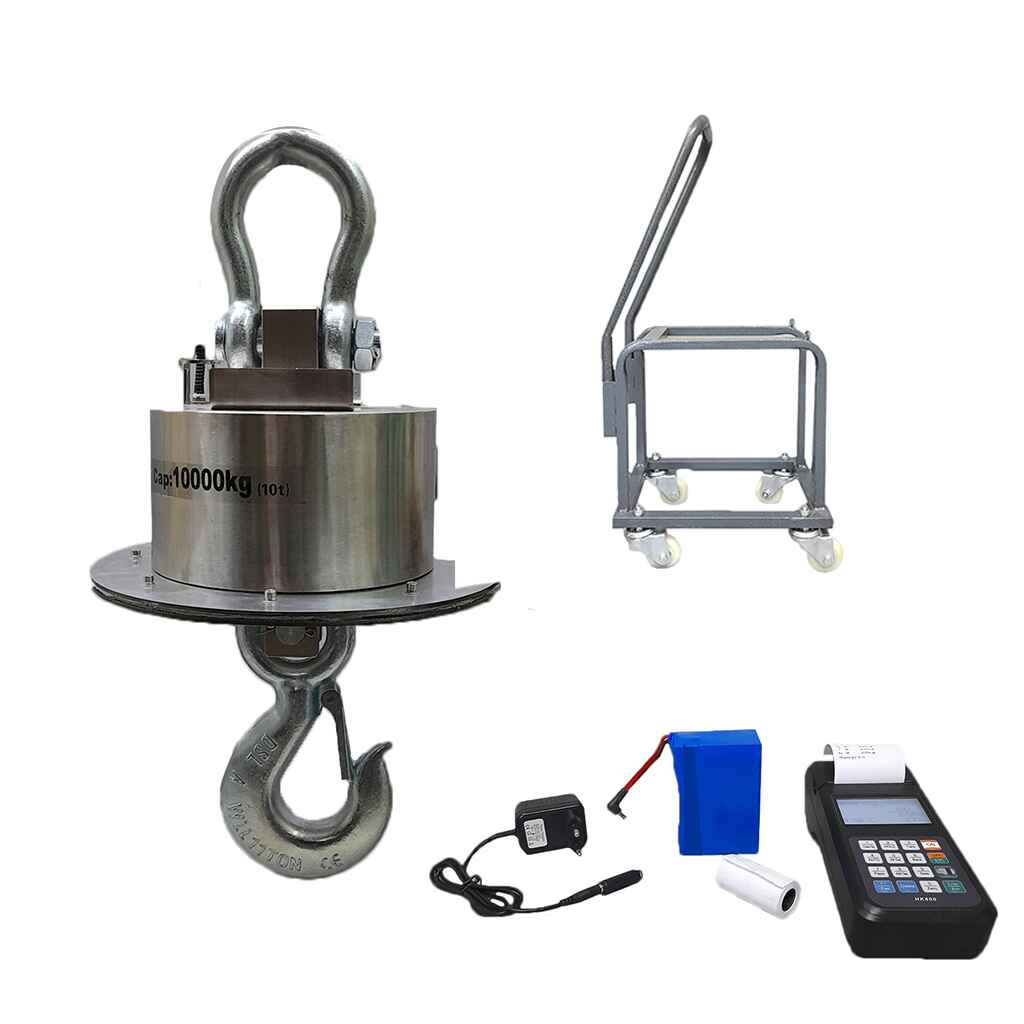
Hindustan Scale Company builds its wireless crane scale as a two-box system: the transmitter on the hook — the CRHBT10K Bluetooth crane scale for a 10 t hook; the range runs from 3 t to 50 t — and a remote desktop indicator at the desk. Each box carries a two-digit pair number, 00 to 99, set on the transmitter and set again on the indicator. The indicator shows a frame only if it carries the indicator’s own number. Any other frame is dropped — not corrected, not displayed.
That is not a quirk; it is how every serious radio protocol behaves. The Bluetooth core specification says a packet whose access address is incorrect “shall be rejected”, and one whose integrity check fails “shall be rejected”. The LoRaWAN specification, from a separate body for a different kind of radio, requires a device to check the address and the integrity code “before forwarding it to the application layer”. Reject, do not repair.
Why both boxes? Because every one of these schemes keeps the same identifier at both ends: ETSI’s hopping pair on one pattern, a Bluetooth access address held by both devices, a LoRaWAN address stored in the device. The identifier lives at both ends or it lives nowhere. Change the number on the hook box alone and its own desk starts dropping its frames — while still accepting the other crane’s. Change it on both, and you have a locked pair.
| The bay | Crane 1 (hook → desk) | Crane 2 (hook → desk) | What each desk shows |
|---|---|---|---|
| Both cranes on the same number | 07 → 07 | 07 → 07 | Both hooks on both desks — the week-long silent mix-up |
| Number changed on one box only | 23 → 07 | 07 → 07 | Crane 1’s desk drops its own hook and shows only Crane 2’s |
| Own number on both boxes | 07 → 07 | 23 → 23 | Each desk shows only its own hook |

Why the wrong crane’s weight is a compliance problem, not a clerical one
The rulebook for trade scales says the same in its own language. OIML D 31:2023, the international guidance for software-controlled measuring instruments, requires a transmitted weight to carry the “identification of the measuring instrument that was used for the measurement” and requires the receiving software to check its authenticity and integrity — if something is wrong, “the data shall be discarded or marked unusable”. OIML R 76-1 says an interface shall not let measurement data be influenced “by other interconnected instruments”. WELMEC, Europe’s legal-metrology cooperation, says the same in its 2026 software guide and adds a test: introduce foreign frames and “check that these are detected and discarded”. A weight from the other crane is a foreign frame. (A description of a well-behaved receiver, not a type-approval claim for any particular scale.)
Indian law adds the sharper edge. Under the Legal Metrology Act, 2009, a weighing instrument used in any transaction — a sale, a purchase, an assessment of dues, wages or work done — must be verified and stamped before use. Using an unverified one carries a fine of ₹2,000 to ₹10,000, and up to a year’s imprisonment for a repeat offence. The stamp belongs to a specific instrument, and a weight that actually came from the other crane’s scale cannot be traced to the certificate you would show the inspector. Which scale produced a number is a compliance question, not bookkeeping.
The port world learned how common silent misattribution is the hard way. After the MSC Napoli casualty of January 2007, an investigation by the UK’s Marine Accident Investigation Branch reported that 137 of about 660 dry deck containers it weighed — 20 % — were more than 3 t off their declared weight, and that 53 of 700, 7 %, were in the wrong slot or declared as the wrong container. One investigation’s figures, and about containers, not cranes — but the response was global: from 01/07/2016 the IMO’s SOLAS rules have required every packed container’s gross mass to be verified before loading. A number that cannot be tied to the thing it describes is not a record. It is a guess with a decimal point.
And India — 149.6 million tonnes of crude steel in calendar 2024, second in the world by the World Steel Association’s count — is where crane scales work hardest.

What paired numbering is not
It is not a licence. The band stays shared, and India’s 2005 rules put a licensed user’s complaint ahead of any unlicensed device. The number decides which frames your desk counts; it does not reserve the air.
It is not a fix for range or reflections. Girders still bounce signals and hotspots still compete for the band — which is why NIST recommends a survey. Hopping handles traffic; the number handles identity.
It is not a substitute for stamping. A paired indicator shows the right hook’s weight; whether that weight may be used in a sale is for the stamping rules to say.
And it is not automatic. Hopping is; pairing is a decision somebody in your plant makes, sets on two boxes and records in the register.
What changes for you on Monday morning
- Each desk shows its own hook and nothing else. The reading stops jumping between two loads.
- A dispute about a weight ends with a pair number in the register, not an argument between two operators.
- Adding a third crane is a two-minute job — a fresh number on two boxes, not a new radio plan.
- A weight on a challan traces back to the stamped instrument that produced it — what the inspector, the auditor and the customer all want.
How to start: two cranes, thirty days
- List every wireless box in the bay — crane scales, remote indicators, hand-held units — and which desk should hear which hook.
- Give each crane its own pair number. Set it on the hook box and on the desk box. Label both and log it.
- Run the two-crane test. Lift on Crane 2 and watch Crane 1’s desk: it must hold its own reading. Then swap. Five minutes.
- Survey what else is on the air — access points, hotspots, the canteen microwave — and keep the indicator away from them.
- For thirty days, log every reading that does not match a lift. The count should be zero; if it is not, the cause is no longer the other crane.
Hindustan Scale Company has made weighing scales in Mumbai since 1955 and builds the crane scale, its transmitter and the remote indicator itself, so the number is set the same way at both ends. The CRHBT10K Bluetooth crane scale is the 10 t model; the full range, 3 t to 50 t, is on the crane scale page, and what is a crane scale covers the basics.
Frequently asked questions
Can two wireless crane scales interfere with each other?
Yes. Both run on the same licence-free 2.4 GHz band, which India opened to low-power equipment on a shared, non-protection basis in 2005, and any receiver in range hears any transmitter on that band. Unless the indicator checks an identity on every frame, it can display the other crane’s weight as if it were its own.
What is a pair number on a crane scale?
A two-digit number, 00 to 99, set on both boxes of an HSCo two-box crane scale — the transmitter on the hook and the remote indicator at the desk. The indicator shows only frames that carry its own number and drops every other frame, so two cranes on different numbers cannot hear each other.
Why must the pair number be set on both the scale and the indicator?
Because a filter set on one end is not a filter. Every radio scheme — Bluetooth’s access address, LoRaWAN’s device address, the hop pattern in the European 2.4 GHz standard — keeps the same identifier at both ends. Change the number on one box only and that pair stops working; change it on both and the pair is locked.
Doesn’t frequency hopping already stop crane scales from hearing each other?
No. Hopping spreads transmissions across 40 channels to reduce collisions with Wi-Fi and other radios, but it does not tell a receiver which transmitter sent a packet. That is the job of the address in the packet — in Bluetooth the hop sequence is itself derived from that address. Hopping handles traffic; the pair number handles identity.
Is a weight from the wrong crane a legal problem?
It can be. Under the Legal Metrology Act, 2009, a weighing instrument used in any transaction must be verified and stamped before use, with a fine of ₹2,000 to ₹10,000 for using an unverified one and up to a year’s imprisonment on a repeat offence. A weight that cannot be traced to the stamped instrument that produced it is hard to defend, and the international rulebooks for weighing software require a receiver to discard data that fails an identity or integrity check.
How many crane scales can share one bay?
The numbering gives 100 distinct pairs, so identity is not the limit. How many transmitters the air in your bay can carry cleanly depends on the steelwork and what else is transmitting, which is why NIST recommends a site and spectrum survey. Start with the cranes you have, test each pair, and add the next one the same way.
Next step
Tell us how many cranes share your bay and where each desk sits, and we will propose a thirty-day paired-numbering pilot for two of them.
Hindustan Scale Company (HSCo) · Mumbai · est. 1955 · www.hindustanscale.com · hsc@hindustanscale.com
Sources
- Government of India, Department of Telecommunications — Notification G.S.R. 45(E) of 28/01/2005, Use of low power Equipment in the frequency band 2.4 GHz to 2.4835 GHz (Exemption from Licensing Requirement) Rules, 2005: licence-exempt on a “non-interference, non-protection and shared (non-exclusive) basis”.
- ITU-R Recommendation SM.1056-1 — Limitation of radiation from industrial, scientific and medical (ISM) equipment: 2 400–2 500 MHz as an ISM band; services there must accept harmful interference.
- ETSI EN 300 328 V2.2.2 (July 2019) — Data transmission equipment operating in the 2,4 GHz band: band limits, definition of frequency hopping (transmitter and receiver on the same hop pattern), listen-before-talk duty.
- Bluetooth SIG — Bluetooth Core Specification v5.4, Vol 6 Part B, section 3.1 Error checking; Bluetooth Technology Overview; The Bluetooth LE Primer (M. Woolley, 2022): 40 channels of 2 MHz, adaptive hopping, access-address and integrity checks, packet rejection.
- LoRa Alliance — LoRaWAN L2 1.0.4 Specification (TS001-1.0.4, 2020): device address and message integrity code checked before a frame reaches the application.
- OIML D 31:2023 — General requirements for software controlled measuring instruments, clauses 6.3.5.2 and 6.3.5.3 (identification of the instrument in transmitted data; discard or mark unusable on irregularity); 2019 edition clauses 6.2.5.1–6.2.5.2.
- OIML R 76-1:2006 — Non-automatic weighing instruments, Part 1, clauses 5.3.6 and 5.3.6.1 (interfaces and other interconnected instruments).
- WELMEC Guide 7.2 Software Guide, Version 2026 — core requirement R1 and note R1/N1; threat IIT1 functional checks (fraudulent frames detected and discarded).
- NIST Advanced Manufacturing Series 300-4 (April 2018) — Guide to Industrial Wireless Systems Deployments; NIST Technical Note 1951 (2017) — Industrial Wireless Systems: Radio Propagation Measurements: reflective industrial environments, metal canyons, everyday 2.4 GHz interferers, site and spectrum surveys.
- The Legal Metrology Act, 2009 (India) — sections 2(u), 2(v), 2(w), 16, 24 and 33 (verification before use in a transaction; penalties; forfeiture). India Code; Indian Kanoon.
- UK Marine Accident Investigation Branch — Report No 9/2008, Structural failure of MSC Napoli (April 2008), section 1.11 container audit; International Maritime Organization — Verification of the gross mass of a packed container, SOLAS VI/2, in force 01/07/2016.
- World Steel Association — press release, December 2024 crude steel production and 2024 global totals (24/01/2025): India 149.6 million tonnes in 2024, second in the world.
- Hindustan Scale Company — CRHBT Bluetooth crane scale range (3 t to 50 t) and remote desktop indicator; two-digit pair numbering 00–99 on transmitter and indicator (2026).