
Blogs
Goat feed per day: how much does a goat eat for its body weight?

Quick answer
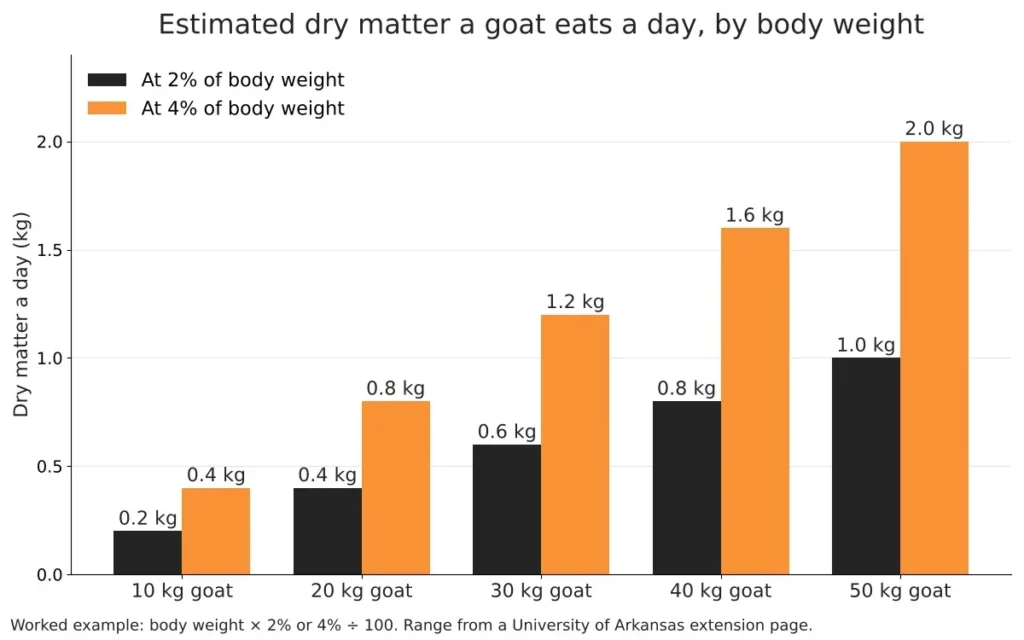
Goat feed per day is about 2 to 4% of the goat’s body weight as dry matter, by a University of Arkansas rule of thumb [1]. Dry matter is the feed with its water taken out. That rule of thumb gives an estimate of 0.6 to 1.2 kg of dry matter a day for a 30 kg goat. The percentage varies by goat. The goat’s weight is the part of the sum you can measure, on a scale.
A 2014 University of Arkansas at Pine Bluff fact sheet says you need to know your animals’ weights because feed requirements are higher for larger animals [3]. The University of Arkansas page on sheep and goat nutrition gives 2 to 4% as a rule of thumb [1], the Kentucky State University guide gives 2 to 3% [2], and Penn State Extension gives 2.5 to 3.0% for market goats [5].
How much goat feed per day should you estimate for each body weight?
Multiply the goat’s weight by the intake percentage. At 2% the estimate for a 30 kg goat is 0.6 kg of dry matter a day, and at 4% it is 1.2 kg. These figures estimate everything the goat eats in a day, and the dry matter it gets from grazing counts towards that total. The table runs the same sum at 2%, 3% and 4% [1].
Dry matter a day (kg) = body weight (kg) × intake percentage ÷ 100
| Goat weight | At 2% | At 3% | At 4% |
|---|---|---|---|
| 10 kg | 0.2 kg | 0.3 kg | 0.4 kg |
| 20 kg | 0.4 kg | 0.6 kg | 0.8 kg |
| 30 kg | 0.6 kg | 0.9 kg | 1.2 kg |
| 40 kg | 0.8 kg | 1.2 kg | 1.6 kg |
| 50 kg | 1.0 kg | 1.5 kg | 2.0 kg |
How much hay or silage is that, with the water counted in?
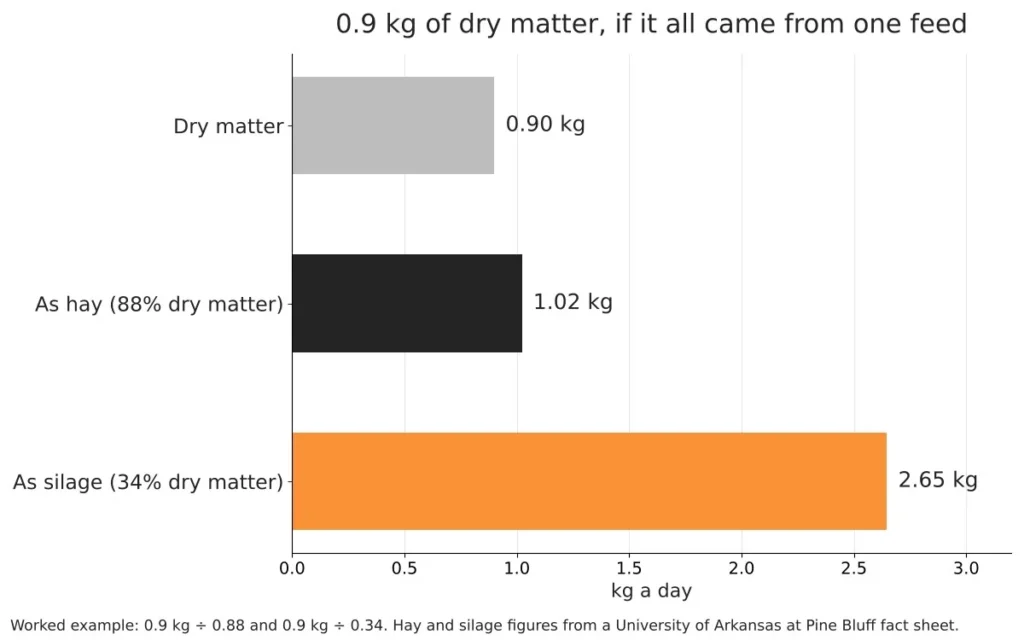
Hay and silage weigh more than the dry matter in them, because both hold water. Hay tends to be about 88% dry matter and silage averages 34% [3]. To turn the dry matter you assign to one feed into that feed’s weight, divide it by the feed’s dry matter percentage as a decimal (0.88 for 88%). The answer is the estimated weight of that feed that supplies the dry matter, if the goat eats it all. Leftovers and waste come on top, and your own feed’s dry matter can differ from the average.
Feed weight eaten (kg) = dry matter (kg) ÷ (dry matter percentage ÷ 100)
Take a 30 kg goat at 3%, or 0.9 kg of dry matter. As hay alone, that is 0.9 ÷ 0.88 ≈ 1.02 kg a day. As silage alone, it is 0.9 ÷ 0.34 ≈ 2.65 kg. These two cases show the conversion only. A real ration mixes several feeds, and the Pine Bluff fact sheet’s worked example, for ewes, balances one for dry matter, energy and protein [3].
Do kids, pregnant goats and milking goats need more feed?
Growth, pregnancy and milk can raise a goat’s nutrient needs [1]. The University of Arkansas page says smaller animals need a higher intake as a percentage of body weight [1]. The Kentucky State University guide says requirements vary with age, stage of production and weather [2].
The Merck Veterinary Manual notes that goats can eat up to 6.5% of their body weight as dry matter [4]. Let your vet or feed adviser set the intake percentage for each goat and stage.
How does a wrong weight guess change the feed estimate?
At 3% of body weight, every 5 kg you guess wrong moves the estimate by 0.15 kg of dry matter a day. Take a goat guessed at 25 kg that weighs 30 kg. The estimate from the guess is 25 × 3 ÷ 100 = 0.75 kg of dry matter a day, while the estimate at 30 kg is 0.9 kg.
| Period | Gap between dry matter estimates, per goat | Gap for 20 goats |
|---|---|---|
| 1 day | 0.15 kg | 3 kg |
| 30 days | 4.5 kg | 90 kg |
The 30-day and 20-goat figures assume the same gap and the same intake percentage for every goat, every day. A guess that is 5 kg too high adds the same 0.15 kg a day. Overfeeding, the Pine Bluff fact sheet warns, wastes feed and money and can cause problems, especially around the time of birth [3].
How often should you weigh each goat, and what should you record?
Our earlier post on goat weight tracking suggests weighing once or twice a month [6].
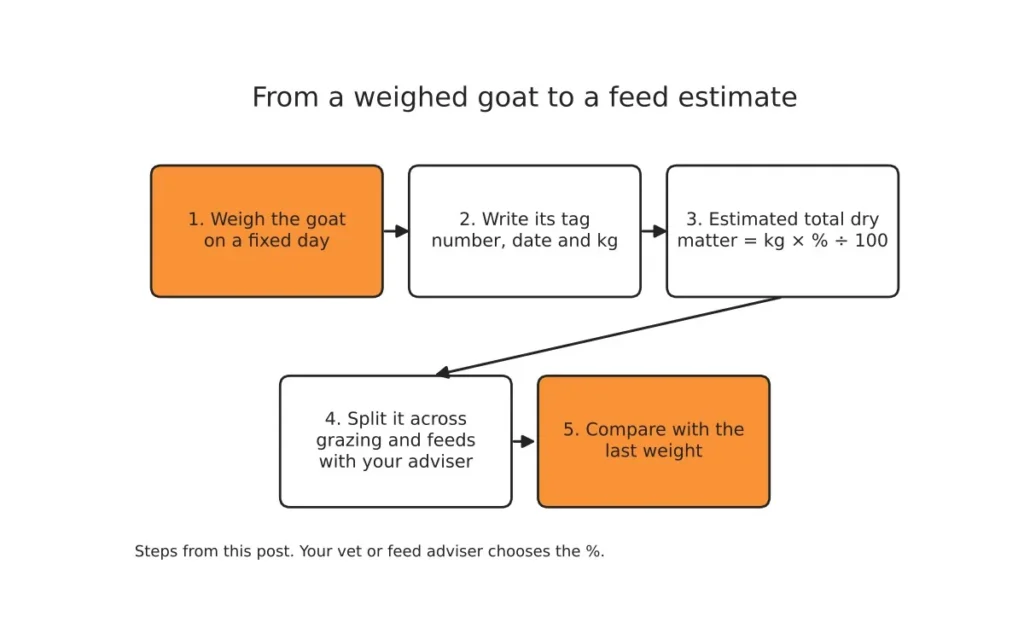
- Weigh each goat on a fixed day, at the same time of day.
- Write the ear tag number, the date and the weight in kg.
- Work out the day’s estimated total dry matter, grazing included, with the formula above and the intake percentage your vet or feed adviser chose.
- Have your feed adviser split that dry matter across grazing and each feed, and balance the whole ration for energy and protein for the goat’s stage [3]. Convert each feed’s portion with the formula above, weigh it out, and record leftovers and waste.
- Compare each weight with the last one, and show your vet any goat that has lost weight.
Which HSCo scale fits a goat farm?
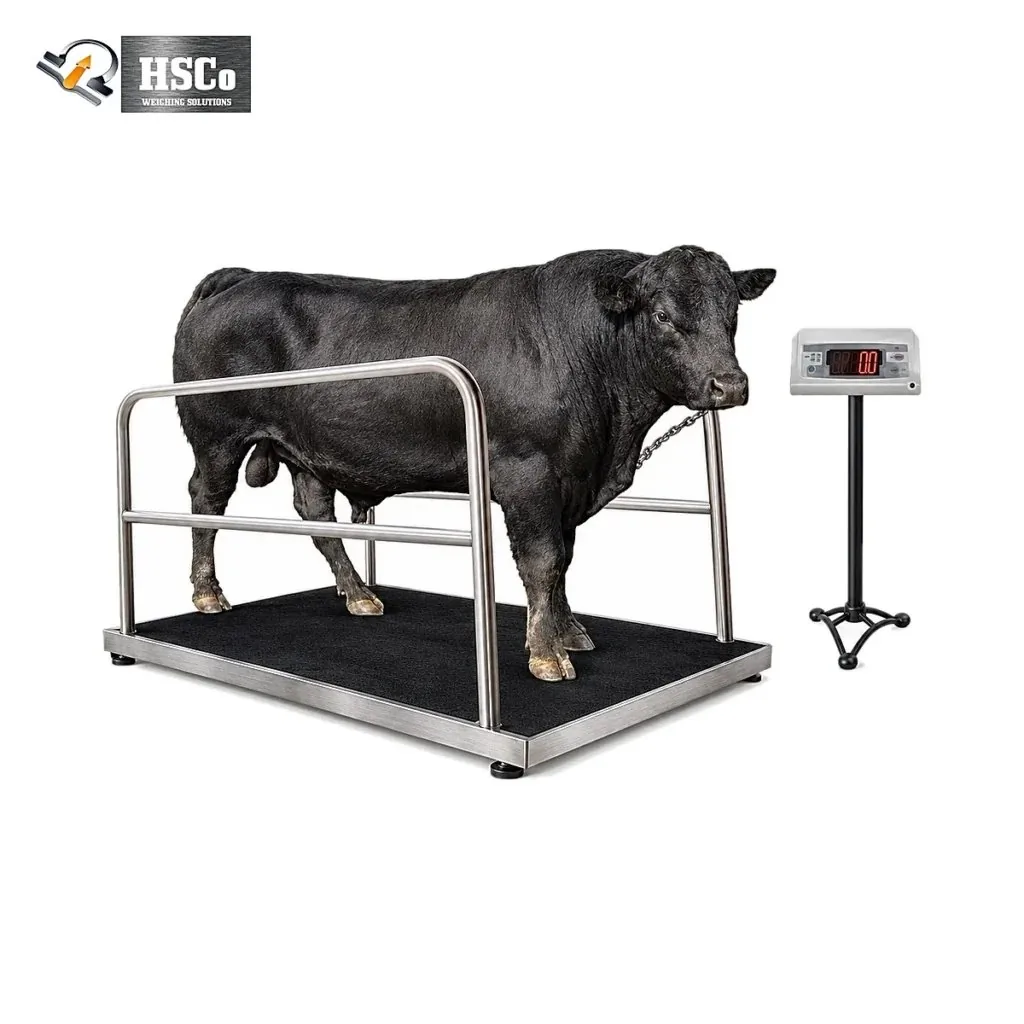
Weigh the goats on a side-bar platform and weigh the feed on a second scale.
 ASMS electronic animal weighing scale: side bars keep the animal in place on a chequered plate over four load cells. Capacities of 150, 250, 500 and 1,000 kg, with 50 g or 100 g accuracy options [7].
- CRSA digital hanging scale: 100 kg and 300 kg models, with a least count of 10 g on the 100 kg model and 50 g on the 300 kg model [8]. For weighing hay or a feed bag on a hook.
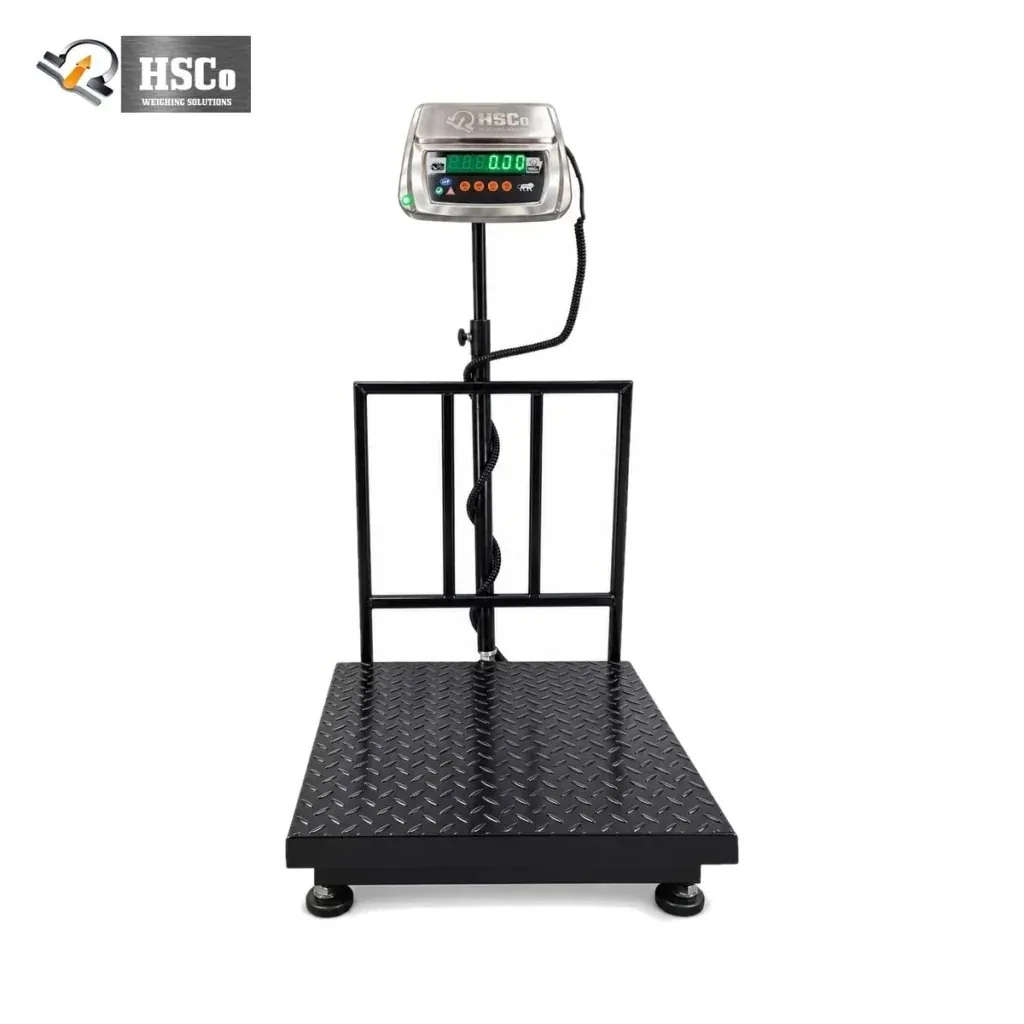
- PLCHQB platform scale: chequered MS plate, 500 kg and 1,000 kg, readability 50 g or 100 g [9]. For checking feed sacks.


All three scales above are listed with government stamping on their product pages [7, 8, 9]. More farm scales are on our weighing scales for agriculture page. Call +91-7045922250 or write to hsc@hindustanscale.com and tell us how many goats you weigh.
Frequently asked questions
How much does a goat eat per day in kg?
A University of Arkansas page gives, as a rule of thumb, 2 to 4% of body weight a day as dry matter [1]. At those rates a 20 kg goat is estimated to eat 0.4 to 0.8 kg of dry matter a day, and a 40 kg goat 0.8 to 1.6 kg. Individual goats vary.
What is dry matter in goat feed?
Dry matter is goat feed with its water taken out. A University of Arkansas at Pine Bluff fact sheet notes that hay tends to be about 88% dry matter while silage averages 34% [3]. To estimate how much of one feed a goat eats, divide the dry matter you assign to that feed by its dry matter percentage as a decimal, 0.88 for hay at 88%. Leftovers and waste come on top. Then balance the whole ration [3].
How often should goats be weighed?
Weigh goats once or twice a month, as our goat weight tracking post suggests [6]. Ask your vet how often to weigh young or sick goats. Write the tag number, date and weight, then estimate the day’s dry matter from the new weight at the intake percentage your vet or feed adviser chose. A balanced ration still has to be worked out from that estimate [3].
Sources
- University of Arkansas System Division of Agriculture, “Basic Nutrition of Small Ruminants” (uaex.uada.edu).
- Kentucky State University Cooperative Extension, “Goat Production” (kysu.edu). Listed as a 2009 publication on the university’s publications page
- University of Arkansas at Pine Bluff, Cooperative Extension Program, “Balancing Rations for Sheep and Goats (FSA9613)” (uaex.uada.edu). Published 2014 (printed code FSA9613-PD-5-2014N)
- Merck Veterinary Manual, “Nutritional Requirements of Goats” (merckvetmanual.com). Full review July 2025, last updated July 2026
- Penn State Extension, “Feeding Market Goats for Show” (extension.psu.edu, 6 April 2023). Updated 6 April 2023
- Hindustan Scale Company, “How Regular Weight Tracking Improves Goat Farming Profitability” (hindustanscale.com). Page shows two dates: 15 January 2026 (after ‘On’) and 22 September 2026
- Hindustan Scale Company, “ASMS Electronic Animal Weighing Scale, 150 kg to 1,000 kg, Side Bars” (hindustanscale.com).
- Hindustan Scale Company, “CRSA Digital Hanging Scale, 100 kg and 300 kg” (hindustanscale.com).
- Hindustan Scale Company, “PLCHQB Platform Scale, Chequered MS Plate, 500 / 1,000 kg, Dual Display” (hindustanscale.com).