
Blogs
Wet sand in concrete: how much less water should you add?

Quick answer
Wet sand in concrete brings water into the mixer when the sand is wetter than saturated surface-dry (SSD), and that surface water counts as mixing water. When the mix sheet gives SSD sand weights, cut the water you add by the weight of surface water the sand carries, and weigh that much extra wet sand [1, 4]. Sand drier than SSD soaks up mixing water instead [4].
Clause 10.2.5 of IS 456:2000, from the Bureau of Indian Standards, asks for the moisture in fine and coarse aggregate to be checked as often as possible and says the added water shall be adjusted to compensate for any observed variations in the moisture contents [1]. IS 4926:2003, for ready-mixed concrete, repeats it [2]. Amendment No. 6 to IS 456 was established on 6 June 2024, and the Bureau’s notice of it was published in the Gazette of India on 26 June 2024 [7].
How much water does wet sand carry?
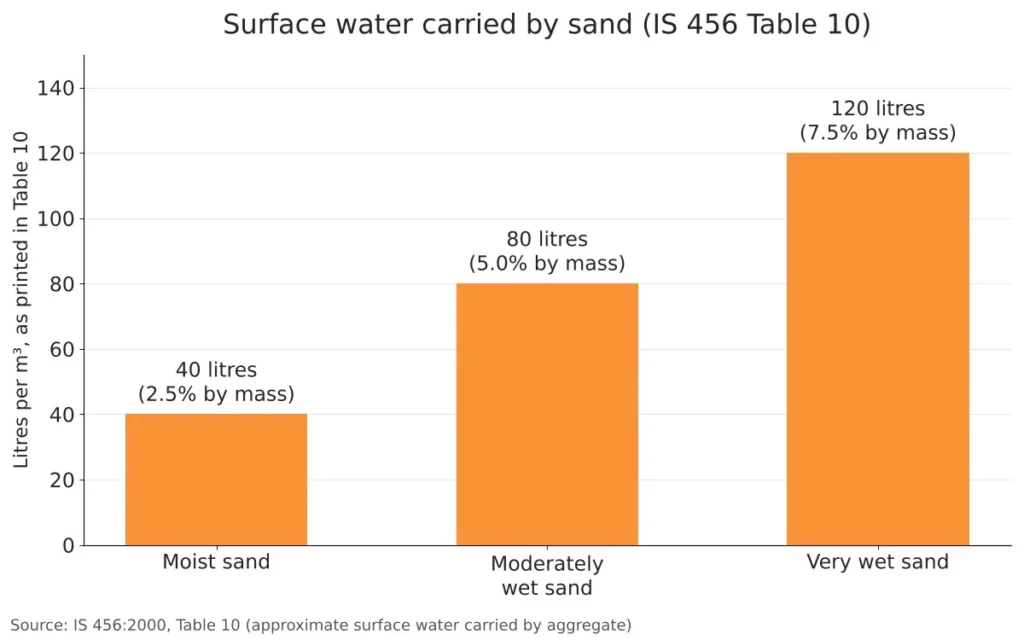
IS 456 gives approximate figures in its Table 10, where this water is called surface water: moist sand carries about 2.5% by mass, or 40 litres per cubic metre; moderately wet sand 5.0%, or 80 litres; very wet sand 7.5%, or 120 litres [1]. The code allows these values only for nominal mixes without a measured figure [1].
How do you correct the batch for wet sand in concrete?
The American Concrete Institute’s correction starts from a mix sheet worked out on saturated surface-dry sand [4]. Surface water is the water on the sand beyond that state. IS 2386 gives surface moisture on either an SSD or a wet-weight basis; the formula below uses surface water as a percentage of the SSD sand weight [3]. It covers the sand alone and holds when the water on the mix sheet is the total mixing water and every other ingredient is at SSD or adds or absorbs no water; otherwise each one needs its own correction [4].
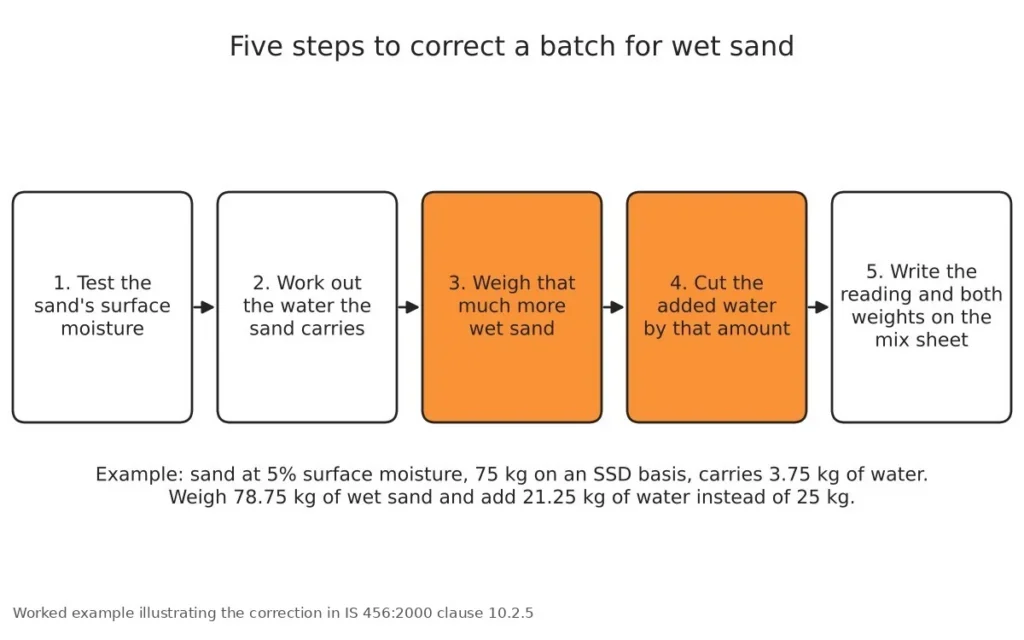
Water on the sand = SSD sand weight × surface moisture %. Wet sand to weigh = SSD sand weight + water on the sand. Water to add = water on the mix sheet − water on the sand.
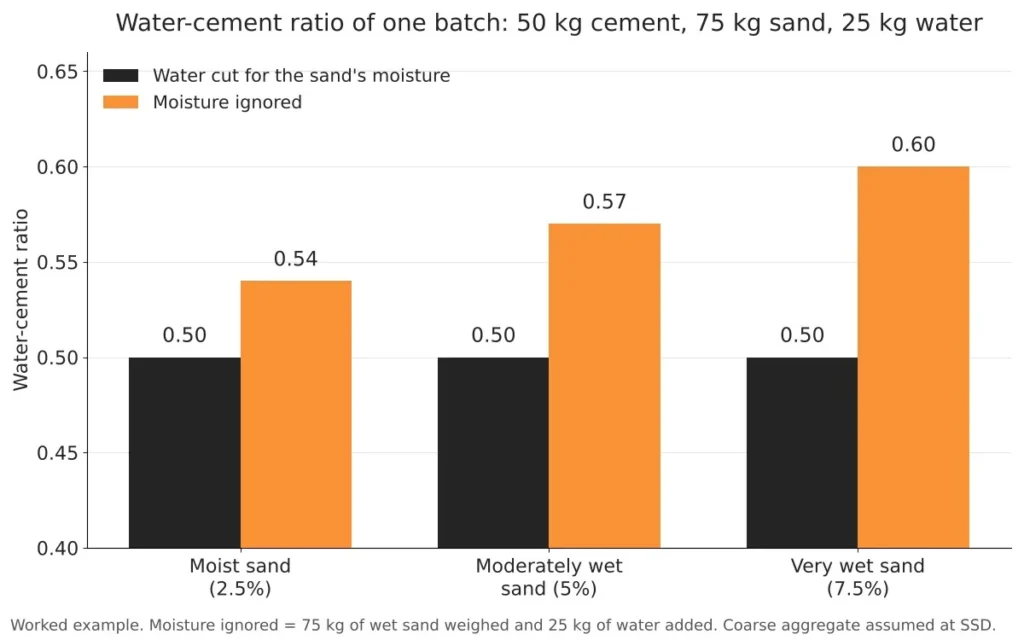
Take a mix sheet, worked out on SSD sand, that asks for 50 kg of cement, 75 kg of SSD sand and 25 kg of water per batch, a water-cement ratio of 0.50. For illustration, the example takes the three levels in IS 456 Table 10, 2.5%, 5% and 7.5% [1], and assumes them on an SSD basis. Its weights are exact arithmetic for these assumed inputs, not the precision of a site measurement. The IS 2386 displacement field method reports surface moisture only to the nearest 1% [3], so for real batches use a moisture test and batching tolerances that suit the job.
| Sand condition and surface moisture | Water on 75 kg of sand | Wet sand to weigh | Water to add |
|---|---|---|---|
| Moist sand, 2.5% | 1.875 kg | 76.875 kg | 23.125 kg |
| Moderately wet sand, 5% | 3.75 kg | 78.75 kg | 21.25 kg |
| Very wet sand, 7.5% | 5.625 kg | 80.625 kg | 19.375 kg |
What happens if you ignore the water in the sand?
Say the sand is at 5% surface moisture and the crew weighs 75 kg of wet sand and adds the full 25 kg of water. That 75 kg holds 71.43 kg of SSD sand and 3.57 kg of water. With the coarse aggregate at SSD, the batch now has 28.57 kg of water for 50 kg of cement, a water-cement ratio of 0.57 instead of 0.50. The mixer also gets 3.57 kg less SSD sand than the sheet asks for, 4.8% of 75 kg.
How do you test sand moisture on site?
The IS 2386 (Part 3) field method finds the surface moisture of sand by how much water a weighed sample displaces in a flask. It needs a sample of at least 200 g, a balance with a capacity of 2 kg or more and a sensitivity of 0.5 g or less, and the specific gravity of the sand in the SSD state; the result is reported to the nearest 1% [3].
- Test a representative sample from the heap by the IS 2386 (Part 3) field method [3].
- If the sand is wetter than SSD, work out the water on the sand with the formula above, using the surface moisture on the SSD basis; IS 2386 gives both an SSD and a wet-weight figure [3].
- Weigh that much extra wet sand on a platform scale.
- Take the same amount off the water you add. Correct the coarse aggregate the same way, by its own moisture [1, 4].
- Write the surface moisture reading, the wet sand weight and the water added on the mix sheet, and test as often as possible, at a frequency the engineer-in-charge sets according to the weather [1].
Which HSCo scale weighs sand and cement for the batch?
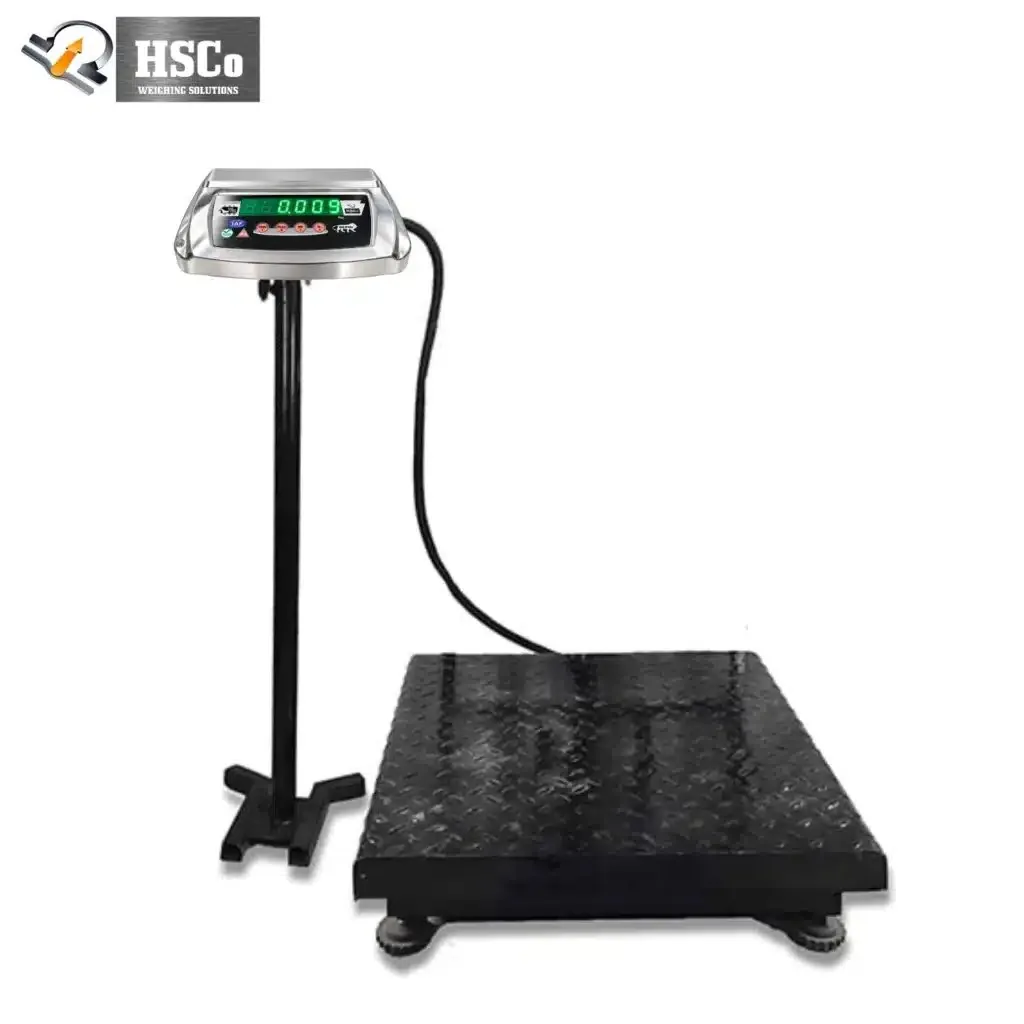
For the batch above, 50 kg of cement and about 79 kg of wet sand, the PLCHQS in 100 or 150 kg has an accuracy of 10 g [6]; for bigger loads the PLCHQHS takes 1,500 or 2,000 kg [5]. Pick a capacity that covers the gross load, including any pan or barrow.
 PLCHQHS heavy duty platform scale, 1,500 and 2,000 kg: comes in 1,500 kg (75 × 75 cm platter) and 2,000 kg (90 × 90 cm), with four IP67 load cells, a jumbo green display in front and a big green display at the back [5].
- PLCHQS electronic platform scale, 50 to 300 kg: comes in 50, 100, 150, 250 and 300 kg, with accuracy of 10 g at 100 and 150 kg and a double-sided display [6].


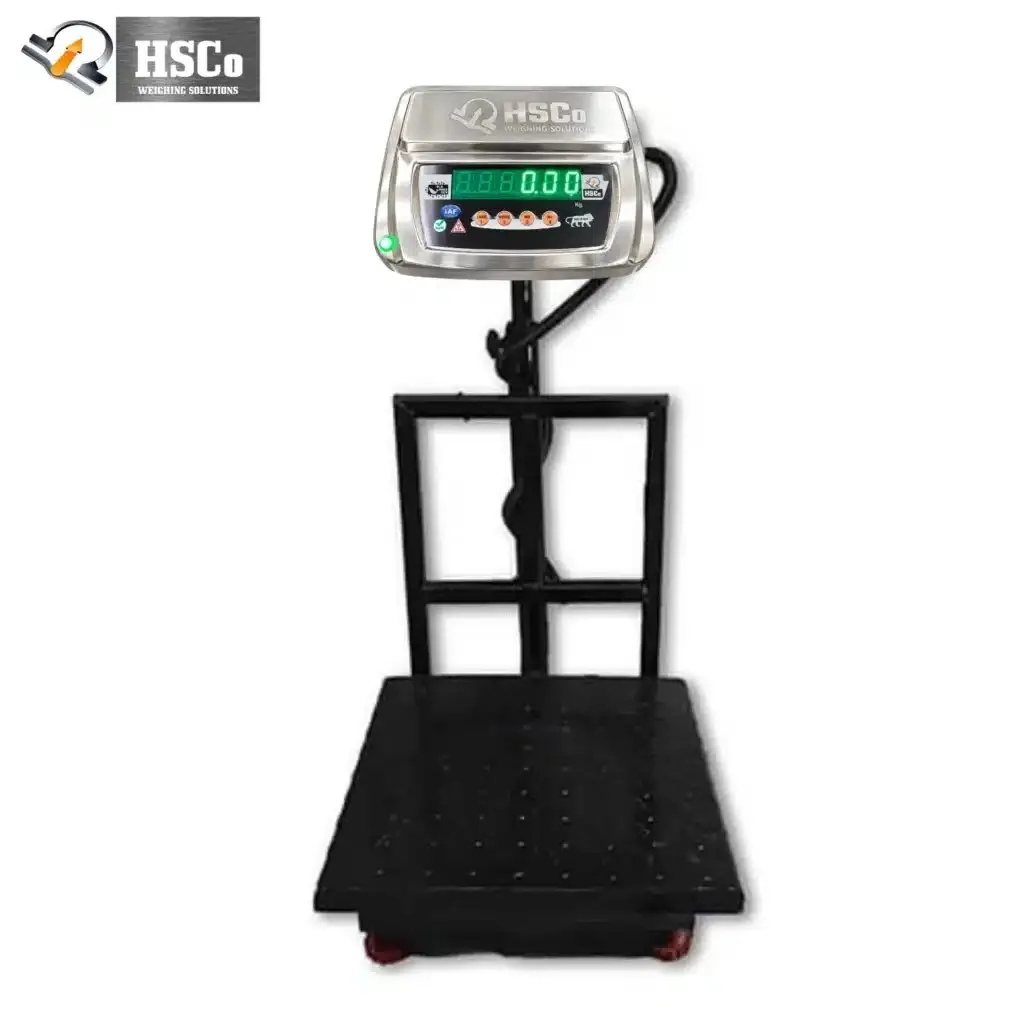
More models are on our platform scales page, and our post on government stamping explains the stamp a trade scale needs. Tell us how much sand and cement goes into each batch: call +91-7045922250 or write to hsc@hindustanscale.com.
Frequently asked questions
Does wet sand change the water-cement ratio of concrete?
Wet sand raises the water-cement ratio when its surface water is not counted. Sand wetter than saturated surface-dry (SSD) carries surface water that counts as mixing water [1, 4]. Cutting the added water by that amount keeps the design ratio when other ingredients are at SSD or corrected [4]. With 50 kg cement, 25 kg water, coarse aggregate at SSD and 75 kg of wet sand at 5% surface moisture, adding the full 25 kg gives 0.57 instead of 0.50.
How much water is in moderately wet sand?
IS 456:2000 Table 10 gives moderately wet sand about 5.0% surface water by mass, which the table also gives as 80 litres per cubic metre [1]. The code allows these approximate figures only for nominal mixes when no measured moisture figure is available [1].
What does saturated surface-dry sand mean in a concrete mix?
Saturated surface-dry (SSD) sand has its permeable pores full of water but no free water on its surface [3, 4]. The American Concrete Institute says sand wetter than SSD brings extra water into the batch, so the added water is reduced; sand drier than SSD soaks up mixing water, so more water is added to keep the water-cement ratio unchanged [4].
Sources
- Bureau of Indian Standards, “IS 456:2000 Plain and Reinforced Concrete – Code of Practice (Fourth Revision), July 2000, reprint April 2007 with Amendments 1 and 2: clauses 10.2.5 and Table 10” (law.resource.org). Public copy at law.resource.org/pub/in/bis/S03/is.456.2000.pdf
- Bureau of Indian Standards, “IS 4926:2003 Ready-Mixed Concrete – Code of Practice (Second Revision), May 2003: clauses 9 and 10.2.2.2” (law.resource.org). Public copy at law.resource.org/pub/in/bis/S03/is.4926.2003.pdf
- Bureau of Indian Standards, “IS 2386 (Part III):1963 Methods of Test for Aggregates for Concrete, Part III: Specific Gravity, Density, Voids, Absorption and Bulking (clause 5)” (law.resource.org). Public copy at law.resource.org/pub/in/bis/S03/is.2386.3.1963.pdf
- American Concrete Institute, “What correction should be made for absorbed water and surface water carried by the aggregates?” (concrete.org). Frequently asked questions, faqid=757
- Hindustan Scale Company, “PLCHQHS Heavy Duty Platform Scale – 1,500 and 2,000 kg, Four Load Cells, Two Displays” (hindustanscale.com).
- Hindustan Scale Company, “PLCHQS Electronic Platform Scale – 50 to 300 kg, Chequered Plate, Double Display” (hindustanscale.com).
- Gazette of India (Extraordinary), “Part III, Section 4, No. 447 (CG-DL-E-27062024-254982): Bureau of Indian Standards notification HQ-PUB015/1/2020-PUB-BIS (916) of 12 June 2024, Amendment No. 6 to IS 456:2000 established 6 June 2024” (egazette.gov.in, 26 June 2024).