
Blogs
Cumin sack weight: how to check that your sacks add up on a platform scale

Quick answer
To check cumin sack weight, weigh each sack alone and add the readings, then weigh the same sacks together once on a platform scale. The group reading should come close to the total. Check a larger gap against the scales’ divisions and the number of readings, then look for a reading copied wrongly, a sack missed or counted twice, or a pallet that was not tared.
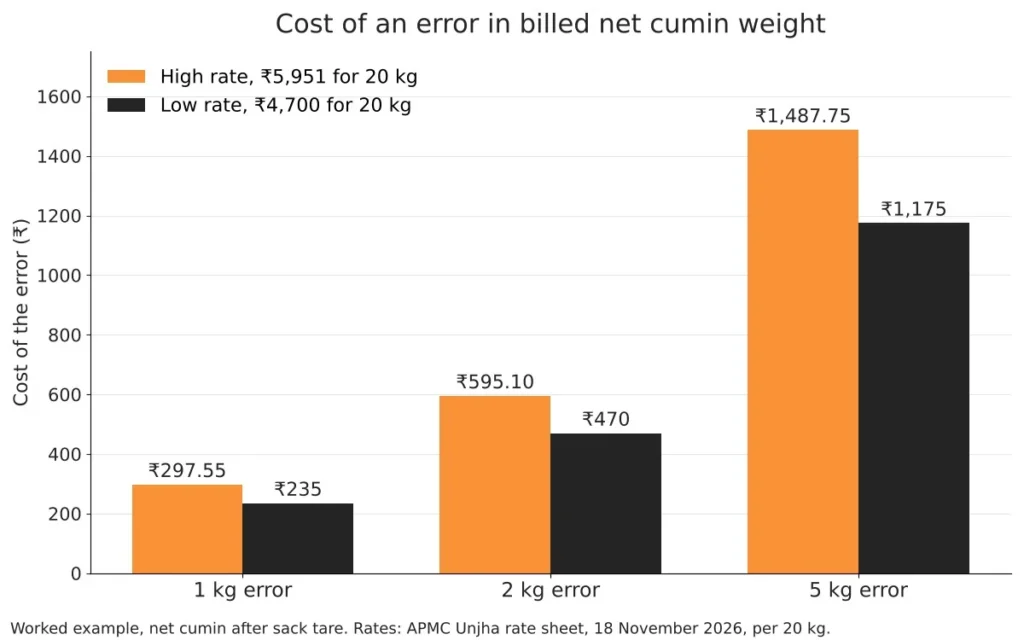
On 18 November 2026, the daily rate sheet of APMC Unjha in Gujarat listed cumin (jeera) at a low of ₹4,700 and a high of ₹5,951 for 20 kg [1]. At that high rate, each kilogram of billed net-weight error is worth ₹297.55.
What does one kilogram of cumin cost at the Unjha rate?
On that sheet, APMC Unjha quoted cumin per 20 kg [1], so divide each rate by 20 to get the price of one kilogram.
Price of 1 kg = rate for 20 kg ÷ 20
| Unjha rate, 18 November 2026 | Price of 1 kg (cost of a 1 kg error) | 2 kg error | 5 kg error |
|---|---|---|---|
| Low, ₹4,700 for 20 kg [1] | ₹235 | ₹470 | ₹1,175 |
| High, ₹5,951 for 20 kg [1] | ₹297.55 | ₹595.10 | ₹1,487.75 |
How do you check cumin sack weight one by one and as a group?
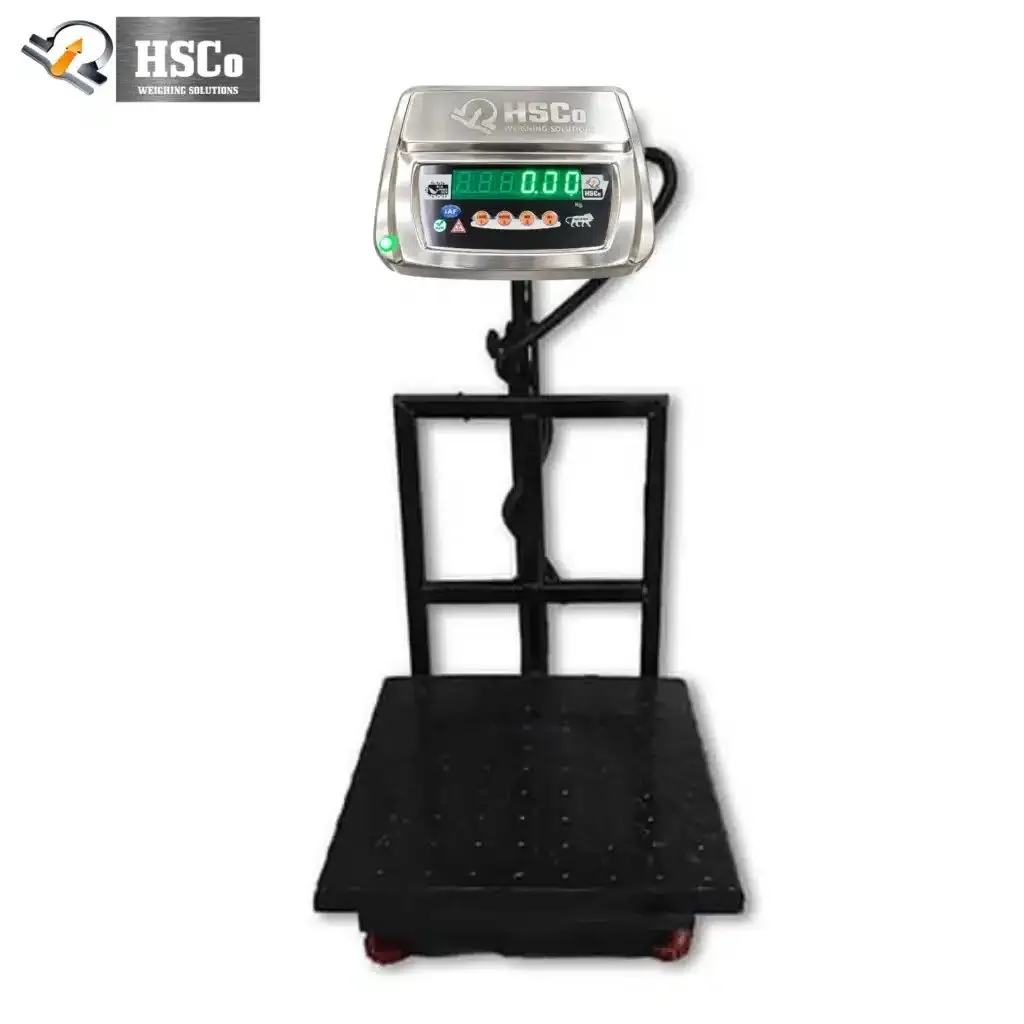
You need a scale that takes one sack, and a pallet platform scale whose capacity covers the empty pallet and all the sacks together.
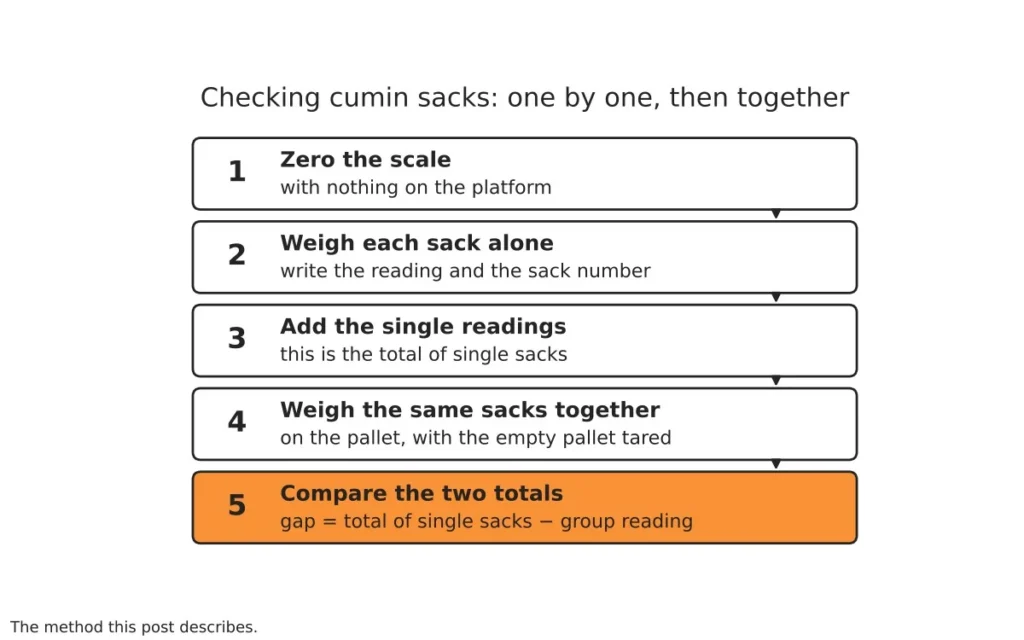
- Switch each scale on with nothing on it and press zero, the pallet scale included. Check that each scale’s verification and stamping are current, because a scale used to buy or sell must be verified before use [2] and re-verified periodically [6].
- Put one sack in the middle of the platform. Wait until the reading stops changing, then write it down with the sack number.
- Repeat for every sack in the lot and add the readings. This is the total of single sacks.
- Put the empty pallet on the pallet platform scale and press tare. Then stack the same sacks on the pallet and write down the group reading. Tare only takes the pallet out of the reading, so the pallet and sacks together must stay within the scale’s rated capacity, fully on the platform and touching nothing else.
- Take the group reading away from the total of single sacks. That difference is the gap.
How big a gap between the two totals is normal?
A digital scale shows each reading in fixed steps called scale divisions, so ten single readings and one group reading can differ through rounding. In this example, assume 100 g divisions, each reading rounded to the nearest division and no extra rounding from a digital tare. Each of the 11 readings can then be off by up to 50 g, which is 0.55 kg in all. Both totals move in 0.1 kg steps, so under these assumptions rounding can show a gap of 0.5 kg at most. Other division sizes, the way a scale handles tare, calibration and repeatability change that, so look into any larger gap before anyone signs.
For example, ten sacks read one by one add up to 503.4 kg, and the same ten sacks on a tared pallet that sits fully on the platform of a 1,000 kg platform scale show 502.4 kg. Under the assumptions above, with 100 g divisions, rounding can explain at most 0.5 kg, so a 1.0 kg gap needs checking.
Gap = 503.4 kg − 502.4 kg = 1.0 kg
Both totals are gross sack weights; the bill is for net cumin, after the sack tare. If the 1.0 kg gap turns out to be a real error in the billed weight, it costs ₹235 at the low rate [1] and ₹297.55 at the high rate. To find the cause, reweigh the sacks one by one and check each written figure.
Which platform scale size fits a pallet of cumin sacks?
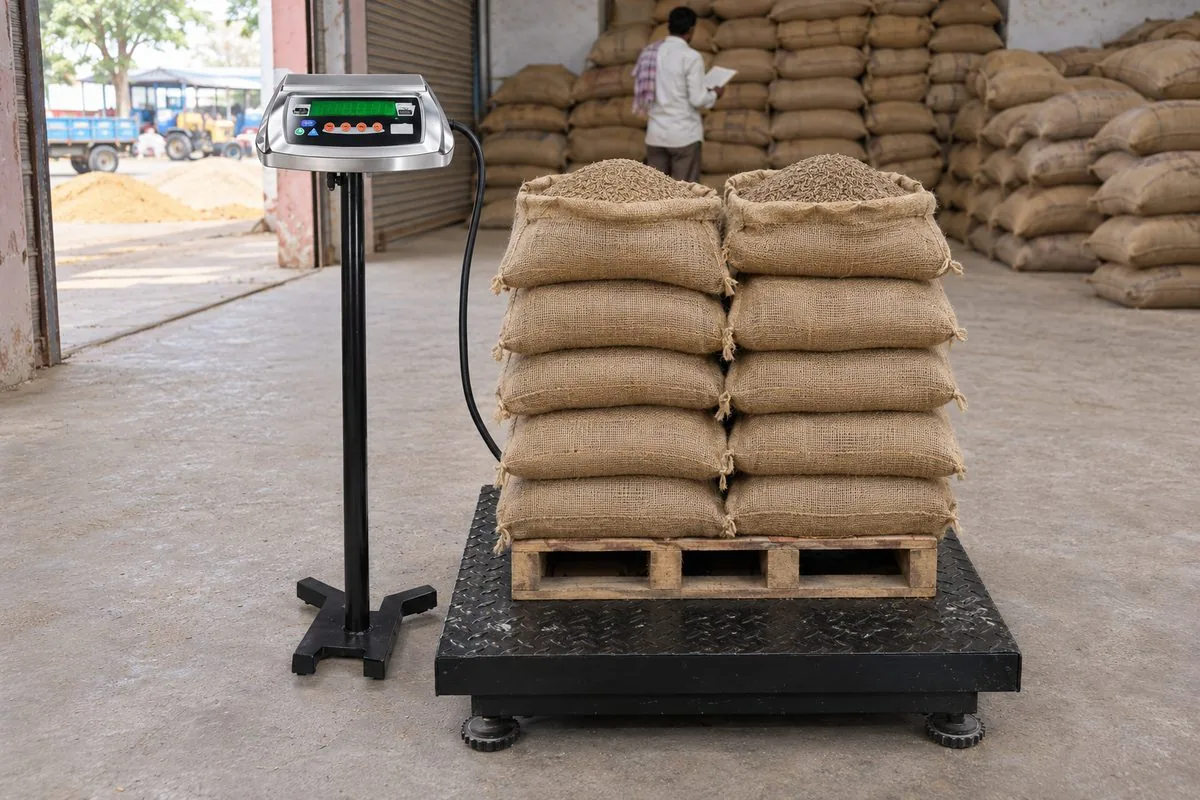
Pick a capacity above the heaviest loaded pallet you will weigh, and a platform the whole pallet sits on. The HSCo PLCHQHB comes in 2,500 kg with a 100 × 100 cm platform, 3,000 kg with 120 × 120 cm or 150 × 150 cm, and 5,000 kg with 150 × 150 cm [3].
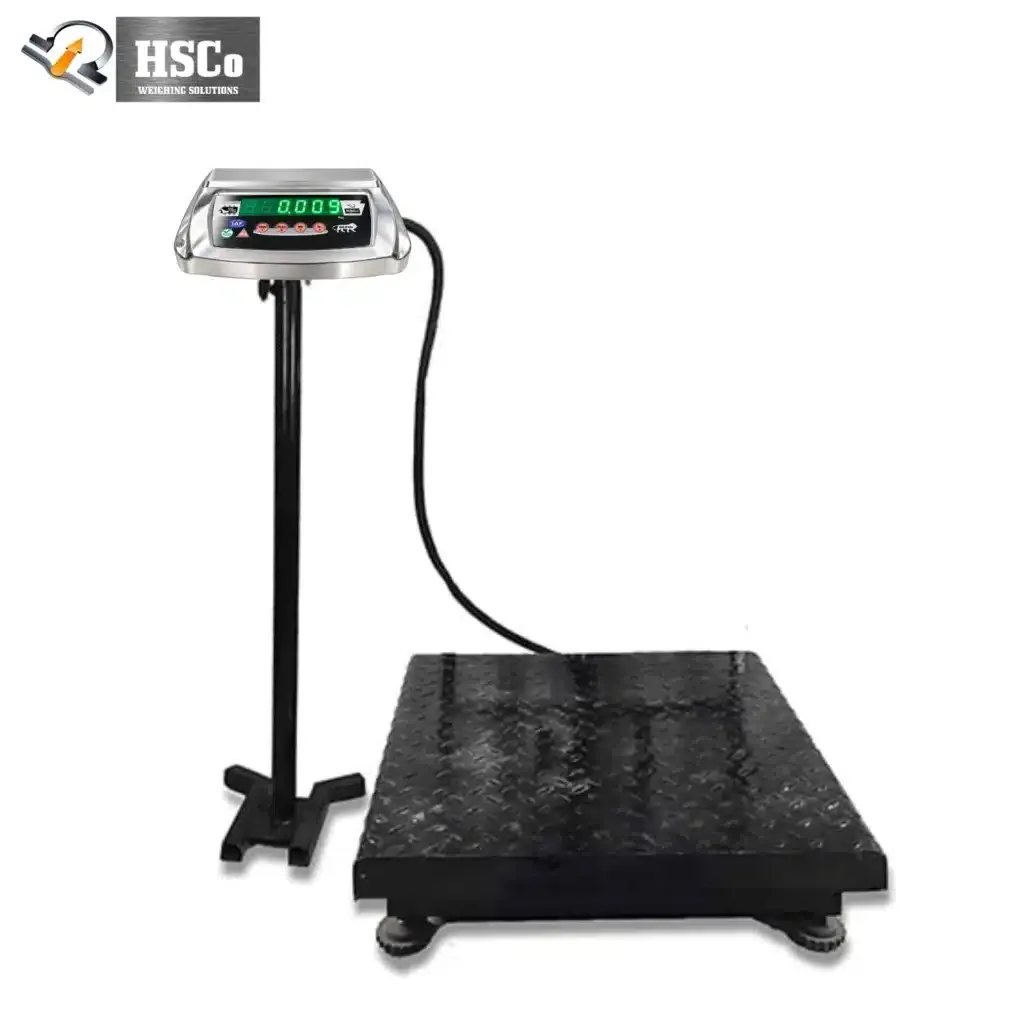
Which HSCo scale fits a cumin godown or mandi shop?
The three scales below are Legal Metrology stamped [3, 4, 5].
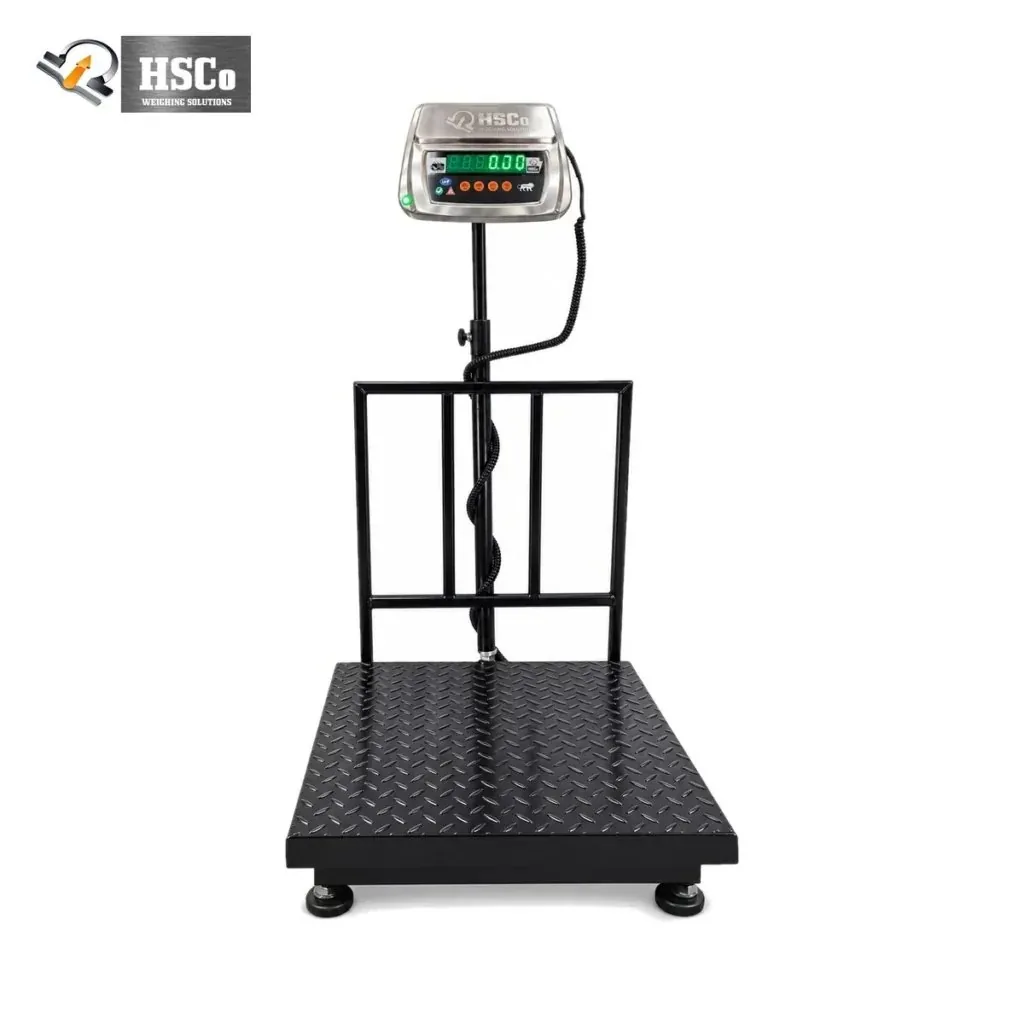
 PLCHQHB heavy duty platform scale, 2,500 kg: weighs up to 2,500 kg on a 100 × 100 cm chequered MS platform. For a pallet of sacks that sits fully on the 100 × 100 cm platform within 2,500 kg in all. For a larger pallet, choose a model whose platform holds it and whose capacity covers the pallet and sacks together [3].
- PLCHQS electronic platform scale: 50 to 300 kg on a chequered plate, with an accuracy of 10 g on the 100 kg and 150 kg models and 20 g on the 250 kg and 300 kg models. For weighing one sack at a time [4].
- PLCHQB platform scale: 500 kg or 1,000 kg, with a readability of 50 g or 100 g and an optional printer. For a smaller lot of sacks [5].
Our government stamping post explains how Legal Metrology stamping works. More scales for mandis, farms and warehouses are on our weighing scales for agriculture page. Tell us how many sacks you weigh in a day: call +91-7045922250 or write to hsc@hindustanscale.com.
Frequently asked questions
What was the price of 20 kg of cumin at Unjha on 18 November 2026?
The APMC Unjha rate sheet for 18 November 2026 listed cumin at a low of ₹4,700 and a high of ₹5,951 for 20 kg [1]. That works out to ₹235 a kg at the low rate and ₹297.55 a kg at the high rate, so a 1 kg billing error settled at those rates comes to ₹235 or ₹297.55.
Should cumin sacks be weighed one by one or all together?
Weigh cumin sacks both ways. Weigh each sack alone and add the readings, then weigh the same sacks together on a tared pallet, with the pallet and sacks within the scale’s capacity. Compare the two totals against the rounding of all the readings, the divisions of both scales and their calibration. Look into any larger gap before the bill is settled.
Why does the group weight of cumin sacks differ from the total of single weights?
A digital scale shows readings in scale divisions, so rounding of the readings can make the total of single cumin sack weights differ from one group reading, and the way a scale handles tare can add to the gap. Calibration, repeatability and differences between the two scales also matter. Handling mistakes can make it bigger, such as a digit copied wrongly, a sack missed or counted twice, a pallet that was not tared or a sack touching the floor.
Does a scale used to buy cumin need a Legal Metrology stamp?
Yes. Section 24 of the Legal Metrology Act, 2009 says a weight or measure used in any transaction must be verified before it is put into use [2]. A scale used to buy or sell cumin by weight therefore has to be verified before it is first used to weigh for sale. Rule 27 of the Legal Metrology (General) Rules, 2011 also requires periodic re-verification and stamping [6].
Sources
- APMC Unjha, “Wednesday-18-Nov-2026” (apmcunjha.com, 18 November 2026). Rate for 20 kg. Cumin (jeera): down rate 4700.00, high rate 5951.00. Archive page: www.apmcunjha.com/index.php/archive/4687-wednesday-18-nov-2026
- Ministry of Law and Justice, Government of India (Gazette copy hosted by Legal Metrology, Meghalaya), “The Legal Metrology Act, 2009, Section 24(1)” (megweights.gov.in, 14 January 2010).
- Hindustan Scale Company, “PLCHQHB Heavy Duty Platform Scale – 2,500 to 5,000 kg, Chequered MS Platform, 4 Load Cells” (hindustanscale.com).
- Hindustan Scale Company, “PLCHQS Electronic Platform Scale – 50 to 300 kg, Chequered Plate, Double Display” (hindustanscale.com).
- Hindustan Scale Company, “PLCHQB Platform Scale – Chequered MS Plate, 500 / 1,000 kg, Dual Display” (hindustanscale.com).
- Department of Consumer Affairs, Government of India (copy hosted by Legal Metrology, Meghalaya), “The Legal Metrology (General) Rules, 2011, Rule 27” (megweights.gov.in, 7 February 2011).