
Blogs
Cotton bale weight: does every bale you buy weigh 170 kg?

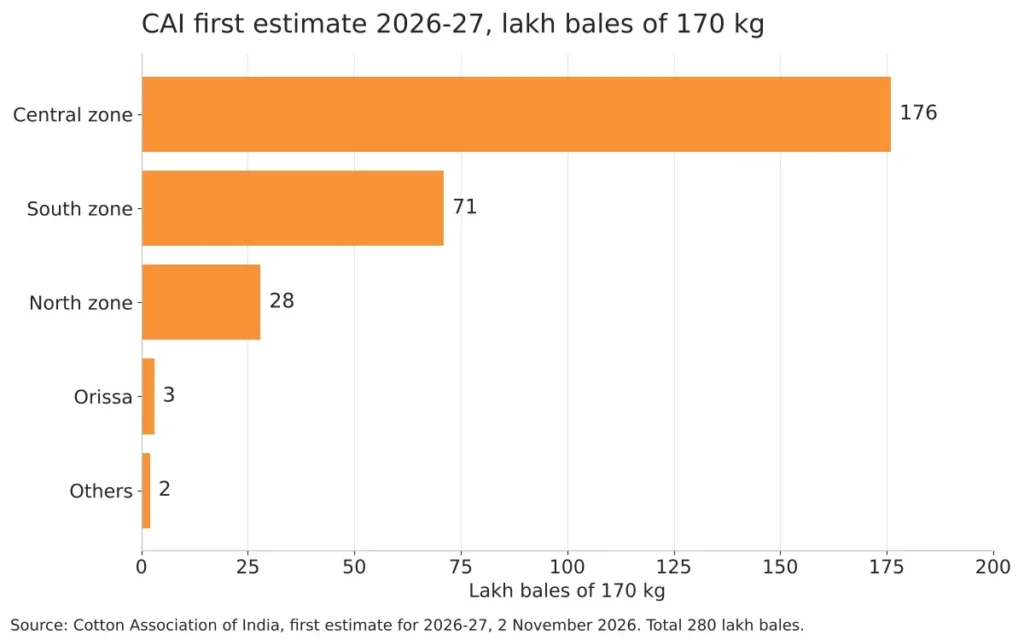
No. The 170 kg cotton bale weight is a counting unit. On 2 November 2026 the Cotton Association of India (CAI) reported its first 2026-27 estimate as 280 lakh bales of 170 kg, and gave it as 294 lakh running bales of 162 kg [1]. A statistical bale count does not establish the net weight of your delivery, so weigh the bales you receive on a stamped scale.
The estimate carries a margin of plus or minus 3% [1]. In its state break-up the CAI put Maharashtra at 91 lakh bales and Gujarat at 66 lakh, and its balance sheet estimated consumption of 365 lakh bales and imports of 65 lakh for the season [1].
What is a 170 kg cotton bale?
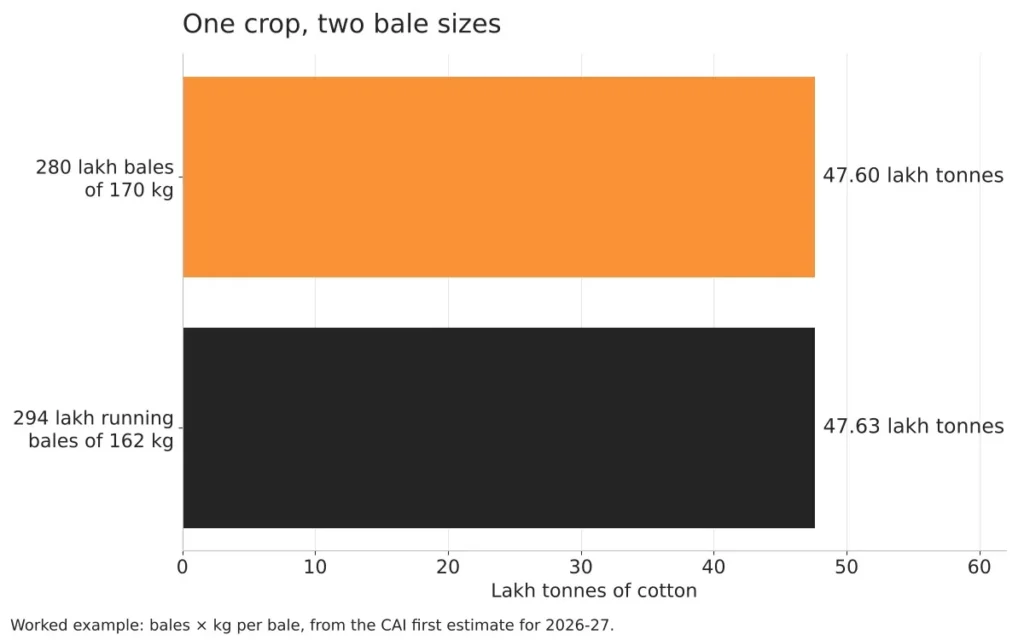
In that first estimate for 2026-27, the CAI expressed the state estimates and the balance sheet in bales of 170 kg [1]. They are statistical equivalents. The same report also gives the crop in running bales of 162 kg [1]. Multiply each count by its bale size and the two give almost the same tonnage.
Estimated cotton in kg = number of bales × kg per bale in that count
| CAI count for 2026-27 | Kg per bale | Cotton in the crop |
|---|---|---|
| 280 lakh bales | 170 kg | 47,600 lakh kg (47.60 lakh tonnes) |
| 294 lakh running bales | 162 kg | 47,628 lakh kg (47.63 lakh tonnes) |
The exact conversion, 280 × 170 ÷ 162, gives about 293.83 lakh running bales, which rounds to 294. The rounding accounts for the 28 lakh kg gap between the two totals, less than 0.1% of the crop. Both lines are rounded forms of the same estimate.
Does each cotton bale delivered to your mill weigh 170 kg?
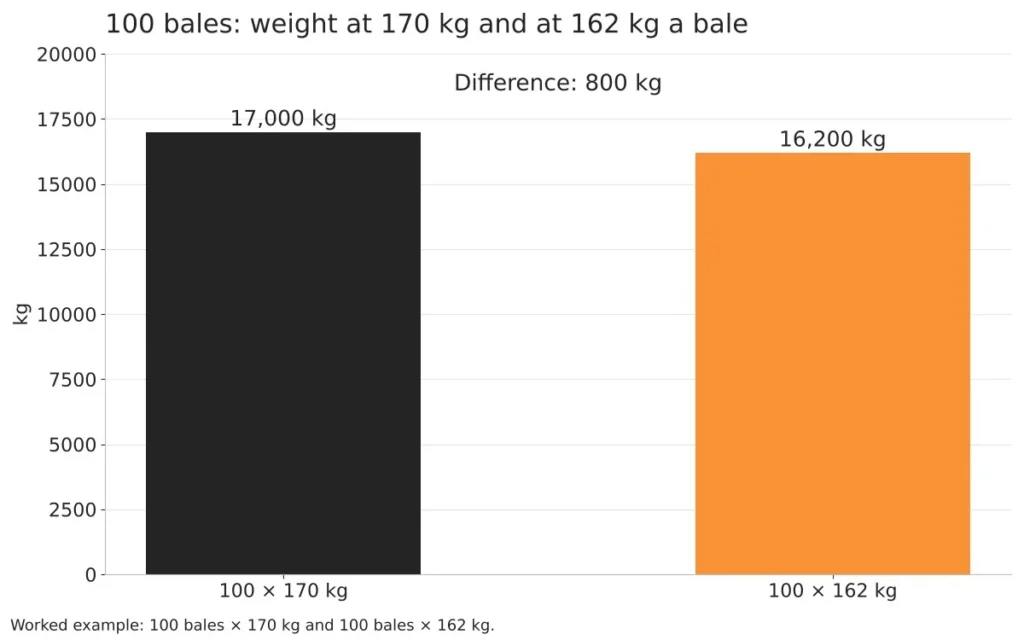
You cannot assume it. Neither CAI count gives the weight of the bales on a particular truck [1]. Count the physical bales delivered and weigh them to find the net cotton weight. If your bales average, say, 162 kg of cotton each and someone multiplies the count by 170 kg, the paperwork shows more cotton than you hold.
Gap in kg = number of bales × (170 kg − actual average kg per bale)
| Bales | Counted at 170 kg | Counted at 162 kg | Gap |
|---|---|---|---|
| 50 | 8,500 kg | 8,100 kg | 400 kg |
| 100 | 17,000 kg | 16,200 kg | 800 kg |
| 500 | 85,000 kg | 81,000 kg | 4,000 kg |
In this worked example both columns are net cotton weights, and the gap is 8 kg a bale, about 4.7% of the weight counted at 170 kg. To put a rupee figure on it, multiply the gap in kg by the price per kg in your own contract.
How do you check cotton bale weight at the mill gate?
- Check that the stamp on the scale is current before you start.
- Agree with the seller before delivery whether the invoice weight is gross or net, what tare per bale comes off for wrapping and straps, and any other weight deductions in the contract.
- Zero the empty platform, or tare the hook with the empty sling or chain hanging from it, before the first bale goes on.
- Weigh each bale on its own and write its bale number and gross weight against the lot.
- Take the agreed packaging tare off each gross weight to get the net cotton weight, and add the net weights. Apply any other deductions in the contract as a separate step, then compare with the invoice on the same basis.
- Keep the weighing slips or printouts with the goods receipt note, and settle any gap with the seller from those records.
As an example of an agreed tare, the NCDEX 29 mm cotton product note counts the net weight of bales wrapped in cloth or hessian and strapped with bands, and takes off 2.3 kg per bale for iron bands or 0.6 kg for plastic bands [7].
Does the scale you weigh bales on need a government stamp?
Yes. Rule 27 of the Legal Metrology (General) Rules, 2011, as amended, requires a weight or measure used in a transaction to be stamped and then re-verified at set intervals [2]. Rule 27(2)(c) sets twelve months as the normal interval for every weight or measure not named in clauses (a) and (b) [2, 6], which covers an electronic crane scale or platform scale. Under Rule 27(3), a scale verified and stamped in place must be re-verified before use if it is dismantled and re-installed before the date its re-verification falls due, and under Rule 27(4) any stamped scale that is repaired before that date must be re-verified and stamped before it is used again [2]. The CRH1000 and PLCHQB product pages state that these models are Legal Metrology stamped [3, 4], and our government stamping post explains how stamping works.
Which HSCo scale fits a cotton godown?
A crane scale weighs each bale on the hook while a chain hoist or crane lifts it. Bales that are set down go on a platform scale.
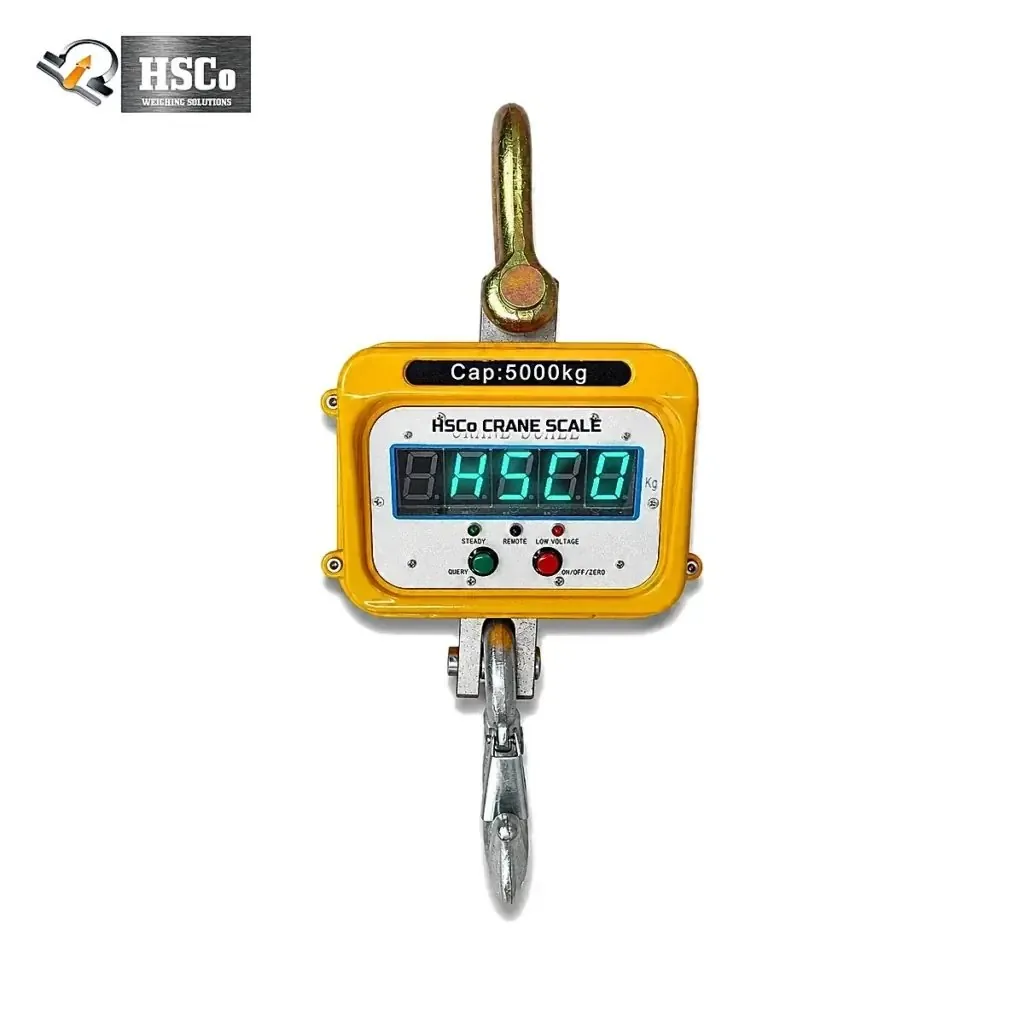
 CRH1000 Electronic Crane Scale: hangs from your crane hook and weighs the load as it is lifted. 1,000 kg capacity, aluminium die-cast body, jumbo LED display and a hand remote for tare from up to 10 m [3].
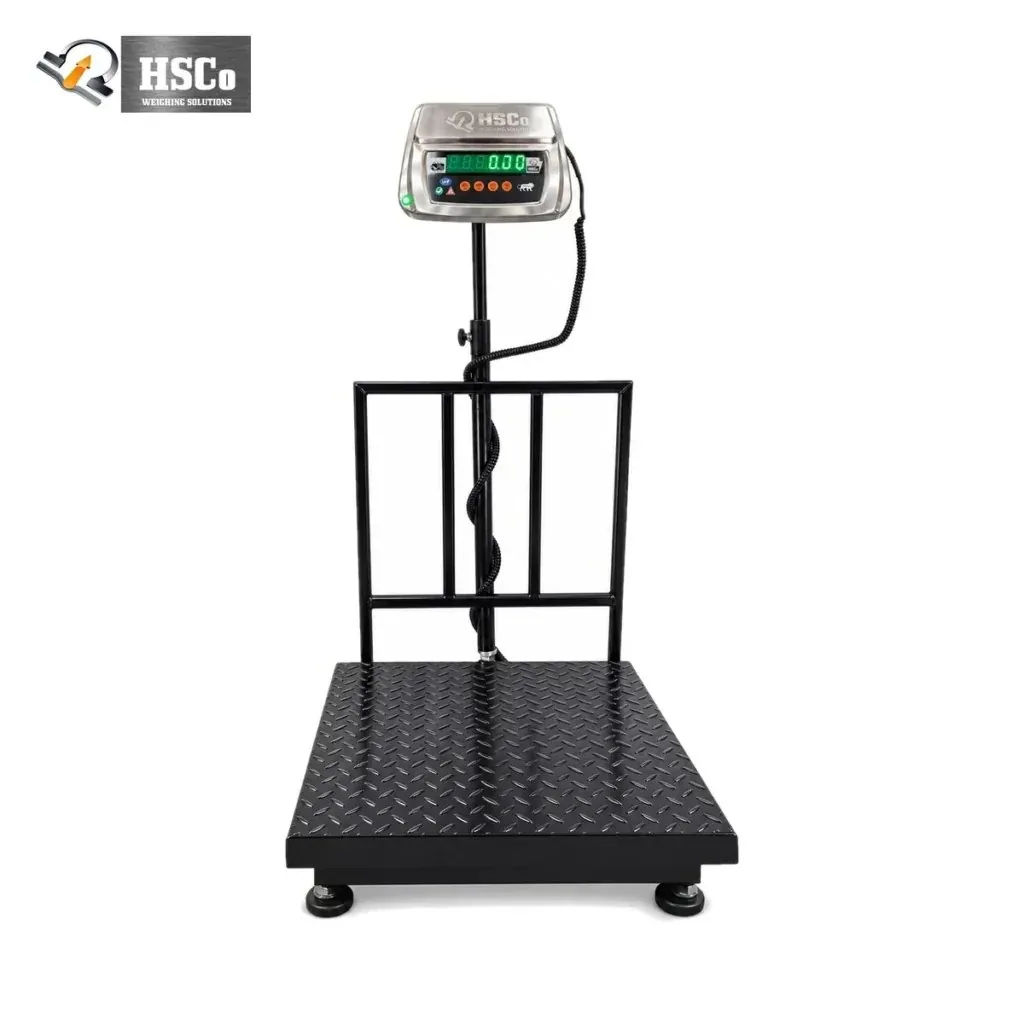
- PLCHQB Platform Scale: full-size MS chequered plate in 500 kg or 1,000 kg, readability 50 g or 100 g, with a display on each side for the operator and the customer and an optional printer output [4].

More crane scales for hoists and godowns are on our crane scale page, and pallet and platform scales for inbound and outbound loads are on the warehouse and shipping page. Tell us how many bales you receive in a day and how they are moved: call +91-7045922250 or write to hsc@hindustanscale.com.
Frequently asked questions
How many kg is one bale of cotton in India?
On 2 November 2026 the Cotton Association of India reported its first 2026-27 estimate as 280 lakh bales of 170 kg, and gave the same crop as 294 lakh running bales of 162 kg [1]. These are statistical bale equivalents. For a delivery, the measured net cotton bale weight is the stamped scale reading less the packaging tare. Apply any other contract deductions as a separate step.
Why does the CAI give two bale counts for the same cotton crop?
In its first estimate for 2026-27, dated 2 November 2026, the CAI expressed its balance sheet in 170 kg bales and also gave the crop as 294 lakh running bales of 162 kg [1]. The exact conversion, 280 × 170 ÷ 162, is about 293.83 lakh, rounded to 294. Multiplied out, the two counts give 47.60 and 47.63 lakh tonnes, and the rounding explains the small gap. Neither count gives the weight of a delivered bale.
How often must a crane scale used for buying cotton bales be stamped?
Rule 27 of the Legal Metrology (General) Rules, 2011, as amended, requires a scale used in a transaction to be stamped and re-verified at set intervals [2]. Rule 27(2)(c) sets twelve months as the normal interval for an electronic crane scale, which is not named in clauses (a) and (b) [2, 6]. A crane scale must also be re-verified before use after a repair, or after being dismantled and re-installed if it was stamped in place [2].
Sources
- Cotton Association of India, “CAI FIRST ESTIMATE REPORT 2026-2027” (caionline.in, 2 November 2026). News item 4032 on caionline.in
- Government of India (Gazette of India, copy on megweights.gov.in), “Legal Metrology (General) Rules, 2011 (G.S.R. 71(E)), Rule 27” (megweights.gov.in, 7 February 2011).
- Hindustan Scale Company, “CRH1000 Electronic Crane Scale – 1,000 kg, Die-Cast Body, Hand Remote” (hindustanscale.com).
- Hindustan Scale Company, “PLCHQB Platform Scale – Chequered MS Plate, 500 / 1,000 kg, Dual Display” (hindustanscale.com).
- Hindustan Scale Company, “What Is Government Stamping And Why Is It So Important?” (hindustanscale.com, 14 April 2021).
- Ministry of Consumer Affairs, Food and Public Distribution, “Legal Metrology (General) Seventh Amendment Rules, 2025 (G.S.R. 905(E))” (consumeraffairs.gov.in, 18 December 2025).
- National Commodity and Derivatives Exchange (NCDEX), “29 MM Cotton Product Note” (ncdex.com). Packaging section; PDF at https://www.ncdex.com/public/uploads/downloads/29%20mm%20cotton%20future%20product%20note_1762943590.pdf