
Blogs
Bajra MSP 2026-27 at ₹2,900: what a short weight costs at the centre

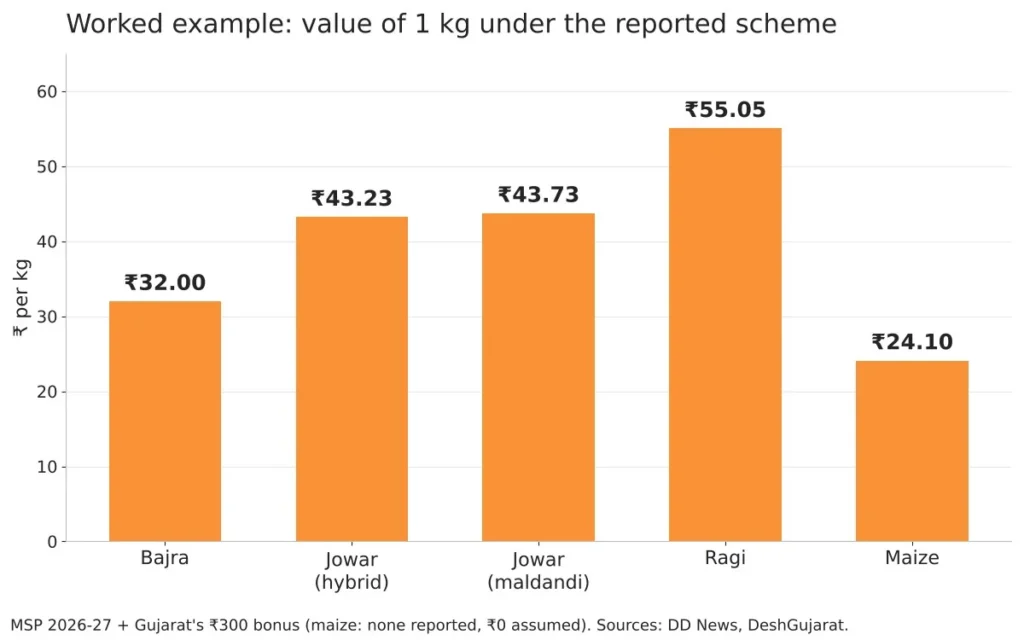
The bajra MSP for the 2026-27 season is ₹2,900 a quintal [1, 2]. DeshGujarat reported a ₹300 bonus under Gujarat’s scheduled procurement, so bajra bought under that scheme would fetch ₹3,200 a quintal, or ₹32 a kilo [2]. A scale that reads 1% light on a 20-quintal lot takes 20 kg off the bill, which is ₹640.
DeshGujarat reported on 29 September 2026 that Gujarat had scheduled direct purchase of paddy, maize, bajra, jowar and ragi from farmers at MSP from 16 November 2026 to 15 January 2027, through the Gujarat State Civil Supplies Corporation [2]. According to that report, online registration was scheduled to run from 2 to 31 October 2026, and produce was to be bought only after the farmer’s biometric verification, with farmers carrying an Aadhaar card or other ID [2]. The centre pays by the quintal, so the reading on its scale sets each farmer’s payment.
What is the bajra MSP for 2026-27 per kg?
The Union Cabinet approved the 2026-27 kharif MSPs on 13 May 2026, with bajra at ₹2,900 a quintal [1, 3]. A quintal is 100 kg, so the price of one kilo is the quintal price divided by 100. The table adds the ₹300 bonus DeshGujarat reported for bajra, jowar and ragi [2].
| Crop | MSP 2026-27 (₹ a quintal) | Gujarat bonus (₹ a quintal) | Worked-example value per kg under the reported procurement scheme |
|---|---|---|---|
| Bajra | ₹2,900 [1, 2] | ₹300 [2] | ₹32.00 |
| Jowar (hybrid) | ₹4,023 [2, 3] | ₹300 [2] | ₹43.23 |
| Jowar (maldandi) | ₹4,073 [2, 3] | ₹300 [2] | ₹43.73 |
| Ragi | ₹5,205 [1, 2] | ₹300 [2] | ₹55.05 |
| Maize | ₹2,410 [1, 2] | not in the report; ₹0 assumed [2] | ₹24.10 |
What does a short weight cost on a 20-quintal lot?
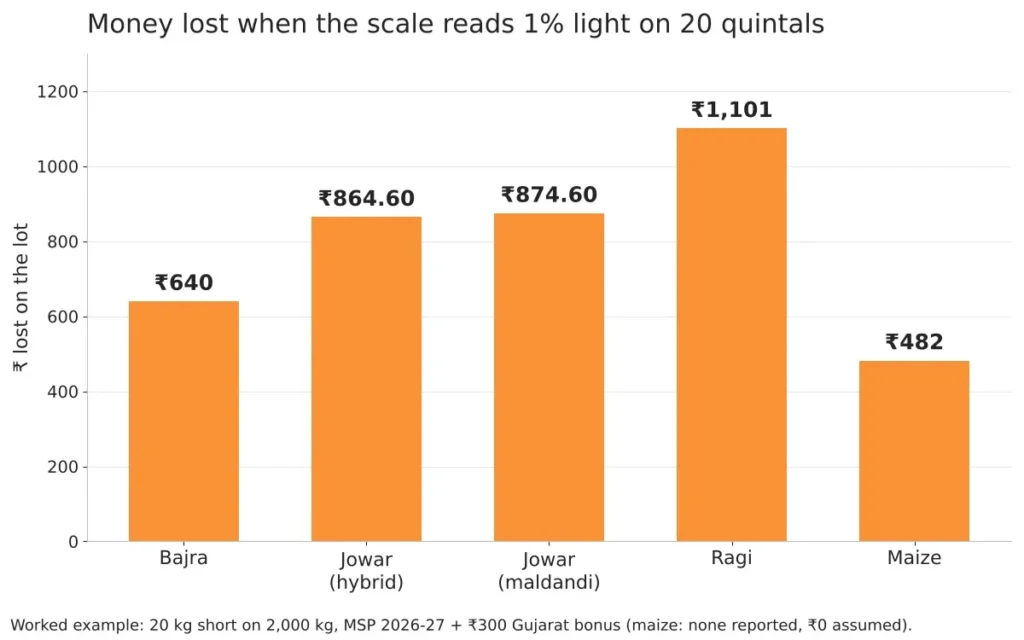
Say you bring 20 quintals of bajra to the centre: 40 bags, each holding 50 kg of grain, so 2,000 kg of grain net of the sacks. If the scale reads 1% light, the 2,000 kg shows as 1,980 kg and you are paid for 20 kg less. The same sum works for any crop and any error:
Money lost = kg short × (MSP + bonus) ÷ 100
| Crop | Short by 0.5% (10 kg) | Short by 1% (20 kg) | Short by 2% (40 kg) |
|---|---|---|---|
| Bajra | ₹320 | ₹640 | ₹1,280 |
| Jowar (hybrid) | ₹432.30 | ₹864.60 | ₹1,729.20 |
| Jowar (maldandi) | ₹437.30 | ₹874.60 | ₹1,749.20 |
| Ragi | ₹550.50 | ₹1,101 | ₹2,202 |
| Maize | ₹241 | ₹482 | ₹964 |
The loss follows the price. A 1% error costs ₹482 on 20 quintals of maize and ₹1,101 on the same weight of ragi, because at the worked-example rates a kilo of ragi is worth more than twice a kilo of maize. The figures are a worked example; they assume no grain is lost from torn bags on the way.
How do you check the scale at the procurement centre?
Rule 27 of the Legal Metrology (General) Rules, 2011, as amended in 2021, says every weight or measure used in a transaction must be verified and stamped by the legal metrology officer, and re-verified and stamped at periodical intervals [4, 8]. For an electronic scale that interval is 12 months [4]. At the centre, you can make these checks:
- Look for the Legal Metrology stamp on the scale [4], ask to see the matching verification certificate, and check the date on it.
- Watch the display read zero with the platform empty before the first bag goes on.
- Ask for one bag you weighed at home to go on first, and compare the two readings on the same basis, sack included both times. A gap does not tell you which scale is off, so ask for the bag to be weighed again on a cleared platform.
- Note each bag’s weight as it is called out, and keep the receipt that shows the total.
How do you weigh your bags before the trip?
Weigh every bag at the farm or godown and write the weight on a tag tied to its neck. You then reach the centre with your own total for the lot. Before the season, put a verified test weight such as 20 kg on your platform and compare the reading with the error allowed for your scale at that load; this tells you how the scale reads near that load. If the reading is outside that limit, have the scale serviced. A scale used for buying or selling that is repaired before its verification falls due must be re-verified and stamped before it is used again [4]. Our government stamping post explains how stamping works.
Which HSCo scale fits a farm or grain godown?
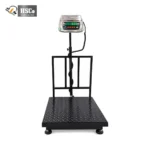
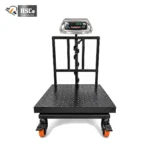
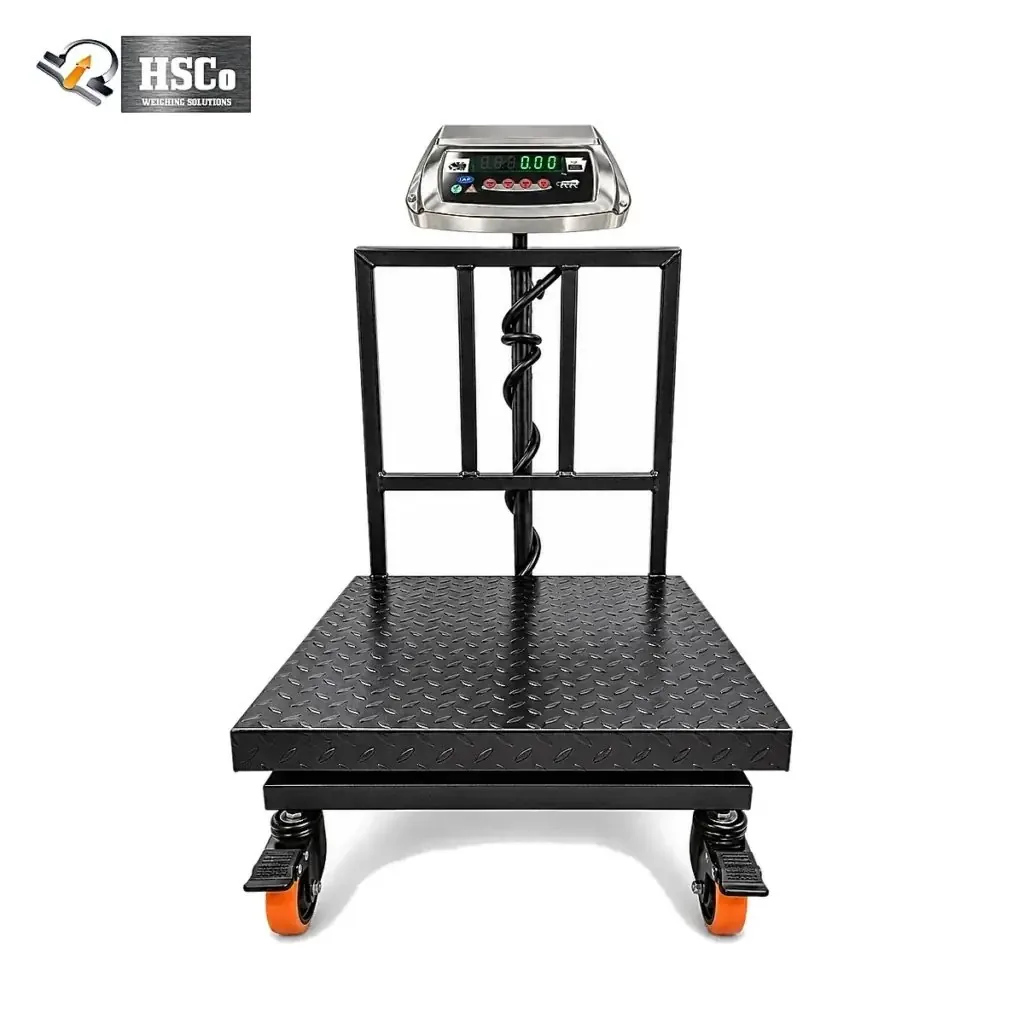
If you choose a platform scale for 50 kg sacks, pick a platform wide enough to hold a sack flat and a display the farmer and the buyer can both read. These three cover weighing the bags and checking the scale.
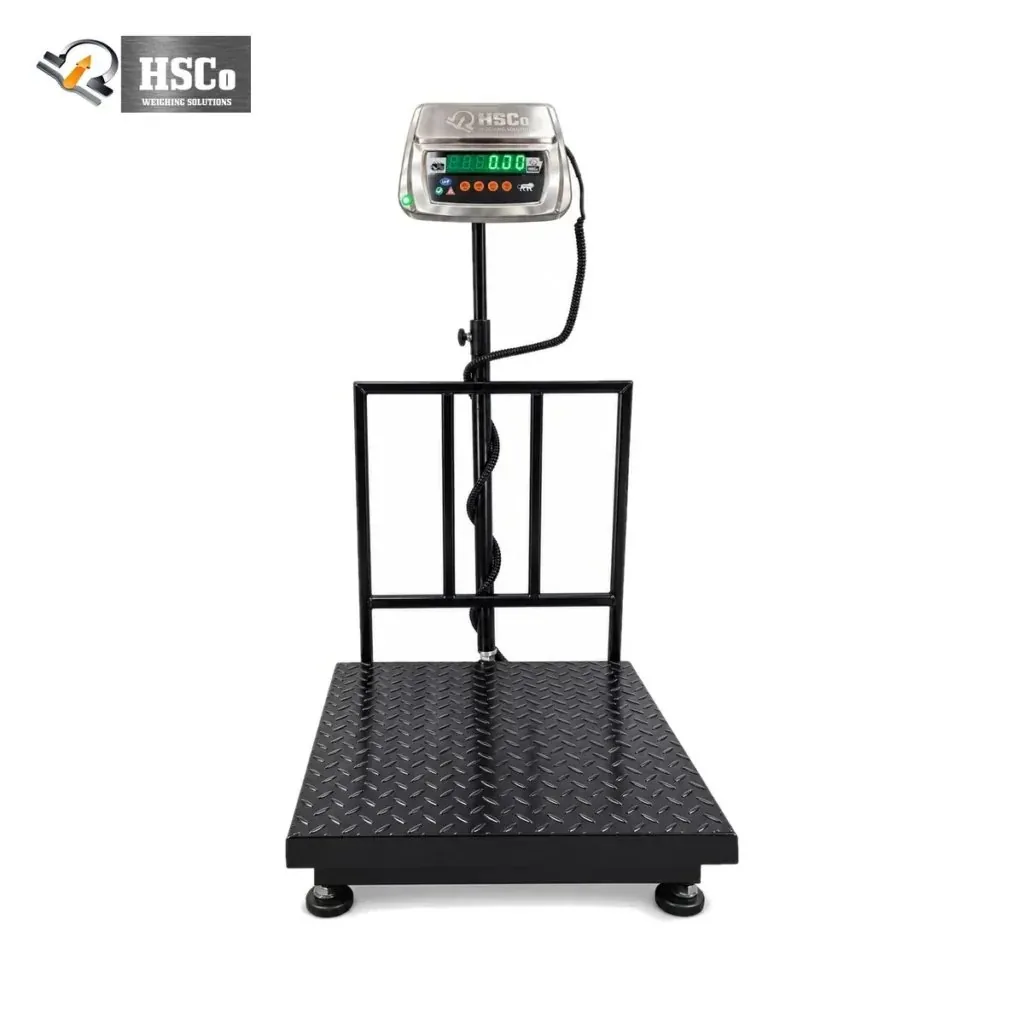
 PLCHQB platform scale: a chequered MS platform in 500 kg and 1,000 kg, readability 50 g or 100 g, with a display at the front for the operator and at the back for the customer. Legal Metrology stamped [5].
- PLCHQW platform wheeler scale: the PLCHQW300 or PLCHQW500, with a 600 × 600 mm MS chequered platform on caster wheels with foot-operated locks. Push it to the heap and lock it before weighing. Legal Metrology stamped [6].
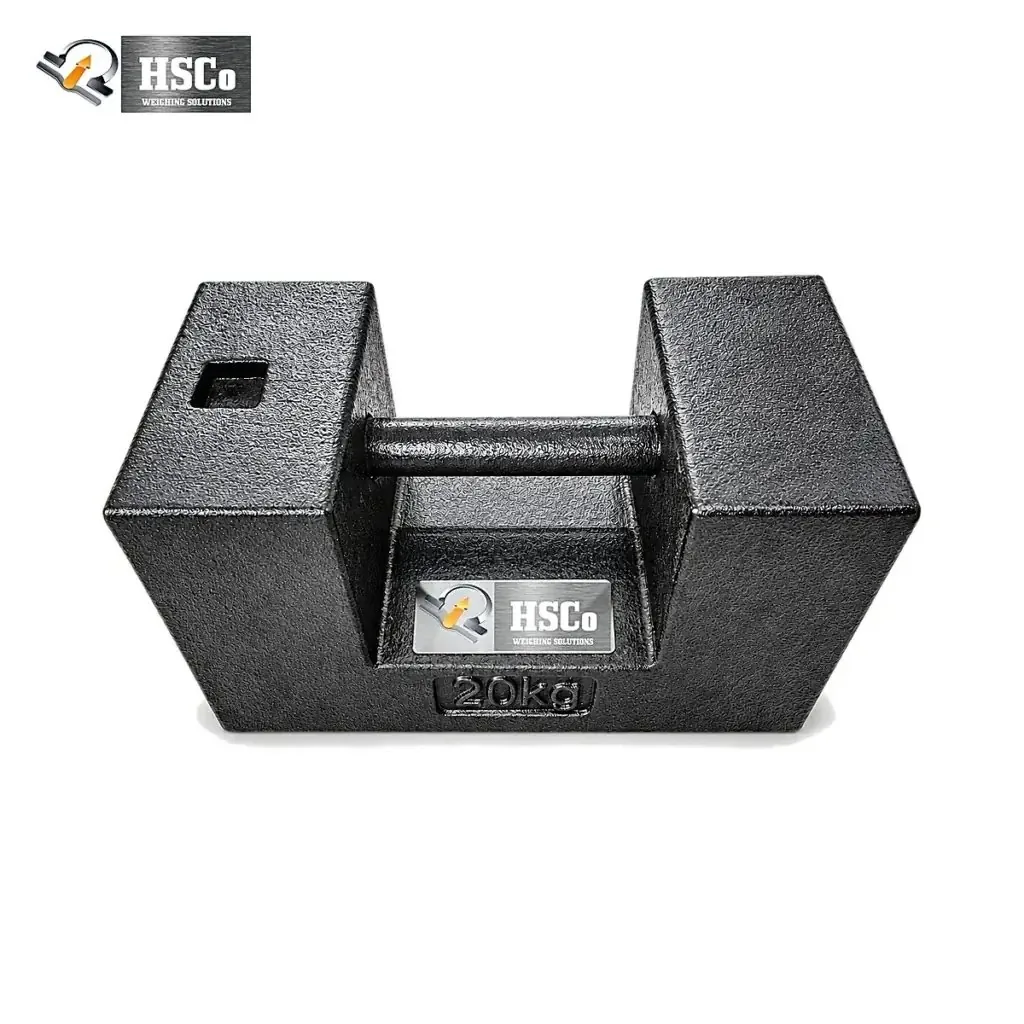
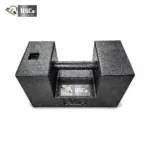
- Cast iron weight 20 kg: a class M1 rectangular test weight with a handle, for routine checks of platform scales [7].
More scales for farms and grain stores are on our weighing scales for agriculture page, and our paddy MSP post works through the same sums for paddy. Tell us how many bags you weigh in a day: call +91-7045922250 or write to hsc@hindustanscale.com.
Frequently asked questions
What is the MSP of bajra for 2026-27?
The MSP of bajra for the 2026-27 kharif marketing season is ₹2,900 a quintal, approved by the Union Cabinet on 13 May 2026 [1, 3]. DeshGujarat reported a ₹300 a quintal bonus under Gujarat’s scheduled procurement, so bajra bought under that scheme would fetch ₹3,200 a quintal, or ₹32 a kilo [2].
When does Gujarat start buying bajra at MSP in 2026?
DeshGujarat reported on 29 September 2026 that Gujarat had scheduled MSP purchase of bajra, jowar, ragi, maize and paddy from 16 November 2026 to 15 January 2027, through the Gujarat State Civil Supplies Corporation [2]. According to that report, online registration was scheduled to run from 2 to 31 October 2026, registered farmers were to receive an SMS, and purchase required the farmer’s biometric verification, with an Aadhaar card or other ID carried [2].
How often must an electronic scale at a procurement centre be stamped?
An electronic scale used in a transaction must be re-verified and stamped every 12 months under Rule 27(2)(c) of the Legal Metrology (General) Rules, 2011 [4]. At a procurement centre, look for the Legal Metrology stamp on the scale [4], ask to see the matching verification certificate, and check the date on it before your bags go on the platform.
How much does a 1 kg short weight cost on bajra?
One kilo of bajra is worth ₹32 at the worked-example price under the reported Gujarat procurement scheme. That price is ₹3,200 a quintal, the ₹2,900 MSP plus the ₹300 bonus DeshGujarat reported [1, 2]. A scale that reads 1% light takes 20 kg off a 20-quintal lot, which is ₹640. On ragi, at ₹5,505 a quintal with the bonus, the same 20 kg is worth ₹1,101 [1, 2].
Sources
- DD News, “Cabinet approves higher MSP for 14 Kharif crops for 2026-27 marketing season” (ddnews.gov.in, 13 May 2026).
- DeshGujarat, “Gujarat govt to procure paddy, maize, bajra, jowar and ragi at MSP from Nov 16” (deshgujarat.com, 29 September 2026).
- Global Agriculture, “India Raises MSP for Kharif Crops for 2026-27; Soybean Seed Sees 7% Increase per Quintal” (global-agriculture.com, 13 May 2026).
- Government of India (copy hosted by Legal Metrology, Meghalaya), “The Legal Metrology (General) Rules, 2011, Rule 27” (megweights.gov.in). Rule 27(1) and 27(2)(c)
- Hindustan Scale Company, “PLCHQB Platform Scale – Chequered MS Plate, 500 / 1,000 kg, Dual Display” (hindustanscale.com).
- Hindustan Scale Company, “PLCHQW Platform Wheeler Scale – 50 to 500 kg, MS Chequered Platform on Lockable Wheels” (hindustanscale.com).
- Hindustan Scale Company, “Cast Iron Weight 20 kg – Class M1, Rectangular with Handle” (hindustanscale.com).
- Department of Consumer Affairs, Government of India, “Legal Metrology (General) (Amendment) Rules, 2021, G.S.R. 149(E)” (consumeraffairs.gov.in, 3 March 2021). Amends rule 27(1) and adds a proviso to rule 27(2)