
Two Scales Side by Side: How the App Knows Which One It’s Talking To
Two scales, one shed, two lorries at the gate. At ₹120 a kilo of live weight — about what The Indian Express reported as the North India farm-gate rate in September 2026 — a 2,000-bird load is roughly ₹5.28 lakh on one invoice. Guess wrong and you bill the wrong trader for the wrong birds.
That is the problem with multiple Bluetooth scales one app has to serve. A phone never finds “the” scale; it finds every scale within earshot. Hindustan Scale Company builds its Bluetooth scales and its phone app around one rule for that moment: two or more scales found, list them, never guess. Here is why, what the app does instead, and what a mix-up costs on paper.
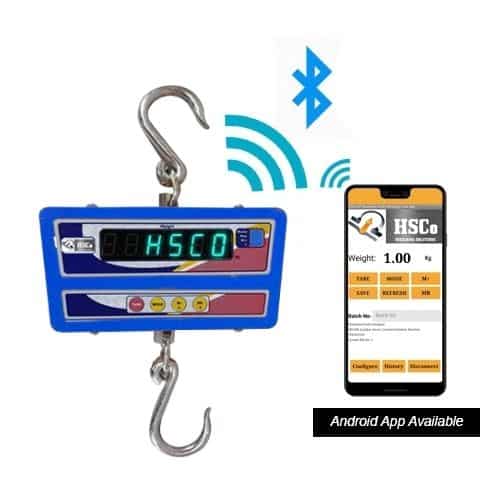
A phone never finds “the” scale — it finds a list
A Bluetooth Low Energy scale does not wait to be asked. Switched on and free, it keeps broadcasting short “here I am” packets on three radio channels reserved for that. A phone looking for scales listens on those channels and hears every device that is broadcasting — the Bluetooth Core Specification (v5.4) describes the mechanism, and Google’s Android reference shows what each hit contains: the device’s 48-bit address, whatever name it chose to send, and the signal strength as it arrived.
So discovery always produces a list. With two scales, an app has to decide — and the two obvious shortcuts both fail.
The name is not a proof. The standard calls the device name a “user-friendly” label: free text, up to 248 bytes, often shortened over the air, in some devices re-writable. Nowhere does it require the name to be unique. Two scales of the same make and model can broadcast the same name unless the maker deliberately gives each its own — and Android’s documentation warns the name can even come back empty.
The address is not a label a person can use. The 48-bit address does tell one radio from another, but it is shown as twelve hexadecimal characters — 00:0C:3E:3A:4B:69 is nobody’s idea of a scale number. A privacy-enabled device may change its address on purpose; the standard recommends a fresh one every 15 minutes, and NIST’s Bluetooth security guide explains why. And an iPhone never shows the address at all — Apple’s Core Bluetooth substitutes an identifier the phone invents.
Neither is a defect. It just means an app cannot honestly say “this row is your scale” from the broadcast alone.
Can’t the app just pick the nearest scale?
That is the shortcut most people reach for: sort by signal strength, take the top one. Sorting is fine. Choosing is not. Three peer-reviewed studies measured how much Bluetooth signal strength wobbles when nothing is really changing:
| What was measured | How much the signal moved | Source |
|---|---|---|
| A clear line of sight, nothing moving | ±5 dB or more — “intrinsically noisy” | Leith & Farrell, Trinity College Dublin, 2020 |
| A person turning their body | about 20 dB | Leith & Farrell, 2020 |
| The same distance, indoors, repeated | close to 30 dB of spread | Su, Pahlavan & Agu, IEEE Access, 2021 |
| One fixed beacon, one still phone, 5 m apart | −71.9, −68.1 and −78.8 dBm on its three channels — a 10.7 dB spread | Zhuang et al., Sensors, 2016 |
The Dublin study settles it: received signal strength “need not decrease with increasing distance”. Two scales three metres apart, an operator half-turning with the phone in hand, a stack of crates in between — the “strongest” scale changes from one second to the next. An app that picks the top row is not choosing the nearest scale. It is rolling a die with the trader’s money.
Multiple Bluetooth scales one app: the rule is list, never guess
HSCo customers do run two scales side by side, and the app’s rule exists for them:
- The app starts looking on its own. No pairing screen, no settings menu.
- One HSCo scale found — it connects by itself. The common case stays one-tap simple.
- Two or more found — it lists them, strongest signal first, and stops. The operator taps the number printed on the front of the scale they are standing at.
- The scale proves its own number. Once connected, the app reads the permanent factory number from the scale itself — nobody types it — and writes it into every reading, challan and invoice as the machine ID.
Step 4 is what makes step 3 safe. Even if an operator taps the wrong row, the record still names the scale that actually did the weighing — and that you can catch.
Reading the identity from the connected device is not an HSCo invention; it is how Bluetooth is meant to work. The standard’s Device Information Service defines a Serial Number String that “shall represent the serial number for a particular instance of the device”, read from the connected device. Weighing law agrees: OIML R 76-1, the international recommendation for non-automatic weighing instruments, lists the serial number among the compulsory markings and allows them to be shown by software, not only on a plate.
Every HSCo Bluetooth scale leaves the factory with that permanent number on its display at power-on; it is what the phone sees and what the record carries.

What a wrong tap costs on the invoice
Start with the birds. India’s poultry trade settles on live weight at a farm-gate rate that trade committees fix daily, and 2026 was volatile: BusinessLine reported about ₹146 a kilo around Bengaluru in March 2026 against about ₹90 the previous November; The Indian Express put North India at ₹150-plus per kilo of live weight in early July, settling at ₹115–120 by September, against a production cost of roughly ₹110. A market-ready broiler weighs about 2–2.5 kg.
Now the arithmetic — ours, as an illustration. 2,000 birds at 2.2 kg is 4,400 kg; at ₹120 a kilo that is ₹5,28,000 on one invoice. Even a ten-bird crate of about 22 kg is about ₹2,640. Substitute your own rate.
Then the paperwork. A GST tax invoice must carry the recipient’s name, address and GSTIN and the quantity with its unit (CGST Rules, Rule 46). Once issued it is not edited: an over-billed invoice is corrected only by a credit note to the same recipient, declared by 30 November after the end of the financial year (CGST Act, section 34). On e-invoicing it is tighter still: the National Informatics Centre’s own system documentation says an invoice reference number can be cancelled within 24 hours of generation — the reason code is “Data entry mistake” — and not at all if an active e-way bill exists; the GSTN FAQ adds that a generated IRN cannot be amended.
And the law behind the weight. Under India’s Legal Metrology Act 2009, every weight or measure must be verified and stamped before it is used in any transaction (section 24) — per instrument, so the number on the scale is what links a weight to a verified machine. Using an unverified one carries a fine of ₹2,000 to ₹10,000, and up to a year’s imprisonment plus fine for a repeat (section 33). Internationally, OIML D 31:2023 expects a stored weighing record to identify the instrument that made the measurement and to carry a running number tying it to the invoice; Europe’s WELMEC software guide says traceability “requires the correct assignment (linking) of measurement data to the measuring instrument that has generated them”.
The record must name the scale, the invoice cannot be quietly fixed, and the sum runs to five or six figures. That is why the app does not guess.

What this is not
It is not a fault in Bluetooth. Names not required to be unique, addresses that may change, signal strength that wobbles — these are the design, not a bug. The fix belongs in the app and the scale, and that is where HSCo put it.
It is not a substitute for stamping. The number ties a weight to a verified scale; it does not verify the scale.
It is not multi-phone. An HSCo scale serves one phone at a time. The Bluetooth standard says that the moment a broadcasting device accepts a connection it leaves the advertising state — it stops announcing itself — so a scale talking to one phone drops off every other phone’s list while that connection lasts, and reappears when released. If the second scale is missing from your list, check before you call anyone:
- Is another phone already connected to it? Ask that person to close the app.
- Is it switched on and showing its number?
- Are you within a few metres, with nothing large and metal in between?

What changes on Monday morning
- Two scales, two operators, two phones — no mix-ups. Each phone lists both; each operator taps the number in front of them; each record names its scale.
- Nobody types a scale number. The scale supplies it; the app writes it into every reading, challan and invoice.
- A dispute takes a minute, not a week. “Which scale weighed this load?” is answered by the record, not by memory.
- The wrong-trader invoice stops at the source — before the 24-hour e-invoice window, before the credit note.
And it is not a small market: the government’s Basic Animal Husbandry Statistics 2025 put India’s meat output at a record 10.50 million tonnes in 2024-25, about half of it poultry (5.18 million tonnes), with five states supplying 57.55% — the belts where two scales in one shed is how a lorry gets loaded.
How to start: two scales, thirty days
- Pick the shed or yard where two scales already work side by side — or where one scale is the loading-time bottleneck.
- Put the Bluetooth Enabled Customized Scale on both positions — an HSCo platform scale with the Bluetooth link and the app; public pricing on 15/09/2026 was ₹9,900 to ₹18,000 by platform size and capacity, indicative and before GST. HSCo scales you already own take the Bluetooth add-on module, which gives them the same app link and the same listing rule.
- Give each operator the app on their own phone. Show them once: two rows, tap the number on your scale.
- For thirty days, count the loads, the disputes and the credit notes; compare with the thirty days before.
- Roll out to the next shed only if the numbers say so.
Hindustan Scale Company has made weighing scales in Mumbai since 1955 and builds the scale, the Bluetooth link and the app itself — one supplier answers for the whole chain. The wider menu is on the IoT connected weighing scales page; if you are unsure whether your scales are verified for trade, start with what government stamping means.
Frequently asked questions
Can one app work with multiple Bluetooth scales?
Yes. The HSCo app finds every HSCo scale that is switched on within range. With one scale it connects on its own; with two or more it lists them and the operator taps the number printed on the scale in front of them. Each phone connects to one scale at a time.
Why doesn’t the app just connect to the strongest signal?
Because Bluetooth signal strength is too noisy to tell two nearby scales apart — peer-reviewed measurements show swings of 5 to 30 dB with nothing really changing, and a signal that “need not decrease with increasing distance”. Strongest first is how the list is sorted; the choice belongs to the operator.
How does the app know the scale’s number is correct?
It reads the number from the scale itself after connecting, rather than trusting the broadcast name or asking anyone to type it. The number is permanent, shown on the display at power-on, and written into every record and invoice as the machine ID.
My second scale is not on the list. Is the app broken?
Usually not. A scale that is already connected to one phone stops broadcasting while that connection lasts, so it disappears from every other phone’s list until it is released. Close the app on the other phone, check the scale is on and showing its number, and it will reappear.
Does it work on iPhone as well as Android?
The listing rule does not depend on the phone. iPhones never show a Bluetooth address, which is one more reason the app identifies a scale by the number it reads from the scale, not by the address.
What if the wrong trader has already been invoiced?
Under GST an issued invoice is not edited; you correct it with a credit note declared by 30 November after the financial year, and an e-invoice IRN can be cancelled only within 24 hours and not while an active e-way bill exists. It is far cheaper to have the record name the right scale and the right trader before the invoice exists.
Next step
Tell us where two scales work side by side, and we will propose a thirty-day two-scale pilot with the app on your operators’ phones.
Hindustan Scale Company (HSCo) · Mumbai · est. 1955 · www.hindustanscale.com · hsc@hindustanscale.com
Sources
- Bluetooth SIG — Bluetooth Core Specification v5.4, Vol 6 Part B (Link Layer): 48-bit device address, three primary advertising channels, scanning, exit from the advertising state on connection, 15-minute private-address change.
- Bluetooth SIG — Bluetooth Core Specification v5.4, Vol 3 Part C (Generic Access Profile): the “user-friendly” device name, address shown as 12 hexadecimal characters, privacy feature.
- Bluetooth SIG — Core Specification Supplement v11; Device Information Service v1.1 (Serial Number String); Assigned Numbers (2023).
- Google — Android developer reference, BluetoothDevice and ScanResult; Apple — Core Bluetooth documentation, CBPeripheral.name and CBPeer.identifier.
- NIST Special Publication 800-121 Rev. 2 (update 1, 2022) — Guide to Bluetooth Security, section 3.1.
- Leith D. J., Farrell S. — “Coronavirus Contact Tracing: Evaluating the Potential of Using Bluetooth Received Signal Strength for Proximity Detection”, ACM SIGCOMM Computer Communication Review 50(4), 2020.
- Su Z., Pahlavan K., Agu E. — “Performance Evaluation of COVID-19 Proximity Detection Using Bluetooth LE Signal”, IEEE Access 9, 2021.
- Zhuang Y. et al. — “Smartphone-Based Indoor Localization with Bluetooth Low Energy Beacons”, Sensors 16(5):596, 2016; Gomez C., Oller J., Paradells J. — “Overview and Evaluation of Bluetooth Low Energy”, Sensors 12(9), 2012.
- OIML R 76-1:2006 — Non-automatic weighing instruments, clauses 7.1.2, 7.1.4, 7.1.5.4; OIML D 31:2023 — Software-controlled measuring instruments, clause 6.3.4.2; WELMEC Guide 7.2:2023, requirements L4 and T1.
- The Legal Metrology Act, 2009, sections 24 and 33 (India Code); Department of Legal Metrology, Government of NCT of Delhi — penalties table.
- CGST Rules 2017, Rule 46; CGST Act 2017, section 34 as amended by the Finance Act 2022; National Informatics Centre — e-Invoice System API documentation v1.03, “Cancel IRN”; GSTN e-invoice FAQ Q.99–100 (TaxGuru reproduction).
- Press Information Bureau — Basic Animal Husbandry Statistics 2025 (26/11/2025); DAHD Annual Report 2025-26; FACTLY (19/12/2025).
- BusinessLine (20/03/2026); The New Indian Express (16/07/2026); The Indian Express (07/09/2026); Business Standard (23/07/2026) — farm-gate live-bird prices and bird weights.
- Hindustan Scale Company — Bluetooth Enabled Customized Scale product page; indicative public price range on 15/09/2026, before GST.