
Crane Scale Wrong Reading? Why Two Displays of One Scale Can Disagree
The hook reads −22.0 — a net figure after tare. The hand-held indicator six metres away reads −20. Same load, same scale, same second. Neither box has failed — and the instrument is still wrong.
That is the crane scale wrong reading nobody expects, because it is not a broken load cell and not a flat battery. It is two displays that have quietly stopped speaking the same language: one holds a decimal point the other does not. This article explains how one stored number becomes two different weights, what the law allows between two displays of one scale (nothing), what a ten-fold slip does on a crane hook, and the one design rule that stops it.
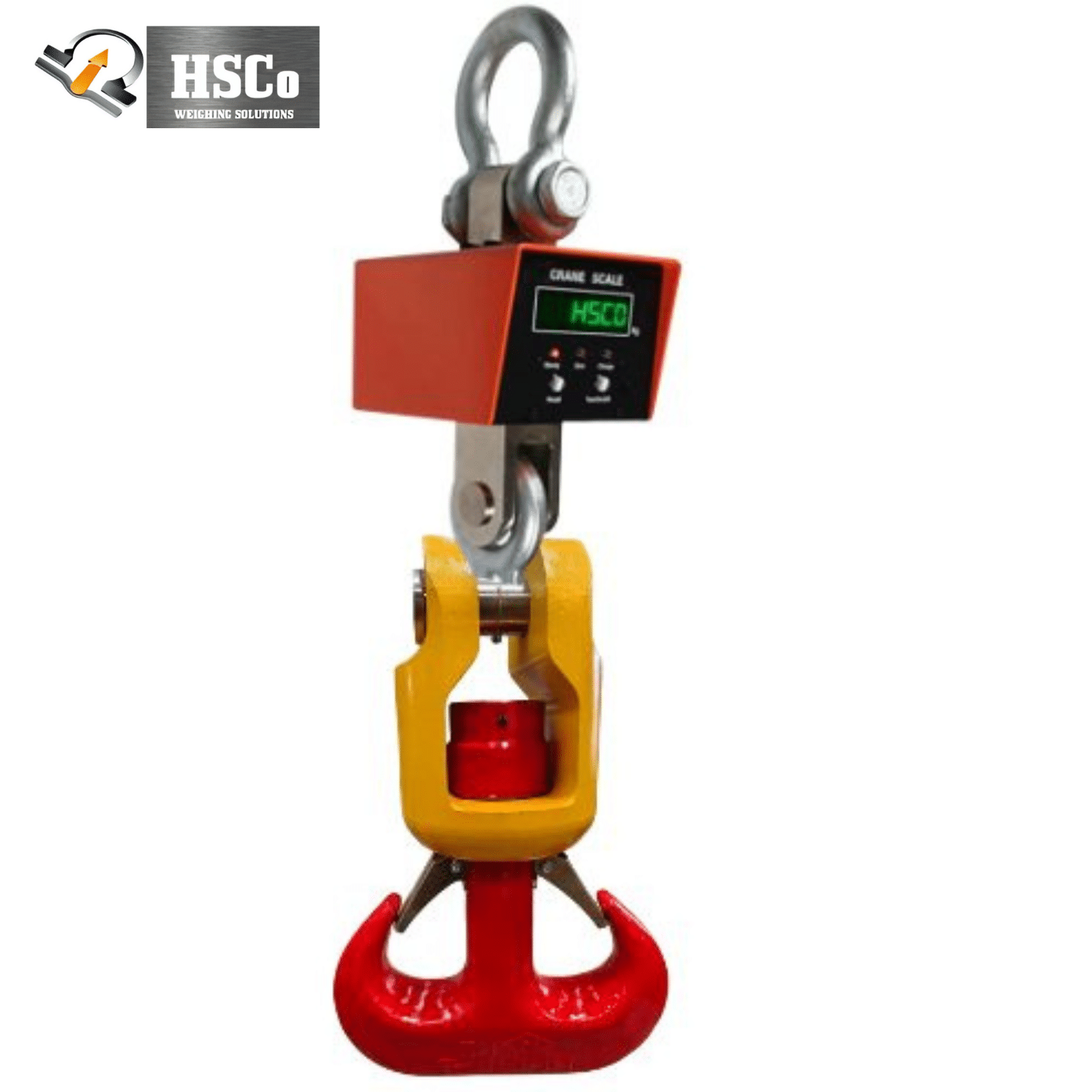
Two displays, one scale: the law allows a difference of exactly zero
A crane scale with a display on the hook and a second in the cabin, on the wall or on a phone is still one instrument. The international recommendation for weighing instruments, OIML R 76-1, calls the second box a “secondary display” — a device that repeats the result — and sets the permitted difference between two digital displays of one instrument at zero. Not a division. Not a rounding. Zero.
India transposed the clause word for word: the Legal Metrology (General) Rules, 2011 say the difference “shall be zero”, and Rule 13 makes it binding on every scale used in trade. NIST Handbook 44 (2026 edition) puts it plainly: “all digital values of like value in a system agree with one another.”
The same rules go further. Every display of one instrument must use the same step, only one unit may be shown, and the decimal sign must keep its place. The decimal setting belongs to the instrument, not to one box.
So two displays that disagree are not “both right”. By definition they are a non-conforming instrument. The question is how a verified scale gets there.
What causes a crane scale wrong reading on one display only?
Almost always this: a number travelled from one box to the other, and its meaning did not travel with it.
Inside every electronic scale the weight is not stored as “22.0 kg”. It is stored as a whole number — a count — and a separate setting says where the decimal point goes and what unit applies. The standards say so themselves. OIML R 76-1 lists the final result as the value “including the decimal sign and the unit”, and requires stored data to carry the decimal sign and the unit as separate items. NIST Handbook 44 calls the division value and the unit configuration parameters — set once at installation, then left alone.
In a one-box scale nobody notices: the box that stores the count is the box that shows it. In a two-box scale — a transmitter on the hook, an indicator in the operator’s hand — the count crosses a radio link, and the second box applies its own decimal setting to whatever arrives. Same setting on both, and the two weights are identical. Different settings, and the same count is read two ways.
The arithmetic, as an illustration (a rule of thumb, not a measured case):
| What is stored | Box set to one decimal place | Box set to no decimal place |
|---|---|---|
| A step setting of “10” | 1.0 kg steps | 10 kg steps |
| A count of “220” | 22.0 kg | 220 kg |
| A true load of −22.0 kg | −22.0 | −20 (rounded to its 10 kg step) |
A shifted decimal multiplies the reading by ten; a step ten times too coarse swallows the tenths, so a true −22.0 kg shows as −20. Either way it is a configuration fault, not a drift you can calibrate away.

Same number, wrong unit: the slip that lost a US$125 million spacecraft
On 23/09/1999 NASA lost contact with the Mars Climate Orbiter as it arrived at Mars. The mishap board’s finding, reported by NASA’s Jet Propulsion Laboratory on 30/09/1999: one team’s ground software calculated thruster force in pounds-force, while the navigation software read the same numbers as newtons. Both programs were internally correct. Nobody had written the unit into the number. CNN and Wired both put the loss at US$125 million. NASA’s science chief, Dr Edward Weiler, said: “The problem here was not the error, it was the failure of NASA’s systems engineering, and the checks and balances in our processes to detect the error.”
One pound-force is about 4.45 newtons, so those two systems disagreed by a factor of four and a half. A decimal slip on a crane scale disagrees by a factor of ten. A widely reported 1983 airline case had the same shape — a fuel quantity worked out in the wrong unit, an aircraft that ran out of fuel in flight.
The lesson is the one the legal-metrology guides write down: a bare number is not a measurement. The decimal sign and the unit are part of the result, and the receiving end has to know them, not assume them.
What a ten-fold slip does on a crane hook
A crane is a lifting machine under section 29 of the Factories Act, 1948. Its safe working load must be plainly marked, it may never be loaded beyond it except for a test, and it must be thoroughly examined by a competent person at least once every twelve months. The US rule for overhead cranes, OSHA 29 CFR 1910.179, says the same three things.
Now let the second display read a tenth of the truth. A 6,000 kg lift shows as 600 kg. On a crane rated for 5,000 kg, the overload the law forbids looks like a light lift. The scale did not merely mis-bill — it hid the one thing it was fitted to reveal. Turn the error the other way and every lift trips the overload alarm, and within a week nobody believes the scale. Scrap, billets and coils are sold by the tonne, off the hook: a reading ten times out is an invoice ten times out.
Compare that with what tolerance allows. A crane scale is a medium-accuracy trade instrument — Class III under OIML R 76-1 and the Indian Rules — with 500 to 10,000 display divisions, and it may be out by half a division to one and a half divisions at verification, twice that in service. A generic 10,000 kg crane scale with a 5 kg step may read 5 kg out at verification and 10 kg out in service. Never 600 kg, and never the wrong decimal point. Between its two digital displays, the permitted difference is zero.

The design rule that stops it: one master, decimal first
The rule is short. One box owns the decimal setting. The other copies it. And the copy is written before any value that depends on it.
In Hindustan Scale Company’s two-box crane scales, the hook-mounted transmitter is that master. Its decimal setting is synchronised to the indicator, and it goes across first — before capacity, before the zero band, before any weight — so the indicator never applies a stale decimal to a fresh number. A stored ten cannot mean one kilogram on one box and ten on the other, because what a count is worth is decided once, in one place.
That is the principle the standards write down. OIML R 76-1 requires the link to a secondary display to transmit the result “in such a manner that the peripheral device can meet the requirements”. OIML D 31:2023 requires transmitted data to include the “measured value including unit” and the receiver to check its integrity. NIST Handbook 44 asks that the division value and the unit be sealed or audit-trailed, so any change is evident.
On HSCo’s CRHBT5K Electronic Bluetooth Crane Scale — a 5,000 kg hook scale — the secondary display is the HSCo Android app on a phone up to about 10 m away. The value, its decimal and its unit come from the scale; the phone only paints them, and the supervisor reads the lift from beside the truck, not under the load. The wider family is on the crane scale range page; the crane scale buying guide covers capacity, hooks and safety.

What this fix is not
It is not calibration. Calibration corrects the scale’s response against a known mass. It cannot correct a decimal mismatch — and the tempting shortcut, adjusting one box until it “agrees” with the other, builds the fault into the calibration.
It is not a radio fault, though it looks like one. Neither box reports an error. The link is fine. The numbers simply mean different things at each end — which is why the fault survives a hardware check.
It is not “both right”. By law a two-box scale is one instrument, and the permitted difference between its displays is zero. A scale that disagrees with itself is non-conforming, whichever display you prefer.
It is not a reason to distrust two-box scales. A remote readout is what lets the operator stand clear of a suspended load. The fix is a design rule, not a retreat to the hook.
What changes on Monday morning — and how to start in thirty days
The check to run before lunch:
- Hang one known load — a test weight, or a load just weighed on a verified platform scale — and read both displays side by side.
- Read the size of the gap. A division or two is a calibration question. Ten times, or a decimal point in a different place, is a configuration question. Do not touch the calibration.
- Compare the settings on both boxes: decimal places, step, unit, capacity. All four must match. Fix them from the master, never by hand on the second box.
- Ask the supplier three questions: Which box is the master? Is the decimal sent before the values? Is the setting sealed or logged?
Then the thirty-day version. Week 1 — list every two-box or wireless scale in the plant and run the known-load check on each one. Week 2 — correct any mismatch from the master box and note the fix against the scale’s number. Week 3 — add “both displays agree” to the crane’s inspection sheet, next to the safe-working-load check the Factories Act already requires. Week 4 — review which scales disagreed, by how much, and whether anyone was lifting or billing on the wrong display; decide which need a one-master design.
Hindustan Scale Company has made scales in Mumbai since 1955 and builds the transmitter, the indicator and the app itself, so one supplier answers for what a count means at both ends of the link. The connected side of the range is on the IoT connected weighing scales page.
Frequently asked questions
Why does my crane scale show different readings on the hook and the remote display?
Almost always because the two boxes hold different decimal or step settings, so the same stored count is displayed two ways. A gap of ten or a hundred times, or a decimal point in a different position, is a configuration mismatch, not a calibration fault. Fix it by copying the setting from the master box, never by adjusting the calibration.
Is a small difference between two displays of one crane scale legal?
No. OIML R 76-1, India’s Legal Metrology (General) Rules, 2011 and NIST Handbook 44 all require the digital displays of one instrument to agree exactly for the same load. The scale as a whole may be out by a division or so within its class tolerance, but its own displays may not differ from each other.
Can recalibration fix a crane scale reading that is ten times out?
No, and it makes things worse. Calibration adjusts the scale’s response to a known mass; a decimal mismatch is a whole-number error in how the count is displayed. Adjusting one box to agree with the other builds the fault into the calibration. Correct the decimal, step and unit settings first, then re-check both displays.
What is a “count” in a weighing indicator?
The whole number the scale actually stores and transmits before the decimal sign and the unit are applied. A count of 220 is 22.0 kg with one decimal place and 220 kg with none. The standards treat the value, the decimal sign and the unit as separate items of the result, which is why the decimal setting has to be shared by every display of one instrument.
How far away can the remote readout of a Bluetooth crane scale be?
On the HSCo CRHBT5K the Android app reads the scale by Bluetooth at a range of up to about 10 m — far enough to stand beside the truck instead of under the load. Longer-range two-box crane scales use a dedicated radio transmitter on the hook and a separate indicator.
How often must a crane and its hook scale be checked?
The Factories Act, 1948 requires every lifting machine to be thoroughly examined by a competent person at least once every twelve months, and never loaded beyond its marked safe working load except for a test. The scale’s legal verification is a separate duty. Adding a “both displays agree” line to the crane’s inspection sheet costs a minute and catches a decimal mismatch before anyone lifts or bills on it.
Next step
Tell us which crane scale has two displays, and we will run the known-load check with you and propose a thirty-day plan for every two-box scale in the plant.
Hindustan Scale Company (HSCo) · Mumbai · est. 1955 · www.hindustanscale.com · hsc@hindustanscale.com
Sources
- OIML R 76-1:2006 — Non-automatic weighing instruments, Part 1: Metrological and technical requirements (International Organization of Legal Metrology): clauses 3.6.3, 4.2.2.1–4.2.2.2, T.2.2.6, T.2.8.1, T.2.8.4, 4.1.2.4, 5.3.6, 5.5.3.2, Tables 3 and 6.
- Legal Metrology (General) Rules, 2011 (Government of India, Department of Consumer Affairs): Rule 13; Seventh Schedule Heading A, paras 3(7)(iii), 4(2)(ii), 5(3)(vi), Tables 17 and 20.
- NIST Handbook 44 (2026 edition) — Specifications, Tolerances, and Other Technical Requirements for Weighing and Measuring Devices (US National Institute of Standards and Technology): General Code G-S.5.2.2, G-S.5.2.4, G-S.8; Section 2.20 S.1.2, S.1.2.1, S.1.11, UR.1.3, Tables 7a/7b; Appendix D.
- OIML D 31:2023 — General requirements for software-controlled measuring instruments: clauses 6.2.3.4, 6.3.5.2, 6.3.5.3.
- WELMEC Guide 7.2 Software Guide, Version 2026 (European Cooperation in Legal Metrology), chapter 6.4 — number of decimal places listed among protected parameters.
- The Factories Act, 1948 (India), section 29 — lifting machines, chains, ropes and lifting tackles.
- US OSHA, 29 CFR 1910.179 — Overhead and gantry cranes, paras (b)(5), (j)(1)(ii), (n)(1).
- NASA / Jet Propulsion Laboratory — press release “Mars Climate Orbiter Team Finds Likely Cause of Loss” (30/09/1999); NASA Science mission page “Mars Climate Orbiter”.
- CNN — “Metric mishap caused loss of NASA orbiter”, Robin Lloyd (30/09/1999).
- Wired — “Nov. 10, 1999: Metric Math Mistake Muffed Mars Meteorology Mission” (10/11/2010).
- Board of Inquiry final report on the Air Canada Boeing 767 emergency landing at Gimli, Manitoba, 23/07/1983 (Lockwood, 1985), as summarised on Wikipedia “Gimli Glider” — single source; used without figures.
- Hindustan Scale Company — product page “CRHBT5K Electronic Bluetooth Crane Scale”.