
Heat Resistant Crane Scale With Wireless Readout: Weighing a Ladle at 1,400 °C
You cannot walk up to molten metal to read a display. So the display comes to you.
Iron leaves a foundry furnace at around 1,400–1,500 °C, by the figures of both the US Department of Energy and the European Commission’s reference document on foundries; steel is hotter still. The ladle carrying it hangs from a crane, and somebody needs to know what it weighs — now, not after it has cooled. A heat resistant crane scale with a wireless readout is built for exactly this: a shielded scale that stays in the hook’s load path, keeps its sensor inside the temperature band the law assumes, and sends the reading by radio to the furnace desk. Here is how the shield, the stand-off and the radio link work, and why the weight has to reach the furnace desk fast.
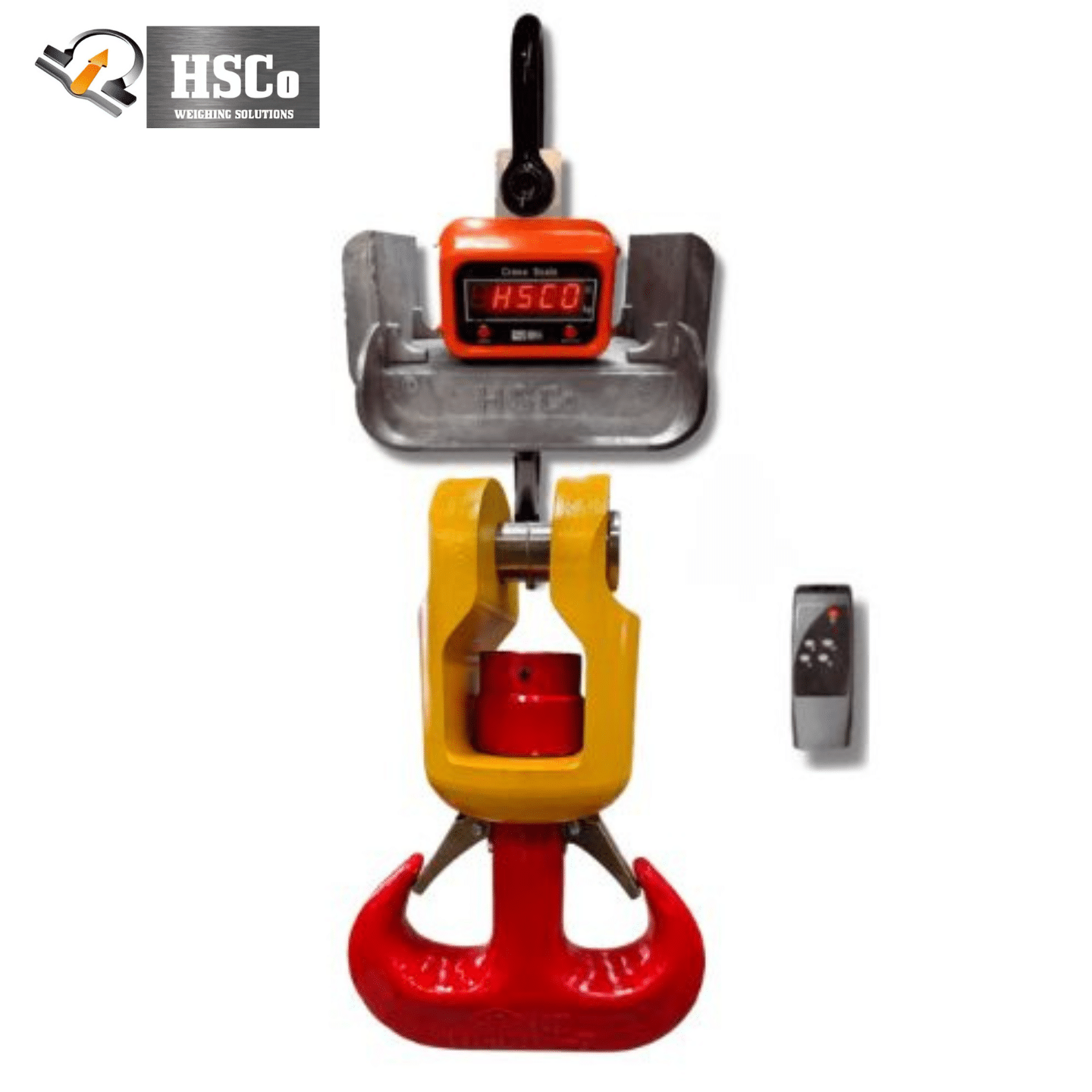
The ladle is at 1,400 °C. The sensor’s legal limit is 40 °C.
Every weighing instrument — and the load cell inside it — is legally assumed to hold its accuracy only within a fixed temperature band. OIML R 76-1 (2006), the international recommendation for weighing instruments, sets that band at −10 °C to +40 °C unless a special range is marked; the US regulator’s NIST Handbook 44 (2025 edition) says the same. OIML R 60 (2000) applies the identical envelope to the load cell itself. A Class III instrument with its own special range must still span at least 30 °C, and its zero reading may drift by no more than one verification scale interval — one “e” — for every 5 °C of change.
Read that against a foundry. On the Celsius scale, a ladle of iron at 1,400 °C is about 35 times the top of the sensor’s legal envelope. Nothing in the standard says the scale must fail at 41 °C; it says nobody has promised it will be accurate there. A crane scale hung close above open metal with no shield is working outside its specification, and every 5 °C it warms adds another interval of permitted zero drift.
That is the engineering reason a foundry crane scale needs a heat shield, stand-off distance and a readout somewhere cooler: the sensor has a temperature band it was verified in, and the ladle is nowhere near it.

What makes a heat resistant crane scale different from an ordinary one?
The same three controls that protect a foundry worker from radiant heat protect the scale. The US National Institute for Occupational Safety and Health (NIOSH) lists them in its 2016 criteria document on hot environments: put a line-of-sight reflective shield between the source and the target, increase the distance from the source, and move the operation remote. The US OSHA Technical Manual repeats the first two and names foundries among the significant radiant-heat workplaces. A heat resistant crane scale is simply a crane scale with all three built in.
| Radiant-heat control (NIOSH, 2016) | What it does | Where it lives on the scale |
|---|---|---|
| Line-of-sight reflective shield | Blocks the heat that travels as light before it reaches the sensor. NIOSH puts the reduction at up to 80–85 %. | The shield plate around the load cell and the indicator box |
| Increase the distance | Puts the sensor further from the source, as NIOSH advises for any radiant work. | Extra chain or shackle length between the scale body and the ladle |
| Remote operation | Nobody stands where the heat is to see the number. | The radio link to a remote display, a hand-held unit or a phone |
Radiant heat behaves like light: it travels in straight lines and is stopped by anything reflective in its path. The heat a hot surface throws off rises with the fourth power of its absolute temperature, which is why the shield does most of the work at iron temperatures.
Stand-off distance does the second job: extra chain or a longer shackle so the body hangs higher above the ladle. Hindustan Scale Company’s heat-resistant models — the HSC-NZS series and the CRHHR — are the shielded versions of its standard CRH electronic crane scale; the CRH covers 1,000 kg to 10,000 kg as standard, with capacities to 50,000 kg and a readability of 1 kg or 2 kg. Prices are indicative, before GST: about ₹14,500–₹26,500 for the CRH, ₹24,000–₹60,000 for the HSC-NZS series and ₹36,500–₹3,29,000 for the CRHHR, depending on capacity.

Why the reading must leave the hook by radio
Distance only helps if the person who needs the number can also keep it. A display on the scale body forces someone to walk under the crane and read digits, through heat shimmer, off a hook above hot metal. Every rule for hot-metal cranes says not to.
The clearest illustration of what distance buys comes from a NIOSH evaluation of an aluminium smelter potroom, reported in the same 2016 document. The process ran at about 982 °C. Radiant temperatures reached 86.7 °C and air temperatures 56.7 °C. Portions of every task on the floor exceeded the recommended heat-exposure limits — every task except one. The crane operator, working at a distance, stayed within limits. The person farthest from the metal was the only one the heat could not reach.
A wireless readout gives everyone the crane operator’s advantage. On HSCo’s crane scales the reading can travel three ways: to a remote display with a range of up to 200 m, to a hand-held display with a range of up to 30 m that stores up to 1,000 weighments and prints them, and by Bluetooth to a phone or PC for logging. The number reaches the desk; the person stays where the heat is not.
How the charge weight reaches the furnace desk
The European Commission’s reference document lists “preparation and weighing of the metallic charge” as a named step in the process, next to weighing the coke and adding the ferroalloys. The US Department of Energy describes the same sequence: charge, melt, adjust the bath chemistry, hold, tap into a ladle, transport. The additions are calculated on the weight of metal actually in the furnace or the ladle. Guess the weight and you guess the chemistry.
Timing matters because temperature does: both documents name preheated ladles and minimal temperature loss between tap and pour as good practice. A weight carried from the crane bay to the desk on a chit arrives after the metal has been sitting. A weight that arrives by radio, the moment the load is stable, is one the melter can act on while the ladle is still at temperature.
As an indication of what heat costs, the same European reference document (EU JRC, 2005) puts the electricity to melt a tonne of iron in a coreless induction furnace at under 600 kWh for the best foundries and around 1,000 kWh for many others. At ₹8 a unit, that gap is ₹3,200 a tonne — arithmetic, not a promise.

Why this matters more in India than almost anywhere
India was the world’s second-largest producer of crude steel in calendar 2025, at 164.9 million tonnes, up 10.4 % on the year, according to the Ministry of Steel’s Annual Report 2025-26; the World Steel Association’s monthly figures put July 2026 alone at 14.4 million tonnes. Behind every tonne are ladles on cranes, and behind the steel plants sit thousands of foundries.
Cranes that carry molten metal are also regulated differently from ordinary cranes, and a crane scale sits in their load path. The US rule for overhead cranes (29 CFR 1910.179) defines a “hot metal handling crane” and requires two holding brakes on each hoist, provision to stop molten metal falling on the operator, no loads carried over people, and a daily visual and monthly recorded inspection of hooks. The UK Health and Safety Executive requires lifting accessories — hooks, shackles and slings — to be thoroughly examined by a competent person at least every 6 months. Indian factory law also requires periodic examination of lifting tackle by a competent person. A shielded scale read from the desk fits that regime; one that must be approached under a hot ladle does not.
What a heat resistant crane scale is not
It is not fireproof. The shield and the stand-off keep the sensor inside its legal band for the minutes each lift takes; they do not make the scale a permanent fixture over an open furnace.
It is not a substitute for the crane’s own safety systems. The holding brakes, the hook inspections and the rule about loads over people belong to the crane and the rigging. The scale adds a number; it does not add a brake.
It is not a trade instrument by default. In most foundries it is a process scale for charge calculation and internal records. If a weight is used for buying or selling, the stamping rules apply.
And the radio range is not a guarantee. “Up to 200 m” is a line-of-sight figure. Steel structures, ladle cars and furnace walls shorten it. Test it in your bay first.
What changes for you on Monday morning
- Nobody walks under the ladle to read a weight. The number appears at the furnace desk, on a hand-held unit or on a phone.
- The additions are calculated on the real weight, not on the nominal ladle capacity or last shift’s figure.
- The weight arrives while the metal is still at temperature, so the melter acts on it instead of waiting for it.
- Every lift is recorded — on the hand-held unit or by Bluetooth to a PC — so the day’s tonnage and the alloy log agree without a clerk.
- The scale itself lasts, because its sensor stays inside the band it was verified in.
How to start: one crane, thirty days
- Pick one hot-metal crane — the one whose ladle weights are guessed most often.
- Fit a shielded crane scale with the stand-off rigging the bay allows, and pair it with the readout that fits: a remote display for a fixed melt desk, a hand-held unit for a roving melter, Bluetooth for a PC log.
- Give the scale a place in the lifting-tackle inspection register from day one.
- Log every lift for thirty days. Compare the recorded ladle weights with the nominal figures the additions used to be calculated on.
- Roll out to the other cranes only if the gap justifies it.
Hindustan Scale Company has made weighing scales in Mumbai since 1955 and builds its crane scales, their heat-resistant variants and the wireless readouts itself. The standard model is on the CRH electronic crane scale page, the full range on the crane scale page, and the general checklist in the crane scale buying guide.
Frequently asked questions
What is a heat resistant crane scale?
A crane scale fitted with a reflective heat shield around its load cell and electronics, rigged with extra stand-off distance from the load, and usually read by radio from a safe distance. It is built for foundries, steel plants and metal-processing units lifting hot loads.
Why does a normal crane scale lose accuracy near molten metal?
Because the law assumes a weighing instrument and its load cell are accurate only between −10 °C and +40 °C unless a special range is marked (OIML R 76-1, OIML R 60, NIST Handbook 44). Above that band the zero reading is permitted to drift by one scale interval for every 5 °C, and nothing about the reading is promised.
How far can the wireless readout be from the scale?
On HSCo crane scales the remote display has a range of up to 200 m and the hand-held display up to 30 m; both are line-of-sight figures. Bluetooth to a phone or PC covers the furnace desk. Test the range in your own bay before relying on it.
Can the crane scale be used to weigh the charge for alloy additions?
Yes — that is its main job in a foundry. The metallic charge is weighed as a named step in the process, and the additions are calculated on that weight. A wireless readout gets the number to the furnace desk while the metal is still at temperature.
What does a heat resistant crane scale cost in India?
As an indication, before GST: about ₹24,000–₹60,000 for the HSC-NZS series and ₹36,500–₹3,29,000 for the CRHHR, against about ₹14,500–₹26,500 for the standard CRH. The exact price depends on capacity and the readout chosen.
Does the crane scale need to be inspected with the hooks and shackles?
Treat it as a lifting accessory. The US rule for hot-metal cranes requires daily visual and monthly recorded hook inspections; the UK HSE requires a thorough examination of lifting accessories at least every 6 months; Indian factory law requires periodic examination of lifting tackle by a competent person.
Next step
Tell us the capacity of your hottest crane and where the melter sits, and we will propose a thirty-day shielded, wireless-readout pilot for it.
Hindustan Scale Company (HSCo) · Mumbai · est. 1955 · www.hindustanscale.com · hsc@hindustanscale.com
Sources
- OIML R 76-1:2006 (E) — Non-automatic weighing instruments, Part 1: Metrological and technical requirements, clauses 3.9.1.2 and 3.9.2.1–3.9.2.3 (temperature limits, minimum marked range, zero drift per 5 °C).
- OIML R 60:2000 (E) — Metrological regulation for load cells, clauses 5.5.1.1–5.5.1.3 (load-cell temperature range and drift limits).
- NIST Handbook 44 (2025 edition) — Section 2.20 Scales, T.N.8.1.1–T.N.8.1.3 (temperature limits and zero-load drift).
- NIOSH — Criteria for a Recommended Standard: Occupational Exposure to Heat and Hot Environments, DHHS (NIOSH) Publication 2016-106 (radiant-heat controls, up to 80–85 % shielding reduction, fourth-power law, aluminium-smelter potroom case).
- OSHA Technical Manual — Section III, Chapter 4: Heat Stress (reflective shields, insulating hot surfaces, foundries as radiant sources).
- US OSHA — 29 CFR 1910.179, Overhead and gantry cranes (hot metal handling crane, two holding brakes, no loads over people, hook inspection intervals).
- UK Health and Safety Executive — INDG422, Thorough examination of lifting equipment (LOLER 1998; lifting accessories every 6 months).
- US Department of Energy, Industrial Technologies Program — Advanced Melting Technologies: Energy Saving Concepts and Opportunities for the Metal Casting Industry (BCS Inc., November 2005): tapping temperatures, ladle sizes, melting process steps, ladle preheating.
- European Commission JRC (EIPPCB) — Reference Document on Best Available Techniques in the Smitheries and Foundries Industry (May 2005): cupola and cokeless-cupola temperatures, weighing of the metallic charge, molten-metal transfer good practice, induction-furnace energy (indicative).
- Ministry of Steel, Government of India — Annual Report 2025-26 (April 2026): 164.887 million tonnes in 2025, second-largest producer, 200 million tonnes capacity.
- World Steel Association — press release, July 2026 crude steel production (24/08/2026): India 14.4 million tonnes in July 2026.
- Hindustan Scale Company — CRH Electronic Crane Scale product page, with the CRHHR and HSC-NZS heat-resistant variants; capacities, readouts and indicative prices before GST (September 2026).